Probiotic Herxheimer Reactions

Jarisch-Herxheimer reaction (JHR or ‘herx’) is an acute febrile reaction which may complicate the initiation of an effective treatment against infections due to intracellular microorganisms. JHR can also be expressed as the worsening of symptoms or the appearance of new symptoms. JHR is traditionally associated with antibiotics and antivirals but may appear from taking anything that impacts the immune response or infections.

When it comes to probiotics, the usual Herx pattern is different. With an antibiotics induced herx, the herx will usually start when the concentration of the antibiotic approaches it’s maximum concentration and then ease off as the antibiotic leaves the system. The pattern is illustrated below.
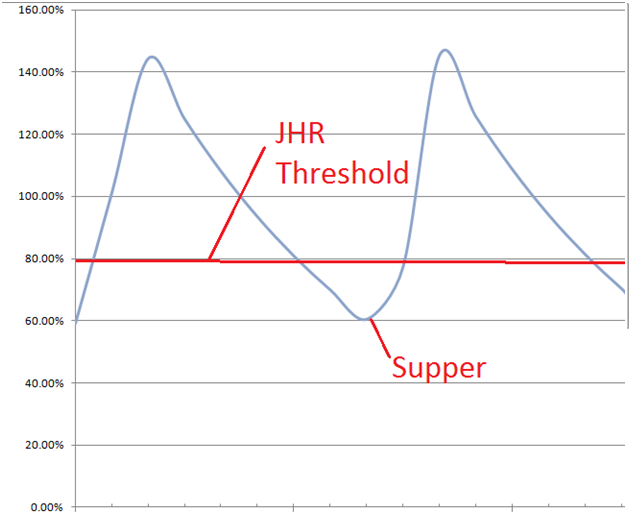
Example of tissue concentration from an antibiotic taken twice a day

With a biological agent, each probiotic capsule increases the amount of it’s species that is alive and living in the gut. Probiotics have friend-foe identification and produce ‘antibiotics’ against other species.  When the population of the probiotics species reaches the JHR threshold (may be a week or more in some cases), then a herx may start from killing off foe-species. This is where the challenge begins in handling the herx. If the herx gets too severe, then stopping will not result in a quick ebbing (as happens with antibiotics), but may continue until one of two states are reached:

  • Most of the foe-species producing the toxin causing the herx are killed, so there is insufficient toxins to produce a herx.
  • The population of this probiotics is reduced / out-competed so it is not producing sufficient foe-antibiotics to create a herx.

The time to take this may be days….  the herx just keeps going and going…
 

Vitamin D

Vitamin D is very important for patients. Studies have found that 22% – 65% of CFS patients are technically deficient ( less than 20 ng/mL) . While for Fibromyalgia 61%- 80% of Fibromyalgia patients are deficient.

In terms of results, significant improvement is seen when blood level of 25(OH) D exceeded 50 ng/ mL (125 nmol/L). What type of improvement do studies report?

  • Decrease or elimination of headaches
  • Decrease or elimination of hypersomnia
  • Decrease or elimination of orthostatic intolerance
  • Decrease or elimination of impaired memory
  • Decrease or elimination of palpitation
  • Decrease or elimination of mood disturbance
  • Decrease or elimination of restless leg syndrome
  • Treatment with high-dose vitamin D resulted in clinical improvement in all FM patients
  • There are also studies finding some patients went into remission seen with 2000-10000 IU/day (with magnesium and phosphate)

A level of at least 50+ ng/mL (125 nmol/L) appears to be a critical threshold for improvement. This is in the normal range, but towards the upper end.

Vitamin-1,25D (Calcitriol)

A related vitamin D measure, that of 1,25 D, is usually not done — but evidence suggest that it should be monitor as an ongoing status of  CFS, FM and other autoimmune diseaase. A 2009 study found for most autoimmune disease, this is High: 1,25-D > 110 pmol/L. The top of the normal range is about 75. It appears to be a good clinical indicator that someone has CFS/FM/IBS/chronic Lyme or other autoimmune conditions.

The higher the level, the more severe the symptoms. Getting this measure monthly may help monitor treatment.

In general, minimum supplementation should be 5000 IU or more. The older you are, the higher the dosage needs to be.


D-Ribose

D-Ribose is a simple sugar that is a precursor for tryptophan(low in CFS patients) and histidine. There has been no studies on histidine levels in CFS or FM patients.

D-Ribose was postulated to help CFS/Fibromyalgia in 2004 in several papers. Recently it has been demonstrated to help 66% of CFS/Fibromyalgia patients. It is a neuroprotective (protects the brain and will likely help with brain fog).

See also these posts

In terms of microfloras, several gut bacteria appear to require/prefer this sugar according to PubMed. It has been explicitly identified as being used by the healthful Escherichia Coli Nissle 1917 in a 2007 study. Whether this is part the mechanism of action is unclear at present.

Since this is a simple sugar, all sources should be equivalent, so the best buys are shown below.

The dosages used in the studies was 5gm done 3 times a day.

Remember, 1 in 3 will see no help from this. The reason may be variation in microflora between responders and non-responders.

(c) 2012 Ken Lassesen

Magnesium and Malic Acid

Malic Acid and Magnesium was reported effective in this 1995 study, Treatment of fibromyalgia syndrome with Super Malic: a randomized, double blind, placebo controlled, crossover pilot study.Russell IJ, Michalek JE, Flechas JD, Abraham GE., May;22(5):953-8. J Rheumatol. 1995. The study recommended further study which has not happen over the last 17 years.

Various internet sites cite studies that are not on PudMed, for example

Many studies have found that magnesium is low in Fibromyalgia and Chronic Fatigue Syndrome patients. Low levels are associated with low levels of glutamine. Taking magnesium supplements have reduced symptoms according to studies.

In terms of microfloras, magnesium is required by Bacteroides which are very low in 25% of patients. Bifidobacterium (also low in patients) plays an important role in extracting it from food. A cascade.

At this point I must point out that studies found only 50% of CFS patients are deficient in magnesium. The improvement reported was on the average of the study group. Not every person will have an improvement. Given the low cost and no apparent down side risk, it should be tried — especially when symptoms flare. Dosages may depends on the degree of deficiency seen.

Magnesium and Malic Acid are both pure chemicals and thus any supplement grade source is adequate.

I tend to favor Magnesium Malate because it is a needed for the Krebs Cycle.


Treatment: Symptom Mitigation

CFS/FM/IBS are difficult conditions to treat. One of the major challenges for physicians is that patients often hyper-react to drugs, do not react at all, or react contrary to the results with normal patients.

Microflora changes may be the source of this unpredictability.  A difference of microfloras can result in a half life of a drug changing from 6 days to 100 days as found by this 1988 [study]. This would explain the observed difficulty  in predicting how patient actually responds.

Assuming this is true, then mountains of “reasoned recommendations” for CFS / FM / IBS become illogical because the core assumption is that the absorption and processing will be like normal patients.

Stale Recommendations and Knowledge

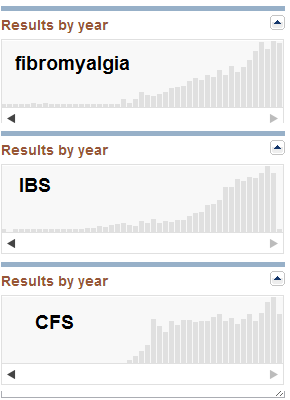
Often I see patient refer to books that were written 15 years ago. Our knowledge have greatly increased and are not in these old books. To Illustrate this look at the following charts from PubMed.

Number of new Articles on PubMed by Year  - each bar is 1 year

Our knowledge on CFS/FM/IBS has exploded. Most MDs are unable to keep current. Each Year is One Bar

Recommended Books

There are two recent books that should be on most patients’s bookshelf (or tablet). They are recent and reasonably complete.

While these books are current and of value, I often find that they recap information only without a critical analysis. Since both authors have CFS, weakness in executive decision making is normal. While I have this weakness also (for the same reason), I created a simple rule for evaluating supplements:

“The supplement must be documented by human studies to improve symptoms with no contradictory reports. Contradictory reports include no effect found.”

In the next series of posts, I will summarize the supplements that meet this criteria and explore the mechanisms of each supplement. There are many recommendations that I have seen in CFS/FM/IBS books that recent studies found negative effects when the earliest study had positive effects. Often the reason was poorly constructed studies earlier that ended up measuring placebo effects.

Stay tune for the first supplement tomorrow!