

This is a report from someone who started trying some of my suggestions in June.
- Week #1: Prescript Assist just before bed. In morning Vitamin D3 and Licorice
- Week #2: Add Equilibrium in AM, Mag Malate in evening
- Week #3: Add Symbioflor 1 + 2 in PM, D-Ribose with it
- Week #4: Add Miyarisan in AM, CoQ10 in evening
- Week #5: Stop Symbiorflor, Start L.Reuteri
- Various gums (Mastic etc)
There is a second uBiome that also has a bifidobacteria overgrowth with no lactobacillus which I looked at in another post.
“Id love to write a a summary but It would be very short, I haven’t had any changes in symptoms except for maybe a bit of more wired-and-tired after taking symbioflor-1. ”
Basics Criteria

- Diversity is 44%ile (I am starting to suspect that moving closer to 50%ile indicates recovery in some form)
- No E.Coli
- Not directly reported, but it parent is: Enterobacteriaceae is not reported (i.e. none)
- Akkermansia: 0 – none reported

It is interesting that we see a drop of diversity which may be connected to bifidobacterium being high. Bifidobacterium suppress many of the bacteria genus that are high in CFS uBiome results.
Analysis of Over Growth by Bacteria Genus

- Turicibacter (genus)
- Bifidobacterium (genus)
- Faecalibacterium (genus)
- Blautia (genus)
- Roseburia (genus)
NUTRIENTS/ SUBSTRATES
- Raffinose -2,3, 5
- D-Glucose -2,3
- Ellagic acid -2
- Stachyose (soy oligosaccharide) -2, 3, 5
- Galacturonic acid – 3
- Riboflavin -3
- Arabinogalactan -3
- N-Acetyl-D-glucosamine -3, 5
- Inulin -3
- Acetate -3, 5
- Pectin -3
- β-Glucan -5
- Resistant starch (type III) -5
- Resistant starch (type II) -5
- Arabinoxylans -5
- Chitin – 5
INHIBITED BY
- Flaxseed -1, 3, 4, 5
- Propyl gallate -1
- Tannic acid – 1
- Navy bean (Cooked) -1, 3
- Laminaria hyperborea (curvie) -2
- Chemotherapy -2, 3
- Magnesium-deficient diet -2
- High fat diet -2, 3
- Iron supplements -2
Berberine -2- High fat diet -2
- Glyphosphate -2
- Sucralose (Splenda) -2
- Low carbohydrate diet -2
- Low FODMAP diet -2, 3
- Ascophyllum nodosum (rockweed) -2
- High sugar diet – 3
- High animal protein diet – 3, 5
- Gallate -3
- Omega 3 fatty acids -3
- Fructo-oligosaccharides -3, 5
- Bile salts -3
- Resistant starch (type IV) -3
- High animal fat diet -3
- Low fiber diet -3
- High processed foods diet -3
- Walnuts -4
- Low carbohydrate diet – 5
- High animal protein diet -5
- Epinephrine – 5
- Fructo-oligosaccharides
- High meat diet – 5
ENHANCED BY
- Walnuts -1, 3, 4, 5
- Resistant starch (type II) -1,4, 5
- Partial Sleep Deprivation – 1
- Sesame cake/meal -2
- Resistant starch (type III) -2, 3
- Resistant starch (type IV) – 4
- Daesiho-tang (DSHT) -2
- Almonds/ almond skins -2
- Jerusalem artichoke -2, 3
- Red wine -2, 3
- Fructo-oligosaccharides -2
- Arabinoxylans -2, 5
- Chicory -2, 3
- Inulin -2
- Resveratrol -2
- Magnesium -2
- Chondrus crispus (red seaweed) -2
- Green tea -2
- Navy bean (Cooked) -2
- Fasting -3
- Epinephrine -3
- Saccharomyces boulardii – 3, 4, 5
- Arabinogalactan -3
- Low animal protein diet -3
- Low processed foods diet – 3
- High fiber diet -3
Berberine -3, 4- Dopamine -3, 5
- Cholic acid -4
- Vitamin D – 5
- Dietary fiber -5
- Polymannuronic acid
- N-Acetyl-D-glucosamine
INHIBITS
- Bifidobacterium – 1, 3, 4, 5
Analysis – I have marked the items only connected to Bifidobacterium in blue.
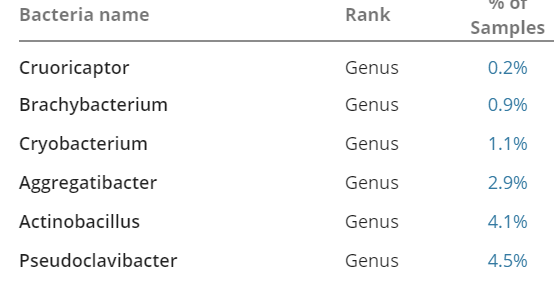
Number of Very Elusive Bacteria:
These are not overgrowth of common bacteria, but mystery bacteria who may have special traits.
Bottom Line
Melatonin Candidate
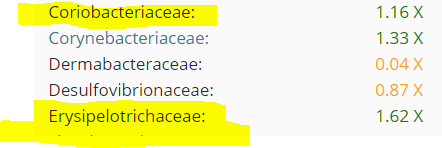
This person is high in all of the genus that melatonin may reduce (see this post). These are the triplet of genus associated with Partial Sleep Deprivation on DataPunk.Net.
General Suggestions
Suggestions are similar to other recent analysis:
- No Saccharomyces boulardii
- No Resistant starch (type II)
- No Walnuts
- Lots of Flaxseed
- Navy bean (Cooked)
A question that I have is what the strains and species of bifidobacteria are for this patient and the earlier post of a ubiome that was also high in bifidobacteria and zero lactobacillus. This earlier post ubiome did not have any Coriobacteriacease and low Erysipelotrichaceae with the Firmicutes-to-Bacteroidetes ratio in the opposite direction (so NOT a melatonin candidate).
Given both the drop in diversity towubiomeards typical and high bifidobacteria (positive signs), I would suggest adding in some human-source lactobacillus probiotics – for example:
- L. Reuteri –> BioGaia and Cardioviva
- L. Fermentum ME-3
- Shown to persist (see this post)
- L. rhamnosus GG (Culturelle)
- L. rhamnosus CNCM I-4036 (Human origin)
- L. rhamnosus (573L/1-3)
- L. plantarum MF1298, DC13
As always, consult with your medical professional before starting or altering your supplements.
 CFS Remission