Rosehip, Pomegranate and other teas — Biome impact

A reader forward Antimicrobial activities of widely consumed herbal teas, alone or in combination with antibiotics: an in vitro study[2017]

This study found “Of the 31 teas (24 different herbs and seven bag teas), as shown in Table S1, only 15 teas showed inhibition zones against one or more microorganisms in the disk diffusion assays, while the others: linden, lemon balm, hibiscus, rosemary, nettle, chamomile, bay, yarrow, eucalyptus, lavender, galangal, orange, sage, ginger, herb bennet, and echinacea teas did not show any activity.”

It then presents this lovely table. S. Aureus is a suspected maintainer of CFS(see post). The smaller the number, the less is needed.

teas

Among the tables is one that suggests you need to have cups of teas every 8 hours and the effect may take up to 4 hrs, at least for rosehip tea bags. (RB)

rosetea.PNG

Note, ” The combinations of herbal teas with antibiotics showed synergistic, additive, or antagonistic effects, depending on the antibiotic or type of tea. ” So if you are doing teas and antibiotics — you need to read this article in full.  The tea may reduce the effect of the antibiotics (or increase it!).

Bottom Line

Rosehip (Rosa canina) tea (and soup?) looks like a excellent item to take 3 times per day — assuming you are not taking E.Coli probiotics at the same time.

  • “Among the tested bacteria, Pseudomonas aeruginosa and Salmonella typhimurium were the most susceptible to the activity of R. canina leaf extract with MIC and MBC values both 0.009 mg mL(-1). For most of the bacterial strains investigated the extract showed significantly higher activity compared to the used standard compounds streptomycin and ampicillin. [2015]
  • In vivo anti-inflammatory effect of Rosa canina L. extract.[2011]

Rose hips contain the carotenoids beta-caroteneluteinzeaxanthin and lycopene.

It has been used in some IBS Studies [2000] [2009]. A 2008 technical paper on rose hip is here.

A rose hip preparation (not clear whether it was rose hip or rose hip and seed) was investigated in a randomized double-blind study including 60 patients suffering from irritable bowel syndrome. They started to register their intestinal complaints 2 weeks before the administration of the products by means of a questionnaire. Patients receiving the proprietary rose hip drink as placebo pro-fited less than those receiving additional Lactobacillus plantarum 9843, but abdominal pain was reduced in both groups (Nobaek et al., 2000).

According to WebMd:

“Rose hips are also used for stomach disorders including stomach spasms, stomach acid deficiency, preventing stomach irritation and ulcers, and as a “stomach tonic” for intestinal diseases. They are also used for diarrhea, constipation, gallstones, gallbladder ailments, lower urinary tract and kidney disorders, fluid retention (dropsy or edema), gout, back and leg pain (sciatica), diabetes, high cholesterol, weight loss, high blood pressure, chest ailments, fever, increasing immune function during exhaustion, increasing blood flow in the limbs, increasing urine flow and quenching thirst.”

We do not know a great deal about which bacteria it kills or encourages — so this is definitely an item for “the art of microbiome manipulation“.

Discuss with your medical professional trying 3 cups of tea (every 8 hrs) for a week and see if there is any significant change. Do not substitute “rose hip capsules” , you want actual tea (and yes, it is a bit of an acquired taste).
uBiome of a long time stable CFS patient


Patient Summary

– Current age 44

– Main symptoms: Brain fog, fatigue, weakness, exercise intolerance, feel worse after eating, certain weather (high winds or overcast skies) cause me to feel extremely anxious/exhausted. The physical symptoms haven’t changed much since teenage years, but are gradually worsening with age.

– Typically able to work around 10 hours per week, running own company from a zero-gravity chair, but requires significant effort. Brain fog is the major impediment.

– Hypersensitive to chemical fragrances, but equally sensitive to light, sounds, tastes, and touch. No strong Aspergian tendencies, but an INTJ on Myers-Briggs and a 5w4 on the Enneagram.

– Fell from the second floor to the first floor of family home when 18 months old (no resulting broken or fractured bones).

– Non-restorative sleep since age 7, when began waking up sluggish and with a tired-achy-pressure sensation around eyes. The sensation itself is present 24/7 and is still present today. (ENT doctors consistently report I have no sinus problems.) Tended to be constipated.

– Developed chronic gas at age 14

– Chronic fatigue since age 15, with gradual onset and no known infection that preceded the onset of fatigue

– At age 17 undertook an elimination diet and discovered refined sugars caused feeling ill, grains cause bloating, and cultured milk products make eyes burn. Since then I’ve loosely followed a paleo diet.

Earlier this year I tested positive for EBV antibodies, and I vaguely recall this was already true in my late teens, as well.

Recently I’ve tried Symbioflor-2 (concurrent with Symbioflor-1) for a week, and Act’Regen five days now, with no discernible reaction to either.

uBiome results

From the notes above, we have a much higher functioning CFS person than most. The uBiome results suggests that is the case — many items are much less severe than what is often seen in other’s uBiome.

Diversity 88%ile (Common on uBiome results for CFS)

x1

x3– E.Coli’s parent — much higher than most. But Genova Diagnostics lab report Zero for E.Coli specifically.

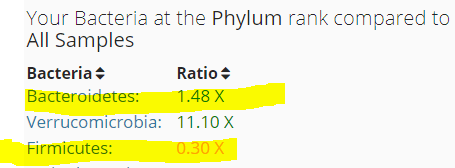
Bacteriodetes/Firmicutes shift is very moderate compare to other CFS patients

x2

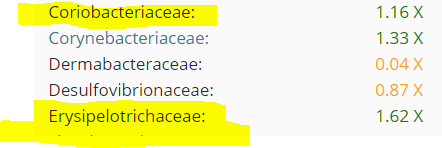
Sleep deprivation (possible Melatonin) families — not too bad, g low firmicutes; melatonin is not suggested

x4

Proposed bacteria genus contributing to MCS: above threshold (0.32x)

x5

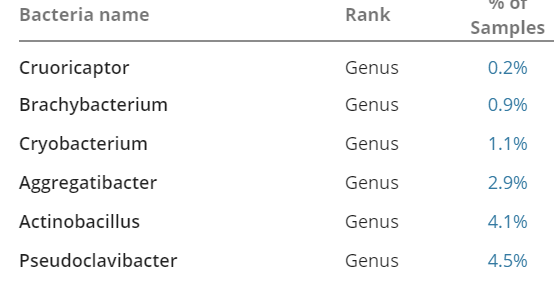
Uncommon Bacteria

x6

Overgrowths

x7

Analysis of Overgrowth and Rare Genus

  1. Acholeplasmataceae (family) 
  2. Alloprevotella (genus) 
  3. Anaerotruncus (genus) 
  4. Cronobacter (genus) 
  5. Elusimicrobium (genus) 
  6. Enterorhabdus (genus) 
  7. Erysipelatoclostridium (genus) 
  8. Oscillibacter (genus) 
  9. Pseudobutyrivibrio (genus) 
  10. Terrisporobacter (genus) 
  11. Thalassospira (genus) 
  12. Klebsiella pneumoniae (species)  (From Genova Diagnostics)

NUTRIENTS/ SUBSTRATES

INHIBITED BY

ENHANCED BY

INHIBITS

Despite 11 genus listed, there is little known information on what makes them tick.  Flaxseed porridge with a glass of Pomegranate juice for breakfast is the only clean suggestion.

Elusimicrobium is a new genus to me (a.k.a. Termite Group I),  I have not seen it in other uBiomes. It is both rare and the greatest relative overgrowth. Going over to http://www.genome.jp/  we can discover what antibiotics it may be resistant to (based on it’s DNA):
x9

Digging into PubMed, we find:

  • ” an unusual peptide degradation pathway comprising transamination reactions and leading to the formation of alanine, which is excreted in substantial amounts. ” [2009]
  • “The isolate grows heterotrophically on sugars and ferments D-galactose, D-glucose, D-fructose, D-glucosamine, and N-acetyl-D-glucosamine to acetate, ethanol, hydrogen, and alanine as major products but only if amino acids are present in the medium. ” [2009]
  • “Unexpectedly, Elusimicrobia made up 14% of the operational taxonomic units detected in one subject at day 7, which is the only value that contributes to the Elusimicrobia average abundance of 3% for that date. This may be due to a subject that originated outside of North America with some rarely reported microbiome taxa.” [2017] – in this study, yogurt increased it’s abundance.

Avenues to Explore

These are based on history and labs that were included.

Epstein–Barr virus (EBV)

  • Lactobacillus casei Shirota probiotic (Yakult) – “A similar effect was found for plasma EBV antibody titres in EBV seropositive participants (p < 0.01) with antibody titre falling in the probiotic group but increasing in the placebo group over time.” [2016]

Hypercoagulation

  • See this post, it may account for cognitive, sleep and other issues.

IBS Probiotics

  • See this post and the literature supporting these specific probiotics.

High Triglycerides, Cholesterol

We know that some bacteria increases it (and may be a contributing factor), so looking at those known to lower it (perhaps by taking out the other strains).

Antibiotics for Oscillibacter

The “grains cause bloating,” combined with Oscillibacter being enhanced for Resistant starch Type I, II, III hints that this may  play a significant role.

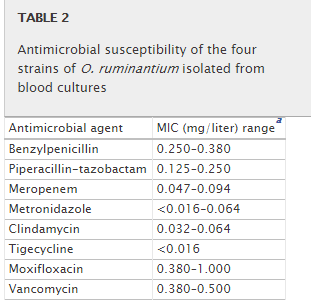
There is a 2013 study from Denmark treating this genus, the antibiotics tested are shown below. Tigecycline is a tetracycline and metronidazole is a common antibiotics that generally reports good results with CFS patients.

x8

Bottom Line

There was no clear clustering of nutrients or inhibitors in the rare or overgrowth. If iron supplements are being taken, consideration should be done for stopping them (see this post on the bacteria connection for iron, and “Could iron supplement makes CFS recovery harder?

Given the food sensitivities reported, the reader will need to slowly feel out  the best path.

As always, consult with your medical professional before adding probiotics, changing supplements etc.


Probiotics Available in Spain

One of the challenges is just getting the probiotics that are likely to help. Often they are unavailable in one country but easily available in another (or if available the price is many times higher!!). Another source of single strains probiotics in the UK.

During my 2nd round of CFS, I ended up working with a Czech CFS patient to get some stuff (Piracetam) that was over the counter there and totally unavailable in the US at that time. She sent me packages and I sent her money (usually 50% more than her cost as a thank you for the effort). This model is something to keep in mind.

A reader in Spain forwarded me the list of those available in Spain — here is my quick review of the interesting ones. Two are unusual and I will research each for a future post.

  Probiótico
Aflorex (cáps)
  • B. infantis 35624TM
  • 1 BCFU/cáps.
Bivos (polvos)
  • L. rhamnosus GG (ATCC53103)
  • 6BCFU/cap
gotas) (Casen)
  • L. reuteri Protectis ((DSM 17938).
  • 0.1 BCFU/cap
Bi-Oral suero
  • L. reuteri.
  • 0.1 BCFU/cap
SHS – Synbiotic
  •  Bifidobacterium longum
Lactanza hereditum (Angelini)
  • Lactobacillus fermentum Lc40 (CECT 5716).
  • 3BCFU/caps.
Muvagyn® probiótico (cap vaginales)
  • L. rhamnosus PB01 (DSM 14870)
  • L. gasseri EB01 (DSM 14869).
  • 100 millones de ufc/cáps.
Kaleidon 60

Kaleidon 30

Kaleidon Hidro

(Menarini)

  •  Lactobacillus rhamnosus GG (ATCC 53103).
  • BCFU/cap
Yobalex (Bayer)
  • Bifidobacterium longun
Symbioran (Ordesa)
  • B. longum subespecie infantis CECT7210,
  • L. rhamnosus
  • L. helveticus),
Lactibiane ATP (Pileje)
  • Lactobacillus rhamnosus
  • LA801. 12BCFU
Probiomax flora intestinal (Aquilea)
  • Lactobacillus paracasei LPC00,
  • Lactobacillus rhamnosus LR04),
  • Fructooligosacáridos.
  • 6.000 millones de ufc.6BCFU
Probiomax defensas (Aquilea)
  • Lactobacillus plantarum LP02,
  • Bifidobacterium lactis BS01,
  • Lactobacillus rhamnosus LR04,
  • Vitamina C, 40 mg, FOS (40 mg).
  • 12BCFU.
I3.1® L. plantarum (CECT 7484 y CECT7485)

P. acidilactici (CECT 7483).

3.000 BCFY

NS Florabiotic Instant (sob). L. rhamnosus GG (ATCC 53103)

5 BCFU

Protransitus® (cap) L. plantarum 299v (LP299vTM)
10 BCFU
Reuteri® gotas L. reuteri Protectis (DSM 17938).

More Before and After Fecal Microbiome Transplants uBiomes

Fecal Microbiome Transplants(FMT) had great promise when the first ones happened — almost immediate remission of CFS symptoms. With time we have discovered that the FMT benefit fades, sometime quickly, sometimes slowly. I fear that it may be a similar problem as blood transfusions and organ transplants — compatibility is needed, but we still do not know how to determine it.

There have been attempts to do high dosage antibiotics prior — which according to reports from readers — have not made significant changes in the pattern.

Patient Summary

History

  • Respiratory tract infections as a child
  • Pneumonia twice as an adult (hospitalised once)
  • Reflux and IBS symptoms on and off through the 2000s
  • In sept 2011 I came down with flu type symptoms may have been ebv. Looking back in retrospect I was overexercising at the time and probably not supporting it nutritionally so there were a number of stress factors contributing. I gradually went down hill. Diagnosed with CFS December 2011.
  • Had a small recovery in 2013 due to lots of relaxation techniques (breathing and mindfulness) strict paleo diet.
  • 2014 started back to work. Things were pretty bad(full blown SIBO symptoms) had bioscreen gut test done (attached) was given emycin.
    • Post emycin[Erythromycin] histamine  symptoms went away and mood/energy improved.
    • 3 months after did a course of flagyl,rifaxmin and nistatin followed by FMT (10 rounds).
    • Improvement for a few months then bronchitis required AB and gut symptoms came back.
  • 4 more rounds of AB combinations of Flagyl, neomycin,cipro and rifaximin.
    • Each time less benefit from the AB each time followed up by FMT.
    • In 2016 stopped work did elemental diet 2 rounds of 14 days.
    • Improvement of gut problems but lots of inflammation symptoms.
    • Things have been very bad since I have tried lots of different herbal protocols in the last 2 years with a limited amount of success.
    • My liver is struggling to process things (based on experimentation and a functional not supported by mainstream medicine test).

Current symptoms:

  • Fatigue is not that bad.
  • Constant cycling of gut symptoms: burning, cramping gas, bloating.
  • I react to many things I eat both foods and supplements but it is inconsistent. Histamine is definitely a problem and I think High salicylate/phenol also seem to be a problem.
  • Inflammation symptoms.
  • Tingling in face hands and feet.
  • Whole body trembling
  • Sharp pains in feet
  • Feeling like head will explode
  • Headaches
  • Mental state: Extreme depression and anxiety

uBiome

Time Line

Phyllum Changes

phy

Genus Changes

gen

Details

1/10/2017 3/07/2017

E.Coli Parent:Enterobacteriales:  < 0.01X
Gordonibacter:   0.04

E.Coli Parent:Enterobacteriales:  < 0.01X
Gordonibacter:   0.08
Diversity: 86%ile Diversity: 86%ile
Unique Bacteria
Unique Bacteria
bf1
B/F Ratio: 4.8x normal
bf2
B/F Ratio: 4x normal
Sleep Deprived Genus
CE1
Sleep Deprived Genus
ce2

Initial Impressions

  • EMycin: Erythromycin belongs to a group of drugs called macrolide antibiotics.  (one of the recommended ones, see this post)
  • cipro – Ciprofloxacin is fluoroquinolone antibiotic (one of the recommended ones, see this post)
  • Rifaximin: Does not reduce Bifidobacteria [2010] [2007] [2002]
  • Neomycin is an  aminoglycoside antibiotics.

I am unhappy to see that Bifidobacteria decreased, and happy to see the histamine issue disappear.

Analysis of Overgrowth on Both uBiome

  1. Akkermansia (genus) 
  2. Alistipes (genus) 
  3. Butyricimonas (genus) 
  4. Desulfovibrio (genus) 
  5. Odoribacter (genus) 
  6. Parabacteroides (genus) 
  7. Phascolarctobacterium (genus) 
  8. Victivallis (genus) 

NUTRIENTS/ SUBSTRATES

ENDPRODUCTS

INHIBITED BY

ENHANCED BY


INHIBITS

Analysis

The FMT did not result in positive significant change of the microbiome — same diversity, similar bacteroidetes/firmicutes ratio, etc.

There was one interesting change at the family level was those related to the Melatonin /sleep bacteria went down. Items #3 and #4 are my greatest concern — but all available information on inhibitors is zero.

The only thing common with the nutrients is D-Glucose — a familiar theme in many uBiome studies, dietgrail.com has a helpful table here of foods low or without glucose. There are no common inhibitors 😦 .

One question that arises, does a FMT result in “noise” in the microbiome for N weeks after the FMT — resulting in instability of the microbiome (i.e. is this the cause of an absence of clustering seen above?)

Bottom Line

There was no mention of probiotics in the patient notes. Given the number of rounds of antibiotics I would suggest starting with Prescript Assist and then add in Equilibrium.  The E.Coli probiotics OR Lactobacillus Fermentum ME3 would be the next ones to rotate to.

The reader also supplied results from Genova Diagnostic test done before either of the above.
gut

This would suggest:

  • butyrate supplements
  • Miyarisan (Clostridium butyricum) probiotics

As always, consult with a medical professional before altering diet, changing supplements or probiotics.


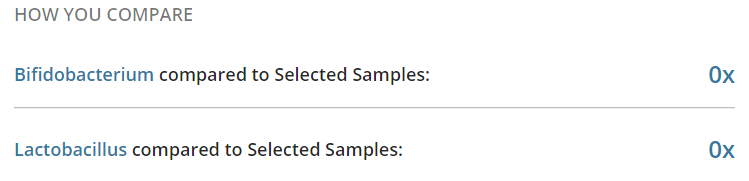
Another uBiome Review with Bifidobacteria Overgrowth


This is a report from someone who started trying some of my suggestions in June.

  • Week #1: Prescript Assist just before bed. In morning Vitamin D3 and Licorice
  • Week #2: Add Equilibrium in AM, Mag Malate in evening
  • Week #3: Add Symbioflor 1 + 2 in PM, D-Ribose with it
  • Week #4: Add Miyarisan in AM, CoQ10 in evening
  • Week #5: Stop Symbiorflor, Start L.Reuteri
  • Various gums (Mastic etc)

There is a second uBiome that also has a bifidobacteria overgrowth with no lactobacillus which I looked at in another post.

“Id love to write a a summary but It would be very short, I haven’t had any changes in symptoms except for maybe a bit of more wired-and-tired after taking symbioflor-1. ”

Basics Criteria
bifido

  • Diversity is 44%ile (I am starting to suspect that moving closer to 50%ile indicates recovery in some form)
  • No E.Coli
    • Not directly reported, but it parent is: Enterobacteriaceae  is not reported (i.e. none)
  • Akkermansia: 0 – none reported
  • ratio

It is interesting that we see a drop of diversity which may be connected to bifidobacterium being high. Bifidobacterium suppress many of the bacteria genus that are high in CFS uBiome results.

Analysis of Over Growth by Bacteria Genus

e1

  1. Turicibacter (genus) 
  2. Bifidobacterium (genus)
  3. Faecalibacterium (genus) 
  4. Blautia (genus) 
  5. Roseburia (genus) 

NUTRIENTS/ SUBSTRATES


INHIBITED BY

ENHANCED BY

INHIBITS

Analysis – I have marked the items only connected to Bifidobacterium in blue.

Number of Very Elusive Bacteria:

These are not overgrowth of common bacteria, but mystery bacteria who may have special traits.

elusi

Bottom Line

Melatonin Candidate

mela

This person is high in all of the genus that melatonin may reduce (see this post).  These are the triplet of genus associated with  Partial Sleep Deprivation on DataPunk.Net.

General Suggestions

Suggestions are similar to other recent analysis:

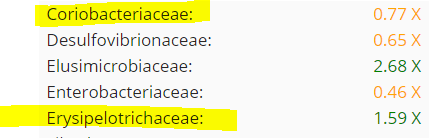
A question that I have is what the strains and species of bifidobacteria are for this patient and the earlier post of a ubiome that was also high in bifidobacteria and zero lactobacillus. This earlier post ubiome did not have any Coriobacteriacease and low Erysipelotrichaceae with the Firmicutes-to-Bacteroidetes ratio in the opposite direction (so NOT a melatonin candidate).

Given both the drop in diversity towubiomeards typical and high bifidobacteria (positive signs), I would suggest adding in some human-source lactobacillus probiotics – for example:

  • L. Reuteri –> BioGaia and Cardioviva
  • L. Fermentum ME-3
  • Shown to persist (see this post)
    • L. rhamnosus GG (Culturelle)
    • L. rhamnosus CNCM I-4036 (Human origin)
    • L. rhamnosus (573L/1-3)
    • L. plantarum  MF1298, DC13

As always, consult with your medical professional before starting or altering your supplements.