

I had done a BioScreen report on an earlier post. The details of the microbiome is a lot less than uBiome, but in some way better for specific items — namely, bacteria treatable by antibiotics.
This person has used Proton-pump inhibitors in the past (see below)
Standard Checks
- No Lactobacillus
- No Bifidobacteria
- High E.Coli — The same as the prior post — this may be a test methodology issue
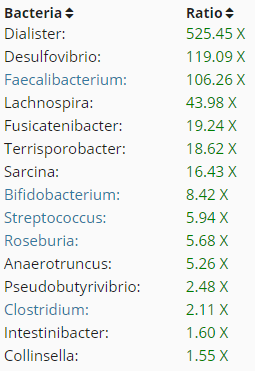
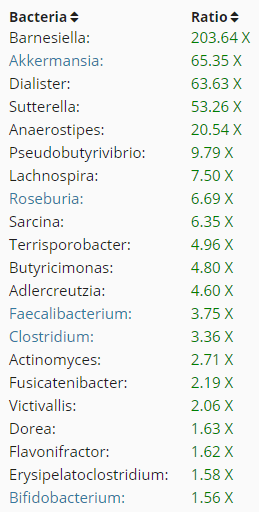
Compare to other report
- This person is also high in Streptococcus (50x or more than reference) but with different strains (and one in common)
- No Yeast here
- This person has high Klebsiella pneumoniae (which was reported in the 1998 study as being seen)


Analysis
With the high E.Coli and Strepoccocus, it was interesting to find that some species can co-exist together:
Using DataPunk, we can go to the species level (finer than the genus level of uBiome). Unfortunately this does not buy us any more information for these than the genus would.
- Streptococcus parasanguinis (species)
- Streptococcus salivarius (species)
- Streptococcus anginosus group (species group)
- Klebsiella pneumoniae (species)
- Erysipelato- clostridium ramosum (species)
NUTRIENTS/ SUBSTRATES
- D-Glucose – 1,2,3
- L-Lysine -4
- Acetoin – 4
- Sucrose – 4
- L-Histidine – 4
- D-Lactose – 4
- Myo-inositol – 4
- Urea – 4
- D-Sorbitol– 4
- Acetoin – 4
- L-Ornithine – 4
- Iron supplements – 4
- L-Rhamnose -4
INHIBITED BY
- Thyme oil -1,2,3
- Peppermint oil -1,2,3
- Lemongrass oil -1,2,3
- Navy bean (Cooked) -1,2,3
- Garlic (allicin) -1,2,3,4
- Resistant starch (type IV) -1,2,3
- Cinnamon bark oil -1,2,3
- Aloe vera -1,2,3
- Stevia -1,2,3
- Hyocyamine -1,2,3
- Berberine -1,2,3,4
- Hyocyamine 4
ENHANCED BY
INHIBITS
- Bifidobacterium, 1,2,3
Antibiotics
- Streptococcus anginosus (milleri) Group Strains Isolated in Poland (1996-2012) and their Antibiotic Resistance Patterns[2016].
- “All analyzed strains are sensitive to penicillin, a substantial group of strains is resistant to macrolides and the majority of strains are resistant to tetracycline.”
- Oral cavities of healthy infants harbour high proportions of Streptococcus salivarius strains with phenotypic and genotypic resistance to multiple classes of antibiotics.[2016]
- “Strains resistant to erythromycin, penicillins and tetracyclines were isolated from …100.0, 66.6 and 50.0 % respectively”
- A Patient with a Wedge-shaped Pulmonary Lesion Associated with Streptococcus parasanguinis] [2016].
- “Ceftriaxone and minocycline”
- Antimicrobial activities of widely consumed herbal teas, alone or in combination with antibiotics: an in vitro study.
- “While synergy was observed more frequently between ampicillin, ampicillin-sulbactam, or nystatine, and the various tea combinations, most of the effects between the ciprofloxacin, erythromycin, cefuroxime, or amikacin and various tea combinations, particularly rosehip, rosehip bag, and pomegranate blossom teas, were antagonistic. ” BEWARE: Herbal tea may weaken or help antibiotics, depending on which one!
- Rosehip and pomegranate blossom reduces K.pneumoniae (but do not take with antibiotics)
- K.pneumoniae is reduced by ciprofloxacin, ampicillinsulbactam and cefuroxime
- Clostridium ramosum bacteremia: case report and literature review [2014].
- “Resistance of C. ramosum to antibiotics is uncommon.”
Bottom Line
A low or no glucose diet may be beneficial (see this post for information) to starve the bacteria. This is not a low or no sugar diet, this is for a specific type of sugar. Also, you may wish to review the suggestions on my earlier post.
- With antibiotics, rotation is clearly the preferred approach because of the high resistance rates reported. The three antibiotics: cefuroxime, minocycline and a penicillins seem reasonable.
- The non-antibiotic route are likely the items listed under inhibit, plus Rosehip and pomegranate blossom teas.
Which test is better – Bioscreen or uBiome? If you have a physician that is willing prescribe antibiotics, then Bioscreen is better because you are able to better determine the candidate antibiotics. Unfortunately, you will not see overgrowth of other bacteria genus.
If you are in a “diet, herb, supplements only” path — then uBiome is better. One of the difficulties with uBiome results is that for many of the bacteria genus we do not know which antibiotics are resistant. In many cases, we do know something that inhibits them.
As always, consult with your knowledgeable medical professionals before making any changes.


 CFS Remission