

Today I added another tests to the list on this page. This is the 2nd one from this lab.

Dealing with non 16s tests means that a totally different lab process is used with ranges being different. Ranges for most labs is done by taking a sample of people close to the labs and then computing average and standard deviations. This works fine if you are a match for the people in the sample (DNA, diet, etc.) If you are Hindu vegetarian working in pork-country of Germany — your numbers may be very different. The reality is that their values are the only thing we can work from.
The lab may show values like this, with the ranges covering 65-95% of the population according to statistics. The numbers from our 16s samples do not agree. Instead of 5% being outside of the normal range, we could have 80% outside.

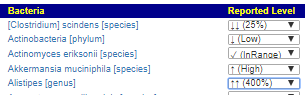
Each lab will have different normal ranges. The solution that I used to allow people to use the suggestion engine is pretty simple.
- Red below – pick two down arrows
- Yellow below – pick one down arrows
- Green — no errors
- Yellow above – pick one up arrows
- Red above – pick two up arrows
Can you use Jason Harwelak reference ranges? In general, likely. The values are below, so just copy your numbers across. I used the results from the above A6 test below. Notice that there can be major disagreement between the two on what the desired range is!!!
| Taxonomy | Rank | Low | High | Your Value | Status |
|---|---|---|---|---|---|
| Bacteroidetes A6: 27 – 36 | class | 0 | 35 | 39.7 | Not Ideal |
| Akkermansia A6: 0.01-1.5 | genus | 1 | 3 | 5.2 | Not Ideal |
| Bacteroides A6: 12-15 | genus | 0 | 20 | 13.2 | Not Ideal |
| Bifidobacterium A6: 0.6 – 4.5 | genus | 2.5 | 5 | 0.12 | Not Ideal |
| Blautia | genus | 5 | 10 | MISSING | |
| Desulfovibrio A6: 0 – 0.1 | genus | 0 | 0.25 | 0.026 | Ideal |
| Eubacterium A6: 0.3 – 2.3 | genus | 0 | 15 | 0.342 | Ideal |
| Lactobacillus A6: 0.01 -0.05 | genus | 0.01 | 1 | 0.012 | Ideal |
| Methanobrevibacter A6: 0 – 0.03 | genus | 0.0001 | 0.02 | 0 | Ideal |
| Roseburia A6: 0.5 – 2.4 | genus | 5 | 10 | 0.145 | Not Ideal |
| Ruminococcus A6; 4.9 – 8.1 | genus | 0 | 15 | 3.9 | Ideal |
| Proteobacteria A6: 2-5 | phylum | 0 | 4 | 9.5 | Not Ideal |
| Bilophila wadsworthia A6: 0 – 1.89 | species | 0 | 0.25 | 0.450 | Not Ideal |
| Escherichia coli | species | 0 | 0.01 | MISSING | |
| Faecalibacterium prausnitzii A6: 1.9 – 5.0 | species | 10 | 15 | 2.986 | Not Ideal |
Remember, on the data entry — you can pick if you want to deem a value to be normal or abnormal. No one has the perfect answer (unfortunately).
Bottom Line
Try to isolate definite issues.
- If the lab says “normal” skip that bacteria
- If it says outside of range a little, you may wish to skip it.
- If it says outside a lot,
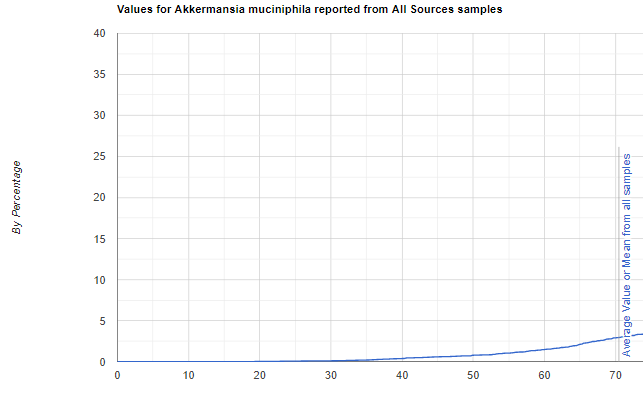
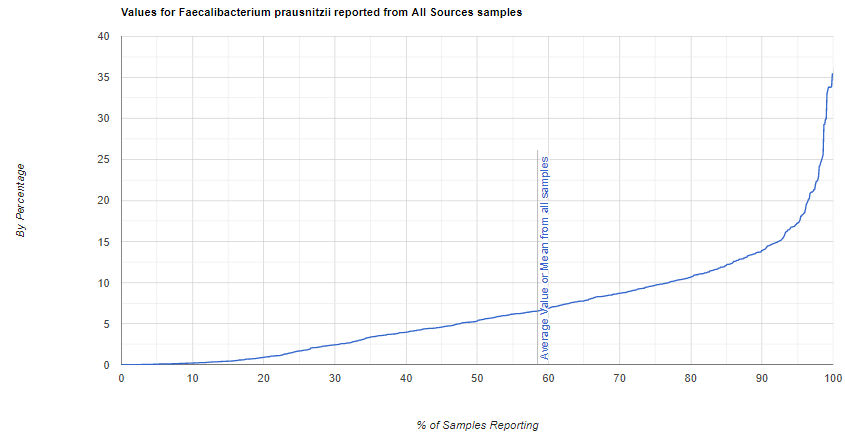
- Check Jason’s ranges
- Click on the bacteria link and see if your values are:
- In the top 5-10% of values
- In the bottom 5% for bacteria that 99% of people have
Then click Analysis and see what suggestions comes up. If the lab has suggestions, compare them. If both agree — those are your first choices. If one is quiet and the other recommends, those are your second choices.
If the suggestions disagree — discuss with your medical professional before doing.
 CFS Remission