

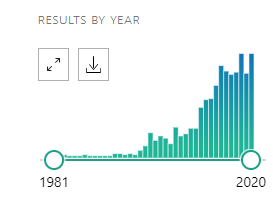
I have done prior posts on POTS (POTS Revisited) and been requested to check the latest research. Checking PUBMED statistics, we see there have been many papers in the last few years
- “The physiology underlying “brain fog” in the absence of orthostatic stress in postural tachycardia syndrome (POTS) remains poorly understood. … greater slowing in psychomotor speed and a greater increase in symptom scores at study completion in the patients with POTS, including increased difficulty with concentration. All other physiologic responses (blood pressure and end-tidal carbon dioxide) did not differ between groups after PCST ” [2020]
- Restless legs syndrome is increased in postural orthostatic tachycardia syndrome [2020]
- Dry Eye Syndrome and Sicca Complex are Commonly Found in Patients with Postural Orthostatic Tachycardia Syndrome [2020]
- Mechanisms and management of gastrointestinal symptoms in postural orthostatic tachycardia syndrome [2020]
- Treatment of Postural Orthostatic Tachycardia Syndrome With Medication: A Systematic Review [2020] “Postural orthostatic tachycardia syndrome has been recognized for decades, but treatment is largely based on anecdotal experience and expert opinion. Pharmacologic treatment is inconsistent and unstandardized. …There is a paucity [very few] of high-quality data about effectiveness of medication in the treatment of postural orthostatic tachycardia syndrome. “
Trying Citizen Science
We have 55 samples annotated with POTS and we recently added enzymes to the system. Time to go on a statistical fishing expedition… and we found some fish, all of them small one (i.e. too low production)
| EnzymeName | POTS Average | No POTS Average | Test Statistic | Obs |
| crotonobetainyl-CoA reductase | 174 | 1500 | -5.31511 | 28 |
| L-carnitine CoA-transferase | 177 | 1381 | -5.04204 | 31 |
| D-apionate oxidoisomerase | 573 | 1541 | -4.57861 | 29 |
| nitrite reductase (NO-forming) | 5311 | 17941 | -4.46254 | 51 |
| 5-aminopentanamidase | 5900 | 16862 | -4.31631 | 51 |
| phosphatidyl-myo-inositol alpha-mannosyltransferase | 5523 | 17379 | -4.16094 | 50 |
| cysteinylglycine-S-conjugate dipeptidase | 5611 | 17868 | -4.15823 | 48 |
| polyphosphate—glucose phosphotransferase | 5621 | 17638 | -4.09764 | 48 |
| 8-oxo-dGDP phosphatase | 5725 | 17788 | -4.05173 | 47 |
| 8-oxo-(d)GTP phosphatase | 5930 | 17351 | -3.93432 | 48 |
| lactocepin | 1411 | 8104 | -3.90514 | 50 |
| formyl-CoA transferase | 5998 | 17156 | -3.84911 | 46 |
| oxalyl-CoA decarboxylase | 6234 | 18799 | -3.80263 | 39 |
| galactofuranosylgalactofuranosylrhamnosyl-N-acetylglucosaminyl-diphospho-decaprenol beta-1,5/1,6-galactofuranosyltransferase | 5714 | 14910 | -3.60734 | 50 |
| lipid II isoglutaminyl synthase (glutamine-hydrolysing) | 8292 | 22101 | -3.5937 | 54 |
| galactan exo-1,6-beta-galactobiohydrolase (non-reducing end) | 6876 | 19457 | -3.53129 | 35 |
| N-acetylhexosamine 1-kinase | 6876 | 19434 | -3.52637 | 35 |
| dehydrogluconokinase | 6710 | 18931 | -3.52007 | 36 |
| Pup amidohydrolase | 5718 | 15393 | -3.51166 | 47 |
| prokaryotic ubiquitin-like protein ligase | 5718 | 15393 | -3.51166 | 47 |
| all-trans-retinol dehydrogenase (NAD+) | 6484 | 17326 | -3.47966 | 41 |
| gamma-glutamyl hercynylcysteine S-oxide hydrolase | 6876 | 19217 | -3.47867 | 35 |
| glucosyl-3-phosphoglycerate phosphatase | 7804 | 18811 | -3.474 | 50 |
| isopenicillin-N epimerase | 6367 | 17710 | -3.44546 | 38 |
| 2-acetylphloroglucinol acetyltransferase | 6295 | 15991 | -3.43971 | 45 |
| phosphatidylinositol dimannoside acyltransferase | 8899 | 20502 | -3.38033 | 50 |
| dolichyl-phosphate-mannose—protein mannosyltransferase | 8156 | 17812 | -3.34246 | 54 |
| sorbose reductase | 6144 | 15938 | -3.29349 | 41 |
| tRNA (adenine57-N1/adenine58-N1)-methyltransferase | 8093 | 18743 | -3.26853 | 48 |
| tRNA (adenine58-N1)-methyltransferase | 8093 | 18743 | -3.26853 | 48 |
This is actually a happy path because for too low, we can identify probiotics that produces these missing enzymes. Three bifidobacterium are at the top of the list. Custom Probiotics daily recommended dosage for these are 350-400 BCFU /day.
| bacillus pumilus | 8 |
| bacillus simplex | 2 |
| bacillus velezensis | 8 |
| bifidobacterium adolescentis | 26 |
| bifidobacterium animalis subsp. lactis bb-12 | 26 |
| bifidobacterium longum | 26 |
| clostridium beijerinckii | 5 |
| clostridium butyricum | 5 |
| enterococcus durans | 1 |
| enterococcus faecalis | 1 |
| lactobacillus acidophilus | 4 |
| lactobacillus helveticus | 4 |
| lactobacillus kefiri | 2 |
| lactobacillus paracasei | 2 |
| lactobacillus plantarum | 1 |
| lactobacillus rhamnosus (strain atcc 53103 / gg) | 2 |
| lactobacillus salivarius | 2 |
| lactococcus lactis | 3 |
| leuconostoc lactis | 2 |
| streptococcus thermophilus | 3 |
Bottom Line
We have deduced which probiotics should help POTS (if taken in sufficient dosage) by using citizen science on the annotated-with-symptoms uploads, the KEGG Enzyme data and statistics. We may not know the why’s of these enzymes missing causing POTS, but we have some ideas of where to start looking for explanations. Until then, we at least know what to try.
There have been NO STUDIES using Bifidobacterium probiotics with POTS published.
Again consult with your medical professional first.
 CFS Remission