

I am a statistician and for ME/CFS I took an odds approach to treatment back in 1999. Two treatments reported 90% remission (not improvement) rates from conference reports. They had no apparent connection to each other. I persuaded my MD to do both. Assuming they are not connected much, the statistical odds of remission jumped to 99% doing both. It worked.
I have spent 50 years in Information Technology and tend to use successful patterns from that career. One key pattern is finding isolation points to subdivide the problem (find a wedge point) and then focus on whichever side of the issue it the cause . The other pattern is focus on fixing the problem (often without knowing the real cause of the problem). A file gets corrupted — was it a disk issue, a memory issue, a code defect in the official program using it, a code defect in the libraries (the Operating System’s DNA), a voltage spike, a virus that infected the system (which may have since been removed by an anti-virus update) or human error (from too much booze?!?) in entering or processing the data.
With ME/CFS (and other conditions), many patients and researchers seem to exhibit obsessive compulsive behavior to find the cause; instead of fixing the problem. In some cases, researchers seek fame (or at least more grants) searching for the cause — and likely more publication for their Curriculum Vitae (resume for common people).
Many years ago I started CFSRemission, this blog, with the focus on fixing the problem. Actually problems is a better term because of multiple symptoms. I chose not to work off theories but off clinical studies that improve symptoms (reduce the problem). This makes no assumptions as to the cause.
Request from a Reader
I got this email from a long time correspondent. She has been doing regular microbiome samples (via BiomeSight, discount code: “MICRO”), transferring to my analysis site (Microbiome Prescription) andusing suggestions generated from the microbiome alone (the “Advance Suggestions” mentioned below).
I’m not seeking medical advice but asking how you’d go about things: For years PERSON (CFS) has been following your basic supplement advice as on CFSremission.com, and adding to them your “advance suggestions”. Currently it’s not working for her- though it has in the past, very well! Yesterday her new lab results arrived (Biomesight – thank you very much for easy transference!).
Question #1 I’m thinking of abandoning your basic supplements and just using the “advanced suggestions” – is that what you’d do? Or do the lot as long as none of them appear on “decrease”?Question #2 What’s the relationships between the new “just give me suggestions” and the “advanced suggestions”? Is the latter preferable to follow if we don’t have brain fog?
Answer #1: The material on CFSRemission are from studies — that is group of patients. Typically 80% improve 10% has no effect and 10% get worse. The group as a whole improved. This does not mean an individual will. To return to the odds motif, if you do enough of them, the odds are that you will improve. It is very similar to picking stocks — some will go up in value and some may go down… there is a little gamble involved.
Question #3 To follow Jadin (see this post), do we just pick the two highest rating antibiotics and have them together for 7 days, then in 3 weeks another two antibiotics? That’ll involve that rarity, a compliant doctor!
Many thanks,
In recent years, there have been more and more studies showing that the effectiveness of treatment (even for cancer) depends on the microbiome. In keeping with stacking the odds in favor of the patient, I would go with suggestions from the microbiome analysis that are also shown to help ME/CFS. You want two check marks!
The second aspect is resistance. There are many ways an infection or other “source” will survive and subsequently flourish. Whatever works today, may fail tomorrow. Back to my usual work environment, the next mutation of a computer virus may not be stopped by your antivirus software. The next infection may not come from the internet but from someone plugging in a USB drive. It may come embedded in the official release of a computer application. The human system is a lot more complex than any computer system. Many people view it as a static system made up of Lego blocks; it is far closer to a herb garden containing dozens of herbs and fruit trees. People grossly underestimate this complex system agility to adapt and evolve.
The need for regular rotation of all modifiers/substances has been growing in my understanding. The original concept came from Cecile Jadin and applied to antibiotics. Subsequently I found published studies confirming this approach produced better results. This was then extended to probiotics because they produce natural antibiotics. This was then extended to antibacterial and antiviral herbs and spices. All for the same reason, bacteria and virus adapt. The last step, rotating everything — including vitamins — is now in my suggested approach stated in the new PDFs New Reports for Medical Professionals.
Last week I was discussing this with a recently minted doctor, Chidozie Ojobor, Ph.D. who’s thesis was in this area and he was in complete agreement.
The recommended process to obtain a persistent shift of the microbiome is:
* Generate 4 lists from the suggestions with nothing repeated on another list
* Emphasize one list each week
* After 8 weeks (2 cycles), retest the microbiome to obtains the next set of course corrections
This approach allows the microbiome to stabilize towards normal.
Answer #2: The “just give me suggestions”, on Microbiome Prescription, is intended for the technically, biologically, and medically challenge. Often these people have brain fog or other neurological challenges. Its intent is to give suggestions with good odds. Advance suggestions is the person that wants to “hack themselves”. It presents a literal smorgasbord of different approaches (whatever people asked for has been tossed into it); I have also include some of my experimental approaches (especially around KEGG derived data). Adding in the consensus feature — where you can try dozen of different approaches and see what most of the approaches agree on — is a subtle attempt to stack the end-suggestions towards good suggestions (without being dogmatic).
One of the features of the advance suggestions is this: I have 6 conditions listed on the Medical Conditions with Microbiome Shifts from US National Library of Medicine page and three symptoms on Special Studies Suggestions. I want to know what I can take that is likely to help all of these. You can do each and then get your answer from the consensus page. If you have done two different labs at the same time, you can then do the Uber Consensus located on the Multiple Sample pages. The results are highly probable suggestions without debating which lab is better.
Answer #3: If you go to the Changing Microbiome tab, you will see 4 red buttons
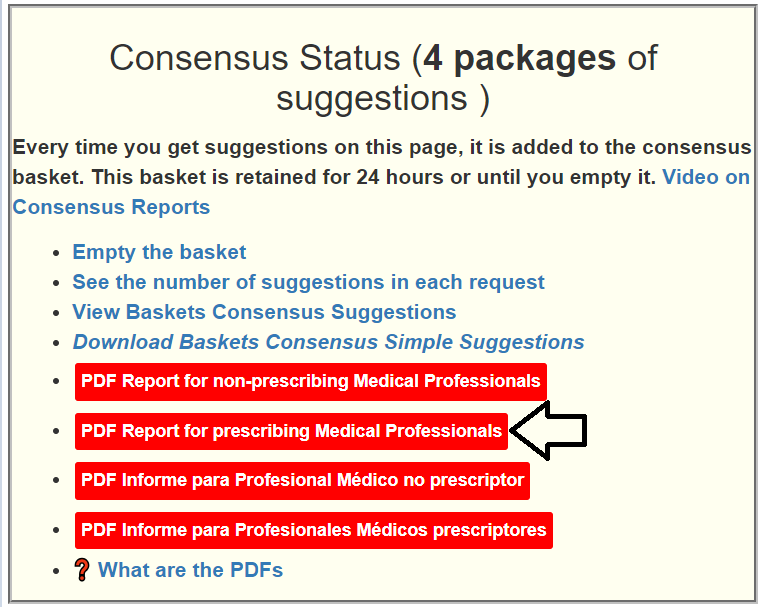
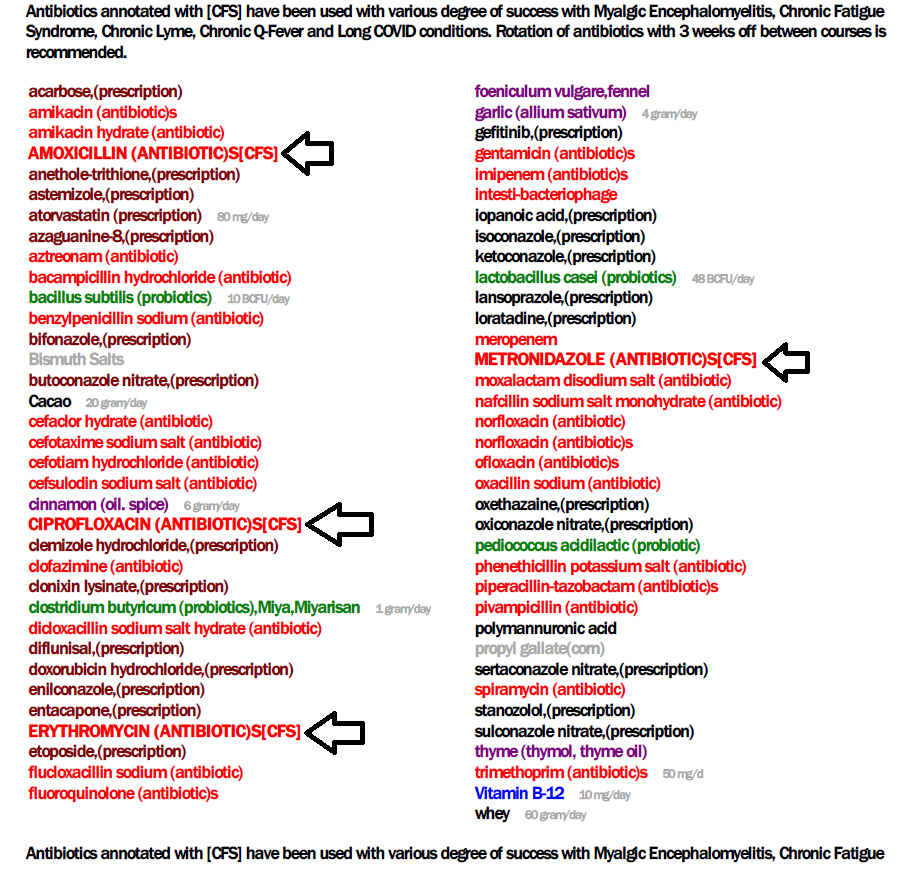
Clicking the prescribing Medical Professional one will generate a report containing antibiotics often. Below is the latest for the person you referred to. There are 4 listed. Those are the ones that likely have the best odd — favored to correct the microbiome and also favored by Dr. Jadin (see Dr. Jadin’s Current Protocol for ME/CFS)
Beware of Social Influencers!
People saying “it worked for me” or “This is what ME/CFS is and thus this is how you should treat it” are the biggest threats to successful treatment. The microbiome influences almost every medical condition and appears to be very connected to symptoms and speed of progression. It may not be the cause — it is likely a “chicken and the egg” question (which came first); or in more computer terms, it’s a feedback loop that needs to be broken. The microbiome is a far easier target than whatever is “behind door #2”.
 CFS Remission