

Recently on my Microbiome Sites I added a table of metabolites whose presence or absence is associated with various symptoms. Technical details is give in this post: Metabolites and Symptoms. The volume of data is overwhelming.
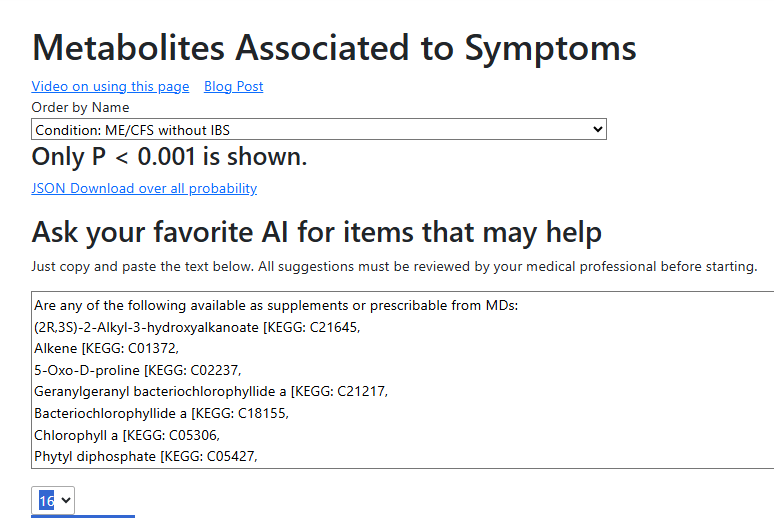
Today I realized that a good solution for the brain fogged, is to have the page frame a question that people can paste into their favorite AI. The question takes those that are lacking results in increased odds of having ME/CFS (or other symptoms).
These metabolites have been identified statistically: their levels, estimated from the microbiome, are abnormally low with P < 0.001 for people reporting this symptom pattern (for example, ME/CFS without IBS). They are hypothesis-generating signals only and have not been validated in clinical trials. In my opinion, they highlight candidates that could be explored in formal clinical research or cautiously by an experienced physician with individual patients. None of these AI-assisted suggestions should be used without review and approval by an appropriate medical professional.
Today I realized that a good solution for the brain fogged, is to have the page frame a question that people can paste into their favorite AI. The question takes those that are lacking results in increased odds of having ME/CFS (or other symptoms).
Go to this ME/CFS without IBS link as an example or to look at other symptoms.
Perplexity Response
None of the listed KEGG compounds appear to be commonly prescribable by MDs as pharmaceuticals. A few are available or derivable as dietary supplements, primarily those related to natural pigments and vitamins found in plants or bacteria.Available Supplements
Chlorophyll a (KEGG: C05306) is widely sold as a supplement in forms like chlorophyllin for odor control, detoxification, and general health support, often derived from alfalfa or algae.
Ectoine (KEGG: C06231) is offered in over-the-counter supplements, eye drops, and skincare for dry eye relief, skin protection, and anti-inflammatory effects.
Vitamin E Forms
Alpha-tocopherol (KEGG: C02477), beta-tocopherol (KEGG: C14152), alpha-tocotrienol (KEGG: C14153), and beta-tocotrienol (KEGG: C14154) are standard vitamin E components available in tocopherol/tocotrienol supplements for antioxidant and cardiovascular support.
Unavailable Compounds
All others, including bacteriochlorophylls (e.g., C11242, C18155, C21217), complex lipids, CoA derivatives, and specialized bacterial metabolites like archaeal lipids or mycothiol conjugates, show no evidence of commercial supplements or prescriptions; they remain research or biochemical intermediates.
Claude AI Response
Based on my research, I can provide you with information about which compounds from your list are available as supplements or prescribable by physicians. Here’s a summary:
Compounds Available as Supplements:
Chlorophyll a – Available as dietary supplements, typically sold as “chlorophyllin” (a water-soluble derivative with copper instead of magnesium). Available in liquid drops, capsules, and tablets at most health food stores and drug stores WebMDWebMD.
Arachidonate (Arachidonic acid) – Marketed as a dietary supplement, particularly for bodybuilding and muscle growth Wikipedia. Available over-the-counter in capsule form.
Raffinose – Not typically taken as a standalone supplement, though it occurs naturally in foods and may have prebiotic properties Nutrients ReviewWikipedia. Used primarily in research and cryopreservation applications.
Alpha-Tocopherol (Vitamin E) – Widely available as a dietary supplement in capsule, gel capsule, and liquid forms, and can also be prescribed by doctors for certain conditions MedlinePlusWikipedia. In 2023, it was the 290th most commonly prescribed medication in the United States Wikipedia.
Beta-Tocopherol, Alpha-Tocotrienol, Beta-Tocotrienol – Available in mixed vitamin E supplements containing various tocopherols and tocotrienols.
Compounds with Medical/Prescribable Uses:
Bilirubin – Not available as a supplement. Medications like phenobarbital can be prescribed to reduce bilirubin levels in conditions like Crigler-Najjar syndrome and Gilbert’s syndrome Medscape, but bilirubin itself is not supplemented.
D-Xylose – Used primarily as a diagnostic tool in medical testing for malabsorption.
Important Notes:
The vast majority of the compounds on your list are:
- Biochemical intermediates in metabolic pathways
- Research chemicals
- Bacterial/plant-specific compounds
- Not available as supplements or prescription medications
Only a very small number (primarily the vitamin E forms, chlorophyll, and arachidonic acid) are commercially available as dietary supplements. I’m not a medical professional, so if you’re considering any of these supplements for health purposes, please consult with a healthcare provider.
This is intended for MD and Researchers
None of the listed KEGG compounds have robust clinical trial validation for therapeutic use. They represent microbiome-derived metabolites with statistically low levels (P < 0.001), suggesting potential biological roles worth exploring in formal trials or under MD supervision.
Key Caveat
Always consult a medical professional before trying any supplement or intervention based on these findings. AI suggestions are not medical advice.
 CFS Remission