Ascribing a condition to one (or even a few) bacteria may be very wrong

An illness to a single bacteria is a standard medical practice. Helicobacter pylori for ulcer, or one of several E. Coli (E. coli O157:H7 and other STECs like E. coli O145 and E. coli O121:H19) for food poisoning.

If we expand our eyes and ask “What if the condition is caused by over or under production of some metabolite?”

For CFS over production of d-lactic acid has been proposed, see this post

Let us assume that this is part of it. So which bacteria produces it?

Our old friend DataPunk lists:

PRODUCED AS ENDPRODUCT BY: 

  1. Aerococcus
  2. Allobaculum
  3. Anaerostipes
  4. Atopobium
  5. Bacillus coagulans
  6. Bifidobacterium
  7. Cardiobacteriales
  8. Cardiobacterium
  9. Carnobacterium
  10. Catenibacterium
  11. Enterococcus
  12. Faecalibaculum
  13. Faecalibaculum rodentium
  14. Gemella
  15. Haemophilus
  16. Holdemania
  17. Lachnobacterium
  18. Lactobacillales
  19. Lactobacillus
  20. Lactobacillus acidophilus
  21. Lactobacillus casei
  22. Lactobacillus delbrueckii
  23. Lactobacillus helveticus
  24. Lactobacillus rhamnosus
  25. Lactococcus
  26. Leptotrichia
  27. Leuconostoc
  28. Microbacterium
  29. Moryella
  30. Oenococcus
  31. Pediococcus
  32. Rothia
  33. Ruminococcus faecis
  34. Scardovia
  35. Serratia marcescens
  36. Streptococcus
  37. Tetragenococcus
  38. Vagococcus

Let us suppose that we also have low or no butyrate – again datapunk lists:

PRODUCED AS ENDPRODUCT BY:


  1. Agathobacter rectalis
  2. Allobaculum
  3. Anaerostipes
  4. Anaerostipes hadrus
  5. Anaerotruncus
  6. Butyricicoccus
  7. Butyricicoccus pullicaecorum
  8. Butyricicoccus sp. ORNL_6EZ5-Gt_4_Pl1-35
  9. Butyricicoccus sp. ORNL_6EZ5-Gt_6_Pl2-147
  10. Butyricicoccus sp. ORNL_V42_E05
  11. Butyricicoccus sp. ORNL_W42_C10
  12. Butyricimonas
  13. Catenibacterium
  14. Christensenella
  15. Cloacibacillus
  16. Cloacibacillus porcorum
  17. Clostridia
  18. Clostridiales
  19. Clostridium
  20. Clostridium butyricum
  21. Coprococcus
  22. Defluviitalea
  23. Eubacteriaceae
  24. Eubacterium limosum
  25. Eubacterium oxidoreducens
  26. Faecalibacterium
  27. Faecalibacterium prausnitzii
  28. Flavonifractor
  29. Flavonifractor plautii
  30. Fusibacter
  31. Fusobacterium
  32. Lachnobacterium
  33. Lachnospiraceae
  34. Moryella
  35. Moryella indoligenes
  36. Oscillospira
  37. Peptoniphilus
  38. Roseburia
  39. Roseburia faecis
  40. Roseburia hominis
  41. Roseburia intestinalis
  42. Roseburia inulinivorans
  43. Ruminococcus torques
  44. Subdoligranulum

So how many possible “too much and not enough” pairs are there if we just pick just one from each list…  38 x 44 = 1,672!!! 

My current gut feeling is that taking the % of each taxonomy in each group –> producing a fuzzy measure of a 0.23% Lactic acid and 0.01% butyrate, may reveal clearer patterns for symptoms than the individual bacteria taxonomy. This is a fuzzy measure because the production of lactic acid and butyrate vary greatly from genus to genus.

Other options for stepping away from pine needles of individual bacteria to looking at tree as a whole include KEGG pathways,

KEGG pathways produce some tentative correlation for D-Arginine and D-ornithine metabolism in CFS/IBS in my earlier post.

Bottom Line

The same change of metabolites in the body can happen in many many different ways. Looking at the metabolites (even with fuzzy ‘punted’ data base on what is available) may produce better predictive results than just looking at individual bacteria.

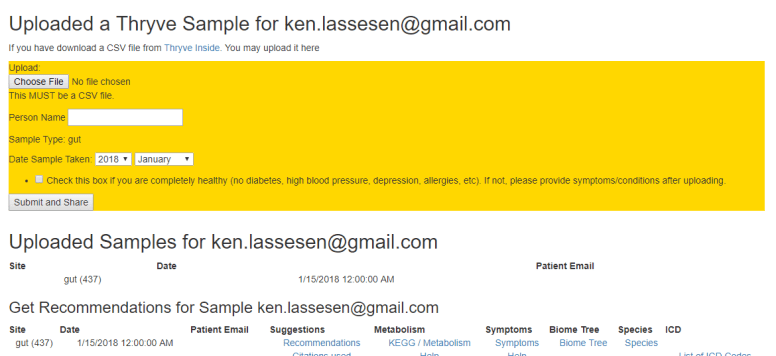
Unloading Thryve Profiles

v1

The page will update as shown below

v2

In a few minutes an email should be delivered

v3

Click on the link, and this will appear

v4

Enter password (please try to make them strong …) You will next be sent to the login screen

v5

You will land on a page like below (unless you also have ubiome samples already uploaded under your email – in which case they will be listed)

Please check your upload file, the first line should be:

“taxon_id”,”rank”,”name”,”parent”,”count”

If it is not, please email it to me at ken /at/ lassesen /dot/ com so I may adjust the code.

v6

Select your file, the name of who it is (in case you are handling several people) and when the sample was taken.

v8

Bottom Line

This is still in Alpha–  there were a lot of side-effects and refactoring required to support these imports — but changes would make it easier to support other uploads.

Email me if you encounter any bugs  Ken /at/ lassesen /dot/ com


From new scientist today

This describes how ubiome and other gut bacteria work… And more important, what they totally miss.

To identify microbial species, researchers usually look for a particular gene that acts as a genetic barcode for bacteria and archaea. Different species have subtly different DNA sequences in this gene, so reading the sequence can tell you what microbes are present in a sample.

Moissl-Eichinger and her colleagues have shown that the standard sequencing method often detects no archaeal species, or just one, in samples taken from people’s bodies. But when her team used a version of the sequencing method optimised to detect archaea in the same samples, it revealed that there were in fact dozens of these species present.

Each part of the body seems to be home to characteristic species of archaea, as with bacteria.

What’s more, in the nose and appendix, individual archaea cells outnumbered those of bacteria. “We did not expect that,” says Moissl-Eichinger. Because we have only just discovered them, we don’t know what most of the archaea in our bodies do.”

From A huge number of mystery microbes are living on your skin https://www.newscientist.com/article/2172076-a-huge-number-of-mystery-microbes-are-living-on-your-skin/

Hay fever and thick blood — the connection

A reader wrote about this year being very bad for allergies/hay fever for her. DAO, REAL sudafed, etc only made a small dent in it. She tried niacin (the flushing type) and fibrinolytics (bromelain, serrapetase, lumbrokinease, nattokinease) which made a much bigger improvement …. what gives?

For back references:

Allergy and Coagulation

Different Allergy Mechanisms

  • “The immune-mediated adverse reaction to food is defined as food allergy (FA) which is roughly divided into IgE mediated or non-IgE mediated FA (NFA)… there is far less of an understanding of NFA than IgE-mediated FA and its clinical relevance is likely under-estimated in most cases…The lack of easily accessible diagnostic measures also contributes to the problem.  ” [2008]
    • This also applies to Hay Fever and other allergies
  • “Although pathogenesis of NFA is still not well understood, recent studies indicate widely variable clinical manifestations of NFA…This review discusses recent progress in our understanding of the regulatory mechanisms of gut immune homeostasis and recently revealed widely variable clinical presentations of NFA with respect to it pathogenesis.” [2012]
  • Inhibition of IgE- and non-IgE-mediated histamine release from human basophil leukocytes in vitro by a histamine H1-antagonist, desethoxycarbonyl-loratadine. 1994
  • “Nonallergic rhinitis represents a non-IgE-mediated group of disorders that share the symptoms of nasal congestion, rhinorrhea, sneezing, and/or postnasal discharge but not pruritus that characterizes allergic rhinitis…. skin testing for aeroallergens is negative.” [2012]

Of special interest (especially for MCS folks)
“The classic symptoms of idiopathic nonallergic rhinitis are nasal congestion, postnasal drip, and sneezing triggered by irritant odors, perfumes, wine, and weather changes.” [2012]

“: Idiopathic nonallergic rhinitis (iNAR) has been difficult to define because of the long differential diagnosis of rhinopathy in the absence of allergic rhinitis. iNAR has traditionally been a diagnosis of exclusion with no clear unifying pathophysiology. Increased sensitivity to triggers such has climate changes, cold air, tobacco smoke, strong odors, and perfumes have been thought to be characteristic, but recent studies do not support this hypersensitivity hypothesis. New investigations of the local nasal environment and systemic “functional” syndromes have offered new insights into this condition. iNAR may be a heterogenous disorder that includes (1) anatomic abnormalities requiring nasal endoscopy for diagnosis, (2) incipient, local atopy (entopy), (3) dysfunction of nociceptive nerve sensor and ion channel proteins, and (4) autonomic dysfunction as found in chronic fatigue syndrome and other functional disorders.” [2009]

Bottom Line

If you are having bad hay fever and the “standard popular knowledge” is not doing it for you, you may wish to discuss coagulation as being part of it with your medical professional.


DNA and Microbiome interplay….

A reader forwarded their report from NutraHacker (https://www.nutrahacker.com/). They offer free reports and more advanced paid reports.  Their reports also contain Encourage and Avoid items.

What is interesting is when you combine recommendations from http://microbiomeprescription.com/ with their recommendations. In some cases they corresponds and in other cases disagree. DNA says one thing, existing microbiome says another thing.

Simple Example for Vitamin E

VitaminE

So this person with AG should NOT be supplementing with Vitamin E because it will increase inflammation. What about the case of a high Vitamin E take by diet?

Looking at a list of foods that are HIGH in vitamin E, we see:

  • Almonds
  • Hazelnuts
  • Sunflower Seeds
  • Avocado
  • Mango
  • Abalone
  • Salmon
  • Wheat Germ Oil

Looking at this person’s suggestions from the Microbiome, we see Almonds listed.

Almonds

This suggests that almonds should be excluded (mainly because there are lots of other suggestions) because of DNA and not microbiome.

Bottom Line

DNA and microbiome interacts.