Blaisi Salts, Electrolyte Salts and unhealthy “Healthy Recommendations”

Alfred Blasi Protocol

A few years ago, this protocol was very popular and then faded from sight. This approach used Recuperat-ion, mineral salts containing the minerals that were found to be low in CFS and Fibromyalgia. It had some success in improving symptoms (as would be expected because of the high magnesium content).  The composition of these salts is:

Contents of Recuperat-ion Electrolyte Salt

Ion per 100g per sachet
Calcium 428 mg 15 mg
Magnesium 428 mg 15 mg
Potassium 5.7 g 200 mg
Sodium 21 g 740 mg

All electrolyte salts are not the same. For example, ElectroMix (produced by Alacer Corp) was used by many who could not afford Recuperation. Its contents are shown below.

Contents of ElectroMix Electrolyte Salt

Ion per sachet
Calcium 100 mg
Chromium 20 mcg
Magnesium 120 mg
Manganese 2 mg
Potassium 408 mg

One significant difference is the amount of Sodium which is the main ingredient of one and missing from the other. This difference impacts blood pH and orthostatic intolerance.

A third commercial electrolyte salt, SaltStick details is shown below.

Contents of SaltStick Electrolyte Salt

Ion per capsule
Calcium 22 mg
Chromium 20 mcg
Magnesium 11 mg
Potassium 63 mg
Sodium 215 mg

Another related approach was “Salt and Vitamin C”. Which also cause improvement for some,

The interesting thing is that studies have found that CFS tend to eat “healthy low-salt diets”, despite studies finding that increased salt improves some CFS symptoms (unless other conditions are an issue).

IMHO: two normally healthy recommendations:

  • Low Salt Diets
  • Taking Lacterbacillus Adolphius probiotics

Are NOT healthy recommendations for CFS patients…
 

Blaisi Salts, Electrolyte Salts and unhealthy "Healthy Recommendations"

Alfred Blasi Protocol

A few years ago, this protocol was very popular and then faded from sight. This approach used Recuperat-ion, mineral salts containing the minerals that were found to be low in CFS and Fibromyalgia. It had some success in improving symptoms (as would be expected because of the high magnesium content).  The composition of these salts is:

Contents of Recuperat-ion Electrolyte Salt

Ion per 100g per sachet
Calcium 428 mg 15 mg
Magnesium 428 mg 15 mg
Potassium 5.7 g 200 mg
Sodium 21 g 740 mg

All electrolyte salts are not the same. For example, ElectroMix (produced by Alacer Corp) was used by many who could not afford Recuperation. Its contents are shown below.

Contents of ElectroMix Electrolyte Salt

Ion per sachet
Calcium 100 mg
Chromium 20 mcg
Magnesium 120 mg
Manganese 2 mg
Potassium 408 mg

One significant difference is the amount of Sodium which is the main ingredient of one and missing from the other. This difference impacts blood pH and orthostatic intolerance.

A third commercial electrolyte salt, SaltStick details is shown below.

Contents of SaltStick Electrolyte Salt

Ion per capsule
Calcium 22 mg
Chromium 20 mcg
Magnesium 11 mg
Potassium 63 mg
Sodium 215 mg

Another related approach was “Salt and Vitamin C”. Which also cause improvement for some,

The interesting thing is that studies have found that CFS tend to eat “healthy low-salt diets”, despite studies finding that increased salt improves some CFS symptoms (unless other conditions are an issue).

IMHO: two normally healthy recommendations:

  • Low Salt Diets
  • Taking Lacterbacillus Adolphius probiotics

Are NOT healthy recommendations for CFS patients…
 

A completely different probiotic blend — and I mean different!

A reader of this blog shipped me a link to a very interesting probiotic. Finding ‘unusual’ probiotics is a good quest because at many conferences, CFS MD’s have stated that they have seen no evidence of (typical) probiotics helping the patient. My own impression is that  since most contain L.Acidophilus (which inhibits E.Coli), I am almost surprised that they did not say, “makes CFS a little worst”.

This probiotic is described at this UK site as well as at Amazon.com (but not Amazon.co.uk). It contains none of the usual bacterias!

  • Anthrobacter agilis,
  • Anthrobacter citreus,
  • Anthrobacter globiformis,
  • Anthrobacter luteus,
  • Anthrobacter simplex,
  • Acinetobacter calcoaceticus,
  • Azotobacter chroococcum,
  • Azotobacter paspali,
  • Azospirillum brasiliense,
  • Azospirillum lipoferum,
  • Bacillus brevis,
  • Bacillus marcerans,
  • Bacillus pumilis,
  • Bacillus polymyxa,
  • Bacillus subtilis,
  • Bacteroides lipolyticum,
  • Bacteriodes succinogenes,
  • Brevibacterium lipolyticum,
  • Brevibacterium stationis,
  • Kurtha zopfil,
  • Myrothecium verrucaria,
  • Pseudomonas calcis,
  • Pseudomonas dentrificans,
  • Pseudomonas flourescens,
  • Pseudomonas glathei,
  • Phanerochaete chrysosporium,
  • Streptomyces fradiae,
  • Streptomyces celluslosae,
  • Streptomyces griseoflavus

In terms of PubMed Studies, there are two, both done by Battelle Seattle Research Center, Washington, USA.

Both studies dealt with Irritable Bowel Syndrome which is often co-morbid with CFS. From these studies:

  •  At >or=52-week follow-up, the rate of remissions was 81.5% to 100% (P < 0.003).
  • This study identified 3 subsyndromic factors of IBS: general ill feelings/nausea, indigestion/flatulence, and colitis. In this methodologically oriented double-blind study in patients with IBS, combined probiotic-prebiotic treatment with Prescript-Assist was associated with significant reductions in these factors.

There have been no studies with CFS or FM. Studies with Lactic acid bacteria and IBS found “The probiotic combination was not significantly superior to the placebo in relieving symptoms of IBS.”.

Bottom line: A definite thumbs up on trying this for at least 4 weeks.

Time to commit to Haritaki?

Terminalia chebula:  Haritaki

Several studies have found this is effective against many of the over-growths of bacteria families seen in CFS, unfortunately it also impacts E.Coli which CFSers are low in. This herb was found to be as potent as ciprofloxacin, gentamycin, kanamycin, ofloxacin and cephalexin. This superior performance was reported in another study of 66 herbs.  It has no adverse effects on the growth of the lactic acid-producing bacteria.

Personally, I found that it caused a significant cognitive improvement within days. I was doing a capsule of Mutaflor daily after doing the haritaki.

According to Wikipedia[Wikipedia]:

Haritaki is a rejuvenative, laxative (unripe), astringent (ripe), anthelmintic, nervine, expectorant, tonic, carminative, and appetite stimulant. It is used in people who have leprosy (including skin disorders), anemia, narcosis, piles, chronic, intermittent fever,heart disease, diarrhea, anorexia, cough and excessive secretion of mucus, and a range of other complaints and symptoms. According to the Bhavaprakasha, Haritaki was derived from a drop of nectar from Indra’s cup. Haritaki is used to mitigate Vata and eliminate ama (toxins), indicated by constipation, a thick greyish tongue coating, abdominal pain and distension, foul feces and breath, flatulence, weakness, and a slow pulse. The fresh fruit is dipana and the powdered dried fruit made into a paste and taken with jaggery is malashodhana, removing impurities and wastes from the body. Haritaki is an effective purgative when taken as a powder, but when the whole dried fruit is boiled the resulting decoction is grahi, useful in the treatment of diarrhea and dysentery. The fresh or reconstituted fruit taken before meals stimulates digestion, whereas if taken with meals it increases intelligence, nourishes the senses and purifies the digestive and genitourinary tract. Taken after meals Haritaki treats diseases caused by the aggravation of Vayu, Pitta and Kapha as a result of unwholesome food and drinks. Haritaki is a rasayana to Vata, increasing awareness, and has a nourishing, restorative effect on the central nervous system. Haritaki improves digestion, promotes the absorption of nutrients, and regulates colon function.

Drug interactions are known[Online Herbal].

Testing for Microflora/Gut Bacteria Dysfunction

I have been back-channeled by several people on what tests to do. There are several approaches possible:

  • Assume that you have similar to the reported gut-flora dysfunction presented at the 1998 Clinical and Scientific Meeting in Australia by Butt HL [1,2], Dunstan RH , McGregor NR , Roberts TK, Harrison TL and Grainger JR from Department of Biological Sciences, University of Newcastle, Newcastle Australia (partially confirmed by Richard Schloeffel, MD at the 2001 Clinical and Scientific Meeting)
  • Test using one of the commercial gut bacteria packages
  • Find a state of the art university department willing to test…

For myself, I assumed that I matched the pattern seen in the population of 27 CFS patients that was reported on.

Normal Gut Bacteria Populations

You should know that every person’s gut bacteria is different. Fecal transplants work much better from blood relatives than spouses or strangers. It appears that gut bacteria is inherited (possible influenced by DNA).

microfloRA FAMILY
Quantity Range
Bacteroides 1010 – 1012
Bifidobacterium 108 – 1011
Clostridium 106 – 1011
Eubacteria 109 – 1012
Lactobacillus 106 – 1010
Peptostreptococcus 1010 – 1012
Enterobacter (Escherichia Coli and other) 104 – 1010
Staphylococcus 104 – 109

Commercial Tests

I will be reviewing these two tests today (please tell me of any additional tests that you are aware of). Note that most of these tests are marked with “assays are For Research Use Only“.

So how do you evaluate these? My take is:

  • Do they cover the families reported from Australia (if they cover other stuff, that is fine)?
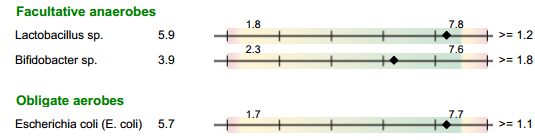
  • Do they provide information on overgrowth or undergrowth (Especially for E.Coli)? Is the information more than “No issue” or “Issue”?


Australian Results Metametrix Great Smokies Diagnos-Techs
Over/Undergrowth Reported? yes  No  No
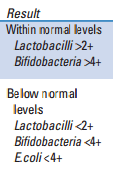
Low Bifidobacterium species yes  Yes  ?
Low Lactobacillus species yes  Yes  ?
Low Bacteroides species yes  No  ?
High Streptococcus  ?  Yes  ?
Low Escherichia coli yes  Yes  Yes
High Klebsiella/Enterobacter no  Yes(*)  ?
High Enterobacter species no  Yes(*)  ?

* – indicate appearance of single species of the family test

My general opinion is that Myhill’s choice is the best for CFS. I will do a future post on the ideal test (IMHO).