Microbiome Prescription Worked for ME/CFS But Events Went South

I got an interesting request

I wonder if you would be willing to write a blog post looking at my recent test results in comparison to last year? Confirmed diagnosis of ME/CFS. UK NHS only helps with pacing advice.

  • First BiomeSight test: 2025-04-17

Following this, 3 self-directed cycles of antibiotics, probiotics, prebiotics, and diet changes based on MicrobiomePrescription results. First 2 cycles increased my baseline and reduced symptoms dramatically, third cycle set me back slightly. Overall very positive.

Unfortunately then was hospitalised later in 2025 with a perforated and infected gallbladder, sepsis. They rotated through quite a few different harsh antibiotics trying to find one which worked. Then in December 2025 went in for surgery to remove the gallbladder, more antibiotics.

  • Second BiomeSight test: 2026-03-16

My baseline now is worse again, many symptoms returned. I am loathe to use more antibiotics while some of my bacteria are so low (Akkermansia at 0.006) even though my positive scores are dominated by antibiotic suggestions. Would like to focus on probiotics, prebiotics, herbs, supplements, diet changes for now.

Any insight would be most appreciated.

Confirming the Worst

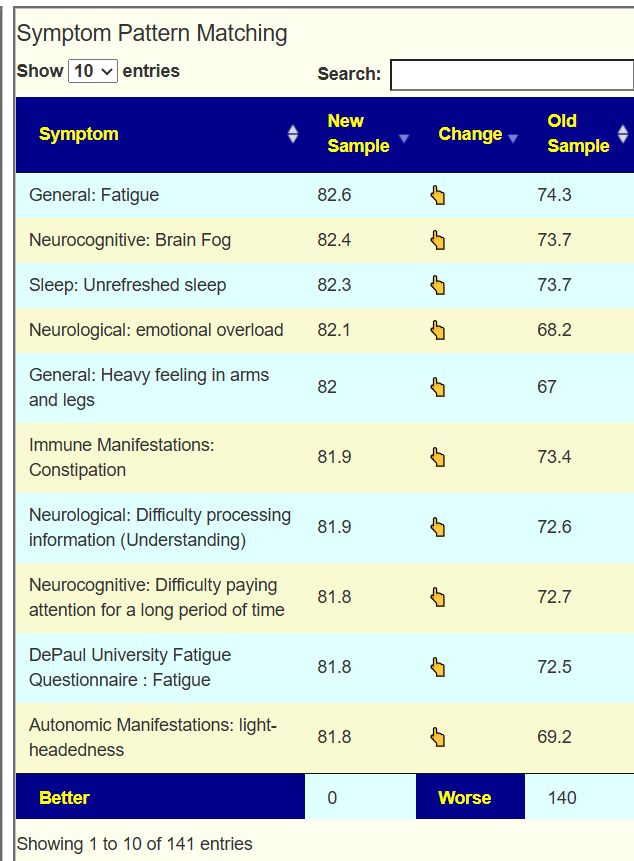
Going over to the symptom compare tool, we see that you are now worse than a year ago. 140 of 141 symptom forecasts are significantly worse! Seeing number this much worse is unusual but consistent with his events and perception.
Going Forward

My last two post has been evaluating the alternative path — instead of attacking the bacteria causing symptoms, push the person to a statistically significant healthy microbiome. The following links may be worth a reading:

This approach matches “I am loathe to use more antibiotics” because antibiotics typically are on the avoid lists with the healthy approach and high on the to take list attacking symptoms. It is sitting on the Simple UI page.

Basic Results:

  • 52 bacteria were identified — every single one was too high.
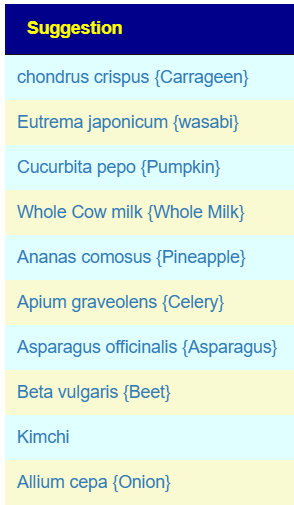
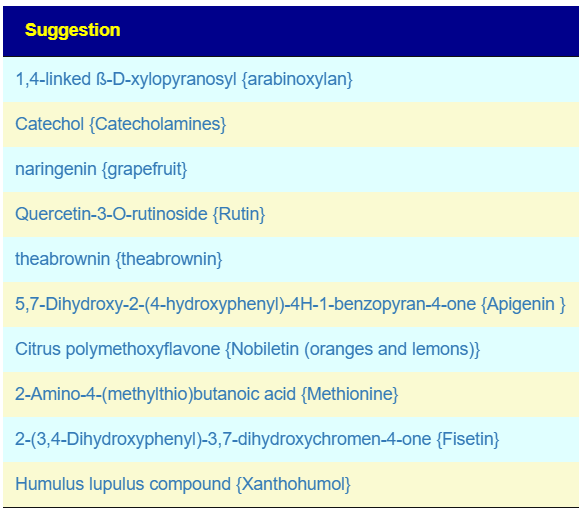
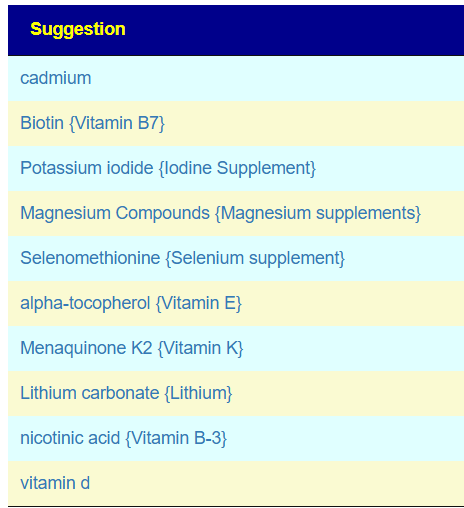
  • I have broken suggestions into classes below. In general, I have kept them to items with an impact of at least 1.
    • Items listed are order by largest impact first.

Herbs

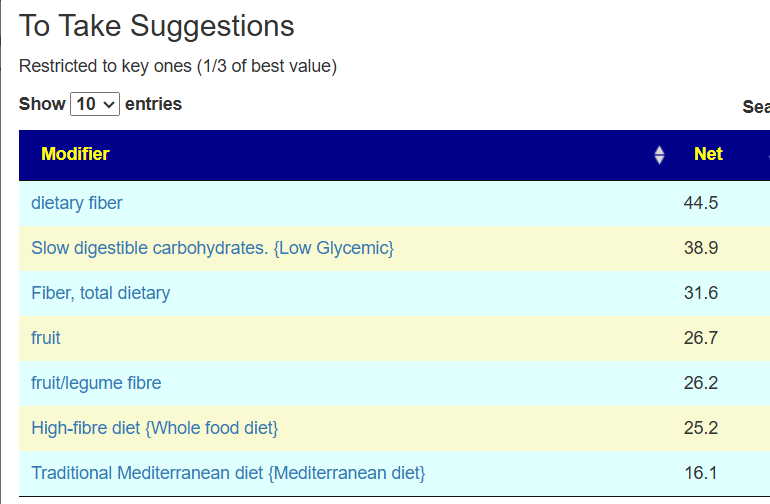
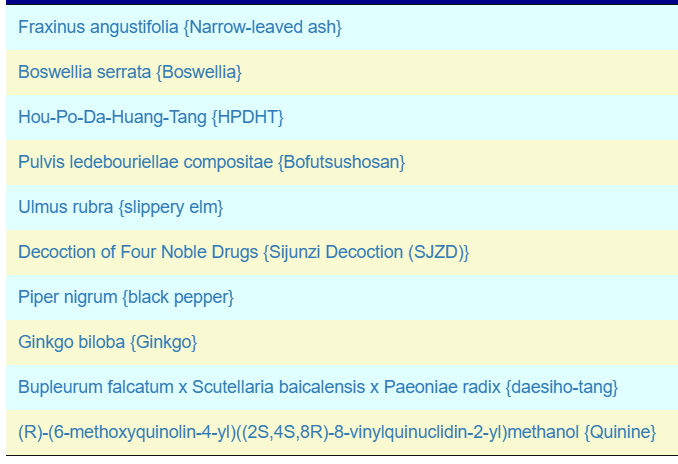
The top herbs are below. I was delighted {Bofutsushosan} was listed because it is well known increases Akkermansia which he is concerned about.
Food
Flavonoids
Vitamins
Common and OTC Supplements
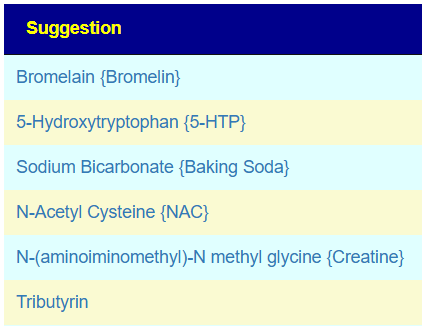
Probiotics x PubMed

This list is done using PubMed studies.
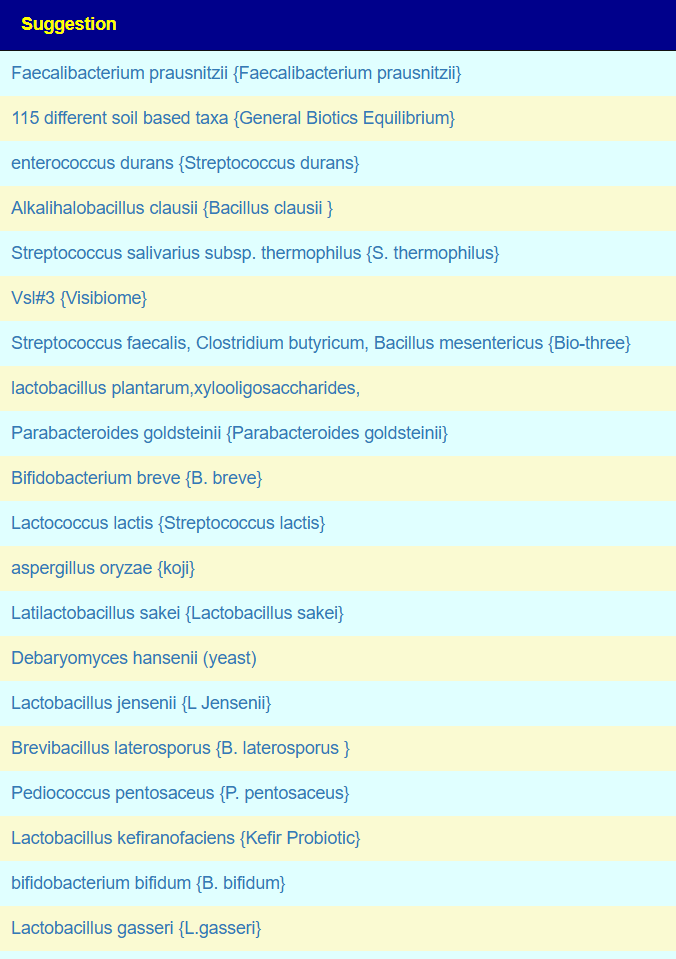
Probiotics x R2 Model

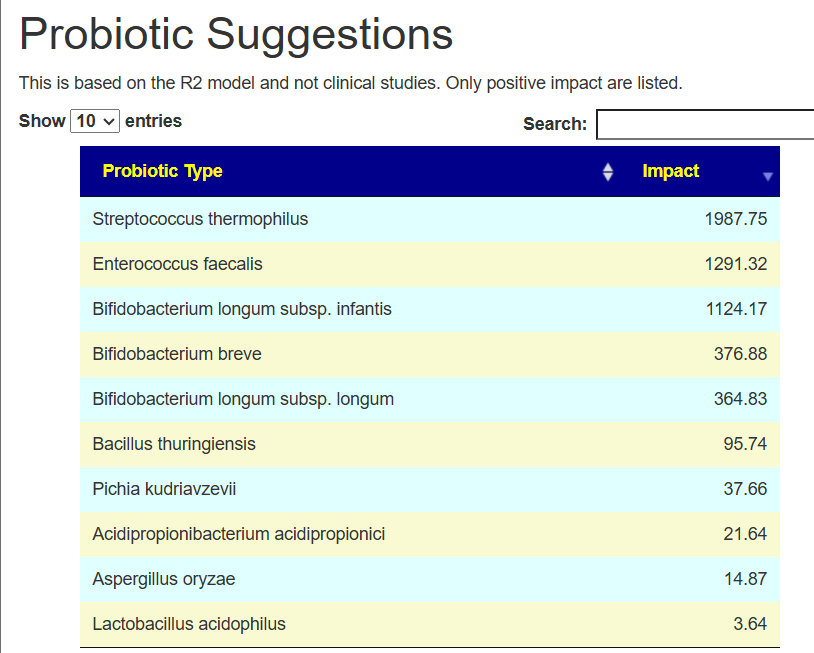
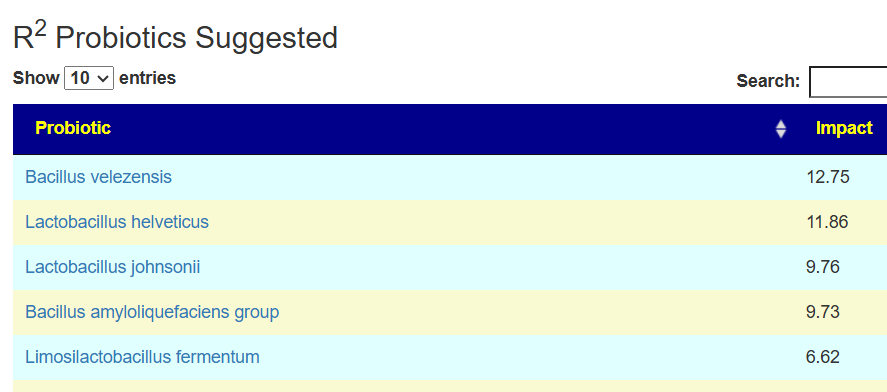
I prefer the R2 Model because we have a lot more data to use than with PubMed. On the flip side, this does not have clinical studies supporting the choices.
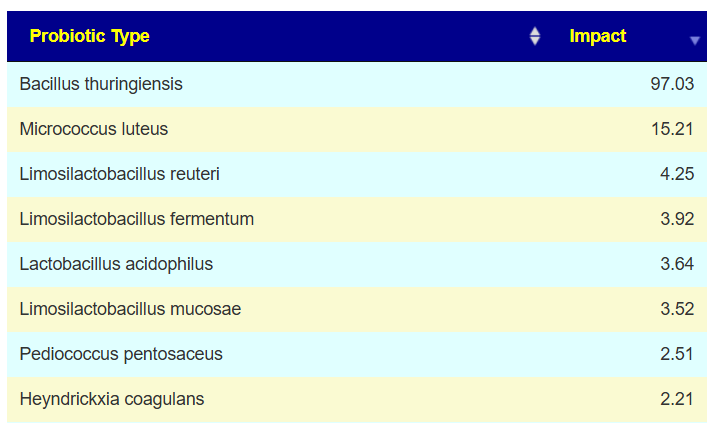
The top probiotic Bacillus thuringiensis suitable for human consumption may be a challenge. Most retail products are formulated to control caterpillars, worms, or mosquito larvae in gardens and standing water, not for ingestion or probiotic use.

Non-Human Retail options

  • Home Depot sells Monterey B.T. Bacillus Thuringiensis Pint Concentrate as an online retail product.
  • Wilco Farm Stores / Farm Store lists Bonide Bt Bacillus Thuringiensis as a garden pest-control product.
  • DoMyOwn sells a dedicated Bt category and says it’s available through their store rather than big-box shelves.
  • FBN lists Bt ingredient-based products, including Bacillus thuringiensis subspecies tenebrionis.
  • DIY Pest Control lists Bt products and notes common trade names like Thuricide and Mosquito Dunks.

Summary

I look forward to see how well this alternative approach performs. It does not focus on the bacteria associated with his 141 symptoms — instead, we focus on shifting to a healthy microbiome profile (with very high statistical significance, p < 0.0001,) I would suggest retesting every 3-4 months to track progress.

Questions And Answers

Q: It’s interesting to see how some Odds Ratio based suggestions match with the Consensus Suggestions, and some vary wildly.

  • A: Suggestions are based on bacteria target and available literature. Literature is sparse and often without replication of results
    • The safest path would be to start with items that are in agreement.

Q: I had one question with regard to whole milk, dairy, and lactose. The Odds Ratio analysis suggested these were positives – this makes my life a lot easier as I was using milk to help ferment and increase the CFU of the probiotics I used last year and hoped to again, and I eat a fair amount of dairy in general (I mostly eat a vegetarian diet with occasional fish, and dairy helps with my protein intake).

However when I ran the Consensus Suggestions earlier this week I got scores of -294.9 for bovine milk products, -120 for whole cow milk, and -158.6 for lactose.

  • A: I favor the Odds Ratio. On this point as you have no issues with dairy, keep to your current usage.

Q: Does this mean I likely need to make a choice between the Consensus Suggestions route (which I followed last year) and the new Odds Ratio route?

  • A: No, you could start doing a consensus of the consensus and odds ratio. Then add in items that disagree. I would suggest using an ratio evaluation:
    • Consensus: -120 with min of -960, so -(120/960) = -12.5%
    • Odds Ratio: 4 with max of 8, so 4/8 =50%
    • Thus odds ratio would win

Postscript – and Reminder

Other posts dealing with ME/CFS or Long COVID.

I am not a licensed medical professional, and the laws where I live prohibit any activity that could be interpreted as practicing medicine or giving personal medical advice. My work is limited to academic and analytical models, and I restrict myself to the language of science and statistics rather than clinical recommendations.

I cannot tell anyone what they should or should not take. Instead, I can present information about items that, based on numerical and statistical analysis, appear to have better odds of improving microbiome-related measures. I am a trained, experienced statistician with appropriate degrees and professional affiliations, and my role is to interpret data—not to treat patients.

All information I provide is for educational and informational purposes only and is not a substitute for professional medical advice, diagnosis, or treatment. Any ideas, rankings, or “suggestions” derived from my analyses must be reviewed and approved by your qualified medical professional before you decide to act on them.

The answers and explanations I provide describe my reasoning and methodology. They are not intended as medical advice for you or for anyone else, and they do not create a doctor–patient or provider–patient relationship. Always consult a knowledgeable licensed healthcare professional before starting, changing, or stopping any treatment, supplement, or health-related regimen.
Another ME/CFS Microbiome Update

This is part of this continuing saga with this person. Prior posts and the labs shown below. Repairing the microbiome is not a single test, take a pill, and you are done. It may be like a long journey by sail through the fjords of Norway: a lot of course corrections!

Person’s Summary

I would say that there is no improvement since the last test. So this is still applicable:

I have not been feeling so well lately (since the last year). I would say that my symptoms has become worse. Earlier it has always felt as I have done some progress but the last 18 months it has been the opposite. Earlier I got rid of my muscle and joint pain but it has come back and I have much bigger issues with my red nose and my body feels very stressed.

Also feel very bloated.

  • A summary of my biggest issues:
  • Get the red nose (some form of rosacea).
  • Feel fatigued (both physically and mentally).
  • Feeling stressed.
  • Brain fog.
  • Bloated.
  • Lots of gas – I fart and burps a lot.
  • Issues with allergies
  • Muscle and joint pain

For the last 4-5 years I’ve been eating large amounts of rye and oats.

  • Around 150-200 gram of rye bread every day.
  • Around 70 gram of oats every day.

Been eating low fat, low protein and high carb (specially from rye, oats, apple juice and potatoes) because this diet seem to reduce my symptoms. As soon as I start to eat high meat and high fat my symptoms get worse.

In this analysis, I am going to look at:

  • Changes since the last sample
  • Review a new approach that is being incorporated
  • Looking at suggestions and the difference between the new approach and the traditional approach

At the end, I suggest following the new approach with the motivation that the traditional approach has appeared to have stalled. The microbiome adapts to antibiotics and diet changes; rotation to alternatives often seems to be needed to keep destabilizing the microbiome dysbiosis.

Changes Between Samples

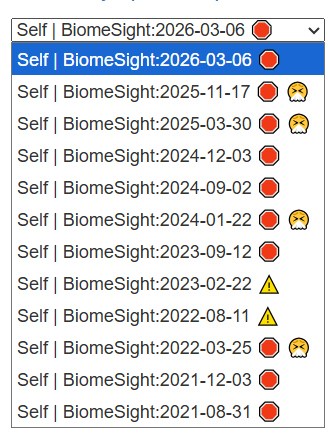
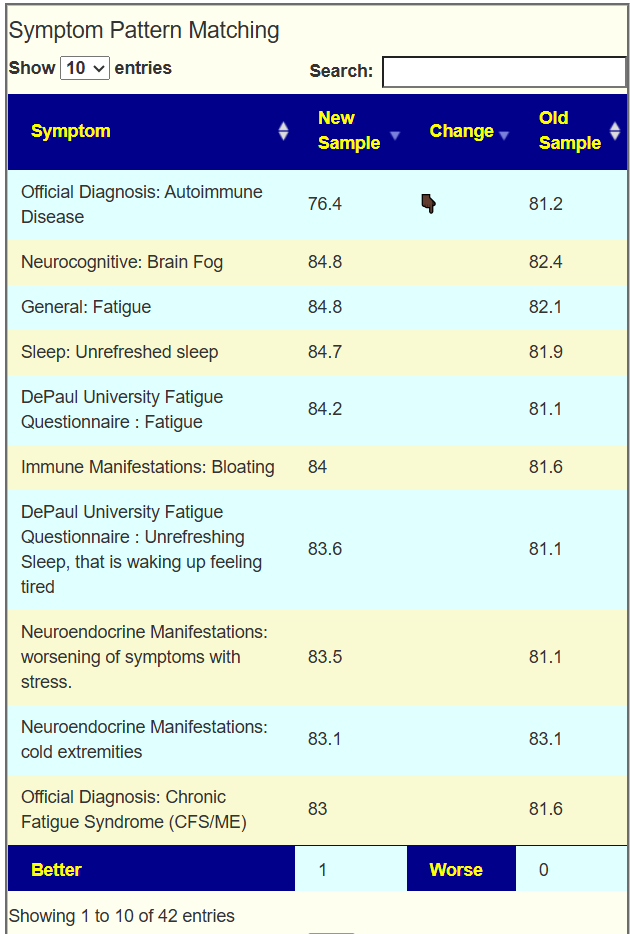
Going to Old UI/Multiple Samples we compare symptom matching values. We see that just 1 of 42 showed improvement.

Looking at the new Odds Ratio data, we see the number of bacteria identified as critical in different samples below / Odds Estimate. I am not clear on the meaning and significance…

  • Odds Estimate: The higher the number, the more likely that the person is healthy
  • Number of Bacteria: Not reliable because different bacteria contribute differently to health.
  • 2026-03-06: 59 / 1632
  • 2025-11-17: 36 / 1588
  • 2025-03-30: 20 / 1671
  • 2024-12-03: 21 / 1561
  • 2024-09-02: 36 / 1611
  • 2024-01-22: 58 / 1586
  • 2023-09-12: 38 / 678
  • 2023-02-22: 52 / 1707
  • 2022-08-11: 30 / 886
  • 2022-03-25: 24 / 1037
  • 2021-12-03: 15 / 1287
  • 2021-08-31: 49 / 757

My general reading is that from 2021-2024 there was improvement and now the person is in a new stable healthier state but with still dysbiosis. I am hoping that the switch to an alternative view of solving his health may result in further improvement. In other words, rotation of approaches.

Another View on the Same Issue

In my recent post, Turning Fixing the Microbiome Upside Down!, I introduced a different way to think about repairing the microbiome. A human–society analogy might make it clearer.

Imagine your city is struggling with homelessness, vagrancy, and petty crime. The usual response—especially in the U.S.—is to send in the police. Round up those panhandling on the streets! In microbiome terms, that’s like identifying “bad bacteria” and launching an attack.

But there’s another approach: offer housing, mental health care, and job training. You don’t punish people—you help them heal and reintegrate.

Traditionally, Microbiome Prescription has focused on detecting problematic bacteria and trying to suppress or adjust them. The challenge is that most people have many interconnected symptoms. Research often shows that substance X improves one symptom but worsens another. You end up chasing symptoms—fixing one only to see another emerge or intensify.

A more holistic alternative, which has only recently become possible, is to guide the person’s microbiome toward a naturally healthy state instead. See this post: Mathematically Derived Healthy Microbiome.

Recently I asked the head of a microbiome testing company, what statistical evidence do you have for what is a healthy or desired microbiome profile. How do you obtain the importance of each bacteria? He knew that using means and standard deviation were invalid because of the high skew with the data. His response was requesting his staff to remedy this situation, looking at odds-ratio as a starting point.


Evaluation

I am a modeler, not a medical professional. Modelers try putting together mathematics using available data and use that to generate predictions. Once the predictions are made, they are evaluated against any available facts.

Above we have some observations from the person, the model does not know this information — so we can evaluate predictions against this data.

Been eating low fat, low protein and high carb (specially from rye, oats, apple juice and potatoes) because this diet seem to reduce my symptoms. As soon as I start to eat high meat and high fat my symptoms get worse.

Comparing Suggestions

HealthSymptomsNovice
Rye-0.11-183.5-352.3
Oats0.15-179.2-742.6
Apple2.34-385.1-351.5
Potato1.32-1102.7-1418.5
High Meat2.2155.9763
Raw Meat-2.78105.521.2
High Fat Diet-.79154.4-246.1
high-saturated fat diet-.3596-291.1
low-fat diet0.86195.9378.4
Range of Values-6.82 to 5.43-2075 to 1359-2296 to 1461
Best to TakeCatechol {Catecholamines}restricted-fiber diet {low fiber diet}restricted-fiber diet {low fiber diet}

Each of the above depends heavily on the bacteria selected and the threshold used. It is interesting to see that the new “Make Healthy” is a clear winner against his observations.

What is particularly interesting with the “Make Healthy” is that values were computed for 1,632 substances. Looking at the list os suggestions, we do not have a mass of antibiotics seen on the other lists. We are not focused on reducing bad bacteria, rather on improving the good bacteria, and letting those address the bad bacteria. The top items are below.

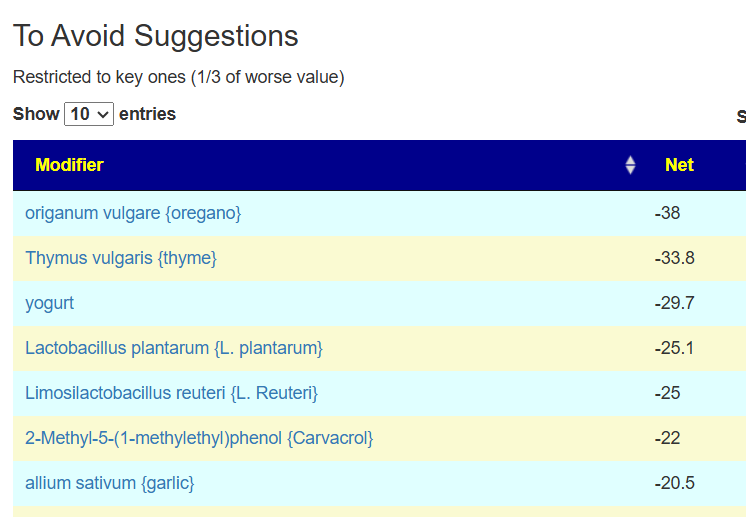
My impression is that this is a much friendlier set of suggestions. In fact, the bottom of the list (to avoid) are pages of antibiotics and prescription drugs.

Probiotics Exploration

There are two ways of getting probiotics:

  • Using published studies on their impact. In general, each study describes one or two bacteria impacted. This results in low data
  • Using the R2 Associations: This is a modelling of their impact with hundreds of bacteria impact estimated.

The new Healthy Algorithm includes R2 recommendations

We got the following suggestions

We will explore how different algorithms evaluate these.

BacteriaHealthy With R2Healthy With StudiesSymptoms With StudiesNovice with Studies
Streptococcus thermophilus1988-1 to 4-132 to -139-132 to -139
Enterococcus faecalis1291.6-579-579
Bifidobacterium infantis1124-27676
Bifidobacterium breve3771213213
Bifidobacterium longum3651-1423-1423
Bacillus thuringiensis96n/an/an/a
Pichia kudriavzevii38n/an/an/a
Acidipropionibacterium acidipropionici22n/an/an/a
Aspergillus oryzae15.1 – 3-192 to 8-192 to 8
Lactobacillus acidophilus40-574-574

Keeping to the “When in disagreement, leave it out” a.k.a. Minimal Risk a.k.a. “Do not harm”, we have

  • Top choice is Bifidobacterium breve
  • Reasonable choice is Bifidobacterium infantis

Alternatively, Streptococcus thermophilus high value, cheap, and easy availability — it is a good candidate to try a 2-4 week experiment.

Personally, I would be tempted to try the following pattern (starting at a low dosage and increasing):

  • 3 weeks of Streptococcus thermophilus (up to 10 BCFU)
  • 2 weeks of Bifidobacterium breve (up to 20 BCFU)
  • 2 weeks of Bifidobacterium infantis (up to 20 BCFU)

Bottom Line

My personal choice would be to go with the “Healthy Algorithm” for the following reasons:

  • The traditional approach has appeared to stall, time for a change
  • It is heavily based on very statistical significance over the entire scope of bacteria involved (i.e. dense data) but it has not been validated by clinical studies.
  • I have always been unhappy about clinical studies because the data is:
    • Messy (typically in the context of one or another medical condition)
    • Small sample sizes
    • Low resolution to bacteria

I am also curious to see how well the “Healthy Algorithm” performs.

Postscript – and Reminder

I am not a licensed medical professional and there are strict laws where I live about “appearing to practice medicine”.  I am safe when it is “academic models” and I keep to the language of science, especially statistics. I am not safe when the explanations have possible overtones of advising a patient instead of presenting data to be evaluated by a medical professional before implementing.

I cannot tell people what they should take or not take. I can inform people items that have better odds of improving their microbiome as a results on numeric calculations. I am a trained experienced statistician with appropriate degrees and professional memberships. All suggestions should be reviewed by your medical professional before starting.

The answers above describe my logic and thinking and is not intended to give advice to this person or any one. Always review with your knowledgeable medical professional.

My academic training is in Operations Research with a large dosage of lateral thinking (Edward de Bono).

My academic training is in Operations Research with a large dosage of lateral thinking (Edward de Bono).

A classic story is below:

One famous story of operations research success during the war involved an analysis of Allied bombers returning from bombing missions over Europe. The military analyzed the location of shrapnel damage and bullet holes in returning bombers, to identify where to place additional armor on aircraft. Operations researchers were brought in at the last minute to do a “confirmatory” analysis, but they recommended that additional armor be placed on bombers everywhere except the places with damage or bullet holes! The operations researchers realized that analyzing damage to returning bombers involved a sampling error. It was the bombers that did not return that needed extra protection—and they needed it in the most vulnerable places (the places not damaged on the returning bombers).

In the past, most medical work has focused on bacterial shifts statistically linked to individual symptoms. Think of the “bullet holes” problem: the literature usually looks at one symptom at a time, while real patients often present with dozens.

Recently, I started using odds ratios instead. Most people know odds ratios from smoking and cancer risk, but they can be applied broadly—for example, the odds of working at Microsoft if you graduated from a particular university.

Using about 5,500 samples and roughly 350 symptoms, I built odds tables and then tested those odds ratios against a reference set of healthy individuals. To my surprise, sample after sample showed the highest odds for being asymptomatic, far more often than I expected.

On reflection, this implies we now have a well-defined, statistically grounded model of a healthy (asymptomatic) microbiome. That was the “lightbulb” moment.

Instead of hunting for individual “holes” and trying to patch them, we should look at all the shifts away from this asymptomatic model. Once those shifts and their contributions (odds ratios) are identified, we can use published research to determine what is most likely to normalize the microbiome. A long list of symptoms (bullet holes) stops being the target; the real target becomes making the microbiome asymptomatic.

Some past links:

A walk through on applying the above methodology pattern.

A New Approach For Treatment of ME/CFS

Recently on my Microbiome Sites I added a table of metabolites whose presence or absence is associated with various symptoms. Technical details is give in this post: Metabolites and Symptoms. The volume of data is overwhelming.

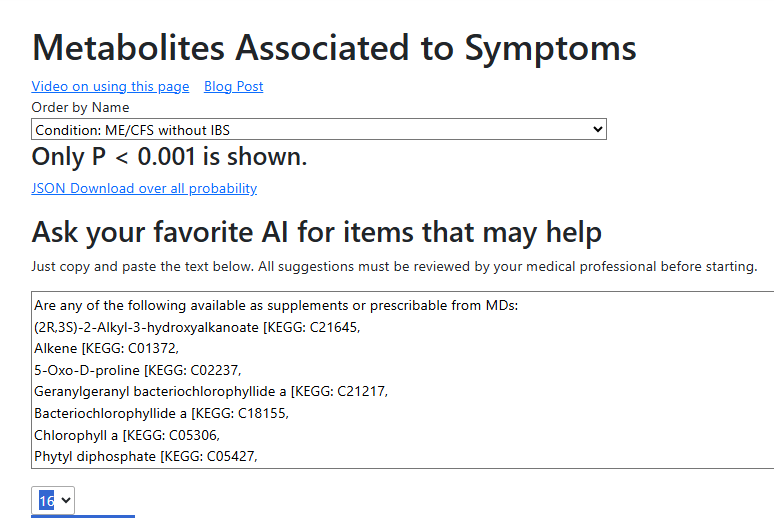
Today I realized that a good solution for the brain fogged, is to have the page frame a question that people can paste into their favorite AI. The question takes those that are lacking results in increased odds of having ME/CFS (or other symptoms).

These metabolites have been identified statistically: their levels, estimated from the microbiome, are abnormally low with P < 0.001 for people reporting this symptom pattern (for example, ME/CFS without IBS). They are hypothesis-generating signals only and have not been validated in clinical trials. In my opinion, they highlight candidates that could be explored in formal clinical research or cautiously by an experienced physician with individual patients. None of these AI-assisted suggestions should be used without review and approval by an appropriate medical professional.

Today I realized that a good solution for the brain fogged, is to have the page frame a question that people can paste into their favorite AI. The question takes those that are lacking results in increased odds of having ME/CFS (or other symptoms).

Go to this ME/CFS without IBS link as an example or to look at other symptoms.

Perplexity Response


None of the listed KEGG compounds appear to be commonly prescribable by MDs as pharmaceuticals. A few are available or derivable as dietary supplements, primarily those related to natural pigments and vitamins found in plants or bacteria.

Available Supplements

Chlorophyll a (KEGG: C05306) is widely sold as a supplement in forms like chlorophyllin for odor control, detoxification, and general health support, often derived from alfalfa or algae.

Ectoine (KEGG: C06231) is offered in over-the-counter supplements, eye drops, and skincare for dry eye relief, skin protection, and anti-inflammatory effects.

Vitamin E Forms

Alpha-tocopherol (KEGG: C02477), beta-tocopherol (KEGG: C14152), alpha-tocotrienol (KEGG: C14153), and beta-tocotrienol (KEGG: C14154) are standard vitamin E components available in tocopherol/tocotrienol supplements for antioxidant and cardiovascular support.

Unavailable Compounds

All others, including bacteriochlorophylls (e.g., C11242, C18155, C21217), complex lipids, CoA derivatives, and specialized bacterial metabolites like archaeal lipids or mycothiol conjugates, show no evidence of commercial supplements or prescriptions; they remain research or biochemical intermediates.

Claude AI Response

Based on my research, I can provide you with information about which compounds from your list are available as supplements or prescribable by physicians. Here’s a summary:

Compounds Available as Supplements:

Chlorophyll a – Available as dietary supplements, typically sold as “chlorophyllin” (a water-soluble derivative with copper instead of magnesium). Available in liquid drops, capsules, and tablets at most health food stores and drug stores WebMDWebMD.

Arachidonate (Arachidonic acid) – Marketed as a dietary supplement, particularly for bodybuilding and muscle growth Wikipedia. Available over-the-counter in capsule form.

Raffinose – Not typically taken as a standalone supplement, though it occurs naturally in foods and may have prebiotic properties Nutrients ReviewWikipedia. Used primarily in research and cryopreservation applications.

Alpha-Tocopherol (Vitamin E) – Widely available as a dietary supplement in capsule, gel capsule, and liquid forms, and can also be prescribed by doctors for certain conditions MedlinePlusWikipedia. In 2023, it was the 290th most commonly prescribed medication in the United States Wikipedia.

Beta-Tocopherol, Alpha-Tocotrienol, Beta-Tocotrienol – Available in mixed vitamin E supplements containing various tocopherols and tocotrienols.

Compounds with Medical/Prescribable Uses:

Bilirubin – Not available as a supplement. Medications like phenobarbital can be prescribed to reduce bilirubin levels in conditions like Crigler-Najjar syndrome and Gilbert’s syndrome Medscape, but bilirubin itself is not supplemented.

D-Xylose – Used primarily as a diagnostic tool in medical testing for malabsorption.

Important Notes:

The vast majority of the compounds on your list are:

  • Biochemical intermediates in metabolic pathways
  • Research chemicals
  • Bacterial/plant-specific compounds
  • Not available as supplements or prescription medications

Only a very small number (primarily the vitamin E forms, chlorophyll, and arachidonic acid) are commercially available as dietary supplements. I’m not a medical professional, so if you’re considering any of these supplements for health purposes, please consult with a healthcare provider.

This is intended for MD and Researchers

None of the listed KEGG compounds have robust clinical trial validation for therapeutic use. They represent microbiome-derived metabolites with statistically low levels (P < 0.001), suggesting potential biological roles worth exploring in formal trials or under MD supervision.

Key Caveat

Always consult a medical professional before trying any supplement or intervention based on these findings. AI suggestions are not medical advice.

What is your next $*^#$^% symptoms and how to head it off!

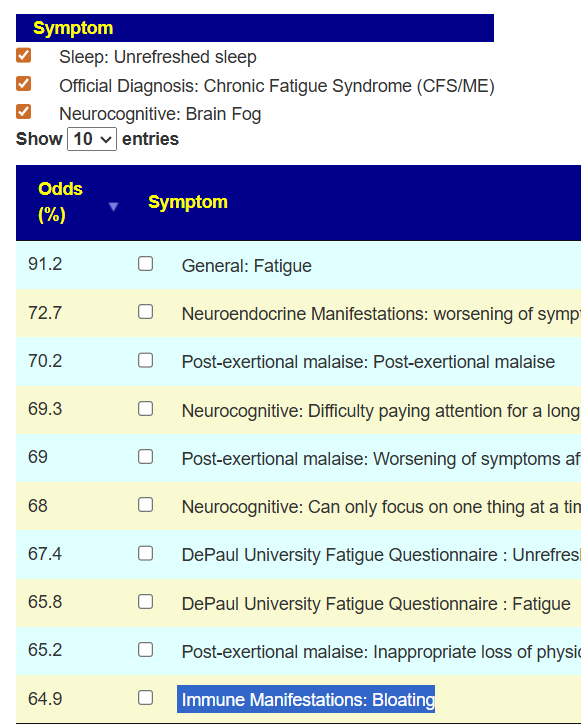
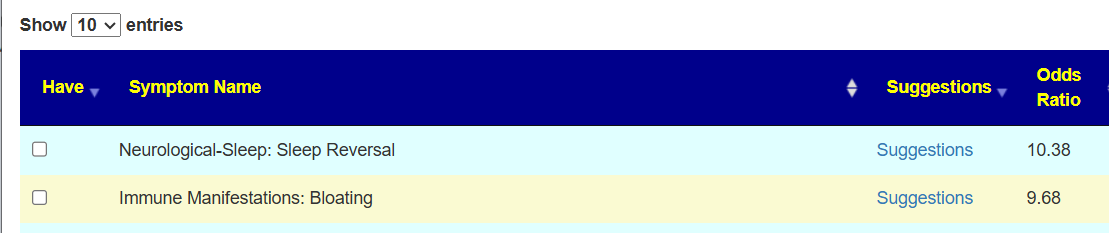
I have just added a new page, Symptom Associations, you can progressively enter symptoms. After each one is added, the page recalculates and show the odds, given that set of symptoms, of potential additional symptoms.

If you have a sample from Biomesight, Ombre or Thorne, you can get a better estimates of the odds of developing this symptom specific to your microbiome!

And then by clicking Suggestions, get suggestions to reduce the risk of developing it.

Probiotics

Substances to Take

Substances to Avoid

Summary

The suggestions are computed explicitly for your microbiome and the bacteria identified for a symptoms. These may be counter-indicated for other symptom treatment. These may often contradict “universal solutions for bloating” from internet hearsay.

Below is a video walkthrough