Cholesterol in CFS and Microbiome

Overall cholesterol has been reported normal with CFS, but HDL (the good cholesterol) is significantly low. This can result in MDs doing symptom/lab results treatment instead of addressing the root cause.

  • “Plasma lathosterol was decreased in both males and females with CFS (Tables 2 and and3).3). Total plasma cholesterol, desmosterol, cortisol, and aldosterone were normal in both males and females with CFS….Our data are consistent with increased flux through the desmosterol pathway to maintain normal cellular levels of cholesterol. The desmosterol pathway corresponds to the stress-inducible arm of de novo cholesterol and sterol synthesis.” [2016] While total cholesterol was normal, the mechanism of production was not.
    • “Plasma chenodeoxycholic acid (CDCA) was decreased in females (Table 3, Females). CDCA is a primary bile acid made from cholesterol. Decreased cholesterol flux can result in decreased substrate for bile acid synthesis needed for normal fat digestion and microbiome signaling (24). The absence of adequate bile acid delivery can lead to a loss in intestinal mucosal integrity and leaky gut via a cascade of events stemming in part from disrupted farnesoid X receptor signaling”
    • “These facts suggest that CFS is an evolutionarily conserved, genetically regulated, hypometabolic state similar to dauer that permits survival and persistence under conditions of environmental stress but at the cost of severely curtailed function and quality of life.” – except the stress in this case is caused by bacteria shifts.
  • “The CFS group had higher levels of triglycerides (p = 0.03), MDA (p = 0.03) and CO (p = 0.002) and lower levels of HDL cholesterol (the good cholesterol) (p = 0.001) than the control group. There were no significant differences in the levels of total protein, total cholesterol or LDL cholesterol...The CFS group had an unfavorable lipid profile and signs of oxidative stress induced damage to lipids and proteins. ” [2012]
  • “a control group of 40 healthy women and 40 CFS women. Levels of total cholesterol (TC), triglycerides (TG), LDL cholesterol (LDLc), HDL cholesterol (HDLc), and malondialdehyde (MDA) levels were measured. There was a negative correlation between HDLc and MDA levels (r=0.3; P=.046), a positive correlation between TG and MDA levels (r=0.4; P=.006), and lower levels of HDL cholesterol in the CFS group (P=.036). [2010]
  • “Bacteroidetes showed positive correlation with LDL- and HDL-cholesterol levels, whereas Firmicutes showed negative correlation with total cholesterol, LDL- and HDL– cholesterol.” [2016]

Concurrent Treatment

Or should I say, how to help correct the shift of bacteria and improve HDL cholesterol. There were sufficient human studies to just use those.

“Recent population-based association studies have shown that the gut microbiota composition can explain a substantial proportion of the inter-individual variation in blood triglycerides and HDL-cholesterol level and predict metabolic response to diet and drug.” [2016]

  • Almond Oil – “almond oil elevating the levels of so-called ‘good cholesterol’, high-density lipoproteins (HDL), whilst it reduces low-density lipoproteins (LDL).” [2010] I suspect eating almonds may be as good or better.
    • ” replaced half of their habitual fat (approximately 14% of approximately 29% energy) with either whole almonds (WA) or almond oil (AO) for 6-wk periods… whereas HDL cholesterol increased 6%.” [2002]
  • The use of probiotic L. fermentum ME-3 containing Reg’Activ Cholesterol supplement for 4 weeks has a positive influence on blood lipoprotein profiles and inflammatory cytokines: an open-label preliminary study[2016]. “HDL cholesterol level rose from 1.60 to 1.67 mml/l,”  i.e. 4%.
  • “a probiotic containing… L. Casei, B.Bifiudu and L. Fermentum .. significantly increased HDL-cholesterol levels (2.7 from 0.9 ) compared with the placebo after 12 weeks.”  [2016] – a 200% increase in HDL.
  • “Previous clinical studies have reported mixed results regarding the effect of probiotics on lipid metabolism…Subjects treated with probiotics demonstrated reduced total cholesterol and LDL cholesterol compared to control subjects by 7.8 mg/dL (95% CI: -10.4, -5.2) and 7.3 mg/dL (95% CI: -10.1, -4.4), respectively. There was no significant effect of probiotics on HDL cholesterol or triglycerides.” [2015] L. Fermentum appears not to be included in this review.

The Gut Microbiome Contributes to a Substantial Proportion of the Variation in Blood Lipids [2015].

  • “we identified 34 bacterial taxa associated with body mass index and blood lipids; most are novel associations. Cross-validation analysis revealed that microbiota explain 4.5% of the variance in body mass index, 6% in triglycerides, and 4% in high-density lipoproteins, independent of age, sex, and genetic risk factors. A novel risk model, including the gut microbiome explained ≤ 25.9% of high-density lipoprotein (HDL) variance, significantly outperforming the risk model without microbiome. Strikingly, the microbiome had little effect on low-density lipoproteins or total cholesterol.”
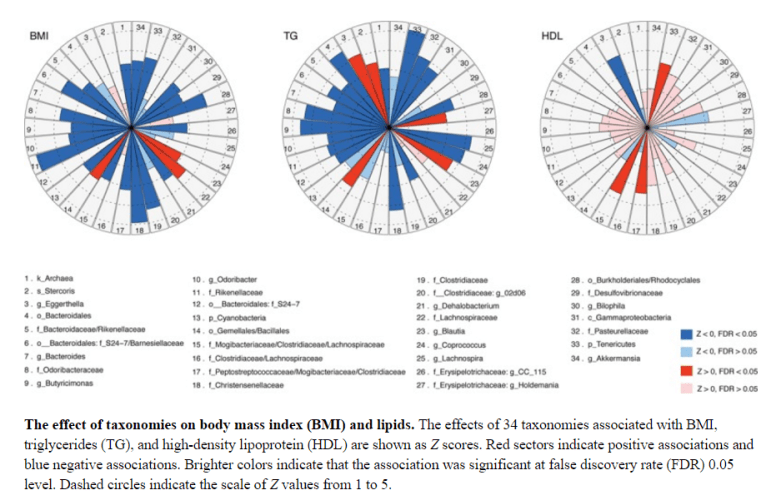
hdl

AkkermansiaChristensenellaceae (phylum Firmicutes; N18) and the phylum Tenericutes and higher levels of HDL (P=0.0047 and P=0.0006, respectively) [RED in chart above]… genus Eggerthella (N3) with  decreased HDL (P=6.3×10⁻⁵), [BLUE in chart above]”

“We observed that the gut microbiome makes a significant contribution, beyond that of clinical risk factors and genetics, to the individual variance seen in BMI and to the blood levels of triglycerides and HDL,but that it has little effect on LDL or TC levels. ”

Bottom Line

While the bacteria cited above are not currently available as a probiotics, we do have L. Fermentum available as a probiotic that has significant effect after 4 weeks and major effect after 12 weeks. Adding almonds as a regular part of your diet would also help.
 

Rotation and Pulsing: Herbs, Probiotics, Antibiotics

In my last post, we found that probiotics may last for just hours or months – depending on the sourcing and type of bacteria. Probiotic behaviors vary greatly. Some produce natural antibiotics that will kill off other species. Others do not — just reduce inflammation etc. or grow more aggressively than bad bacteria. Some commercial probiotics are documented in FDA filing to be easily killed by almost all antibiotics, not to persist and not to produce toxins against other bacteria (good or bad).

We have limited knowledge of which ones produces natural antibiotics, so my rule of thumb is that probiotics should be viewed as producing antibiotics. You should rotate them regularly to prevent resistance to their natural antibiotics occurring. The same applies to herbs. Changing providers when you finish a herb is similarly desired.

The lack of (successful) studies on fixing dysfunctional microbiome

My model appears to be well supported by  Kyberkompact lab results, published papers over seventeen (17) years, etc.

  • ” In contrast, in the stool samples there was a higher relative abundance of Bacteroidetes and lower abundance of Firmicutes observed in ME/CFS patients compared to healthy controls.” [2015]
  • ” For the anaerobes, the mean percentage distribution of Bacteroides spp. for the control subjects and CFS patients was 92.8% and 91% respectively; Bifidobacterium spp, 7.1% and 2%; Lactobacillus spp., < 1% and 0%. The incidence of CFS patients with faecal E.coli greater than the percentage mean of control subjects was significantly different to that of the Bacteroides spp. (7 vs 21 respectively, p=0.0001) suggesting the possibility of an antimicrobial interaction among bacterial species.” [1998]

What is lacking are studies showing consistent successful treatment that persists.

  • “The high success rate and safety in the short term reported for recurrent Clostridium difficile infection has elevated Fecal microbiota transplantation (FMT) as an emerging treatment for a wide range of disorders, including Parkinson’s disease, fibromyalgia, chronic fatigue syndrome, myoclonus dystopia, multiple sclerosis, obesity, insulin resistance, metabolic syndrome, and autism.” [2016]
    • I have corresponded with several people that had them, went into remission for months and then relapses
  • “Case reports of FMT have also shown favorable outcomes in Parkinson’s disease, multiple sclerosis, myoclonus dystonia, chronic fatigue syndrome, and idiopathic thrombocytopenic purpura. FMT is a promising approach in the manipulation of the intestinal microbiota and has potential applications in a variety of extra-intestinal conditions associated with intestinal dysbiosis.” [2015]
  • “This raises the question of whether restoration of a healthy microbiome via probiotics or other ‘dysbiosis therapies’ would be an optimal alternative, or parallel treatment option, to antibiotics.” [2016]
  • “The use of specific probiotics in patients with IBD can be recommended only in special clinical situations. There is no evidence for efficacy of probiotics in CD. By contrast, studies in UC have shown a beneficial effect in selected patients.” [2016]

My approach

The use of antibiotics must be divided into two groups:

  • Acute infection treatment – typically resolved by a single course of antibiotics over 2 weeks with a focus on a single bacteria.
  • Latent/chronic/persistent/occult infections – which are complex to treat.

It is the latter that is needed for CFS, FM and many autoimmune diseases. We are not trying to eliminate one bacteria but reduce dozens of families while increasing dozens of families. When some of the counts for families are reduced to 1% of normal or even 1% of 1% (1/10000), getting those counts up is a challenge, a 400% increase of some counts do not even touch the dysfunction.

We do not know the complete complex interactions between strains, species and families of bacteria. We try to change one item and the side-effects may leave the patient worst.

How to proceed?

My approach comes from being placed successfully into remission three times using rotating antibiotics. The first time, before CFS was a clinical diagnosis (in 1972-3, Incline Village was in 1984) and the physician went with the diagnosis of antibiotic resistant walking pneumonia – rotating antibiotics when one course did not resolve it. The latter two times, modelling treatment on Dr. Cecile Jadin’s protocol for occult rickettesia infections (although my medical records for the last time read chronic lyme).

Bacteria mutate and become resistant. You may eliminate 99%, but if the environment supports growth, that 1% grows quickly and the volume returns. Our goal is to reduce parts of this consortium of evil bacteria until the good bacteria can muscle back in. Each herb, probiotic or antibiotic will only influence a few families of bacteria. You can knock those back and then reduce their friends, and then their friend’s friends.

There is a little literature on rotation:

Pulsing

Pulsing is much less studied. If you rotate, you are in one sense pulsing. Again, very little literature because for most infections – a single course of antibiotics is sufficient to knock out one bacteria.

“The issue of whether it is better to administer antibiotics as an intermittent bolus dose or a continuous intravenous infusion has been debated for several decades.” [1988]

  • My own experience has been modeled on Jadin’s protocols (See this summary)
  • “While this study does not demonstrate a superior response to dosing metronidazole in a pulsatile fashion against B. fragilis and B. thetaiotaomicron isolates, the effect is comparable to that of conventional dosing regimens. Perhaps this novel dosing strategy would prove advantageous against other pathogens.” [2004] – no worst than taking it constantly etc.
  • “In the current study, use of pulsatile dosing against S. pneumoniae with reduced susceptibility demonstrates superior reduction in bacterial concentration compared to that of more traditional two- or three-times-daily dosing. However, further research exploring the mechanism for pulsatile dosing and confirmation of these results are needed before applying this information clinically.” [2006]
  • “Overall bacterial density reduction was similar between the regimens for the susceptible isolate and greater with pulsatile regimens against the less susceptible strain.” [2004] – pulsing works better when the bacteria is more resistant.
  • A 2012 mathematical modeling study pulsing may be the preferred application of anti-pathogens: “We find that constant dosing is not the optimal method for disinfection. Rather, cycling between application and withdrawal of the antibiotic yields the fastest killing of the bacteria.

Bottom Line

I advocate rotation and/or pulsing. See earlier post from 2015. The key for knowledgable medical professional to grasp is that we are not dealing with a infection of a single bacteria (classic) but overgrowths of dozens, perhaps hundreds of bacteria families. We need to correct the shift… and that is far more complex.

How long should I take one thing?  IMHO: 2 weeks minimum (typical course of antibiotics duration), 4 weeks maximum.

ZINC CARNOSINE AND LEAKY GUT

My Icelandic reader also praised the impact of  Zinc carnosine on his gut.

“1)  I believe Zinc Carnosine is of importance for treating Leaky Gut. I had constant nausea for months after using for a while  and quiting the medicine Plaquenil and Kratom.  I think it caused increased permeability of the gut (don´t know which one was the cause – or both).  I experienced increase wellbeing and relaxation after 3 weeks on Zinc Carnosine.  Nausea completely went away and hasn´t been back.It has been used in Japan for abt. two decades now I believe. Somewhere I saw it was researched by making it radioactive and pictures showed it accumulate at the gut lining.  The Carnosine is a big molecule that slows the absorption of the Zinc so it does it´s healing at the gut lining.”

As always, it’s to PubMed to see if there is solid evidence supporting his exceptional experience

Zinc carnosine is also the main component of polaprezinc.

So the evidence supports his experience. What about impact on the microbiome? There was nothing explicit for this, so I will fall back to the impact of zinc.

Microbiome Impact

“Zinc is an essential trace element required for multiple cellular functions, such as enzymatic reactions, DNA synthesis, and gene expression (1). Over 300 enzymes and thousands of transcription factors contain one or more zinc atoms.” [2012]

  • “In the zinc-deficient chickens, the bacterial profiles were less diverse, leading to reduced bacterial activity. Gut bacteria are important for a number of reasons, including breaking down nutrients in food into short-chain fatty acids, which increases gut acidity and contributes to digestion and the solubility of minerals, particularly iron and zinc.” [2017]
  • “Bacterial community composition was altered in the Zn deficient group, where significantly greater abundance of Proteobacteria and significantly lower abundance of Firmicutes (Figure 3A) was observed. In the Zn(−) group, the abundance of Bacteroidetes was increased whereas Actinobacteria was diminished, albeit not significantly.”[2015]
    • ” In contrast, in the stool samples there was a higher relative abundance of Bacteroidetes and lower abundance of Firmicutesobserved in ME/CFS patients compared to healthy controls.” [2015] – same pattern as a Zinc Deficient microbiome.

CFS/FM/IBS

Bottom Line

Just as with molybdenum in my last post, supplementation can reasonably be expected to shift the microbiome away from the usual pattern seen with CFS patients. I could not find suitable comparison between different forms of zinc supplementation.

For dosage: 30-40 mg/day see this post

How long do probiotics stay around?


For some probiotics, specifically, all 0f the E.Coli probiotics, we have studies of them persisting for weeks and months:

  • “In a randomized double-blind clinical trial, healthy newborns were given the bacteria during their first 5 days of life [46]. The stools were (Mutaflor – E.Coli Nissle 1917) EcN-positive in >90% of infants for as long as 6 months.”[2016]
  • “for the control group (not receiving mesalazine), within 2 weeks after secession of EcN administration, the strain could be detected in the stools of only 40% of individuals, dropping to 20% after 9 weeks [35]” [2016]
  • Colinfant (another E.Coli Probiotic) “reported that the strain could still be detected in stools 25 weeks after dosage [13].” [2016]
  • “a human volunteer study was performed to investigate the colonization potential of Symbioflor 2, which resulted in long-term colonization in all five volunteers, for a period of at least 20 weeks;”[2016]

On the other hand, the commonly taken ones — stay just hours,

  • “Seven days after the VSL-3 treatment suspension, no patients and subjects harbored B. infantis Y 1 and B. breve Y 8, indicating a transient presence of these exogenous strains.” [2000]
  • “Streptococcal population was detected after 3 days of administration and persisted for 6 days after the treatment suspension.” [2003]
  • “The probiotic bacterium [Lactobacillus acidophilus] was detected in feces via ribotyping and RNA gene sequencing during the probiotic administration phase but not 2 weeks after cessation of administration.” [2004]
  • ” Dead vegetative cells were detected 9 hr after administration, and C. butyricum cells were not detected in the intestine after 3 days.” [1997]
  • “After 24 h, [Bacillus] spores constituted only 12% of the total counts in the stomach, caecum, and mid-colon. Less spores and more vegetative cells were detected after 24 h…The two Bacillus strains can temporarily remain in the GI system, but will be unable to permanently colonize the GI tract.” [2008]

“After oral consumption of probiotics, E. coli and enterococci could be detected in stool samples (57% and 67%, respectively) [after one week of stopping]. In contrast, with only one exception, ingested lactobacilli and bifidobacteria could not be detected in human feces.” [2007]

Bottom Line: E.Coli probiotics taken for a few days every month or two months, will keep the E.Coli in your system constantly. Enterococcus probiotics appear to have similar staying power.  For almost everything else, the benefit will last only for 1-2 days after you stop taking them.  E.Coli may be more expensive, but is likely a wiser buy.


Another Kyberkompact Biome Analysis

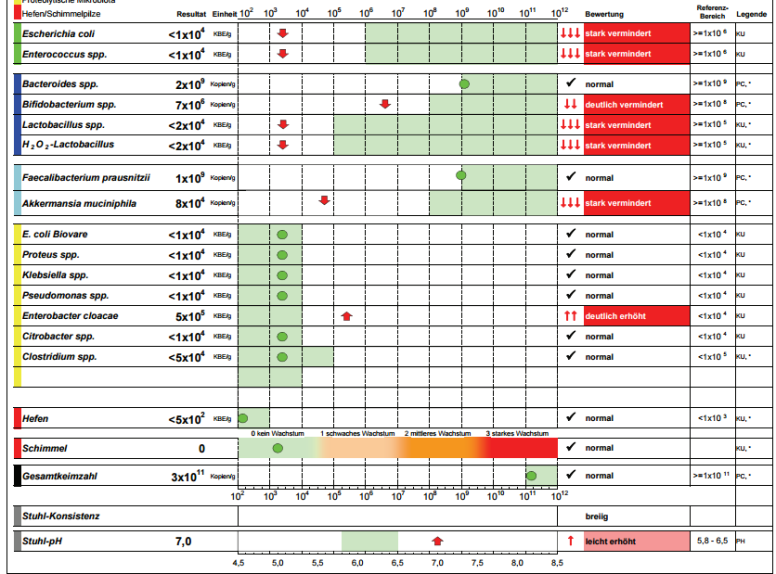
A reader forwarded me their report and asked me to do an analysis and asked some specific questions about what can be done for some items. I had done an earlier post on another patients KyberKompakt Pro report — the results are very similar, consistent with what appears to be the usual shift away from normal seen in CFS patients. I would expect at least 90% of CFS patients to have very similar results (IMHO, this specific test is a good validation of a CFS diagnosis OR if dissimilar, suggests other issues may be occurring.

kyber

Each line means 10x, so E.Coli is 3 lines below the bottom of the normal range, or 10 x 10 x 10 – 1000 times less (not a little decrease).

How do the 2 sample compare?

  • E.Coli: < 1 x 10⁴, < 2 x 10⁴ – 100x less
  • Bifidobactrium:  7 x 10⁶, 4 x 10⁶ – 500x less
  • Lactobacillus: 2 x 106 (Normal), 2 x 10⁴ – 10x less
  • Hydrogen Peroxide producing Lactobacillus: 2 x 104 (Normal), 2 x 10⁴ – 5x less
  • Enterococcus spp: 2 x 105, 1 x 104 – 100x less
  • Akkermansis muciniphia:  5 x 10⁴ , 8 x 104 – 10000x less
  • Faecalibacterium prausnitzi: 1 x 107 (100x less),1 x 109 (Normal)

Lactobacillus is always a problem because patients may be taking it as probiotics or yogurt before the testing. Also, the magnitude is much less than the other ones.

We also see that the pH is off significantly.

Addressing Akkermansis muciniphia shortage