Controlling a Herxheimer Reaction

I have posted before about Jarisch-Herxheimer reaction (JHR or ‘herx’) reactions,

I have had months of herx reactions before two remissions and learn to control it. By control, I mean keep the amount and duration of herx in a comfortable range occurring at the times that I wish it to happen. This is not easy to do with mental fog. I am currently chatting daily with someone that is going thru a herx and additional supplements are arriving that they wish to add. Some of these new supplements are poor choices when you are already herxing hard. The herx has been severe for her, she has had to crawl to the washroom (like my own wife did for her CFS some 15 years ago). One of her characteristics is depression and anxiety – which is very common in CFS (even without a herx!)


How long will it last?

From when you take something until it is at peak concentration in your body is the time that the herx will slowly increase. Typically it is 2-3 hours (see table below). This is why I usually suggest taking antibiotics/antivirals about 1-2 hours before bed so the herx hits in your sleep (or helps you get to sleep).

The half life is the time until the herx or effect decreases by 50%.
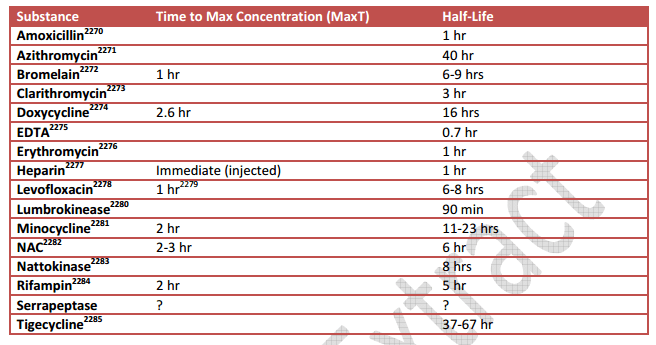
halflife

An example:

  • You are taking minocycline and want to increase the herx and have a choice of NAC or EDTA
    • With NAC, you would take both at the same time and the herx will likely stay more severe for 6 hrs and then start to fade away – why because NAC half life is 6 hrs.
    • With EDTA, you would take it about 3 hours after the minocycline. Because it has a short half life, you want the minocycline concentration to be at it max first.

If you are taking prescription antibiotics or antivirals, you will likely be able to find the time to peak and/or half life on pubmed. Click this link and change “antibiotic” to the specific antibiotics. http://www.ncbi.nlm.nih.gov/pubmed/?term=(MaxT+or+Half-Life)+and+antibiotic

Increases Herx

The items do not directly impact infections, but they either breaks down protective films around infections (biofilms) or increases the penetration of antibiotics. If the herx is waning, taking some of these will likely increase herx. The increase of herx will dependent on the volume taken.

Decreases Herx

The classic way of decreasing herx is reducing the dosage. However, there are items that can reduce the herx -many of these items has the potential of inducing a secondary herx, however, I am not aware of that being reported for any on the lists. The lists are not comprehensive.

Detox herbs

Detoxification herbs are a model advocated by alternative medicine. These are herbs that assist with removing toxins from the body, conceptually, the toxins producing the herx. When I checked PubMed, I found just over 50 articles, it is very understudied. I came across this in the Journal of Alternative Complementary Medicine:

“Whereas supplements for which good supporting evidence exists generally cost around $3-$4 per month, those that are heavily promoted for which there is little supporting evidence cost about $20-$60 per month. The major cause of this problem in the United States is weakness of the law. There is an urgent need for stricter regulation and for giving better advice to the general public.” [2010]

Other Stuff

Honestly, who actually knows! If the herb kills some groups of bacteria (and most do), you may get additional herxing.  IMHO, once you are herxing, you should keep your supplements the same — with CFS there is not only brain fog, but also response to supplements fog!

 

Bacopa monniera and Cognitive Function

A reader wrote me about this herb that was in a mixture that contains several items that I also favor. I was not familiar with it, so I did a little research.

Bacopa monniera is a herb used in Indian Traditional/   “Ayurvedic treatment for epilepsy and asthma.[5] It is also used in Ayurveda for ulcers, tumors, ascites, enlarged spleen, inflammations,leprosy, anemia, and gastroenteritis.[3] ” – Wikipedia

Examine.com writes “Bacopa monnieri is a Nootropic herb that has been used in traditional medicine for longevity and cognitive enhancement. Supplementation can reduce anxiety and improve memory formation.”

There is an excellent narrative on Ayurvedic use of this herb over the last 5500 years.

Many of these areas are known to be associated with microbiome dysfunction. Does modern medical science agree? Over to PubMed which around 160 articles in total. The interesting results are:

  • “These results indicate that, cognition-enhancing and neuromodulatory propensity of BME is through modulating the expression of AChE, BDNF, MUS-1, CREB and also by altering the levels of neurotransmitters in hippocampus of rat brain.” [2015]
  • ” Studies in animal model evidenced that Bacopa treatment can attenuate dementia and enhances memory. Further, they demonstrate that Bacopa primarily either acts via antioxidant mechanism (i.e., neuroprotection) or alters different neurotransmitters (serotonin (5-hydroxytryptamine, 5-HT), dopamine (DA), acetylcholine (ACh), γ-aminobutyric acid (GABA)) to execute the pharmacological effect. ” [2015]
  • “Present study also confirms that 80-120 mg/kg doses of BM extract have significantly higher antidepressant-like activity.”[2014]
  • Bacopa monniera ameliorates cognitive impairment and neurodegeneration induced by intracerebroventricular-streptozotocin in rat: behavioral, biochemical, immunohistochemical and histopathological evidences[2015].
  • “The present results clearly demonstrate that the methanolic extract of B. monniera possesses antidepressant-like activity in the animal behavioral models” [2015]
  • “treatment with BM extract during growth spurt period of neonatal rats enhances learning and memory”[2011]

Human Studies

  • “The current study attempted to determine the chronic effects of single daily dose of 450 mg of Brahmi extract on cognitive performance and anxiety in healthy adults. The results of the current study are not in agreement with findings of some of the earlier studies which have found improvement both on cognitive parameters and a reduction of anxiety scores… However, there was a trend for lower state anxiety in the B. monniera (Brahmi) group as compared to placebo group.” [2013]
  • ” Promising indications for use in humans include improving cognition in the elderly and in patients with neurodegenerative disorders.” [2013]
  • “Promising candidates for future research include Bacopa monniera (brahmi) …providing potential efficacy in improving attentional and hyperkinetic disorders via a combination of cognitive enhancing and sedative effects.” [2011]

Bacteria / Gut

  • ” we had reported the prophylactic and curative effects of standardized extract of Bacopa monniera (BME) in various gastric ulcer models. The effect was due to augmentation of the defensive mucosal factors like increase in mucin secretion, life span of mucosal cells and gastric antioxidant effect rather than on the offensive acid-pepsin secretion.” [2003]
  • “BME showed antimicrobial activity against skin pathogens,”[2013]
  • ” a butanolic extract of Bacopa monnieri showed maximum inhibitory activity against the human pathogen Escherichia coli,” [2005]

Bottom Line

There are no studies with CFS/FM/IBS patients which would be ideal. My gut feeling (subjective) is that it is worth trying at 500-1000 mg/day. The most likely effect is reduction of the stress response (which usually have side effects of improved cognitive abilities). There is also a potential that it may reduce leaky gut – but that has not been explored or demonstrated in studies.


Diabetes and Probiotics

A reader asked me to research this area. I have recalled coming across articles A quick check on PubMed found 298 articles. I suspect many of these articles may also impact sugar cravings.

“In clinical trials, the use of probiotics in glycemic control presented conflicting results, and only few studies have attempted to evaluate factors that justify metabolic changes, such as markers of oxidative stress, inflammation, and incretins” [2015] “Our meta-analysis suggests that probiotic supplementation might improve, at least to some extent, metabolic control in subjects with type 2 diabetes” [2015]

  • “a strong association between one dominant bacterial species, Bacteroides dorei, and type 1 diabetes was discovered…This dysbiosis may cause a lack of butyrate production by gut bacteria, which, in turn, leads to the development of a permeable gut followed by autoimmunity.”[2015]
  • Eating a yoghurt a day is linked to lower risk of type 2 diabetes [2014].
  • “Lactobacillus acidophilus La-5 and Bifidobacterium animalis subsp lactis BB-12… improved the glycemic control in T2D subjects, however, the intake of fermented milk seems to be involved with others metabolic changes, such as decrease in inflammatory cytokines (TNF-α and resistin) and increase in the acetic acid” [2015]
    • “The total cholesterol:HDL-C ratio and LDL-C:HDL-C ratio as atherogenic indices significantly decreased in the probiotic group” [2011]
  • Showed “the efficacy and safety of probiotics administration in preventing conversion of impaired glucose tolerance to diabetes”
    • Bifidobacterium longum [National Center for Medical Culture Collections (CMCC): P0001], Lactobacillus acidophilus [CMCC: P0002] and Enterococcus faecalis [2015]
  • ‘Lactobacillus salivarius UCC118… had no impact on glycemic control” [2015] [2014]
  • “VLS#3 probiotics to NOD mice but found that VSL#3 colonized the intestine poorly and did not delay diabetes.” [2015]
  • Intake of Lactobacillus reuteri improves incretin and insulin secretion in glucose-tolerant humans: a proof of concept[2015].

A summary of studies is given in this 2014 full text article.

Bottom Line

There are few clinical studies with probiotics and diabetes. A mixture of Bifidobacterium longum, Lactobacillus acidophilus  and Enterococcus faecalis has great promise in preventing the transition. Clostridium butyricum may have potential because of low butyrate production being associated with the transition to diabetes [ There have been no studies done yet].

There is work going on with engineered probiotics to treat diabetes, based on Lactobacillus gasseri . [2015] ETA for availability End of 2017.


Probiotic: Saccharomyces boulardii

A reader asked me about this probiotic and I thought that I should dig into it as it is often in probiotic mixtures.

Wikipedia gives a great summary with two items of note:

  • “In healthy patients, S. boulardii has been shown to be nonpathogenic and nonsystemic”
  • “in immunocompromised individuals, S. boulardii has been associated with fungemia or localized infection, which may be fatal.”

Oh…. we just hit a clear issue of safety for CFS patients (or anyone else with a chronic condition) — it’s safety is unknown. We have the classic over simplification happening here — “Yes, studies show that it is good for you (IF YOU ARE A HEALTHY INDIVIDUAL)”. Studies on CFS/IBS/FM patients are really required.

More quick notes from Wikipedia:

  • IBS: improved in one study. No effect in another.
  • Decreases E.Coli (which CFS patients are low in) — not good


What else do we know?

  • No studies with fibromyalgia
  • No studies with chronic fatigue syndrome
  • 4 Studies with Irritable Bowel Syndrome (ONLY with diarrhea-dominant version)
    • “The improvement of the symptom score was greater with mesalazine alone or combined with Sb as compared with Sb treatment alone.”[2013]
    • “S.boulardii treatment for 30 days in diarrhea predominant IBS patients did not result in any improvement in this study.” [2011]
    • “S. boulardii improved IBS-Quality Of Life better than placebo but was not superior for individual symptoms in patients with diarrhea-predominant IBS or mixed-type IBS.” [2011] – the improvement in the QOL may be a placebo effect.
    • “S. boulardii with ispaghula husk was superior to placebo with ispaghula husk in improving the cytokine profile, histology, and quality of life of patients with IBS-D. These preliminary results need to be confirmed in a well-powered trial.” [2014]
  • Going to the heavy weight dysfunction, Crohn’s Disease, 11 hits
    • Saccharomyces boulardii does not prevent relapse of Crohn‘s disease[2013].
    • “S. boulardii added to baseline therapy improved intestinal permeability in these CD patients, even though complete normalization was not achieved.”[2008]
    • “Clinical relapses as assessed by CDAI values were observed in 37.5% of patients receiving mesalamine alone and in 6.25% of patients in the group treated with mesalamine plus the probiotic agent.”[2000]
    • “The group treated with S.b. showed a significant reduction in the frequency of bowel movements in the tenth week, to 3.3 +/- 1.2 evacuations per day,” [1993]

Bottom Line

There is no clean evidence of any significant improvement with CFS or any related condition, there is also a risk of potentially fatal reaction.  Immunocompromised patients and CFS individuals are frequently cited together in studies, additionally, often items used by CFS individuals suppression inflammation and thus part of the immune system. We need more studies (which are expected to show no or marginal results) before this should be included – IMHO.

Do not explicitly take this probiotic. 

For items like candida, it is effective but should be used only when needed.

UPDATE:

See this uBiome post it encourages bacteria that inhibit bifidobacteria.


Health Rising: Remission by Probiotics

Recently on Health Rising, Carol Wolf(her blog) wrote “Did Probiotics Cure My Chronic Fatigue Syndrome?”  I say awesome!  I do have some concerns about the article because it will cause people to try some probiotics and likely fail to put the person into remission. I am concerned because it potentially will result in bad mouthing of the microbiome approach by those that it failed to help.

Such an approach has been tried by many (including physicians) in the past with no or a low rate of success on the general CFS population.  By try — I mean tossing any off the health food store probiotics at the patient.

No warning of Herx risk

Various readers, and my own experience, has had significant herx/die off from some probiotics. Which one varies from person to person and likely reflects that the bacteria in the dysfunctional microbiome are different. The differences causes the difference in symptoms seen from one CFS patient to the next.

If you take a mixture and have a severe (sufficient to discontinue) herx, then knowing how to proceed becomes fuzzy. With a single species (or in the case of Prescript Assist) a specialized mixture not available elsewhere, the next step is clearer.

Cost – especially for those on Social Security / Disability

She cited 4 probiotics — the ones that she is on, not her history of what she took in the past. She correctly kept changing probiotics according to her article — the problem is that she did not give a full history. Taking just one capsule/day of these 4  is $82.50/month. There is an implication from her words that she may be taking a higher dose of each, “I am taking FOUR different high-quality probiotics plus some prebiotics a day with meals.” (it was unclear if it was at each meal).

Some of the probiotics bottles cited suggest a higher dosage than 1 capsule/day.

Screen Shot 2016-01-10 at 5.13.24 PM

Since this post, she has clarified her cost in this post. “I pay between $70 and $100 a month on probiotics.”

Is she cured or just successfully containing?

This is a nasty question to ask.  She indicates that she is still taking probiotics, at least  215 Billion CFU/day. The antibiotics produced from these will likely suppress the evil bacteria. Has her microbiome returned to a stable persistent state? We do not know until she goes off the probiotics at those dosages for at least 3-6 months. Fetal transplants are often reported successful for 3+ months and then a relapse happen.

“I recently quit taking them as religiously and I went into a horrible, horrible depression – remember I’m anti-depressant free at this point. I loaded up on probiotics again and the depression lifted in about three days.”

Probiotic Mixtures Suggested

I took these 4 mixes and examined them below. One of them especially interested me (more below) because of some hard to obtain strains (in bold below).

  • Raw Probiotics for Women 85 Billion CFU, $30 90 capsules or $0.004/ B CFU
    • Lactobacillus plantarum,
    • Lactobacillus reuteri,
    • Lactobacillus rhamnosus,
    • Bifidobacterium bifidum,
    • Bifidobacterium lactis,
    • Bifidobacterium longum,
    • Lactobacillus acidophilus,
    • Lactobacillus bulgaricus,
    • Lactobacillus casei,
    • Lactobacillus gasseri,
    • Lactobacillus helveticus,
    • Lactobacillus kefiranofaciens,
    • Lactobacillus kefirgranum,
    • Lactococcus lactis,
    • Lactococcus cremoris,
    • Streptococcus thermophilus,
    • Lactobacillus kefir,
    • Lactobacillus parakefir,
    • Lactobacillus brevis,
    • Lactococcus lactis biovar diacetylactis,
    • Leuconostoc lactis,
    • Leuconostoc mesenteroides,
    • Leuconostoc cremoris,
    • Leuconostoc dextranicum,
    • Kluyveromyces marxianus,
    • Brettanomyces anomalus,
    • Debaryomyces hansenii,
    • Saccharomyces unisporus,
    • Saccharomyces turicensis,
    • Saccharomyces cerevisiae,
    • Saccharomyces exiguus,
    • Torulaspora delbrueckii
  • Complete Probiotic by Mercola  70 BCFU $35 60 capsules $ 0.008 /B CFU
    • Lactobacillus acidophilus DDS-1
    • Bifidobacterium lactis
    • Lactobacillus plantarum
    • Lactobacillus casei
    • Lactobacillus rhamnous
    • Lactobacillus brevis
    • Bifidobacterium longum
    • Lactobacillus salivarius
    • Steptococcus thermophilus
    • Lactobacillus bfidum
  • Perfect Probiotics 30 BCFU  $40 30 capsules   $0.044 / BCFU
    • Lactobacillus acidophilus,
    • Bifidobacterium lactis,
    • Lactobacillus plantarum,
    • Lactobacillus rhamnosus,
    • Lactobacillus casei,
    • Lactobacillus salivarius,
    • Lactobacillus bulgaricus,
    • Bifidobacterium breve,
    • Lactobacillus paracasei,
    • Lactococcus lactis,
    • Streptococcus thermophilus,
    • Lactobacillus brevis,
    • Bifidobacterium bifidum,
    • Bifidobacterium longum,
    • Bifidobacterium infantis
  • Multidophilus 24, Super 30 bil Solaray 30 BCFU $30 60 capsules $ 0.016 BCFU
    • Lactobacillus plantarum,
    • Lactobacillus rhamnosus,
    • Bifidobacterium lactis,
    • Lactobacillus acidophilus,
    • Lactobacillus lactis,
    • Bifidobacterium infantis,
    • Bifidobacterium breve,
    • Bifidobacterium bifidum,
    • Bifidobacterium longum,
    • Lactobacillus bulgaricus,
    • Lactobacillus casei,
    • Lactobacillus delbrueckii,
    • Lactobacillus brevis,
    • Enterococcus faecium,
    • Lactococcus lactis,
    • Lactococcus cremoris,
    • Lactobacillus paracasei,
    • Lactobacillus salivarius,
    • Lactobacillus gasseri,
    • Lactobacillus helveticus,
    • Lactobacillus fermentum,
    • Lactobacillus kefir,
    • Pediococcus acidilacti
    • Streptococcus thermophilus.

Bottom Line

Her success indicates that the model that I am using may be correct. Symptoms are results of shifts in the microbiome. The Raw Probiotics for Women cited above is very worth trying based on unusual species and excellent cost per BFCU. I would hesitate to suggest it be tried by someone starting an attempt to shift — the number of species is so high that the odds of a herx is likely high. Someone starting should start with single species (where practical) to minimize the risk of a herx.