Special Studies: ME/CFS with IBS

IBS is a common morbidity for both ME/CFS and Long COVID. This is reported often in samples, and thus being examined if it reaches our threshold for inclusion as defined in A new specialized selection of suggestions links. It does, but the degree of association (z-scores) are lower than prior special studies despite having a larger study population.

Study Populations:

SymptomReferenceStudy
ME/CFS with IBS111153
  • Bacteria Detected with z-score > 2.6: found 190 items, highest value was 8.4
  • Enzymes Detected with z-score > 2.6: found 182 items, highest value was 6.3
  • Compound Detected with z-score > 2.6: found ZERO items

The highest z-scores above are greater than other symptoms despite smaller sample size. This indicates that the causes have more of a signature and thus more homogeneous bacteria shifts then ME/CFS without IBS.
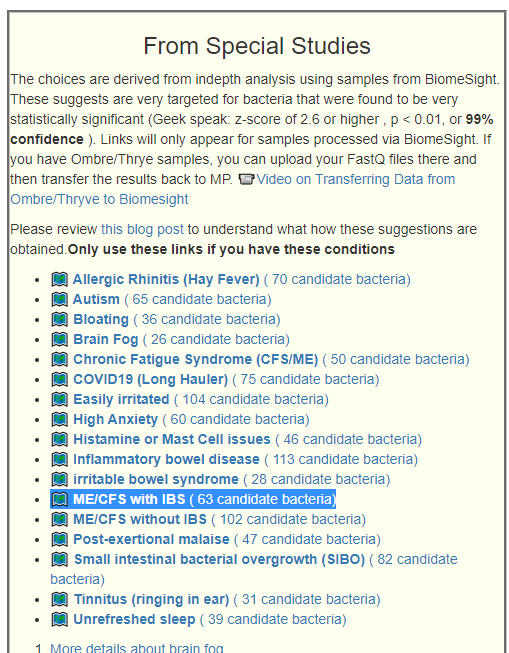
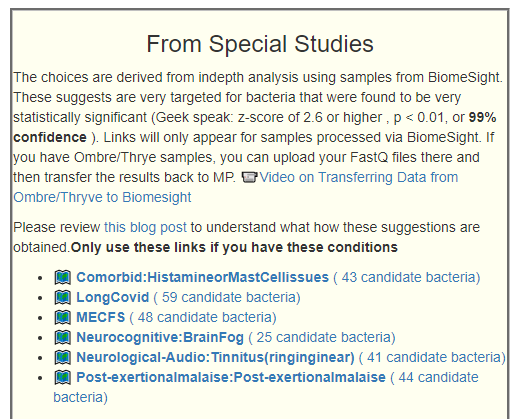
For those that have a sample processed thru BiomeSight software.

Interesting Significant Bacteria

All bacteria found significant had too low levels. Many Bifidobacterium species are significant

BacteriaReference MeanStudyZ-Score
Sporolactobacillus (genus)172368.4
Sporolactobacillus putidus (species)172368.4
Sporolactobacillaceae (family)170368.3
Bifidobacterium kashiwanohense PV20-2 (strain)319566.7
Bifidobacterium catenulatum subsp. kashiwanohense (subspecies)309566.6
Blautia wexlerae (species)602233736.1
Bifidobacterium gallicum (species)36996316
Bifidobacterium cuniculi (species)80226
Bacteroides finegoldii (species)27295505.6
Desulfovibrio simplex (species)219515.4
Succinivibrio dextrinosolvens (species)986885.3
Escherichia (genus)601111675.2
Phocaeicola sartorii (species)8203175.1
Haemophilus parahaemolyticus (species)66205.1
Lactiplantibacillus pentosus (species)123285
Clostridium chartatabidum (species)302505
Phocaeicola massiliensis (species)1385143585

Interesting Enzymes

All enzymes found significant had too low levels.

EnzymeReference MeanStudy MeanZ-Score
(2S)-3-(4-hydroxyphenyl)-2-isocyanopropanoate,2-oxoglutarate:oxygen oxidoreductase (decarboxylating) (1.14.20.10)131216.3
(2S)-3-(4-hydroxyphenyl)-2-isocyanopropanoate,2-oxoglutarate:oxygen oxidoreductase (1.14.20.9)131216.3
propanoyl-CoA:oxaloacetate C-propanoyltransferase (thioester-hydrolysing, 1-carboxyethyl-forming) (2.3.3.5)14384255.3
L-tyrosine:D-ribulose-5-phosphate lyase (isonitrile-forming) (4.1.99.24)103325.3
L-pipecolate/L-proline:NADP+ 2-oxidoreductase (1.5.1.21)177475.2
(R)-lactate hydro-lyase (4.2.1.130)15143265.1
L-carnitinyl-CoA hydro-lyase [(E)-4-(trimethylammonio)but-2-enoyl-CoA-forming] (4.2.1.149)13713285.1
acyl-CoA,ferrocytochrome b5:oxygen oxidoreductase (6,7 cis-dehydrogenating) (1.14.19.3)10092615.1
(2S,3R)-3-hydroxybutane-1,2,3-tricarboxylate pyruvate-lyase (succinate-forming) (4.1.3.30)13894315
CMP-N-acetyl-beta-neuraminate:beta-D-galactoside alpha-(2->6)-N-acetylneuraminyltransferase (configuration-inverting) (2.4.99.1)66205
glutarate, 2-oxoglutarate:oxygen oxidoreductase ((S)-2-hydroxyglutarate-forming) (1.14.11.64)12323165

Cross Validation

Looking at Medical Conditions with Microbiome Shifts from US National Library of Medicine we see agreements on many items (note that we have more bacteria identified because we have bigger sample sizes than those studies). Note that Escherichia (genus) is low, as was reported in the first study of the microbiome from Australia in 1998.

For the very few studies on ME/CFS with IBS

  • Bifidobacterium (genus)
  • Coprococcus catus

For studies of Irritable Bowel Syndrome 📚, we have agreement of these 7 bacteria

BacteriaZ-ScoreDirection
Bacillus (genus)2.1L
Bifidobacterium (genus)2.4L
Methanobrevibacter smithii (species)4.3L
Phocaeicola vulgatus (species)2.8L
Sutterellaceae (family)-2.3H
Turicibacter (genus)2.9L
Veillonella (genus)3.3L

For studies on Inflammatory Bowel Disease 📚, we have agreement on these

BacteriaZ-ScoredIRECTION
Bacteroides fragilis (species)2.5L
Bacteroidetes (phylum)2.1L
Bifidobacterium (genus)2.4L
Cyanobacteria (phylum)2.8L
Methanobrevibacter smithii (species)4.3L
Prevotella copri (species)3L

Bottom Line

The key take away is that Bifidobacterium levels appears to be a significant contributor. Lactobacillus is NOT (and likely is a contributor to oversupply of lactic acid causing brain fog). READ THE LABEL OF YOUR PROBIOTICS — you want Bifidobacterium without Lactobacillus.

The second probiotic to take is any of the E.Coli probiotics: Mutaflor (only available in a few countries) or Symbioflor-2 (US Source, World Wide Source) . NOTE: Lactobacillus is hostile to E.Coli, a second reason to avoid those probiotics.

A Priori suggestions are now available:
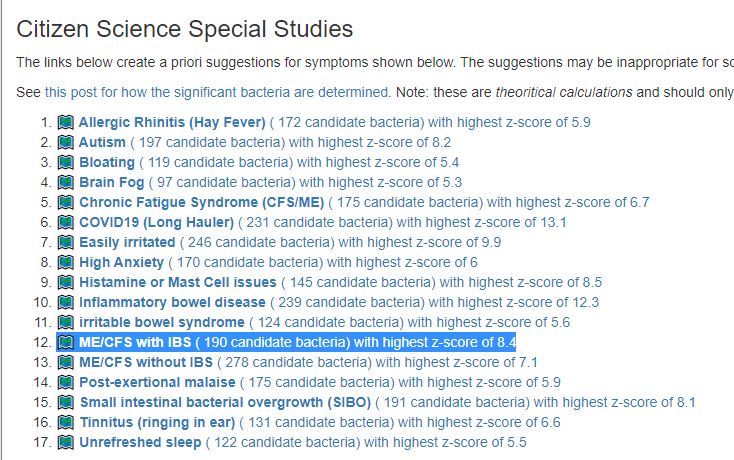
https://microbiomeprescription.com/Library/CitizenScience

The top items are below (more on the web page). Remember no microbiome will be an exact match and these lists may contain items to avoid; using your own microbiome data is always the best choice. As always, any changes should be reviewed by your MD before starting.

Under the tongue and Brain Fog

The alternative title would be “Neurological issues and sublingual”. I got an email this morning from a ME/CFS person which reminded me of what I do often and I thought that I should share/remind others.

Reporting back. I tried  B1 benfotiamine again. I was feeling tired for no reason  so gave it a shot. I just wanted a low dose and so I opened the cap and sprinkled a quarter in my mouth. I usually take 1 cap. Huge effect. Felt like my muscle and brain came alive. In the past when I’ve taken b1 for a while it usually wears off or causes issues though so my question is how would I used Dr. AI to see if I have a deficiency of b1 and if need be what items to shift the microbiome. I’ve tried it prior to crashing  / PEM before and it didn’t stop it but I will do it again since it’s been a while.

For other experiences of ME/CFS with benfotiamine (a special form of Vitamin B1), see my earlier post from 2015

I have done many things sublingual, including heparin (much cheaper and appears just as effective than Low-molecular-weight heparin to deal with coagulation issues, and no injections!). My personal favorite is Piracetam which works far far better to get a tired brain working than strong coffee (at least for me).

The logic is simple, the amount that gets to the brain (which is close by) is much more than being processed through stomach acid and slowly working it way to the brain via the blood.

There is considerable literature supporting this, a few examples:

Note that the instructions for Symbioflor-1 probiotics, (US Source, World Wide Source) ” Take the drops, hold them in the mouth for a while and gargle with them before swallowing.” could be described as sublingual. Taking probiotics sublingual is not common practice…

Which ones?

There is no easy answer. Often taste can be a factor for tolerance of this approach. It may be a good exercise to try many of your supplements (one at a time) via this route and seen what has significant impact.

REMINDER: Rotate, rotate, rotate. A common complaint is that “a supplement benefit wears off”. In terms of the microbiome, this is expected from almost everything. The bacteria population adapts.

The importance of a large variation of diet with ME/CFS

For items like antibiotics and probiotics, I have for a long time been a strong advocated for continuous rotation. The original source for this attitude was Cecil Jadin’s treatment protocol for occult rickettsia (which originated with the Pasteur Institute for Tropical Medicine). This was followed by reading studies finding that rotating or even just pulsing (2 weeks on/ 2 weeks off) was more effective in reducing bacteria than continuous. Probiotics often function via the natural antibiotics they produce (a lot of prescription antibiotics originated with bacteria); hence probiotic rotation became part of my preaching.

If you have microbiome related issues, my soapbox has been “your goal is make the stable dysfunctional microbiome, unstable. Today I read a study on Nature that further clarifies what may be needed.

Together, these findings suggest that the human gut microbiome’s metabolic potential reflects dietary exposures over preceding days and changes within hours of exposure to a novel nutrient. The dynamics of this ecological memory also highlight the potential for intra-individual microbiome variation to affect the design and interpretation of interventions involving the gut microbiome.

Ecological memory of prior nutrient exposure in the human gut microbiome [2022]

If the goal is to make the microbiome unstable, then this gives some clear indication of strategy.

  • Every two weeks change the dominant starch – for example, if pasta is a regular meal item then
    • Made from glucomannan—a starch found in the konjac yam/ Konjac Flour (Source)
    • Made from red lentils and quinoa (Source)
    • Made from white rice flour, organic amaranth flour (Source)
    • Made from chickpea flour, organic yellow lentil flour, organic red lentil flour, organic kale powder, organic spinach powder (source)
  • Every two weeks change dominant proteins source
    • Fish
    • Pork
    • Lamb
    • Duck
    • Chicken
    • Turkey
  • Change vegetables and fruit too…
  • Change main spices used….

The key aspect is that every new addition results in a change of the microbiome. If you have microbiome issues, that is what you want to do. You do NOT want to take the same supplements, herbs, spices, vitamin or comfort food – continuously. You want to shake things up!

Phospholipids, the Microbiome and ME/CFS

For almost a decade I have suspected that there was an interaction between the microbiome and Antiphospholipid syndrome (APS) also known as Hughes Syndrome (after the MD, see below). This is also called  “sticky blood syndrome” [HealthLine]. For some researchers, it is deemed to be a significant contributor to fatigue in Myalgic encephalomyelitis/chronic fatigue syndrome (ME/CFS) [1999 D. Berg] and likely also applies to Long COVID. My own singleton experience seems to confirm it for myself.

A reader asked about phospholipids on Facebook today, so I revisited available literature

This article by Graham R.V. Hughes, MD, FRCP (the discoverer) in 2016 is well worth reading.

For me, APS/Hughes syndrome is very much a neurological condition. Brain function does seem to be especially targeted—the more APS patients one sees, the wider and wider the neuropsychiatric ripples spread.

APS: What Rheumatologists Should Know about Hughes Syndrome • By Graham R.V. Hughes, MD, FRCP

Of course, running off the experience of just one, or even a few people, is not the best practice. Testimonials suck because of rose color glasses, fake testimonials, mainly positive responders report, and placebo effects. So what does the literature state. First there is some literature that are general discussions without the type of detail that I would love to see:

Then we come to this article: Phosphatidylglycerols are induced by gut dysbiosis and inflammation, and favorably modulate adipose tissue remodeling in obesity [2019] which uses one of my favorite information source, the Kyoto Encyclopedia of Genes and Genomes. “We found that PGs were positively associated with microbiomes enriched with endotoxin-synthesis genes and associated with markers of inflammation.”

Digging further we find:

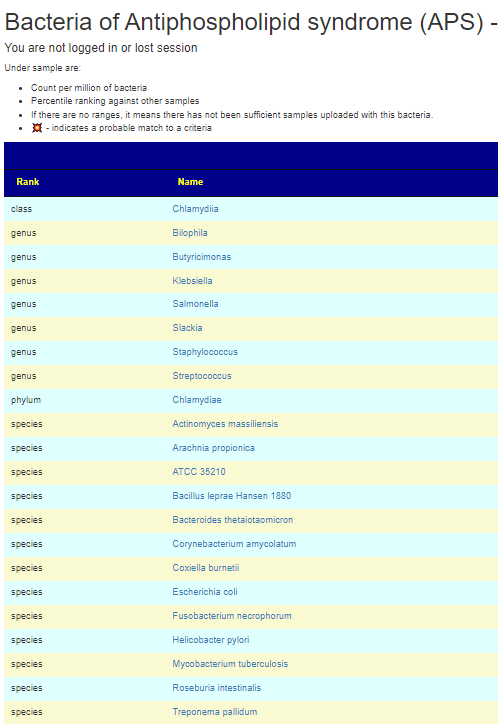
 Bacteroides thetaiotaomicron, Actinomyces massiliensis, Pseudopropionibacterium propionicum, Corynebacterium amycolatum, Ruminococcus gnavus and Roseburia intestinalis[2021] lead to the formation of pathogenic T‑cell and autoantibody responses via the cross-reactivity with autoantigens (Ro60, dsDNA and ß2 glycoprotein I). 

The role of the microbiome in lupus and antiphospholipid syndrome [2020]

M. pneumoniae and Streptococcus spp. infections, which are among the most prevalent bacterial infections in children and young adults, were linked to the occurrence of aPL. …. an anaerobic bacterium Fusobacterium necrophorum, although a variety of other bacteria such as streptococci, staphylococci, and enterococci may be also responsible…. a specific change in the gut microbial composition in APS patients. Particularly, a decrease of bacteria belonging to the genus Bilophila and overgrowth of bacteria of the Slackia genus were shown…  enrichment by Slackia spp. and by the lower abundance of butyrate-producing Butyricimonas 

Environmental Triggers of Autoreactive Responses: Induction of Antiphospholipid Antibody Formation [2019]

More discussion of mechanism is in The Role of the Gut Microbiota in the Pathogenesis of Antiphospholipid Syndrome [2015]

Bottom Line

APS only requires one of the bacteria above to trigger it. In terms of using Microbiome Prescription, I would look at Bilophila and Butyricimonas – if below 50%ile, hand pick it, then look at Slackia, if above 50%ile then hand pick it. Check the other bacteria cited above, and if any are over 75%ile, hand pick those. “It only takes one rotten apple to spoil the barrel” seems to apply here.

I have added APS to my PubMed reference list:

From https://microbiomeprescription.com/library/PubMedCitation?CondId=88

Personal Observations

I checked my samples from my last ME/CFS flare and found that Bacteroides thetaiotaomicron went from 73%ile on first sample after onset, to 96%ile on second sample, down to 79%ile, then 70%ile then 20%ile a few months later with recovery and returning to work. The key triggering bacteria will likely be different for each person but you at least have a candidate list to work from.

A Series of Special Studies are being released…

The current studies are listed below with more being planned. The studies look at specific symptoms reported with uploads of microbiome to Microbiome Prescription. As new studies are added, they will be listed on the first link

Using the results of the study is easy, go to your sample, click on [Change Microbiome] and then select the appropriate item (this list will be growing)