ME/CFS caused by breast augmentation?

Foreword – and Reminder

I am not a licensed medical professional and there are strict laws where I live about “appearing to practice medicine”.  I am safe when it is “academic models” and I keep to the language of science, especially statistics. I am not safe when the explanations have possible overtones of advising a patient instead of presenting data to be evaluated by a medical professional before implementing.

I cannot tell people what they should take or not take. I can inform people items that have better odds of improving their microbiome as a results on numeric calculations. I am a trained experienced statistician with appropriate degrees and professional memberships.

Back story 

I’ve had ME/CFS 14 years (symptoms came on stronger after breast augmentation 2008) but the last 9 yrs I’ve been mostly housebound & bed bound 21 hours per day. I’d say I’m moderate/severe. (I live in the Uk) 

My diet:- 

  • Brekkie :- muesli (take raisins out) with coconut milk or almond milk  Or poached egg on 1 seeded brown bread Or scrambled egg with cumin, coconut milk, salt & black pepper on 1 seeded brown bread Or porridge with coconut milk, frozen blueberries or dried goji berries 
  • Lunch:-A banana, nuts (walnuts, pecans, almonds) & mixed seeds 
  • Dinner:-Salad (bistro salad leaves with a little shredded beetroot) cucumber, celery, grated carrot, with jacket potato (or sweet potato) & vegan cheese on top.. I’ve just started to add a sprinkle of organic olive oil & black pepper (tasty)  Or Steamed veg – carrots, green beans, broccoli, stringless beans & sugar snap peas (or mangetout) with sweet potato & usually something out the freezer I pop in oven… which I know I need to stop as it’s processed. I will begin to change that for chicken or salmon (it’s just been easier) 

More information on diet and supplements was also sent.

Analysis

Looking at Bacteria Deemed Unhealthy, the sole item that stands out was moderately high Streptococcus oralis. Dr. Jason Hawrelak Recommendations came out to 90%ile — so better than most people.

For this person, we have a shift towards rarer bacteria with those seen in only 30-50% of samples being over represented.

PercentileGenusSpecies
0 – 922
10 – 1985
20 – 29119
30 – 391020
40 – 491119
50 – 59913
60 – 6999
70 – 7959
80 – 8946
90 – 9956

Since ME/CFS is the condition, I checked the list of antibiotics often prescribed with the following being the top of the list. It is interesting to note that the literature finds that they do improve some ME/CFS patients

  1. gentamicine sulfate (antibiotic)   (1) [See 2021] [2017]
  2. rifaximin (antibiotic)s   (0.949) [Health Rising] [2011] and many more
  3. amikacin hydrate (antibiotic)   (0.845) – no significant literature
  4. gentamicin (antibiotic)s   (0.745) [2017]
  5. metronidazole (antibiotic)s   (0.727) “Metronidazole/Flagyl is reported to have 75% of CFS patients improving ” [Src] also [BMJ]

On the avoid list are some antibiotics that are also prescribed for ME/CFS

  1. rifampicin (antibiotic)s   ( – 0.423 )
  2. tetracycline (antibiotic)s   ( – 0.291 )
  3. azithromycin,(antibiotic)s   ( – 0.289 )
  4. rifampicin (antibiotic)   ( – 0.289 )
  5. doxycycline (antibiotic)s   ( – 0.191 )

She provided some of the items that she is taking so I looked at the estimated impact on her microbiome

  • sertraline,(prescription) which she is reducing. This is likely a good course of action
    • Take Estimate:  20.4, Avoid Estimate:  24.7
  • dopamine (prescription) – this is a bit of a concern to me because it is likely to contribute to microbiome dysfunction
    • Take Estimate:  13.2, Avoid Estimate:  23.1
  • Vitamin C, — keep taking
    • Take Estimate:  22.3, Avoid Estimate:  13.9
  • Cetirizine:
    • Take Estimate:  20.4, void Estimate:  29.1

Note: the above are estimates on whether they will improve or contribute to the microbiome dysfunction. Medical concerns should always dominate.

Suggestions

Doing my usual pick the bacteria to change using different criteria we have:

The number of bacteria selected for each of the above was lower than I often seen.

Going to the Consensus

The following suggestions stand out:

Dropping down to the avoid list, we see

The full list is attached.

Trying out an Experimental feature

I have used this feature of the several recent blogs on autism (Bacteria to Hand-Pick for Autism with Ombre/Thryve samples, Bacteria to Hand-Pick for Autism with Biomesight samples). I have posted the bacteria identified here. Unfortunately sample size are small (1/3 of the Long COVID samples)

Using the 61 samples annotated with CFS and processed thru the same lab (Biomesight.com). We found 11 bacteria identified as statistically associated with CFS. Three were too high and 8 were too low.

RankNameYour valuePercentile
family Actinomycetaceae8025.7
genus Actinomyces4020.2
genus Adlercreutzia7014.4
species Adlercreutzia equolifaciens7021.3
species Anaerotruncus colihominis156079.7
species Bacteroides acidifaciens7027.7
species Bacteroides rodentium185073.6
species Bacteroides uniformis2116061.8
species Bifidobacterium longum30032.8
species Finegoldia magna4028.4
species Prevotella copri708.9

The results from this custom picked set are shown below.

Modifier – Suggestion to takeConfidence
  Human milk oligosaccharides (prebiotic, Holigos, Stachyose)1  📏
  whole grain diet0.576
  inulin (prebiotic)0.541
  blueberry0.4
  vitamin k20.4  📏
  bacillus subtilis,lactobacillus acidophilus (probiotics)0.38
  lactobacillus fermentum (probiotics)0.38  📏
  lactobacillus gasseri (probiotics)0.38  📏
  lactobacillus reuteri (probiotics)0.38  📏
  maltitol0.38
  oats0.38
  navy bean0.379
  ketogenic diet0.379
  vitamin a0.345
  arabinoxylan oligosaccharides (prebiotic)0.328
  chondrus crispus (red sea weed)0.328
  green tea0.328
Modifier to avoidConfidence
 saccharin0.533
 Slippery Elm0.382
 triphala0.382
 glycyrrhizic acid (licorice)0.382
 sugar0.38
 Cacao0.245
 refined wheat breads0.214
Probiotics that are best to take NameImpact
  Bromatech (IT) / Rotanelle plus7.9
  probiotic pur (de) / realdose nutrition6.18
  Realdose6.18
  Jetson (US) / Immunity Probiotics6.09
  douglas laboratories / multi probiotic 40 billion6.09
  Thryve L.PCasei Th1, L.PCasei Th2,L.Ferm IBF1, L.acidoph6.09
Flavonoid Foods Flaxseed, meal Nuts, almonds Almond
Flavonoid / Supplements   Vitamin K (phylloquinone)  Resveratrol   Magnesium, Mg

We have some contradictions between these suggestions and the ones above. Why? The data we are using is very very incomplete. It is the best that is available. In keeping with my principle of less risk, when suggestions are in disagreement (for example Nuts and almonds – recommended here but to avoid above), then omit them. There are a lot of possible items, keeping to positive items where there are no disagreement is the best path.

Because this person suffers from brain fog, they may wish to sit down with a nutritionist to go thru the download list above to craft a diet plan. The suggestions are in no way a balanced nor complete diet. For example increase food rich in magnesium on the take suggestions, or using supplements.

As always, this information is computed from the best available data and is not based on clinical experience. Always review with your medical professional for appropriateness of suggestions before starting.

Bottom Line

I check with this person and the breast augmentation has not been undone. In other words, there is a reasonable chance that it is a significant contributor to the ongoing symptoms. I expect some progress from microbiome manipulation, but I suspect the side effects from augmentation will limit it. The literature seems to confirm it.

  • “Subclinical bacterial infections (biofilms) are strongly implicated in breast augmentation” [2021]
  • “The most common cause of surgical readmission after breast implant surgery remains infection. Six causative organisms are principally involved: Staphylococcus epidermidis and S. aureus, Escherichia, Pseudomonas, Propionibacterium, and Corynebacterium.” [2015]
  • “The researchers found that the women with silicone gel-filled breast implants were significantly more likely to be diagnosed with autoimmune or rheumatic disorders, such as Sjögren syndrome, systemic sclerosis, and sarcoidosis, compared with women without breast implants of a similar age and socioeconomic status.” [2022]
  • “Silicone breast implants(SBI)  are associated in a proportion of patients with complaints such as fatigue, cognitive impairment, arthralgias, myalgias, pyrexia, dry eyes and dry mouth. Silicones can migrate from the implant through the body and can induce a chronic inflammatory process. Explantation[Removal] of SBI results in the majority of patients in an amelioration of the symptoms.” [2017]
ME/CFS bacteria shifts for Ombre/Thryve tests

This post is intended for researchers by pointing to bacteria whose genetics are likely significant for ME/CFS. The microbiome specific raw data is below. Preliminary z-scores indicated that they are significant (Pr < 0.01) and no filtering has occurred for False Detection Rate. Users are advised to perform their own statistics. For bacteria associated using BiomeSight tests, see this post.

Note: These results are lab-specific, using the data from OmbreLabs / formerly known as Thryve.

The raw data is available at: http://citizenscience.microbiomeprescription.com/.

NOTE: The sample size is very low (less than 1/3 of the size of current Long COVID Study)

Symptom ObsNo Symptom ObsLabSymptomName
51935thryveOfficial Diagnosis: Chronic Fatigue Syndrome (CFS/ME)
Basic Data
Bacteriatax_rankNo Symptom CountSymptom CountNo Symptom Frequency %Symptom Frequency %
Burkholderiales Genera incertae sedisnorank2682028.739.2
Anaerococcusgenus5303756.772.5
Vibrionalesorder89109.519.6
Porphyromonas bennonisspecies4183544.768.6
Anaeroglobus geminatusspecies4743350.764.7
Parvimonas micraspecies178171933.3
Insolitispirillum peregrinumspecies1691718.133.3
Rickettsia honeispecies91139.725.5
Levyella massiliensisspecies327253549
Ezakiellagenus243252649
Synergistaceaefamily3432536.749
Odoribacter splanchnicusspecies7024675.190.2
Mucinivoransgenus5095.317.6
Prevotella buccalisspecies4703550.368.6
Enorma massiliensisspecies80118.621.6
Microbactergenus1711718.333.3
Flavobacterialesorder4993453.466.7
Porphyromonas someraespecies1821619.531.4
Parvimonasgenus178171933.3
Anaeroplasmatalesorder3262834.954.9
Desulfurispora thermophilaspecies5073554.268.6
Ruminococcus gauvreauiispecies2852230.543.1
Synergistetesphylum3442536.849
Prevotella disiensspecies2372025.339.2
Holdemania filiformisspecies6414168.680.4
Prevotella baroniaespecies346243747.1
Corynebacterium jeikeiumspecies5185.515.7
Corynebacterialesorder5854162.680.4
Campylobacter hominisspecies1771818.935.3
Peptostreptococcaceae incertae sedisnorank5233655.970.6
Campylobacteralesorder4012942.956.9
Clostridium frigidicarnisspecies659717.6
Pseudomonadaceaefamily3362635.951
Dialister propionicifaciensspecies299233245.1
Absiella tortuosumspecies2091722.433.3
Epsilonproteobacteriaclass439314760.8
Ezakiella coagulansspecies2352225.143.1
Anaeroglobusgenus4753350.864.7
Tannerellagenus2702228.943.1
Gordonibacter pamelaeaespecies346293756.9
Bacteroides ovatusspecies8125086.898
Schaalia suimastitidisspecies1991721.333.3
Lacrimispora sphenoidesspecies1511416.127.5
Propioniferax innocuaspecies1281413.727.5
Rickettsiagenus1421615.231.4
Corynebacteriumgenus5293656.670.6
Prevotella loescheiispecies2022021.639.2
Corynebacteriaceaefamily5343657.170.6
Desulfovibrio idahonensisspecies2312024.739.2
Thiomonasgenus1911620.431.4
Peptoniphilus lacrimalisspecies2231823.935.3
Lactonifactor longoviformisspecies6073964.976.5
Synergistiaclass3432536.749
Fulvitaleagenus4985.215.7
Alistipes shahiispecies7024475.186.3
Anaerococcus octaviusspecies1251513.429.4
Levyellagenus3322735.552.9
unclassified Burkholderialesfamily1831619.631.4
Enormagenus81118.721.6
Sphingomonas abacispecies5285.615.7
Anaerococcus vaginalisspecies3022432.347.1
Rickettsialesorder2142122.941.2
Thermoanaerobacteraceaefamily262212841.2
Flavobacteriiaclass4993453.466.7
Eubacterium pyruvativoransspecies5223455.866.7
Anaeroplasmataceaefamily3252834.854.9
Peptostreptococcus anaerobiusspecies89149.527.5
Mogibacterium timidumspecies168161831.4
Alistipes obesispecies5533659.170.6
Tissierellia incertae sedisnorank5644060.378.4
Dielma fastidiosaspecies5023353.764.7
Clostridium chartatabidumspecies6384168.280.4
Desulfocellagenus2662128.441.2
Mucinivorans hirudinisspecies4995.217.6
Rickettsieaetribe1932020.639.2
Syntrophomonas sapovoransspecies88109.419.6
Rickettsiaceaefamily1952020.939.2
Butyricimonas faecihominisspecies3142333.645.1
Ectothiorhodospiraceaefamily2131722.833.3
Anaeroplasmagenus1411415.127.5
Gordonibactergenus4973453.266.7
Fulvitalea axinellaespecies4885.115.7
Dehalobactergenus1721518.429.4
Hydrogenisporagenus4233145.260.8
Fenollariagenus4703150.360.8
Anaerococcus murdochiispecies1211612.931.4
Anaerococcus senegalensisspecies112171233.3
Porphyromonas asaccharolyticaspecies2282124.441.2
Mogibacteriumgenus664427182.4
Campylobactergenus3522537.649
Firmicutes sensu stricto incertae sedisnorank4173144.660.8
spotted fever groupspecies group1101511.829.4
Acinetobactergenus2562027.439.2
Synergistalesorder3432536.749
Lactonifactorgenus6134065.678.4
Persicobacteraceaefamily59136.325.5
Desulfurisporagenus5083554.368.6
Holdemaniagenus7794883.394.1
Desulfocella halophilaspecies2632028.139.2
Ezakiella peruensisspecies2582.715.7
Tannerella forsythiaspecies2652128.341.2
Campylobacteraceaefamily3662639.151
Absiellagenus3522537.649
Flavobacteriaceaefamily4533048.458.8
Tepidibactergenus83108.919.6
Dehalobacter restrictusspecies1721518.429.4
Peptoniphilus coxiispecies2702428.947.1
Hydrogenispora ethanolicaspecies4163044.558.8
Pseudomonasgenus327233545.1
Insolitispirillumgenus1731718.533.3
Thermoanaerobacteralesorder3902841.754.9
Odoribactergenus7374678.890.2
Microbacter margulisiaespecies168171833.3
Propioniferaxgenus1291413.827.5
Items deem significant based on Bernoulli distribution


Bacteriatax_rankNo Symptom MeanSymptom MeanNo Symptom StdDevSymptom Std DevSymptom ObsNo Symptom Obs
Alistipes onderdonkiispecies48591162215348.323577.447819
Natranaerovirgagenus1749831892.43879.331578
Rikenellaceaefamily169812825824648.130780.651920
Enterobacteralesorder31161563510315.978732.246856
Blautia gluceraseaspecies123734464110.711731.940727
Desulfobacteraceaefamily91279155.3988.132561
Tenericutesphylum119831693795.417659.146824
Mollicutesclass117831693773.817659.146824
Chromatialesorder1024914952392.333625
Gammaproteobacteriaclass65151765516956.987886.151933
Bacteroides intestinalisspecies199274328144.430306.343779
Alistipesgenus166852749124264.130694.651920
Desulfobacteralesorder94256155.3933.736585
Items deemed significant based on mean and standard deviation

ME/CFS bacteria shifts for BiomeSight tests

This post is intended for researchers by pointing to bacteria whose genetics are likely significant for ME/CFS. The microbiome specific raw data is below. Preliminary z-scores indicated that they are significant (Pr < 0.01) and no filtering has occurred for False Detection Rate. Users are advised to perform their own statistics. For Ombre/Thryve bacteria see this post.

Note: These results are lab-specific, using the data from BiomeSight.

The raw data is available at: http://citizenscience.microbiomeprescription.com/

NOTE: The sample size is very low (less than 1/3 of the size of current Long COVID Study)

Symptom ObsNo Symptom ObsLabSymptomName
611095biomesightOfficial Diagnosis: Chronic Fatigue Syndrome (CFS/ME)
The data available

Bacteria that appear more or less often with statistical significance

Bacteriatax_rankNo Symptom CountSymptom CountNo Symptom Frequency %Symptom Frequency %
Syntrophobacteralesorder5713952.163.9
Chitinophagalesorder5073946.363.9
Anaerococcusgenus4763643.559
Porphyromonas bennonisspecies3082528.141
Rhodovibrio sodomensisspecies2311921.131.1
Novispirillumgenus6534359.670.5
Thiobacillusgenus1591614.526.2
Insolitispirillum peregrinumspecies6514359.570.5
Thiobacillus thiophilusspecies1231311.221.3
Amedibacillus dolichusspecies6844662.575.4
Adlercreutzia equolifaciensspecies6824662.375.4
Hymenobacteraceaefamily7374867.378.7
Streptococcus phocaespecies91128.319.7
Finegoldia magnaspecies4513541.257.4
Anaerococcus tetradiusspecies1231311.221.3
Leuconostocgenus4833544.157.4
Porphyromonas someraespecies2031918.531.1
Vagococcusgenus296232737.7
Carboxydocellagenus591405465.6
Clostridium cadaverisspecies3812834.845.9
Bacteroides acidifaciensspecies8395476.688.5
Thiomicrospira sibiricaspecies7711718
Desulfofrigusgenus107139.821.3
Chitinophagaceaefamily5103946.663.9
Eggerthellagenus7875071.982
Corynebacterium jeikeiumspecies80117.318
Corynebacterialesorder6434258.768.9
Corynebacterium aurimucosumspecies1211511.124.6
Blautia hydrogenotrophicaspecies7495168.483.6
Bacteroides heparinolyticusspecies3192529.141
Rickettsia marmionii Stenos et al. 2005species84137.721.3
Niabella aurantiacaspecies1581514.424.6
Carboxydocella ferrireducensspecies5773952.763.9
Bacteroides caccaespecies832537686.9
Desulfobacteraceaefamily2472022.632.8
Finegoldiagenus537394963.9
Phascolarctobacterium faeciumspecies6534359.670.5
Odoribacter denticanisspecies6564359.970.5
Corynebacterium amycolatumspecies83117.618
Pelotomaculumgenus3872835.345.9
Peptoniphilus asaccharolyticusspecies4183138.250.8
Corynebacteriumgenus5233747.860.7
Corynebacteriaceaefamily5233747.860.7
Pelotomaculum isophthalicicumspecies3872835.345.9
Thiobacillaceaefamily1591614.526.2
Rhodovibrionaceaefamily230192131.1
Bacteroides fluxusspecies8255575.390.2
Symbiobacteriaceaefamily6414258.568.9
Limnobacter litoralisspecies7705070.382
Clostridium akagiispecies5293648.359
Lactobacillus acidophilusspecies76116.918
Desulfofrigus oceanensespecies106139.721.3
Piscirickettsiaceaefamily1371412.523
Marinospirillumgenus2212020.232.8
Moryella indoligenesspecies78117.118
Roseospiragenus1832116.734.4
Halanaerobiaceaefamily2021818.429.5
Rhodovibriogenus2311921.131.1
Limnobactergenus7735070.682
Schaaliagenus5313748.560.7
Chitinophagiaclass5073946.363.9
Clostridiales Family XVI. Incertae Sedisfamily591405465.6
Symbiobacterium toebiispecies6414258.568.9
Anaerococcus hydrogenalisspecies1621614.826.2
Pediococcusgenus6444258.868.9
Symbiobacteriumgenus6414258.568.9
Adlercreutziagenus7865071.882
Actinomycesgenus7975272.885.2
Porphyromonas asaccharolyticaspecies2592323.737.7
Butyricimonas synergisticaspecies3972936.347.5
Bifidobacterium longumspecies7955272.685.2
spotted fever groupspecies group1391712.727.9
Actinomycetaceaefamily8665579.190.2
Phascolarctobacterium succinatutensspecies7865071.882
Contubernalisgenus1431613.126.2
Streptococcus oralis subsp. tigurinussubspecies4403140.250.8
Halanaerobiumgenus2021818.429.5
Shewanella upeneispecies263212434.4
Candidatus Contubernalis alkalaceticumspecies1431613.126.2
Oceanospirillaceaefamily2612223.836.1
Thiomicrospiragenus110131021.3
Roseospira mediosalinaspecies60115.518
Amedibacillusgenus6844662.575.4
Insolitispirillumgenus6514359.570.5
Psychrobacter glacialisspecies1901917.431.1
Ethanoligenensgenus5183547.357.4
Items deem significant based on Bernoulli distribution

Bacteria where the difference in counts is significant


tax_nametax_rankNo Symptom MeanSymptom MeanNo Symptom StdDevSymptom Std DevSymptom ObsNo Symptom Obs
Novispirillumgenus83051613815057.330286.743653
Insolitispirillum peregrinumspecies83271613315072.130272.343651
Streptococcus australisspecies196753434.53495.940739
Anaerovibriogenus12172540271910547.756968
Anaerotruncus colihominisspecies174924331677.82418.4611054
Prevotella coprispecies650825361148361.223886.1571000
Rhodospirillaceaefamily128142705725272.753923.251896
Bacteroides rodentiumspecies296762274910.210044.9611067
Anaerovibrio lipolyticusspecies120125372700.610546.956963
Bacteroides fluxusspecies22312131400.45587.455825
Bacteroides uniformisspecies259804074737165.540517.7601075
Streptococcus parasanguinisspecies192633387.92639.138685
Alphaproteobacteriaclass119392339426761.150681.6601062
Streptococcusgenus304861527181.526974611082
Burkholderiaceaefamily324578559.3817.556970
Rhodospirillalesorder127792613126212.853158.453933
Blautia obeumspecies58571075310528.122306.7601043
Streptococcus thermophilusspecies86321062185.98681.654905
Insolitispirillumgenus83271613315072.130272.343651
Items deemed significant based on mean and standard deviation

Evidence of ME/CFS improving using Microbiome Data

Overview

Short bio: 35yr Male have had ME/CFS for about 7 years, see A review of a ME/CFS Microbiome for prior review plus backstory. This was my review for “A – Thryve:2021-11-21 self” below.

This person has had done three samples, so we will both look at the latest sample and across samples.

  • A – Thryve:2021-11-21 self
  • B – Thryve:2022-03-15 self (he used the microbiome prescription site himself to get next course adjustment)
  • C – Thryve:2022-05-16 self (this review)

The key questions focus on objective improvement and subjective improvement.

General Health Issues

The evenness of Genus and Species across percentile is shown below

AABBCC
PercentileGenusSpeciesGenusSpeciesGenusSpecies
0 – 91116691115
19-Oct123015301927
20 – 29193120241231
30 – 39183523451633
40 – 49162420371830
50 – 59213125452133
60 – 69182017301422
70 – 79162311281623
80 – 8951416241321
90 – 993141320514
Total139238166292145249
Std.Dev.6.057.715.7211.104.607.02

My reading is that at the Genus level, the microbiome is stablizing. An ideal microbiome would have a Standard Deviation of 0.0 (i.e. the appropriate percentage is in each class). We see for Genus move from 6.0 -> 5.7 -> 4.6. Species have a far greater degree of randomness because may species are not identified, most genus are identified.

Potential Medical Conditions Detected

The count has been similar: A:3 B:6 C:2 with the one items in common being Allergies.

Unhealth Bacteria

The counts were similar between all samples: A:18, B:20, C:21

Dr. Jason Hawrelak Recommendations

We had significant improvement between the first two samples and a slight loss going to the third: A: 56.5%(5) B:95.5% (8) C: 89% (7)

AI Computed Probiotics

Sample A
Sample B
Sample C – Nothing

AI Suggested Supplements

Using the default 10% level, we found samples A and B only suggested one supplement. C suggested 2 (L-Histidine and manganese). I looked up the item from A and B and saw that it had continued to improve. 🙂

SupplementsABC
beta-alanine 7.39.217.3

Has there been positive change?

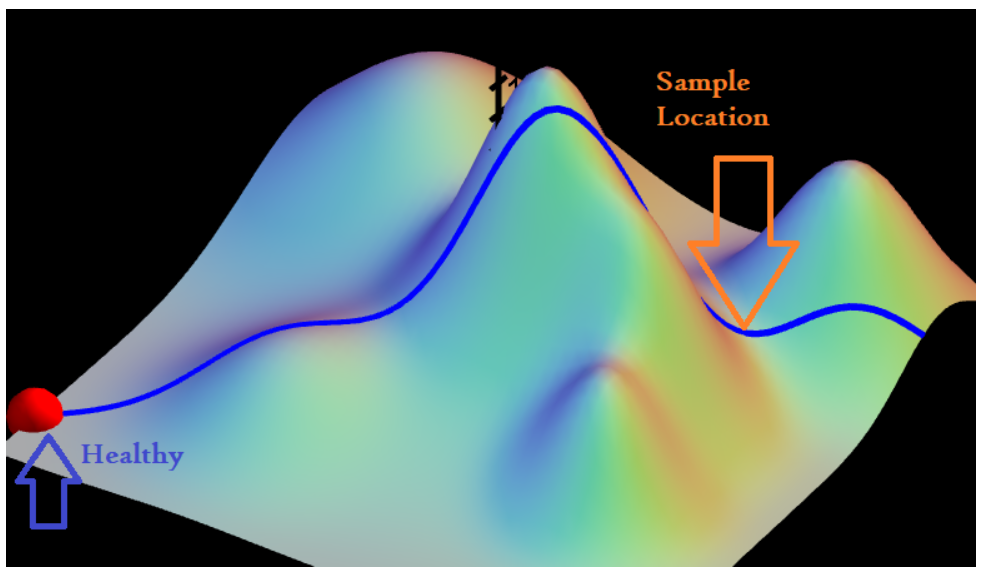
My reading of the above objective numbers is yes in several vectors. There was nothing show a clear negative change. Somethings stayed put — that is fine, it is small steps. As the picture below illustrates, it is not a direct line/tunnel through the mountain ranges of dysbiosis, we have to work our way across passes and valleys.

The “I don’t feel better” quicksand

I have too often seen — especially with people suffering from Myalgic encephalomyelitis/chronic fatigue syndrome (ME/CFS) — patients giving up on a course of action because they reached a point where they may state “I don’t feel better from doing this, so I am changing…”. For these people, this is often caused by several factors:

  • They do not remember how they were actually 2 weeks or 2 months ago…
  • Their MD have no objective tests to show progress
  • They expect significant constant change constantly (they are frustrated waiting for improvement)

Using the microbiome and repeated testing, they can get objective measurement of changes instead of relying on subjective measurement being done under the influence of brain fog with memory problems.

In this person case, we do see objective improvement of the dysbiosis. What about subjective?

“You’re welcome to mention I have noticed improved sleep and lower anxiety despite my good and bad bacteria shifting around “

From the reader

Moving Forward

As reviewed above, we have no KEGG suggested probiotics, but do have these supplements suggested:

On a personal note, I used NADH during my 1999-2000 relapse (1st time diagnosis). I eventually switched to 400 mg of flushing niacin twice a day (after MD checked my liver function see facts) and have continue to do so (with liver being tested every year).

Getting suggestions based on US National Library of Medicine Studies

As is my pro forma approach, I did each of the following (with number of bacteria picked after):

The new layout of the consensus page is shown below

Remember these are blindfolded suggestions, items like polysorbate 80 as a supplement is not recommended by any MD, it is in many supplements. [src]

My suggestion for 3 probiotics to rotate thru are:

For more information on probiotics see the bottom section of this recent review.

For supplements, there are only 3 easily accessed items that are positive, everything else is negative impact!!Ferric citrate (iron supplement), magnesium (commonly used for ME/CFS) and vitamin k2

For other things, see the video or the suggestions on your microbiome.

Bottom Line

You are making objective progress. A word of caution, if some of the items that you are currently taking on the avoid list, slowly remove them by reducing amount and watching for potential adverse effect. Some of the positive objective changes may be due to them (there is a risk of a feedback loop: if you are taking them, they are not needed BUT it you stop taking them, your microbiome may devolve to a state needing them).

Last – Using Symptoms

This is EXPERIMENTAL. It is a thought experiment and I am still learning it’s behavior. For some symptoms it may reduce awesome results, for others it may improve one set of symptoms at a cost of other symptoms getting worst. I picked two of the more unusual symptoms that he had:

  • Comorbid: Methylation issues (MTHFR)
  • Immune: Chronic Sinusitis

This resulted in this list being selected with a very strong Filter (first time I have seen this)

RankNameYour valuePercentile
class Flavobacteriia217
order Chromatiales219.4
order Flavobacteriales217
order Marinilabiliales2113.5
phylum Tenericutes429.5
species Bifidobacterium bohemicum2111.8
species Eubacterium ramulus872095.5
species Prevotella disiens94684.1

I would suggest using it to increase the priority of some items that are positive suggestions in the consensus list, I would not go with using this set of suggestions alone.

Questions from Reader

  • Ferric Citrate ,  haven’t been able to find this type?🤔 Have you seen it anywhere? Also how would one figure out the dose for gut bacteria shifting?

    • I am an ex-science teacher and thus know it more common name, Iron CitrateSwanson and others sells it.
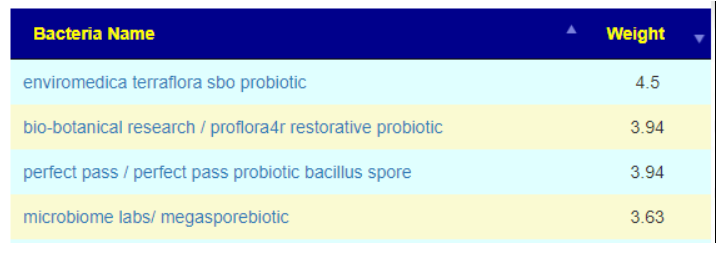
  • Bacillus- taking terraflora , think I’m up to 6 caps. I saw in a study I need to get to 20 !!
  •  …I also have prescript on hand BUT that has a lot of other SBO strains. Would you stuck to TERRAflora for now?  
    • I would keep the Prescript Assist on the shelf, and keep to Terraflora, I would keep increasing the dosage every second day until the bottle was finished. I would look around for ones with similar probiotics for the next cycle, for example Youtheory, Spore Probiotic, 6 Billion CFU, 60 Vegetarian Capsules – for two reasons:
      • Cheaper per BCFU (and also higher BCFU per dosage)
      • Different strains often helps because they produce slightly different products
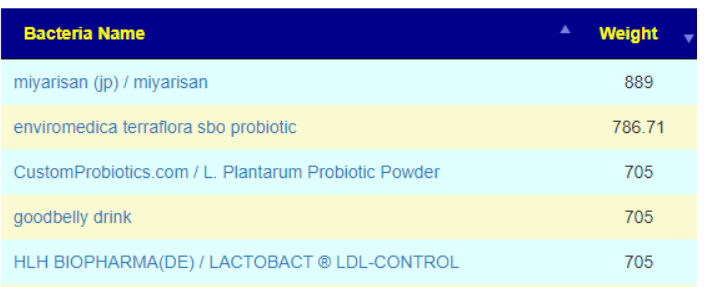
  • Miyarisan , I thought I saw this in my results somewhere , maybe it was far down the list…would you save or finish if you had my results?
    • It is on the list, I would finish it before starting the next cycle of probiotics (REMEMBER: we want to be rotating the probiotics – not take them continuously)
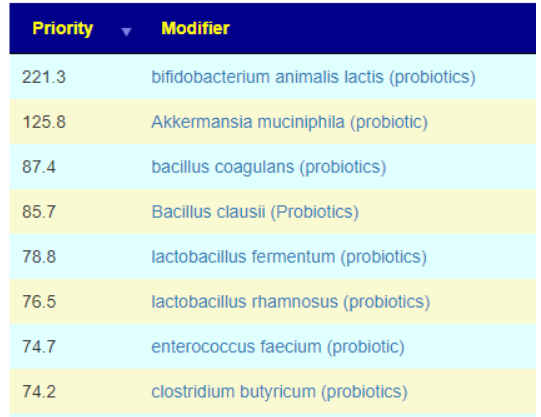
  • Akkermansia – I have 2 bottle of this stuff actually from pendulum . I read you and your wife has taken it. How much did you take or I know it’s a new product but if you’ve seen a study with dosing please let me know. 
    • The one existing study used 10 BCFU/day, and the bottle reads 0.4 gm. Lacking more information, I would just keep to the bottle recommended dosage.
  • NADH- I have the flush stuff and cq10? Do you think that combo works or does it have to be Nadh?
    • Personally, I found flush niacin had greater impact and still look forward to my morning flush to get the mind working (it improves oxygen delivery because it’s a vascular dilator). Assuming you can tolerate the flush.

ALWAYS REVIEW WITH YOUR MEDICAL PROFESSIONAL FIRST

Intelligence of Nature “RESTORE” – still danger?

A reader emailed about my earlier post, RESTORE for gut health Danger Will Robison! I am a firm believer in evidence based medical treatment. Ideally the source of the information will be a study on the US National Library of Medicine (PubMed). If it is not studied, IMHO there is a significant risk of danger.

He writes:

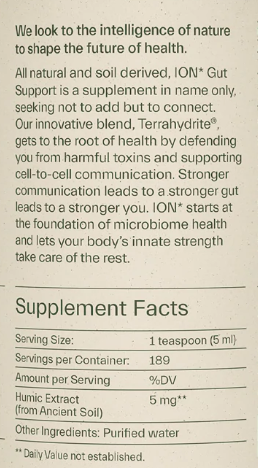
I purchased  a bottle of RESTORE a couple years back which was manufactured by Bionic Sciences LLC which is now ION* Gut Health and the company changed its name to Intelligence of Nature  the ingredients of my RESTORE bottle says Aqueous Humid Substances ( Terrahydrate). 150mg per teaspoon and now the ingredients on the ION* bottle says Humic Extract from ancient soil 5mg per teaspoon …
Are we talking about the same product here???

I proceeded to their site to see if they have any evidence. They linked to studies, I downloaded many of them:

My first impression is that we have gas-lighting here. It has not been peer-reviewed, but most people will not registered the “pending”. It has not been published.

Another of their studies seems like a deliberate attempt to mislead, iMedPub seems to be an attempt to mimic PubMed… Going to that site I see “All Published work is licensed under a Creative Commons Attribution 4.0 International License” and who owns that site is willfully hidden (checking its registration) and it is a “we publish anything for a fee site” – “Hence, the Journals operate solely through processing charges we receive from the authors and some academic/corporate sponsors. ‘[src]

So what is in it? They appear to have obfuscate the ingredients – Dropping the list and replacing it with a non-descript “Humic Extract (from Ancient Soil)”. In other words, I can get the same thing by just going to any National park and collecting some soil!!

There are studies for other products

Bottom Line

The firm is my issue, not the concept. Studies have shown that results depend on the source/content of the humic acids. They have failed to provide scientific information on the content. They have failed to publish respectable studies and the studies on their site appears to be gas-lighting. Their prices is $72 for a 2 month supply… well, I can get 25 pounds of Granular Humic Acid Powder – 25lb Bag, for $20 from Walmart!

I have also commented in the past” A teaspoon of good soil will likely help many microbiome issues” (i.e. the hygiene hypothesis). Most of the bacillus probiotics are soil based bacteria.