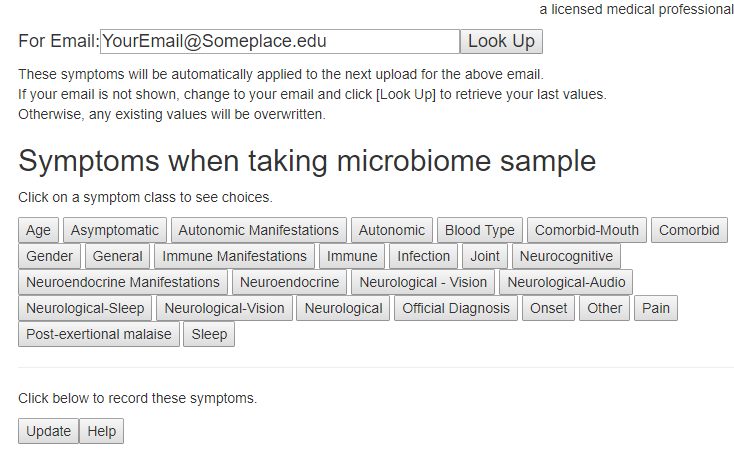
A reader expressed frustration because he could not remember his symptoms when he took his ubiome sample. In response to this, I have added a new page to allow you to record symptoms when you do a sample AND these symptoms will be automatically applied to your next upload.
If you log on first, the email should be yours. If you have never done an upload, then enter your email, click Look Up (to clear out any symptom that some one added to the bogus email) and proceed.
You can return later and adjust the symptoms if you wish.
This item has been on my backburner for a while and today I came up with an efficient algorithm to compute a short most probable symptoms. The results on my own samples were actually quite accurate.
The process is simple: Apply analysis (AI techniques) to the uploaded microbiome samples annotated with symptoms. We then flip the results to predict from an individual sample using these results. A lot of computational magic going in and out.
I have MTHFR issues (reported by conventional testing), this is my age range, cold hands and feet, I have been well aware since the 1970’s of eye focus issues (from eye specialist). The disorientation matches up with my being a high functioning autism spectrum person. The last item makes it a slam dunk….
I checked another person who I know the medical history. The person has TMJ, and just about every symptom listed!
Where is this new feature
One thing that I realized that it predicted symptoms that I would NOT associate with my current state– but actually matches the long term medical issues. For example, eye focus issues — that goes back 40 years and which is not on my radar as an active symptom.
I suspect “mouth sores” which showed up on other issues — may include gum disease being active.
Addendum
A reader try it and posted on facebook.
As a result, I added a link to the page to also give extended prediction with an indicator of the prediction confidence (score).
For new readers: I have had Myalgic encephalomyelitis/chronic fatigue syndrome (ME/CFS) three times in my life and recovered each time. As a result of work stress, I am currently in a ‘flare’, because it was sudden onset and I realized what it was on day one and took aggressive action it did not become established. Established usually means six months of tests ruling out all of the possible alternative causes for the symptoms!
The model foe ME/CFS that I use is a microbiome dysfunction. I reached this conclusion long before mainstream research started to investigate and confirm that it does appear to be that, Some recent literature:
Instead of the usual 6 months of testing for what is not there, I proceeded to get my ubiome done. I had two earlier ones done from when I was in remission. I have an actual base line to compare to. This makes interpreting data a lot simpler. It also mean that I could quickly confirm ‘my gut feeling’ that is was ME flaring.
Following suggestions from my last microbiome results
I had an interesting experience with a morning bowel of barley (β-Glucan) with unpasteurized yogurt with beet sugar. The first two days, felt good, day 3 & 4 sore throat appeared. Missed a day and sore throat disappear. Back on barley and day 2, sore throat re-appear, more mild than before. Disappeared a couple of days later.
I am assuming that the barley and beet sugar feeds bacteria that are attacking other bacteria significantly. The wife was surprised when she tasted the beet sugar — it was not as sweet as cane sugar. I must admit to be confused by the sugar industry saying they are identical, and do find some support for them being different, like in this article.
Oats or barley for β-glucan
This study compares in the same experiment the β-glucan content of nine barley and 10 oat genotypes grown at two locations in each of two years (i.e., four environments) in North Dakota. Averaged across genotypes, total β-glucan content of barley and oat groat was similar.
Longer periods of mild physical activity before warning signs of two much activity (hiccups — a family trait that my kids always have when they are over tired. Sweats (even on a cold morning with no jacket), lisp in speech appears. By longer, I mean has increased from about 11 minutes until just under 20 minutes.
I can handle a 20 minute drive fine and keep to that distance bound. When I have gone longer, suddenly a ton of bricks hits, no gradual tiring.
Longer periods of sleep at night and more sleep. In the past it was short periods only (90-120 minute) then I was awake for a while. Now, I may get up to 6 hrs in a stretch.
Much more refreshed at waking in the morning.
Weight loss — some 20 lbs. Little appetite.
Still experiencing some Multiple Chemical Sensitivity issues, minor — but my work location is toxic with them, so it’s working remotely or leave as the only viable options.
UBiome Results
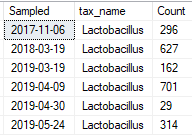
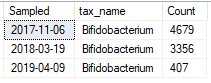
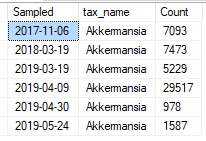
In my last post I gave the history of my readings for Lactobacillus, Bifidobacterium and Akkermansia. There was a little improvement in two of them,. but they are still magnitudes below my past normals.
Other Good News
Serotonin has returned to normal range, but GABA is at around 4% of most people
Old News – Ubiome Edition
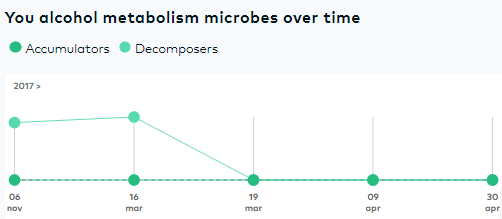
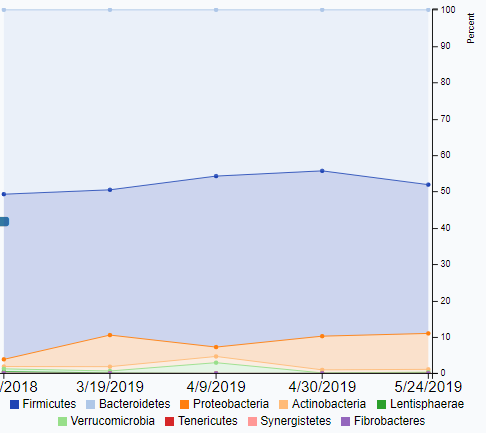
Still flat lining theseGraphic of my last postAnti Inflammatory Polyamine is flat lining still Anti Inflammatory Propionate is flat lining still Anti Inflammatory butyrate is flat lining still At the phylum level the “new kids” are going down, but Actinobacteria is still very elevated. Dropping down to the Genus Level we see we see some of the specific disturbances
On the image below, the 2018 values are from remission, 2019 are during the flare.
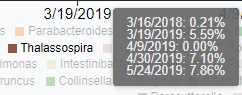
Dropping down to the Genus Level we see we see some of the specific disturbances Growth is reversing itselfFirst value is Healthy valuesAlistipes drop by a factor of 3 and is now recoveringAbove are the elusive bacteria reported by uBiome
In terms of the rare/elusive bacteria, we see many of them disappear as the flare progresses, and strangers appear. The strangers are disappearing and some old friends, like Caldicoprobacter are returning. The high Bacillus count was likely from taking Bacillus coagulans as a probiotic.
In terms of predicted function using KEGG Pathway database, we can see the dynamic shifts. Two OVER represented at the start, has collapsed with a little sign of recovering.
Old News – MicrobiomePrescription Edition
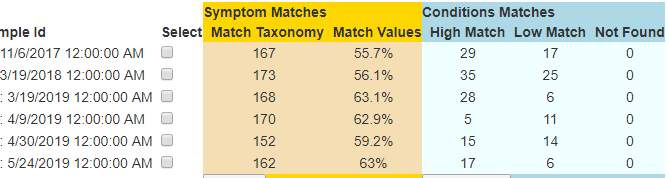
In terms of symptoms associated with bacteria, there was a significant drop in the number of Condition Matches. We must be careful not to read too much into that, because a microbiome in the process of changing (which we see above) will not match the patterns of people who are stable.
Bottom Line
The direction is improving. The improvement can be seen in both the microbiome and the symptoms moving closer to my pre-flare state. Recovery is fragile and in one sense, I am likely in the most dangerous time — significant symptom improvement and one could stop being diligent in keeping to a treatment plan. Over the decades, I have seen too many people make a good solid recovery and then crash because they pushed themselves too far in recovery.
My criteria is simple and objective: Microbiome must return to the older state, especially the levels of lactobacillus and bifidobacteria; but also for other genus that either waxed or waned during the flare. Being disciplined and objective is essential.
I am still “living in a plastic bubble” of restrictions. The bubble is slowly expanding.
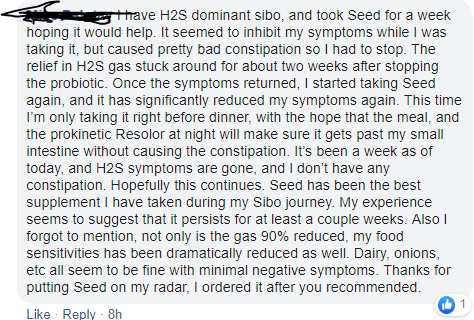
I just got my ubiome results today. The sample was taken after one month on Seed Probiotics. I believe that the Seed Probiotics have made a significant positive impact on me, but the impact that I was most hoping for was seeing more lactobacillus AND bifidobacterium being reported.
See this update on the results after 2 months on Seed.
The answer is, it may.
For new readers, a ME/CFS flare was triggered by work stress around the 12 of March, 2019 — dramatic changes seen across my microbiome (separate posts on these). I am still recovering.
Sample readings
From the last sample (where I had stopped things that I should not have – sampled 04-30) until this time, we see a 10 fold increase in Lactobacillus, but not a single bifidobacterium has appeared. Akkermansia is often associated with these two, so I include it.
A bit of a roller coaster.Not a single unit to be seen despite Seed having many species in itAkkermansia is making some recovery
I will be continuing on with Seed Probiotic and plan to do my next sample in 8 days. I am feeling better and ME/CFS symptoms are reducing — whether that is a natural recovery or impacted by Seed, is a matter for speculation.
Bottom Line
The evidence for Seed persisting is weak. Good evidence would have been both Lactobacillus and Bifidobacterium to make significant improvement.
Personally, I am happy with it for the bacteriocins (natural antibiotics) appears to be in it. I discovered this the hard way. One night I forgot that I had taken 2 capsules an hour before and took a second dose. It was a rough night.
Some readers have asked me to explain my view of what causes a wide range of conditions – from diabetes to autism, from myalgic encephalomyelitis to parkinson’s.
At a high level, there are three dominant factors:
DNA – every autoimmune condition has SNP variations associated. This does not mean you will get the condition — just have greater odds of getting it. (1151 articles on PubMed)
Epigenetic changes to DNA. This means that some environment influence has caused DNA functions to be turn off or on (or scale).
Classic examples are stress (5556 articles on PubMed),
And last, is consequences of infection and even immunization which can alter the microbiome — often in a long lasting way. The best study example occurred in Bergen Norway. 60% of CFS suffers developed the condition after a flu (or ‘flu-like’) illness.
Each factor interacts with the other factors and if you are unlucky, you have a struggle ahead of you. Of the above factors, the microbiome is the simplest to adjust.
Modifying epigenetic changes is more challenging – with stress being likely the only exception. Stress induced epigenetic changes may be reduced or reversed with full removal of stress (speculation) — which is not a trivial path. We may need almost 100% removal of stress, not just reducing it. We know that diet can invoke epigenetic changes – just do not know how. Science is still working on just detecting epigenetic, modification may be decades away.
At what microbiome level may we need to go down to?
Twins with identical DNA with one having a condition and another not, is the classic way of controlling for DNA variation.
” We collected fecal samples and clinical metadata from 20 monozygotic Korean twins … Finally, our unique study design allowed us to examine the strain similarity between twins, and we found that twins demonstrate strain-level differences in composition despite species-level similarities. “
The microbiome is the easiest factor to address. It is not an easy to do. Just the easiest of the available choices. It is made more comlex by different diets, life style (yes, exercising regularly alters the microbiome) and even age (diversity decreases with age).














 CFS Remission