Exercise and the Microbiome

My last post deal with microbiome differences seen between healthy individuals and CFSers after stress exercise. In this post I will look at the reported changes (in healthy individuals usually) as a result of exercise in the hope that it may provide hints on what is happening. There was not much. What I found is below.


NOTE THIS MAY OR MAY NOT BE APPLICABLE TO CFS PATIENTS

A 2014 article included the following chart dealing with mice:

  • ND – Normal Diet
  • HFD – High Fat Diet
  • ND+ex — Normal Diet + exercise
  • HFD+ex – High Fat Diet + exercise

Screen Shot 2015-12-19 at 4.02.44 PM

“Somewhat to our surprise, our data suggest that HFD and exercise independently impact the different behavioral domains of anxiety and cognition, much like the orthogonal effects on the gut microbiome. Though the cognition associations with specific OTUs were weaker compared to anxiety, we nonetheless found significant relationships that all fell within Clostridiales, a diverse taxonomic order within the phyla Firmicutes that has not been previously associated with cognition.. Numerous studies have described how the gut microbiome is altered by a HFD and obesity including changes in Firmicutes and Bacteroidetes [28-31]. Though only a very minor phylum in terms of representation, we also found that HFD reduced the relative abundance of Tenericutes, driven almost entirely by a single OTU (#67) from the genus Anaeroplasma (>99% probability as shown in Additional file 2: Table S2) that has not been previously implicated in dietary manipulations.”
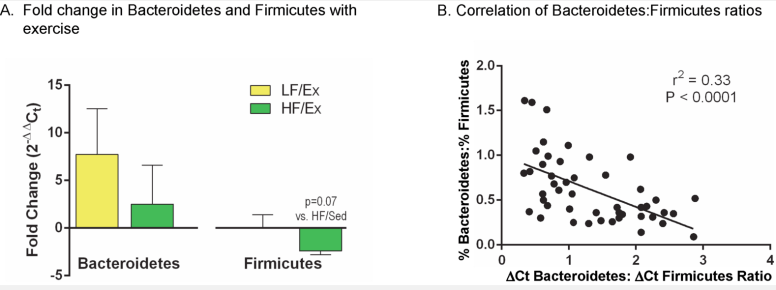
Screen Shot 2015-12-19 at 4.19.53 PMScreen Shot 2015-12-19 at 4.22.32 PM.pngAnother 2014 article looked at mice with Low Fat (LF) and High Fat (HF) diets.

Screen Shot 2015-12-19 at 4.17.25 PM

“Exercise alters the gut microbiota in mice on both a LF and HF diet and normalizes major phylum-level changes for mice on the HF diet; furthermore, the volume of exercise (total distance run) inversely correlates with the Bacteroidetes:Firmicutes ratio. The Ex-induced gut microbiota in both LF and HF conditions are different than their sedentary counterparts and yet, also different from each other. At the taxonomic level of bacterial family, HF diet induced blooms in some of the major constituent groups within Firmicutes such as Lactobacillaceae, Lachnospiraceae, and Ruminococcaceae and a decrease in the major constituent group of Bacteroidetes, S24-7. Exercise in the HF condition prevented some of the dietary changes, such as with Lactobacillaceae and S24-7, but intensified the blooms seen with HF feeding in others such as with Lachnospiraceae, and Ruminococcaceae. Further exploration of the gut microbiota changes induced by Ex may allow for exploitation of this effect and the development of treatments for obesity and dysbiosis associated with high fat intake.”


From a 2013 article “Diet rapidly and reproducibly alters the human gut microbiome”,

“The animal-based diet increased the abundance of bile-tolerant microorganisms (Alistipes,Bilophila and Bacteroides) and decreased the levels of Firmicutes that metabolize dietary plant polysaccharides (Roseburia, Eubacterium rectale and Ruminococcus bromii). Microbial activity mirrored differences between herbivorous and carnivorous mammals2, reflecting trade-offs between carbohydrate and protein fermentation. Foodborne microbes from both diets transiently colonized the gut, including bacteria, fungi and even viruses. Finally, increases in the abundance and activity of Bilophila wadsworthia on the animal-based diet support a link between dietary fat, bile acids and the outgrowth of microorganisms capable of triggering inflammatory bowel disease

“Exercise leads to an increase alpha diversity amongst individual’s microbiome, especially the Firmicutes and Clostridiales. Significant differences were seen in commensal bacteria within the phylum, Firmicutes. These included Faecalibacterium prausnitzii, uncharacterized species of genus Oscillospira, Lachnospira, Coprococcus, and uncharacterized families of Clostridiales. These differences in commensal bacteria can lead to healthier individuals more able to fight off certain pathogens. For example, Faecalibacterium prausnitzii is a butyrate producer, which has been shown to be important in maintaining intestinal epithelial health. (Blottere HM et al. 2003) ” [2014 Thesis Paper] – NOTE: Miyarisan is also a butyrate producer which is available as a probiotic and why I suggest it for CFS (there are no studies on its use with CFS — yet).


An interesting 2015 article ,”Leaky intestine and impaired microbiome in an amyotrophic lateral sclerosis mouse model” states: “These changes were associated with a shifted profile of the intestinal microbiome, including reduced levels of Butyrivibrio Fibrisolvens, Escherichia coli, and Fermicus, in G93A mice[Leaky Gut]. The relative abundance of bacteria was shifted in G93A mice compared to wild‐type mice…We observed a reduction in butyrate‐producing bacteria (Butyrivibrio Fibrisolvens). ” – Note: E.Coli is reported to be low or almost non-existent in many CFS patients. Thus Mutaflor (E.Coli Nissle 1917) and Miyarisan (Clostridium butyricum) would appear to be logical probiotics for CFS and IBS (No studies to date on either could be located).


My next post will look at what research has found effective for Leaky Gut

It appears that leaky gut is connected to the low levels of:

  • Butyrivibrio Fibrisolvens,
  • Escherichia coli, and
  • Fermicus

See my next post more in a day or two.


Exercise alteration of the CFS Microbiome

An article was just published “Changes in Gut and Plasma Microbiome following Exercise Challenge in Myalgic Encephalomyelitis/Chronic Fatigue Syndrome (ME/CFS) [Dec 18, 2015]” that had interesting results. While the sample size (10 control, 10 patients) was far less than ideal, the results were not surprising when applying the model that I use.

CFS Changes compared to Controls

We need to note that blood is generally deemed to be sterile (no bacteria), however bacteria is able to enter the blood and can survive for a limited period of time. The volume found depends on the translocation into the blood and thus things like stomach permeability can increase or decrease the amount.

Family Blood Sample Stool Sample
Actinobacteria Similar Decrease by 50%
Bacteroidetes Decreased Increased
Firmicutes Increased Decreased
Proteobacteria Increased Increased by over 50%

The study then saw how these families changed 72 after doing an exercise challenge. Exercise changes the chemicals circulating in the body, for example lactic acid is increased. These chemicals impact the growth and inhabitation rates of different bacteria.

Some of these changes may include the degree that bacteria can move from the digestive system to the blood system. This can result in a decrease in stools and an increase in the blood (or the reverse) because of the changes induced by exercise chemicals of the barriers.

Screen Shot 2015-12-19 at 7.25.04 AM

They also examined changes in the blood microbiome, as shown below.

Screen Shot 2015-12-19 at 7.30.49 AM

As many CFSers have experienced, they will do absolutely fine during the exercise challenge and then start to crash on the day after (I went thru precisely that during my 2nd CFS episode). What we see is that exercise induces a major change in the microbiome and after 72 hours, the prior state has not been restored. I wished that the sampling had continued longer so we could see what the return to normal time was for both controls and CFS.

They also did a measurement just 15 minutes after the start of the exercise challenge, with CFS levels of certain bacteria increasing quickly in the blood.

Screen Shot 2015-12-19 at 7.38.12 AM

Impact of Study on Multiple Chemical Sensitivity

The last figure above may provide a clean clue as to the mechanism. If the chemical induces a similar change as an exercise challenge in the microbiome, we have a very rapid increase of some bacteria which then start a cascade of microbiome changes — and thus the symptoms.

Selected Quotes

“The evidence of altered intestinal microbiota and bacterial translocation into the bloodstream following exercise challenge in patients with ME/CFS is consistent with previous findings and provides novel evidence of systemic bacterial signal and exercise induced bacterial translocation—one potential explanation for the worsening of symptoms seen in patients when they attempt to become more physically active.”

“Although no “typical” enterotype has been defined to date, reports of dysbiosis in patients with ME/CFS in Norway and Belgium are consistent with the changes in relative abundance of Firmicutes and Bacteroidetes observed here.”

“Evidence for altered intestinal permeability in patients with ME/CFS has been mounting and preliminary studies suggest that treatments designed to modulate the gut microbiota or enhance intestinal barrier function may be able to improve ME/CFS symptoms”

“While the careful selection process allowed for high quality case and control populations, the study sample size was small and as such, many observations failed to rise to the level of statistical significance. Additionally, the small sample size precluded us from directly examining the associations between symptoms and changes to the gut and plasma microbiome.”

“We are still a long way from fully understanding how the intestinal microbiota impacts etiology and symptomology in ME/CFS, but the evidence presented here and elsewhere suggests that changes in gut microbiome are associated with this disease.”

Bottom Line

The above does not explicitly lead to any new type of treatment for CFS. It does demonstrate that unusual rapid changes in gut/blood bacteria does occur with CFS in a very different manner than with healthy individuals.

This study is consistent with my model. It does raises questions on which probiotics impact permeability and thus the amount of translocation.  Whether the translocation is a significant factor, the alternative factor to consider is just the chemicals being produced by bacteria in the gut crossing into the blood, remains unclear/unresolved.


Temperature and the Microbiome

Two years ago I wrote about Infra-red saunas and that studies showed that they were effective in reducing symptoms in CFS. There have not been much published since then that is clearly applicable to CFS:

  • In conclusion, deep penetration of infrared heat (approximately 3-4 cm into fat tissue and neuromuscular system) with mild temperature (35-50°C), and light humidity (25-35%) during FIRS bathing appears favorable for the neuromuscular system to recover from maximal endurance performance.” [2015] – comparing traditional sauna to infra-red sauna.
  • “Ten consecutive inpatients with CFS stayed in a 60°C sauna for 15 minutes and then rested on a bed under a blanket for an additional 30 minutes outside the sauna room. The treatments were performed once a day, five days a week for four weeks…

    Perceived fatigue significantly decreased after therapy, although no significant reductions were observed during therapy. In addition, a negative mood, including anxiety, depression and fatigue, and the performance status significantly improved after therapy. However, the levels of pain and vigor did not change significantly.“[2015]

For those in the US:  35C = 95F,  50C = 122F.

Microbes exist by responding to environmental conditions; i.e if the temperature changes because the water in a river moves from high altitude to lower altitude the microbial system will respond.” [source]. pH (acid or base) is know to effect most bacteria significantly.

In this post, I am exploring the aspect of environmental temperature on the microbiome.

Temperature and Past Research

There has been many studies over the years that found certain bacteria had ideal temperature ranges [1963]. In [2012], ignoring environment temperature on mice used in experimental studies was identified as a major cause for failing to see similar results with humans .. “Studies dating back at least to the 1940s indicate that ambient temperature profoundly alters the course of infection in diverse rodent models… ambient temperature directly correlates with host responsiveness—lower temperatures leading to impaired immune responses … However, considerable data suggest that the cold stress endured by laboratory mice—a practical paradigm followed for nonscientific reasons—profoundly affects mouse (patho)physiology in ways that directly impair the modeling of human homeostasis and disease in mice.”

A 1965 study is particularly interesting because it compared raising and lowering of temperature in mice. “Acute exposure of mice to an environmental temperature of 5C or 37C  reduced . [specific bacteria]. from a high of 2300 to an amount less than 40”. Normal body temperature for a mouse is 35.5C. Thus a raise of 2C had a significant impact.

A recent study [Dec 2015] with mice found that temperature impacts the general composition of the microbiome.

In the experiment, the cold triggered an initial slight drop in temperature, causing the mice to burn fat and lose weight. Blood sugar levels dropped as well, and the cold mice became more sensitive to insulin. What’s more, their microbial makeup shifted significantly. Notably, a microbe called Akkermansia muciniphila, which is associated with obesity and diabetes, virtually disappeared,… Barbara Cannon, a physiologist at Stockholm University, is surprised at the degree of the effects, particularly how quickly the metabolisms of mice living with the bacteria of cold-adapted mice changed. “I find it very remarkable that transplanted microbiota can continuously double the metabolic rate of mice and look forward to an explanation of the mechanism,” she says.

POINT: In mice, environment temperature has been known to impact infections and immune responses for a long time.

Human Studies and Reports

Burrill Crohn (Crohn’s Disease is named after him) had a 45% success rate by purposely inducing a fever. [1936].


The observation, that cancer patients who experienced a feverish period after surgery survived significantly longer than patients without fever, and the fact that spontaneous tumor remission was observed mostly after a fever period, was the rationale for the artificial induction of fever (“fever therapy”)…the epidemiology of cancer incidence and the incidence of febrile infections have been shown to have an inverse correlation and additionally, spontaneous remissions repeatedly have been reported to be associated with febrile infections (reviewed in ref. 20)….  Engels’ studies demonstrate a cancer risk for people who never experienced an infectious disease calculated with odds ratio (OR) of 2.5 to 46.2. Sinek61 finds similar results in 232 cancer patients, which he compared with 2.444 controls. … Rønne could associate a missing history of measles in childhood with increased cancer risk for a variety of tumors in a historical prospective study. Out of 353 individuals with a negative history of measles 21 developed cancer versus only 1 case out of 230 controls with a positive history of measles (p < 0.001).”“[2013] – [Sidebar:this has implications when it comes to vaccines — the side effect may be 20x higher cancer risk!!! I could not find any studies comparing vaccinated, not-vaccinated with measles,  not vaccinated without measles , and vaccinated-with measles (some do happen!). Such a study would clarify matters. Combination of vaccine-strain measles and mumps virus synergistically kills a wide range of human hematological cancer cells: Special focus on acute myeloid leukemia [2014]. suggests some interesting aspects.

In Volume VIII, Nervous and Mental Diseases [1922], inoculation of Malaria had a “unique and astonishingly successful treatment”. Note: That Dr Philippe Bottero also had reported remissions from psychological disturbances with tetracyclines — suggesting some conditions are connected to the microbiome.

Low Thermometer Readings in CFS

Sub-normal readings of temperature in CFS patients have been well known for years (and generally ignored by established medical practices). I recall reading studies where CFS patients ingested devices to record internal temperatures and the results was normal temperatures in the body core [1998] [2001]. The low temperature appears to be a body surface phenomena .  Far Infrared(FIR) sauna applies to these surfaces. One could speculate that there are reserves of bacteria/microbiome in these areas that are dependent on the lower temperatures and those would be impacted by the FIR.

Bottom Line


The nordic habit of going into a hot sauna and then jumping into an ice covered lake may actually have significant benefits to regulating gut bacteria. Is there a Finnish, Norwegian or Swedish CFS group that would like to put this to the test???

This is not available to most people. We do see that Far Infrared Saunas are available and have been demonstrated to have positive impacts in actual studies on CFS patients. How it impacts may be many faceted, but it is likely that one facet is alteration of the microbiome.

FIR sauna will not cure, but they may be a contributor to a remission when done in conjunction to other things.

sauna


Dry Mouth and Probiotics

A reader asked for what probiotics to use for dry-mouth or hyposalivation or Xerostomia.. “is often seen as a side effect of many types of medication, and associated with Sjögren’s syndrome. Over 500 medications produce xerostomia.

  • Probiotic intervention reduced the risk of high yeast counts by 75% , and the risk of hyposalivation by 56%. Thus,probiotic bacteria can be effective in controlling oral Candida and hyposalivation in the elderly.” [2007] [Full article] – “107 cfu (colony-forming units)/g of each of the probiotic strains, L. rhamnosus GG (ATCC 53103), L. rhamnosus LC705, and Propionibacterium freudenreichii ssp shermanii JS (Valio Ltd, Joensuu, Finland) “
  • “Cluster I is made up 76% of subjects with hyposalivation …have higher.. genera Veillonella, Dialister, Prevotella, Fusobacterium, and Streptococcus.”[2014]
  • “species of Candida tropicalis and Parapsilosis were more detected in the primary Sjogren’s syndrome “[2013]
  • “the primary Sjogren’s syndrome subjects displayed an increased frequency of C.albicans, Staphylococcus aureus, enterics, and enterococci”[2001]
  • “These results suggest that particular Candida species are involved in the pathogenesis of oral mucosal disorders in patients with xerostomia.”[2012]

So which probiotics?

If you live in Finland (or planning to visit soon), you may be able to get the one probiotic cited above.

  • “given 1 lozenge containing 2 strains of the probiotic bacterium Lactobacillus reuteri (DSM 17938 and ATCC PTA 5289) … There was a statistically significant reduction in the prevalence of high Candida counts in the probiotic group but not in the placebo group,”[2015]
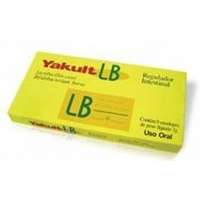
  • “consumption of the probiotic Yakult LBz(®) (Lactobacillus casei and Bifidobacterium breve)…showed a statistically significant reduction (p<0.05) in Candida prevalence (from 92.9% to 85.7%), in CFU/mL counts of Candida and in the number of non-albicans species after consumption” [2012]
  • “the probiotic Yakult LB® for 20 days, showed a significant reduction in Candida prevalence (46%) and mean Candida CFU/mL counts (65%).[2009]

Oral Probiotic tablets usually contain S. salivarius K12, it and M18 appears to have no explicit significant impact on Candida[2013]. It is unclear if they will have impact on Dry Mouth (so they are worth a try if the L.Reuteri longenze or L.Reuteri Oral Probiotics are not easily obtainable).

  • “S. salivarius Strain K12, the prototype S. salivarius probiotic, originally introduced to counter Streptococcus pyogenes infections”[2012]
  • “The study included 67 salivary and subgingival lactobacilli of 10 species…but none inhibited Candida albicans.”[2008]

Yakult LB is a good candidate (two studies) if you can get it (it is sold in Brazil). Regular Yakult (or DanActive) and Bifidobacterium breve may be an alternative

web_detail_349859

The following contain mainly L.Reuteri:

  • BioGaia Chewable (Chewable Tablets) L.Reuteri probiotic
  • Nova Diet Oraldiet

Propionibacterium freudenreichii is only available in Nutricology, Securil

L.Reuteri included as part of a mix in these Oral Probiotics

  • Powerful Oral Probiotics with 7 STRAINS of beneficial bacteria
  • PRO-Dental: Probiotics for Oral & Dental Health

Tradition Guidance for dry mouth should also be checked/tried, like this post. Many of the items are already the norms for CFS patients, i.e. no coffee or alcohol….

Other’s have distinctive CFS/IBS/FM versions:

  • “sugar-free chewing gum” — all of the fake sugars are worse than real sugar for the microbiome. Use Mastic Gum instead.
  • “a hard candy into your mouth to stimulate your saliva glands and aid production.”
  • xylitol washwash is a strongly not recommended.

What to look for (and not look for!)

I have a model that I am advocating that CFS /FM(with some other autoimmune and neurological conditions) is caused by a microbiome dysfunction.  The model thus predicts that correcting this dysfunction should result in reduced symptoms and potentially remission. This model is the simplest model that appears to agree with all of the literature and is testable.  For example, IL-16 was recently identified to be LOW in CFS, the bacteria producing IL-16 were found in PubMed, and those were the same ones that are reported low or almost non-existent in CFS patient. This appears to confirm the model.

A model is useful for determining candidate treatments. Some may work, some may not. The odds are that more will work than doing random treatments. On the last relapse, it was 10 weeks before “a clear turning point happened” — I ascribed it to the last change (8 “OO” capsules of Tulsi for the prior 10 days). It may not have been the Tulsi, rather week 8 of minocycline pushed things over the recovery edge. With a single person during an approach, it is impossible to be certain.

How can you tell if changes are happening

First, a herx is never a certain. A herx depends on the specific strains in your dysfunctional microbiome. Running a marathon easily would also be an indicator — but that is likely not to happen. So how do you answer the question “Did this make a change?”

For me, there are several indicators that I use for myself:

  • If I start to flush (flush more) from my usual 500 mg of flushing niacin each morning — I interpret that is due to toxins from killed bacteria causing vascular constriction.
  • Change in sleep pattern – intensity. Taking Miyarisan resulted in long hard sleeps for me and several others. Taking a Bifidobacterium mixture (10 Billion CFU) resulted in lighter/shorter sleep – without tiredness waking.
  • Change in stool shapes and frequency. Same applies to urination pattern.
  • Change of weight! – several families have been associated with weight gain or loss.
  • Change of preferences for food! — Once upon a time, I had a sweet tooth. Today, it takes little to “max” me out, and I do not have cravings (I do have some conditionings that I need to work on!!)
  • Change in cognitive or neurological functions. Some probiotics really dropped my stress level and reactivity level.
  • Stopping or starting Night SweatsMiyarisan stopped the residue night sweats that I was having despite the remission. Starting may indicate that body is fighting an infection.
  • Changes to temperature preferences. You may like hotter or colder rooms. A recent study found that environmental temperature impacts the diversity of the microbiome.
  • Changes in body temperature. Typically, CFS have low or very low temperatures. As I recovered, my temperature increased. This is a good objective measure. Do at least once a week at the same time each day.
  • Changes to or from having a “dry mouth”

If you look for the grand performance change, you may miss the above and stop something that is actually causing you to slowly improve.

Are there other indicators that readers have used?

Yes, I am going off the belief that any change is better than the status quo.  The path to recovery may be slow, but there are many many many paths to correct a dysfunctional microbiome. Some can be challenging to walk because of the difficulty in obtaining (antibiotics, Mutaflor, Enterogermina, etc ); there are alternatives: selected spices, herbs, etc (Tulsi, Neem, Turmeric, etc) – which may or may not be as effective.

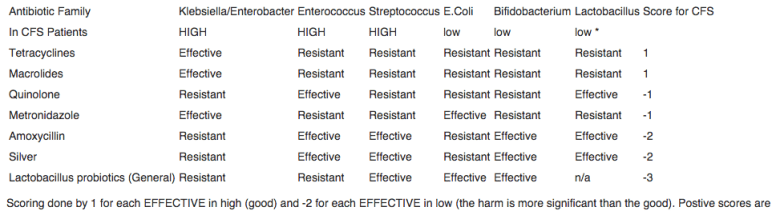
The key is to make sure that the alternatives are appropriate. I have place a copy of my matrix on me-pedia and will update it periodically (or on request from readers for specific items). It is what I used to test proposed herbs, spices, probiotics, and antibiotics.

Screen Shot 2015-12-11 at 12.32.04 PM