How to increase low Lactobacillus if you have CFS

The wrong way is to take lactobacillus probiotics!! Why? Lactobacillus probiotics in general kill off E.Coli which CFS patients are very low in (if they have any), and most lactobacillus are also D-Lactic acid producers (which most CFS patients are very high in! see this post).

The amount of information on interactions is actually quite thin, and often come from veterinary studies.

  • “All tested Lactobacillus strains presented inhibitory activity against Staphylococcus aureus, Salmonella Typhimurium, Salmonella Enteritidis, Listeria monocytogenes and Escherichia coli,” [2016]
  • “Associants (E. coli and Enterococcus faecium) were “friend” species, in which bifidobacteria exometabolites did not change growth properties and stimulated anti-lysozyme activity(by 17,5–32%) and formation of biofilms (by 25 – 39%).” [2011]
  • ” After the introduction of probiotic enterococci, the quantity of lactobacilli and bifidobacteria in the intestines of rats increased, and the content of Klebsiella spp. and Escherichia coli decreased in comparison with the control group 1 and the group fed lactobacilli.” [2013]
  • Enterococcus faecium L5 led to the rapid disappearance of dysbiosis symptoms, normalisation of the microbiota, increase in expression of IL-10 and decrease in IL-8 expression.” [2010]
  • “probiotic E. faecium on enterococci was strain specific and the growth of certain Lactobacillus spp. was enhanced by the probiotic,” [2015]
  • “E. faecium had lower (P < 0.05) concentrations of E. coli on d 14 and 28, less (P < 0.05) Clostridium perfringens on d 28, greater Lactobacillus counts on d 14 and 21, and greater (P < 0.05) Bifidobacterium in their cecal contents on d 21″ [2013]
  • “In general, probiotic bacteria proved to be more inhibitory towards lactic acid bacteria than vice versa since the latter did not exert any effect on the growth of the former, with some exceptions” [2001]
  • “using a synbiotic comprising Bifidobacterium bifidum BB-02 and Bifidobacterium lactis BL-01 (probiotics) …. Counting of viable organisms showed significantly higher total numbers of fecal bifidobacteria, total numbers of lactobacilli, and numbers of B. bifidum during synbiotic feeding.”[2005]

Bottom Line

I read that the following three “play well with each other” and will raise lactobacillus in a balance style. Taking lactobacillus probiotics will destroy the balance and lactobacillus will dominate, resulting in the low populations staying low (or non-existent) of the families that CFS patients are abnormally low in.

  • Enterococcus faecium – Symbioflor-1 and others
  • E. Coli (mutaflor, Symbioflor-2)
  • Bifidobacteria


Probiotics: Nature’s Bounty Probiotic 10

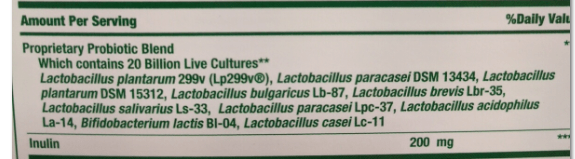
A reader (with Crohn’s Disease, not CFS) asked me about this probiotic — especially as it is just $20 at Costco. The probiotic lists all of the strains (finer identification than species) – which is a very good thing. You know better what you are getting (in terms of expected health impacts).

nature

This is NOT recommended for CFS because it will reduce E.Coli (which are very low to non-existent with CFS). With Crohn’s disease there is an overgrowth of E.Coli.

So what to expect?

Lactobacillus plantarum 299v (DSM 9843)

Lactobacillus paracasei DSM 13434 (8700:2)

  • “In conclusion, intake of the probiotic strains Lactobacillus plantarum HEAL 9 (DSM 15312) and Lactobacillus paracasei 8700:2 (DSM 13434) reduces the risk of acquiring common cold infections.”[2011]
  • “Our findings indicate a therapeutic potential of oral administration of a combination of probiotics and provide a more complete understanding of the host-commensal interactions that contribute to beneficial effects in autoimmune diseases.” [2010]
  • Lactobacillus paracasei 8700:2 (DSM 13434)

Lactobacillus plantarum DSM 15312 (HEAL9)

  • “In conclusion, intake of the probiotic strains Lactobacillus plantarum HEAL 9 (DSM 15312) and Lactobacillus paracasei 8700:2 (DSM 13434) reduces the risk of acquiring common cold infections.”[2011]
  • “Our findings indicate a therapeutic potential of oral administration of a combination of probiotics and provide a more complete understanding of the host-commensal interactions that contribute to beneficial effects in autoimmune diseases.” [2010]
  • Academic Paper [2015]

Lactobacillus bulgaricus lb-87

  • “In his study, both Salmonella sp. and E. Coli are inhibited when mixed with GLB44 invegetable juice.[9] ” Wikipedia
  • No PubMed studies

Lactobacillus brevis LBR-35

Lactobacillus salivarius LS-33

  • “Ratios of Bacteroides-Prevotella-Porphyromonas group to Firmicutes belonging bacteria, including Clostridium cluster XIV, Blautia coccoides_Eubacteria rectale group and Roseburia intestinalis, were significantly increased (p ≤ 0.05) after administration of Ls-33. The cell numbers of fecal bacteria, including the groups above as well as Clostridium cluster I, Clostridium cluster IV, Faecalibacterium prausnitzii, Enterobacteriaceae, Enterococcus, the Lactobacillus group and Bifidobacterium were not significantly altered by intervention.” [2013]
  • Lactobacillus salivarius Ls-33 and Bifidobacterium infantis 35624 preferentially induced IL-10.” [2011]

Lactobacillus paracasei LPC-37

  • “L. paracasei Lpc-37 and B. lactis 420 are able to colonize the intestine transiently.” [2008] i.e. does not stay
  • “The use of probiotic cultures significantly increased the availability of calcium (~2.5%), phosphorus (~6%), and magnesium (~18%).” [2014]

Lactobacillus acidophilus LA-14

  • “Trends toward significant changes in immunoglobulin serum concentrations compared with controls (P<0.1) were found for six out of the seven probiotic strains.” [2008]
  • “Consumption of L. acidophilus La-14, L. rhamnosus HN001 in combination with bovine lactoferrin leads to vaginal detection; even 1 week after consumption was stopped.” [2015]
  • “L. acidophilus La-14 produces bacteriocin active against Listeria. monocytogenes ScottA… L. acidophilus La-14 shows a good resistance to several drugs and may be applied in combination for therapeutic use.” [2011]

Bifidobacterium lactis BL-04 (ATCC SD5219)

  • Monograph from supplier
  • “Trends toward significant changes in immunoglobulin serum concentrations compared with controls (P<0.1) were found for six out of the seven probiotic strains.” [2008]
  • “The pollen season induced a reduction in Bifidobacterium, Clostridium and Bacteroides which could not be prevented by the probiotic intervention… Fecal IgA was increased in the placebo group during the pollen season; this increase was prevented by the probiotics ” [2009]
  • “The risk of an upper respiratory illness episode was significantly lower in the Bl-04 group ” [2014]

Lactobacillus casei Lc-11 (ATCC SD5213)

  • Excellent inhibition of E.Coli,  Good inhibition of Salmonella typimurium, Straphylococcus aureus, Listeria monocytogeners
  • Produces only L(+) Lactic acid (no D-Lactic) [2008]
  • No pub med studies

Bottom Line – Not for CFS Patients

Why? The answer is simple — many of the above strains inhibits or kill E.Coli. E.Coli is very low or non-existent with CFS patients.  This probiotic may make a bad situation worst.


Methylation, CFS and the microbiome

A reader ask me about methylation. In 2013, I did a post “methylation cycle gut bacteria and chronic fatigue syndrome” which found that E.Coli and Bacillus subtilis are both involved in methylation. CFS patients are very low in both, additionally, I posted in 2015 about Methylation Testing via 23andMe.com

Methylation has been a hot topic for a number of years in the CFS community and other medical areas. For example, Dr. Myrna Hill has written a page about it for CFS patients and cite “Rich van Konynenburg has identified a package of micronutrients specifically to support the methylation cycle”. Rich was very active in this area until he passed away in Sept 2012. There is a lot of his material on line. He was inspired by the work of Dr Amy Yasko.

In the month before he died, we had started discussing the role of the microbiome in methylation. I will attempt touch a few items only (there are over 88000 studies on pubmed)

DNA is a factor, but..

Epigenetics is also another factor

Epigenetics is modification of DNA’s behavior due to environmental events and stress.  You may have DNA that disposes you towards methylation issues — but it takes the right set of events to cause methylation issues. Sometimes this activation can persist for generations. Note that environmental includes shifts of the microbiome.

What about CFS and related conditions?

And… the microbiome?

  • The relationship between early-life environment, the epigenome and the microbiota [2015].
    • ” Epigenetics can change gene expression to modify disease risk; unfortunately, how epigenetics are changed by the environment is unclear. It is known that the environment modifies the microbiota, and recent data indicate that the microbiota and the epigenome interact and respond to each other. Specifically, the microbiome may alter the epigenome through the production of metabolites. Investigating the relationship between the microbiome and the epigenome may provide novel understanding of the impact of early-life environment on long-term health.”
  • Epigenetic imprinting by commensal probiotics inhibits the IL-23/IL-17 axis in an in vitro model of the intestinal mucosal immune system [2012].
    • Bifidobacterium breve (DSMZ 20213)  and Lactobacillus rhamnosus GG (ATCC 53103) may exert their anti-inflammatory effects in the gut by down-regulating the expression of the IBD-causing factors (IL-23/IL-17/CD40) associated with epigenetic processes involving the inhibition of histone acetylation and the optimal enhancement of DNA methylation, reflected in the limited access of NF-κB to gene promoters and reduced NF-κB-mediated transcriptional activation. …
    • We describe a new regulatory mechanism in which commensal probiotics inhibit the NF-κB-mediated transcriptional activation of IBD-causing factors (IL-23/IL-17/CD40), thereby simultaneously reducing histone acetylation and enhancing DNA methylation.

Bottom Line

Methylation is a very complex area. One path is that of supplements intending to help — think of this as taking B12, except you are taking methylated-B12. 1000 mcg/ 1 mg seems to be the effective ongoing dosage for B12, see this post. The other path is altering the microbiome to enhance methylation — the equivalent of taking Lactobacillus Reuteri to produce your own B12. Of course, you can do both at the same time. The first path will provide temporary symptom relief, the second path raise the prospect of a permanent correction of methylation issues.

There are four probiotic species that are indicated as good candidates:

  • E.Coli (Symbioflor-2 or Mutaflor)
  • Bifidobacterium breve (DSMZ 20213)
  • Lactobacillus rhamnosus GG (ATCC 53103) – aka Culturelle
  • Bacillus subtilis


Asthma, Eczema and the microbiome

  • “. At 3-months the abundance of the genus,  Lachnospira  (L), was decreased (p = 0.008), while the abundance of the species,  Clostridium neonatale  (C), was increased (p = 0.07) in asthmatics. Quartile analysis revealed a negative association between the ratio of these two bacteria (L/C) and asthma risk at 3-months (quartile 1: Odds ratio (OR) = 15, p = 0.02, CI = 1.8 – 124.7; quartile 2: OR = 1.0, ns; quartile 3: OR = 0.37, ns). We conclude that opposing shifts in the relative abundances of  Lachnospira  and  C. neonatale  in the first 3 months of life are associated with preschool age asthma, and that the L/C ratio may serve as a potential early life biomarker to predict asthmadevelopment.” [2016]
  • ” One study demonstrated a strong association between high abundance of Faecalibacterium prausnitzii and decreased levels of butyrate and propionate, and established eczema. Lower relative abundance of Ruminococcaceae appears to be implicated in food sensitization and to precede the development of atopic eczema. Decreased relative abundance of Lachnospira, Veillonella, Faecalibacterium, and Rothia in early infancy was reported to be associated with increased asthma risk. Inoculation of germ-free mice with these genera decreased airway inflammation in their offspring thereby proposing a causal role of bacteria in preventing allergic airways disease.” [2016]
  • “Low total diversity of the gut microbiota during the first month of life was associated with asthma but not allergic rhino conjunctivitis ( in children at 7 years of age. Measures affecting microbial colonization of the infant during the first month of life may impact asthmadevelopment in childhood.” [2014]
  • “Low intestinal microbial diversity during the first month of life was associated with subsequent atopic eczema.” [2012]
  • “These results support the general hypothesis that an imbalance in the intestinal microbiome is influencing the development of lifestyle-related disorders, such as allergic disease.” [2011]
  • “Presence of older siblings is associated with increased gut microbial diversity and richness during early childhood, which could contribute to the substantiation of the hygiene hypothesis.” [2015]

Actionable Items

Studies have found that generic probiotics and antibiotics do not have any statistically significant effect in human studies. This is not surprising because the same hold true for other conditions associated with a microbiome shift – generic products have no effect. Very specific probiotics and antibiotics do have impact with those conditions. Which ones are effective for Asthma and Eczema is still unknown and to be studied.

There is one exception — Vitamin D, which is known to alter the microbiome

  • :”Other known or potential risk factors for severe asthma exacerbations include …vitamin D insufficiency, … In spite of progress in our understanding of the pathophysiology of asthma, we lack reliable instruments or biomarkers to predict severe asthma exacerbations.[2016]
  • We find a relationship exists between airway obstruction and 25OHD [Vitamin D] levels in asthmatic adults, and the effect is not explained by the presence of potential confounders such as obesity, allergy and systemic inflammation. [2016]
  • “Our results suggest that vitamin D insufficiency is relatively frequent in an equatorial population of children with asthma. In these children, lower vitamin D levels are associated with increased markers of allergy and asthma severity.” [2009]
  • ” studies that focused on vitamin D and severity of asthma which suggest a positive association of vitamin D levels with better asthma control, reduced use of asthma medication, fewer asthma exacerbations and lower utilisation of health care facilities for urgent treatment.” [2015]
  • “These results suggest that vitamin D supplementation may be effective for the prevention of asthma exacerbations, but the findings need to be confirmed by clinical trials.” [2015]

Vitamin D and the Gut

Update on Irritable Bowel Syndrome – 2016 news

I thought it would be good to review some of the hundreds of studies published on PubMed in 2016 to see if anything especially interesting has been published.

  • “During life, the numbers of bifidobacteria decrease from up to 90% of the total colon microbiota in vaginally delivered breast-fed infants to <5% in the colon of adults and they decrease even more in that of elderly as well as in patients with certain disorders such as antibiotic-associated diarrhea, inflammatory bowel disease, irritable bowel syndrome, obesity, allergies, and regressive autism.” [2016]
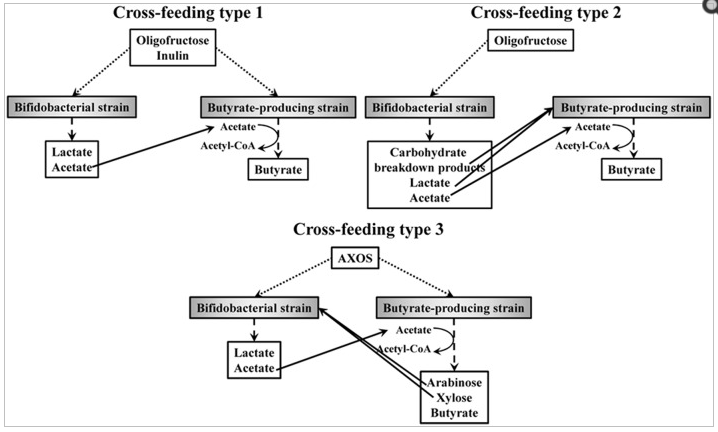
    • ” Butyrate is an essential metabolite in the human colon, as it is the preferred energy source for the colon epithelial cells, contributes to the maintenance of the gut barrier functions, and has immunomodulatory and anti-inflammatory properties. It has been shown that the butyrogenic effects of ITF and AXOS are the result of cross-feeding interactions between bifidobacteria and butyrate-producing colon bacteria, such as Faecalibacterium prausnitzii (clostridial cluster IV) and Anaerostipes, Eubacterium, and Roseburia species (clostridial cluster XIVa). These kinds of interactions possibly favor the co-existence of bifidobacterial strains with other bifidobacteria and with butyrate-producing colon bacteria in the human colon.” – hence Clostridium butyricum (Miyarisan) probiotics may be a very significant factor.
    • AXOS => arabinoxylan-oligosaccharides
    • but
  • “Low-FODMAP rye bread helps IBS patients to control their symptoms and reduces gastrointestinal gas accumulation.” [2016] I have been a long time advocate of 100% rye bread (with zero wheat flour in it) – 100% rye bread  encourage biodiversity, [2012].
  • “a newly emerging condition termed non-celiac gluten (or wheat) sensitivity[NCGS/NCWS] is now well established in the clinical practice. Notably, patients with NCGS/NCWS have symptoms that mimic those present in irritable bowel syndrome.” [2016] – IBS does not mean wheat (or gluten) sensitivity. Many “gluten sensitive” individuals are actually wheat sensitive only.
  • “Using strict criteria as recommended for IBS studies, about one third of patients with IBS-D or IBS-M are wheat sensitive, with a similar proportion in both IBS types. ” [2016]
  • “Of 1074 patients (44.1%) who responded to open-label rifaximin, 382 (35.6%) did not relapse, whereas 692 (64.4%) did; of these, 636 were randomly assigned to receive repeat treatment with rifaximin (n=328) or placebo (n=308). The percentage of responders was significantly greater with rifaximin than placebo (38.1% vs 31.5%, P=.03). The percentage of responders for abdominal pain (50.6% vs 42.2%, P=.018) was significantly greater with rifaximin than placebo, but not stool consistency (51.8% vs 50.0%, P=.42).” [2016] So Rifaximin helps about 1/3 of IBS patients – but this amounts to actually just 7%  (38% improved with Rifaximin, and 31% improved with a placebo — 38% – 31% = 7%) … so real odds is closer to 1/14.
  • More than every tenth Dane have irritable bowel syndrome. The condition is diagnosed by a positive strategy including fulfilment of the Rome III criteria, absence of alarm symptoms, and if needed a few paraclinical tests. Currently, there is no cure of the disorder. Treatment is recommended on a symptom-based approach targeting the dominating symptom/symptoms. If symptoms are reduced, the quality of life is considerably improved.” [2016]
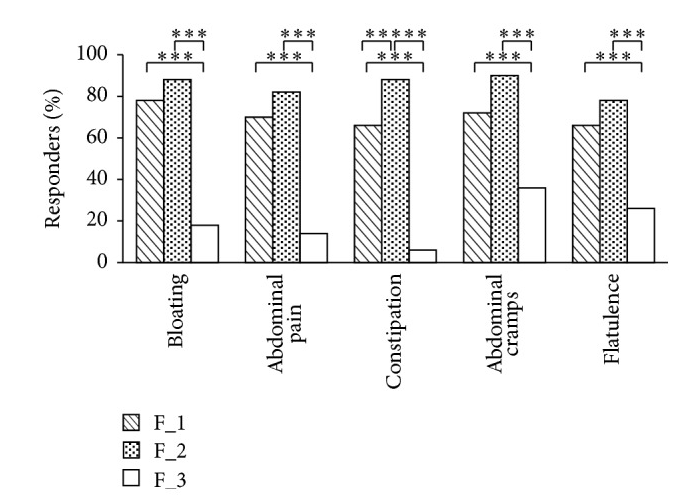
  • “Multispecies probiotic supplementations are effective in IBS-C subjects and induce a different assessment in the composition of intestinal microbiota” [2016]
    • “it is known that the level of bifidobacteria and lactobacilli species is lower in IBS patients compared to healthy persons [28, 29] and several studies show that the supplementation of them, or mixtures including species of these genera, is effective in alleviating symptoms of IBS. Moreover, the selected strains were already known for their effect on intestinal cell lines as previously reported [19].”
    • Mixture F_1: 5 × 10⁹ CFU L. acidophilus , 5 × 10⁹ CFU L. reuteri (30 mg as lyophilized), – 10 Billion CFU
    • Mixture F_2:  5 × 10⁹ CFU L. plantarum, 5 × 10⁹ CFU L. rhamnosus , 5 × 10⁹ CFU B. animalis subsp. lactis – 15 Billion CFU  BEST – see posts on L.Rhamnosus 
    • Mixture F_3:  390 mg inulin (almost a Placebo)
  • mix
  • “self-reported anxiety and depression provide a twofold risk for IBS onset.” [2016]
  • “Species richness, but not community diversity, differentiated all IBS patients from Healthy Controls.” [2016]