Filmjölk – good or bad for CFS?

Filmjölk is a traditional fermented milk product from Sweden, and a common dairy product within the Nordic countries. [Wikipedia] In one sense, Filmjölk is to Sweden as Yogurt is to Bulgaria. The basic version does not contain any Lactobacillus. I have included the hierarchy below to better understand where things are at.
la

What is in it?

There are a variety of commercial versions with additional bacteria added, for example,  Lactobacillus plantarum 299v has been added to one commercial variety.

From uBiome samples shared… I looked at the Families these later two are in.

  • Only one patient had any Leuconostocaceae and the level was less than 2%  of the normal value.
  • Only one patient had high Streptococcaceae, most had less than 10% of the normal value.

In terms of encouraging biodiversity, it seems like a desirable item. Unfortunately, CFS has too many Firmicutes over all (post) which means we are in a balancing act.

I was unable to find any meaningful studies of Lactococcus lactis in isolation. There were multiple studies of it in combination with other bacteria showing changes of brain activity (i.e. improved mood, less depression).

What is the next test? Histamine production

Histamines severely impacts a subset of CFS patients.

  • Leuconostoc mesenteroides – significant producer [2013]
  • Lactococcus lactis – “nisin-producing Lactococcus lactis appears to inhibit histamine productions [1996] and has  no impact on histamine by itself (see post)

This leaves the histamine content fuzzy — unfortunately.

What is the next test? D-Lactic Acid production

D-Lactic acidosis is common with CFS.

  • Leuconostoc mesenteroides – significant producer [2011] [2012]
  • Lactococcus lactis – significant producer [2010]

Bottom Line

Based on the data available, the weight of various factors says it should not be taken. We should also note that Kimchi is very similar, and should also be avoided.


SIBO – is the name misleading?

“Small intestinal bacterial overgrowth (SIBO) is defined as the presence of excessive bacteria in the small intestine. SIBO is frequently implicated as the cause of chronic diarrhea and malabsorption. Patients with SIBO may also suffer from unintentional weight loss, nutritional deficiencies, and osteoporosis.” [2007]


A 2017 study reports: ” Between 4% and 78% of patients with IBS and 1% and 40% of controls have SIBO; such wide variations in prevalence might result from population differences, IBS diagnostic criteria, and, most importantly, methods to diagnose SIBO.

To put it simply, a healthy person walks into a MD’s office. The odds that they will get a SIBO diagnosis is 1 in 100 for some MDs and 4 out of 10 with other MDs. Is this diagnosis meaningful when there is such extreme differences between MDs in diagnosing it?

My first question on SIBO, looking backwards from 10 years later:

What are theses? these are the first level (phyla) that bacteria is classified as. In other words what is overgrown — “bacteria” is an extremely broad term equivalent to “transportation”. Transportation can be broken down to ships, planes, trains, cars, horses, bicycle and even foot. For CFS/IBS/FM there is a distinctive pattern of what bacteria are overgrown and reduced that research from 1998 on wards have confirmed. While there is no official test for CFS — research reports have constantly found similar patterns in the microbiome shifts with over 80% reliable prediction of CFS from a microbiome sample alone.

The official definition appears to be ” growth of bacteria more than 105 colony forming unit (CFU) per milliliter in culture of upper gut aspirate is used to diagnosis small intestinal bacterial overgrowth (SIBO), ” [2017] – which bacteria are over-represented is the critical question.

Looking on pub-med for “Small intestinal bacterial overgrowth phyla” – there were just two hits – none useful.

We read “A variety of antibiotics have been used in the treatment of SIBO, most with little supporting evidence. Ideally, antibiotic therapy would be based on bacterial culture and sensitivity data. ” [2007] – in other words, the bacteria phyla at least should be determined before any treatment. I suspect the shifts will be all over the place for a SIBO diagnosis unless you group into tight symptom groups.

Current status of testing for SIBO

“Case-control studies evaluating the prevalence of SIBO in IBS and healthy individuals have shown conflicting results. Moreover, the tests available in routine clinical practice to diagnose SIBO are not valid and lack both sensitivity and specificity… The SIBO-IBS hypothesis lacks convincing evidence but remains under scrutiny. ” [2017]

Treatment Success

“One hundred and four patients who tested positive for newly diagnosed SIBO by lactulose breath testing (LBT) were offered either rifaximin 1200 mg daily vs herbal therapy for 4 weeks with repeat LBT post-treatment….  Of the 37 patients who received herbal therapy, 17 (46%) had a negative follow-up LBT compared to 23/67 (34%) of rifaximin users (P=.24). ” [2014]

  • Note: other tests may have been positive or negative before or after. There was no report on those who were not treated. They may also have had 40% with a negative followup….  — poor study design…

“Evidence is also increasing on the poor intra-individual reproducibility in breath responses with repeated testing for fructose and lactulose. On the basis of these limitations, it is not surprising that the diagnosis of small intestinal bacterial overgrowth based on a lactulose breath test yields a wide prevalence rate and is unreliable.” [2017]

  • In other words, you may be positive today and negative next week without doing anything. The meal you had last night could be the sole difference of results.
  • If I sell water with a pinch of mint (“proprietary herbal blend“), I will likely get 50% of people who tried it saying and writing glowing “this saved me” testimonials with medical reports backing it!!) – excellent way to make a living!

Bottom Line

SIBO appears to be a very last century definition of a condition. A condition that is too often diagnosis without the critical testing of upper gut aspirate. Even if that is tested, without knowing the profile of the overgrowth (i.e. which bacteria phyla (and finer breakdowns)), the diagnosis almost becomes meaningless for determining appropriate treatment. Which bacterias needs to be reduced?

“Digestive issues” may be as meaningful as SIBO – SIBO appears to give a cause, a very vague cause — “Jack has an infection – is it flu? Ebola? Tuberculous? Common cold? Leprosy?  Salmonella? etc”


Checking assumptions on SIBO and Hydrogen Sulfide breath test

A reader ping me about Hydrogen Sulfide(H2S) breath tests and Small Intestinal Bacterial Overgrowth.  A light went on for a question that may need to be asked:

  • Is it
    • An overgrowth of H2S producing bacteria, OR
    • An undergrowth of bacteria that uses H2S?

Having excessive H2S in the breath is a known fact. The traditional reason behind it may be speculation. It may also ignore dental health, stress levels, etc and may be recording a different issue.

  • “The tongue coating score had a significant positive correlation with H2S [tongue coating area  and tongue coating thickness ” [2015]
  • “The stressed students group showed increased oral emanations of hydrogen sulfide and dimethyl sulfide,  ” [2017]
  • hydrogen sulphide and methane were decreased in inflammatory bowel disease compared to healthy controls” [2015]

What really surprise me was that there was not dozen of articles on PubMed when I searched for “hydrogen sulfide small intestinal bacterial overgrowth” but just TWO!!!!

  • One article dealt with SIBO in combination with IBS-D. “Here, we show that hydrogen sulphide (H2S) in exhaled breath is distinctly altered for diarrhea-predominant IBS individuals with positive and negative SIBO by the activity of intestinal sulphate-reducing bacteria. ” [2016]
  • “Although higher hydrogen sulphide and SRB levels have been detected in patients with IBD, and to a lesser extent in colorectal cancer, this colonic gas might have beneficial effects.” [2012] see below — it is anti-inflammatory!

 Sulphur and bacteria

  • Metabolic niche of a prominent sulfate-reducing human gut bacterium [2013]. ” increasing the abundance of the H2S-producing Actinobacterium, Collinsella aerofaciens.” and a decrease of E.Coli
  • Lactobacillus brevis, Lactobacillus lindneri and Pediococcus damnosus, and some Gram-negative bacteria such as Pectinatus cerevisiiphilus, Pectinatus frisingensis and Megasphaera cerevisiae..and the production of unfavorable smell such as diacetyl or hydrogen sulfide.”[2003]
  • Study of constancy of hydrogenconsuming flora of human colon [1994].
  • “The amount of H2S produced by periodontopathic bacteria or oral bacteria collected from human subjects decreased after an incubation with rSox enzymes. These results suggest that the combination of rSox enzymes from P. pantotrophus GB17 is useful for the prevention of oral malodor.” [2017]
  • Hydrogen sulfide (H2S) is recognized as a biological mediator with various roles such as neuromodulation, regulation of the vascular tone, cytoprotection, anti-inflammation, oxygen sensing, angiogenesis, and generation of mitochondrial energy. ” [2014]
  • “H2S is produced by enzymes from l-cysteine; cystathionine β-synthase, cystathionine γ-lyase, and 3-mercaptopyruvate sulfurtransferase (3MST) along with cysteine aminotransferase.” [2013]
    • “The production of H2S from D-cysteine is 80 times more efficient than that from L-cysteine in the kidney,” [2014]
  • “Endogenous hydrogen sulfide (H2S) renders bacteria highly resistant to oxidative stress,  but its mechanism remains poorly understood.”
  • Staphylococcus aureus is a commensal human pathogen and a major cause of nosocomial infections. As gaseous signaling molecules, endogenous hydrogen sulfide (H2S) and nitric oxide (NO·) protect S. aureus from antibiotic stress synergistically…thus linking sulfide homeostasis to an adaptive response to antimicrobial reactive nitrogen species.” [2017]
  • “The extensive crosstalk between NO and hydrogen sulfide (H2S) related metabolites may further affect nitrate’s bioactivity.” [2017]

Addendum

A reader forwarded a link to Measurement of Hydrogen Sulfide during Breath Testing Correlates to Patient Symptoms (2017)  The authors of this published earlier in 2017, “The focus of this research has been to find non-invasive biomarkers from serum, breath gas, and fecal materials. T..To date, these types of biomarkers for IBS have been disappointing.”

This citation deals with IBS and not SIBO — two different conditions (with some possible overlaps) — I am working on a post examining what SIBO is or is not.

Bottom Line

I am an evidence based person and have come to two surprising conclusions:

  • There is no evidence that we can connect high hydrogen sulfide to SIBO in general
  • There is no evidence that reducing hydrogen sulfide is in a person’s interest (yes, it may be an offensive breath to people) — in fact, it may be the body trying to reduce inflammation.

As always, please share any PubMed links (the gold standard for evidence) that may further clarify the evidence.

I know this runs contrary to common alternative medicine beliefs – “show me the evidence”!

Phage Complete — A review

A reader posted about this new to the market probiotic on CFS Remission’s Facebook. It is promoted by “The Gut Health Protocol“. The site also sells a book. The scope of the book is general health issues and not CFS/IBS/FM specific.

You may wish to read Phages 101 before reading more.

book

Bad/Misleading Advertising Copy

“Contains a completely safe phage complex that is scientifically shown to selectively kill certain strains of “bad” bacteria, does not harm our beneficial bacteria, and supports a healthier microbiome. ”  I have contacted him with the following question:

  • “Please list the strains of these bad bacteria.
  • Please provide the citations that shows that it does not harm good bacteria. My readings state that there is no such thing. Lactobacillus reduce Bifidobacterium –  which are good ones.. “

What is in it?

contents

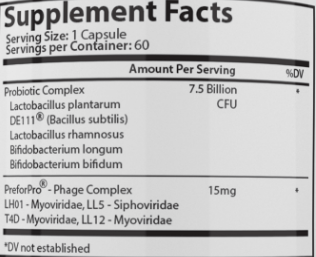
The label lists 7.5 billion CFU of the following without percentages.

  • Lactobacillus plantarum
  • DE111 (Bacillus subtilis)
  • Lactobacillus rhamnosis
  • Bifidobacterium longum
  • Bifidobacterium bifidum

And 15 mg of a Phage complex

  • LH01 – Myoviridae
  • LL5 – Siphoviridae
  • T4D – Myovirdae
  • LL 12 – Myoviridae

DE111 is available in 5 Billion CFU capsules elsewhere (site) which provides citations – and may be the firm where it is manufactured. No strains are listed on the others 😦 .

As a side note, IMHO Kyo-Dophilus9 is a better blend (with 180 capsules for $32 versus $50 for 60 capsules for this product), significantly cheaper per Billion CFU.

The Phages

This is an interesting aspect, so over to PubMed. My understanding of phages are that they are very specific and not broad in their action. “They have been used for over 90 years as an alternative to antibiotics in the former Soviet Union and Central Europe, as well as in France.[5]” [Wikipedia]

So what do we know about these living VIRUS infections, have there been any human safety studies for these specific viral infections?

According to this web site, all of the above kills E.Coli.  Very not good for CFS/FM.

A second issue with this is simple “The treatment is not approved in the US” [2013] with the exception of Washington and Oregon when done by a licensed naturopathic physician. [wikipedia]

FDA Approval?

  • Your search – site:fda.gov LH01 Myoviridae – did not match any documents.
  • Your search – site:fda.gov t4D Myoviridae – did not match any documents.
  • Your search – site:fda.gov LL12 Myoviridae – did not match any documents.
  • Your search – site:fda.gov LL5 – Siphoviridae – did not match any documents.

Other phages are cited “Intralytix reports that five of the phages are classified under the order Caudovirales, family Myoviridae, and are designated LMSP-25, LMTA-34, LMTA-57, LMTA-94, and LMTA-148.” [Source]

Recommend Testing BEFORE using

Lab tests for level of E.Coli (good and bad) should be done before using (see this example). For example,  GanzImmun Diagnostics AG. or MVZ Institute for Micro Ecology GmbH.

Without adequate testing to determine if these phages are appropriate (instead of harmful), blind taking runs significant risks to many. Remember “Escherichia coli (E. coli) is a bacteria that normally is an important part of the healthy intestinal tracts of humans and animals. However, there are some kinds(1-3%) of E. coli that are harmful and can cause disease.” [CDC]

Bottom Line

I give this a thumbs down for several reasons:

  • High cost, much cheaper alternatives are there
  • The inclusion of at least one of the cited phages is harmful to the goal of restoring a healthy level of E.Coli bacteria
  • The appearance of ignoring the laws, rules and regulation in the US and selling direct to the public – including interstate commerce (combined with misleading copy writing)… it is just a matter of time before legal action is likely to occur. He sells his books on Amazon — he sells this direct. I speculate that Amazon would pull it quickly off their website if he tries selling there. It appears to be technically an illegal product.


What is comorbid with CFS/FM etc

Identified Sub Groups

From [2017] Study

  1. fibromyalgia, myofascial pain, multiple chemical hypersensitivity, sicca syndrome, epicondylitis, and thyroiditis
    1. “comprised mainly older women, with low educational level, unemployment, high levels of fatigue, and poor quality of life;”
  2. alterations of ligaments and subcutaneous tissue, hypovitaminosis D, psychopathology, ligamentous hyperlaxity, and endometriosis.
    1. comprised mainly older women, with low educational level, unemployment, high levels of fatigue, and poor quality of life;
  3. with hardly any comorbidities, comprising mainly younger women, university students or those already employed, with lower levels of fatigue, and better quality of life;
  4. poorly defined comorbidities;
  5. hypercholesterolemia.

Other Diagnosis

From 2000 Study

  • Self diagnosis of CFS [2013]
    • Sleep Disorder: 49.8% (especially obstructive sleep apnea syndrome)
    • Definite CFS: 23.3%
    • A psychiatric disorder was diagnosed in 45.2%; mostly mood and anxiety disorder.
  • Incidence of getting IBS:
    • chronic fatigue syndrome (CFS) –  92%;
    • fibromyalgia (FM) – 77%;
    • temporomandibular disorder (TMD) – 64%
  • Hyperacusis [2016]: Noise sensitivity
    • CFS – 3.2%
    • fibromyalgia – 4.2%
    • IBS  -4.8%
    • Anxiety Disorder – 47%
  • postural orthostatic tachycardia syndrome
    • CFS: 11% [2014]
    • Coeliac disease: 4% [2016]

Symptoms

From 2016 Australia Study according to the definition of CFS (Fukuda or  International Consensus Criteria). Percentage is given in ( )

Symptom Fukuda ICCa
Fatigue, n (%)
 Fatigued 162 (100.0) 171 (100.0)
 Postexertional malaise 68 (38.9) 171 (100.0)
 PENEe 25 (15.4) 171 (100.0)
Cognition, n (%)
 Confusion 52 (32.1) 69 (40.4)
 Disorientation 40 (24.7) 77 (45.0)
 Difficulty processing information 51 (31.5) 65 (38.0)
 Difficulty making decisions 53 (32.7) 66 (38.6)
 Slowed speech 46 (28.4) 75 (43.9)
 Difficulty reading 44 (27.2) 78 (45.6)
 Poor short-term memory 54 (33.3) 63 (36.8)
Pain, n (%)
 Headaches 51 (31.5) 64 (37.4)
 Muscle pain 53 (32.7) 65 (38.0)
 Joint pain 54 (33.3) 62 (36.3)
  Abdomen pain 42 (25.9) 71 (41.5)
 Chest pain 48 (29.6) 73 (42.7)
Sleep disturbances, n (%)
 Insomnia 46 (28.4) 69 (40.4)
 Prolonged sleep 51 (31.5) 57 (33.3)
 Reversed sleep 25 (15.4) 84 (49.1)
 Frequent awakenings 47 (29.1) 71 (41.5)
 Awakening earlier than expected 43 (26.5) 72 (42.1)
 Vivid dreams or nightmares 42 (25.9) 75 (43.9)
 Unrefreshed sleep 54 (33.3) 63 (36.8)
Sensory, perceptual, and motor disturbances, n (%)
 Inability to focus vision 47 (29.0) 69 (40.4)
 Sensitivitiesf 50 (30.9) 68 (39.8)
 Poor depth perception 30 (18.5) 78 (45.6)
 Muscle weakness 52 (32.1) 65 (38.0)
 Twitching 49 (30.3) 70 (40.9)
 Poor coordination 49 (30.3) 67 (39.2)
 Feeling unsteady on feet 44 (27.2) 70 (40.9)
Immune (infectious), n (%)
 Sore throat 45 (27.8) 73 (42.7)
 Tender lymph nodes 46 (28.4) 75 (43.9)
 Sinusitis 46 (28.4) 69 (40.4)
 Recurrent or persistent infections 46 (28.4) 71 (41.5)
Gastrointestinal and genitourinary, n (%)
 Nausea 44 (27.2) 73 (42.7)
 Abdominal pain 42 (25.9) 76 (44.4)
 Bloating 50 (30.9) 66 (38.6)
 Irritable bowelg 46 (28.4) 65 (38.0)
 Intolerancesh 45 (27.8) 68 (39.8)
 Urinary urgency or frequency 44 (27.2) 68 (39.8)
Cardiovascular, n (%)
 Orthostatic intolerancy 46 (28.4) 93 (54.4)
 Ataxiai 26 (16.1) 90 (52.6)
 Heart palpitations 42 (25.9) 65 (38.0)
 Light headedness 48 (29.6) 70 (40.9)
Respiratory, n (%)
 Air hunger 44 (27.2) 64 (37.4)
 Labored breathing 42 (25.9) 67 (39.2)
 Fatigue of chest muscles 50 (30.9) 68 (39.8)
Autonomic, n (%)
 Abnormal body temperature 41 (25.3) 66 (38.6)
 Fluctuating body temperature 48 (29.6) 67 (39.2)
 Sweating episodes 45 (27.8) 67 (39.2)
 Recurrent feverishness 43 (26.5) 75 (43.9)
 Cold extremities 45 (27.8) 72 (42.1)
 Intolerance of extremes temperature 50 (30.7) 67 (39.2)