Analysis of a ME/CFS Microbiome

After the last post on Gene base probiotic selection, an old ME/CFS friend asked me to look at her results. Usually I avoid doing individual analysis (not enough time) but when it comes to ME/CFS — I tend to make an occasional exception because of the severe cognitive challenges.

The same was done by BiomeSight.com and had 777 taxonomies identified. This is in the high end of samples processed there. My personal observations of ME/CFS is that over-diversity is a characteristic of ME/CFS

The predicted symptoms from the microbiome sample are below:

We have a gender correct matching

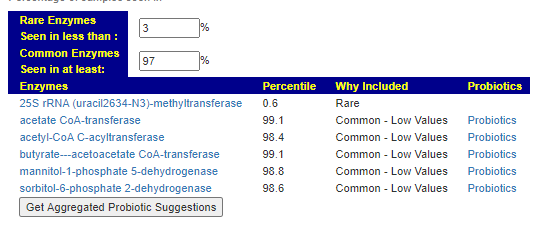
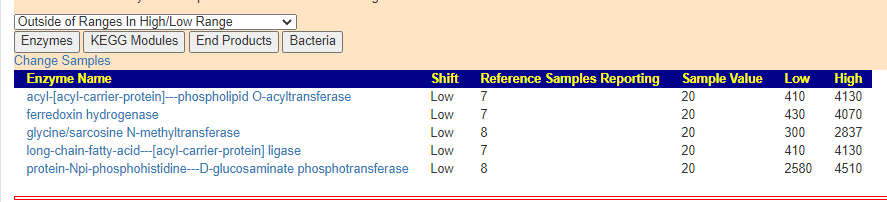
Step 1 – Enzymes Issues

From this we click the button on the bottom and get the list below. We have 5 items above and lactobacillus paracasei has a count of 5 indicating that it helps every enzyme above. In other words, this is the highest priority probiotics.
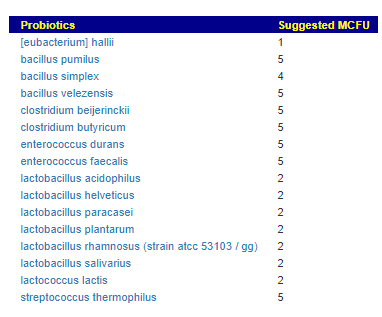
Note that clostridium butyricum and streptococcus thermophilus were also the top suggestion for another ME/CFS person. See this post

Let us see what is suggested by other routes.

Using Quick Suggestions, we see it has a positive value

Net Factors/ Take Factors/ Avoid Factors

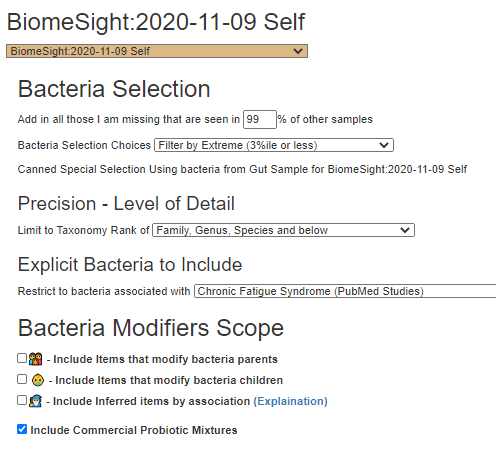
Going to Advance Suggestions and filtering to bacteria associated with ME/CFS (as shown below)
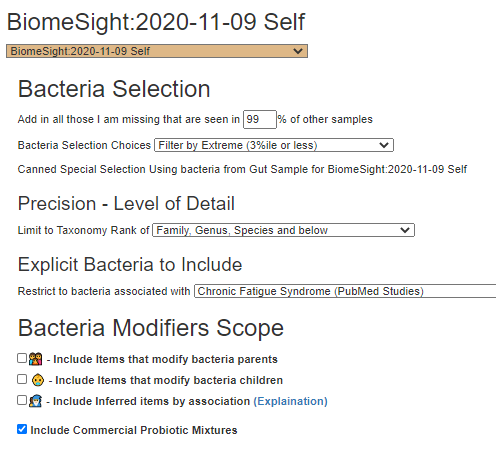
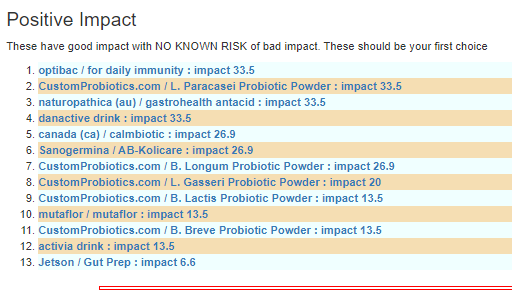
We see this probiotics is tied with 3 others for first choice.

What this suggests is that the enzyme route for probiotics agrees with other paths. The only thing they have in common is the microbiome that they are working on. The logic and algorithms for each is totally different and use different data with no overlap. Many of the enzyme suggested probiotic species lack any significant studies so they do not appear in the usual suggestions list (because those are based on pubmed studies only). My gut feeling is that these enzyme suggested probiotics are very likely good choices.

Other Suggestions

I often cut suggestions off at a probability estimate of 0.5. The main reason is to stop information overload and over-complexity in life and supplements.

Many of the above items are typically recommended for ME/CFS

Flavonoid Foods Suggested

Apples, Coconut, Almond, oolong tea and buckwheat are the de-duplicated list over 0.5

Bottom Line

The reader can go to the site and make the same advance suggestions pick shown above. I could go off into more complex analysis approaches, but with the intended reader having ME/CFS, it is more likely to confuse.

What we have discovered is one particular probiotic species is well recommended by two different paths.

This happens to be the only probiotic strain in DanActive which I believe is available where she lives. Read more in this pubmed study. Note “Study patients received a probiotic yogurt drink, Danactive® (Danone, Boucherville, QC, Canada) containing 10 billion cfu of Lactobacillus casei sp. Paracasei CNCM I-1518 (formally DN-114 001) ” It is sometime cited in the advertising as Lactobacillus casei. At the gene level there are a few differences between generic L.Casei and L. Paracasei. The Enzyme recommendation was done at the gene level.

There is a question of potential dosage, above we have 10 BCFU cited. My usual probiotic supplier, CustomProbiotics.com recommended adult dosage is 320 BCFU. From the above study, we know that 10 BCFU is sufficient to get some results — the question is unclear on what dosage is needed to have a significant impact for ME/CFS.

The reader got back to me, because she has this sitting on her shelf.

No description available.
Both the probiotic and also the Vitamin C suggestions

Gene based Probiotic Suggestions

Using the KEGG: Kyoto Encyclopedia of Genes and Genomes, I have implemented suggestions based on the enzymes being produced according to your microbiome results on MicrobiomePrescription. If you are far below normal for production of one of the enzymes, then we lookup which probiotics also produces those enzymes from those known to be commercially available (our current master list is here – some may not be available in your country). The result is a probiotic mixture that should, theoretically, help to increase those enzymes and reduce symptoms.

To use this tool you need a uploadable report from one of the companies listed here. Note: NirvanaBiome.com uses CosmosId and thus may also be used.

Example on my last sample:

It was interesting that this list is similar to those produced by the AI engine for the same sample.

In some cases, there may be none. If there are no low level, there is nothing to increase. The probiotic suggestions are available enzyme by enzyme, or aggregated across the complete sample.

Where do you find this information? There may be up to three places, depending on how many samples you have.

At the bottom there is a button for the aggregate, and on the right, a link for individual enzymes.

Have fun! Be Safe!

A video walkthru

Microbiome Comparisons

Over this weekend I deprecated my earlier comparison tool and replaced it with more comparisons. To use this tool you need at least three samples uploaded. The comparisons available ate:

  • By Bacteria
  • By End Products
  • By Enzyme production
  • By KEGG Module

Purpose or Usage

The intent is to address the following two needs (there may be more)

  • You want to see what has changed from your prior samples. Typically, to see improvement or deterioration.
  • You have an individual with challenges and have other samples from your microbiome bubble.
    • People with shared DNA are part of your bubble
    • People eating the same diet (i.e. family meals) are part of your bubble
    • Conceptually, people with the share medical conditions could by part of the bubble. My observations is that these people should have the same symptoms not just the same diagnosis.

There are four methods of comparison of one specific sample against a collection of reference samples.

  1. Values outside of the values of the reference sample
  2. Values outside of the values of the reference sample increased by one standard deviation up and down
  3. Values outside of the values of the reference sample increased by two standard deviations up and down
  4. Values outside of the values of the reference sample that are also in the extreme compared to other samples uploaded (top or bottom 3-6%)
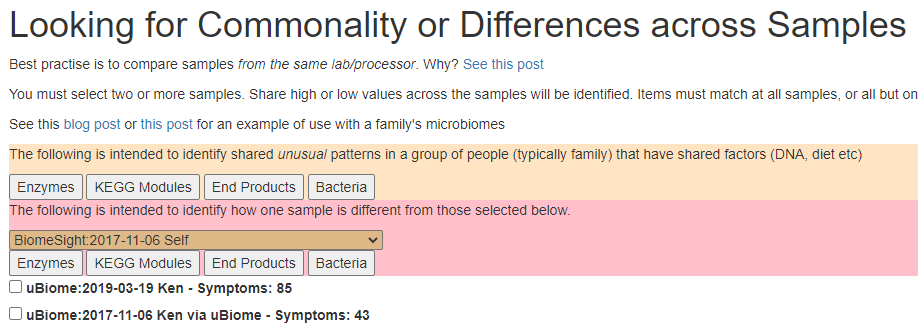
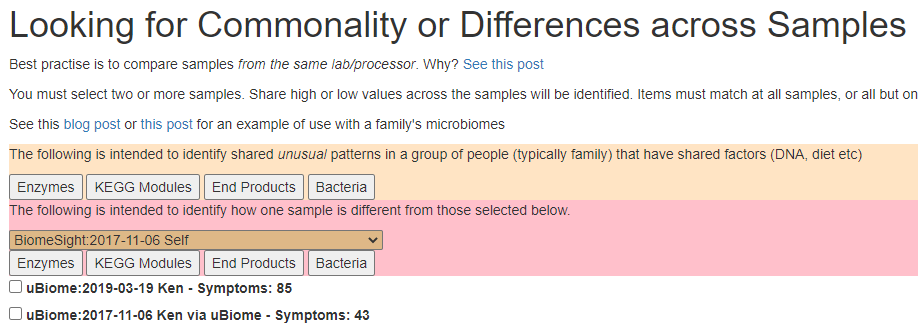
Select the reference below the buttons, pick up the one to compare to above and then click one of the buttons

Bacteria

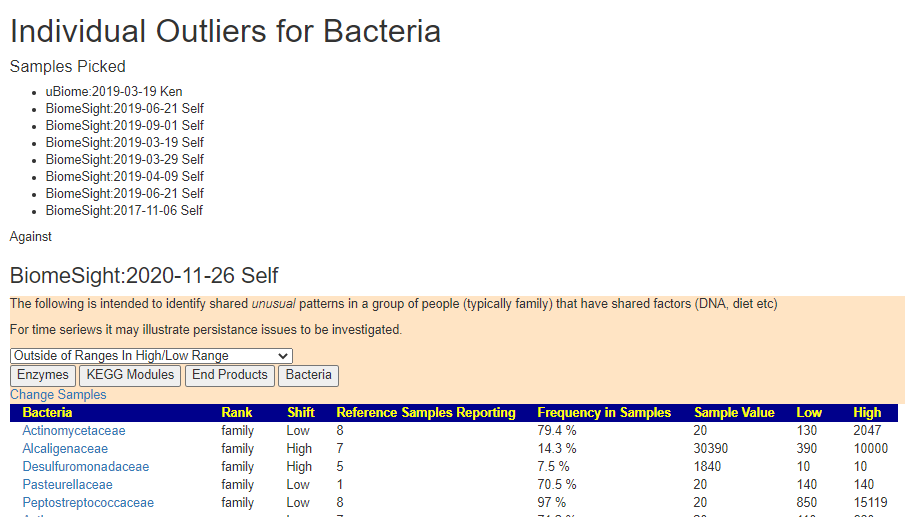
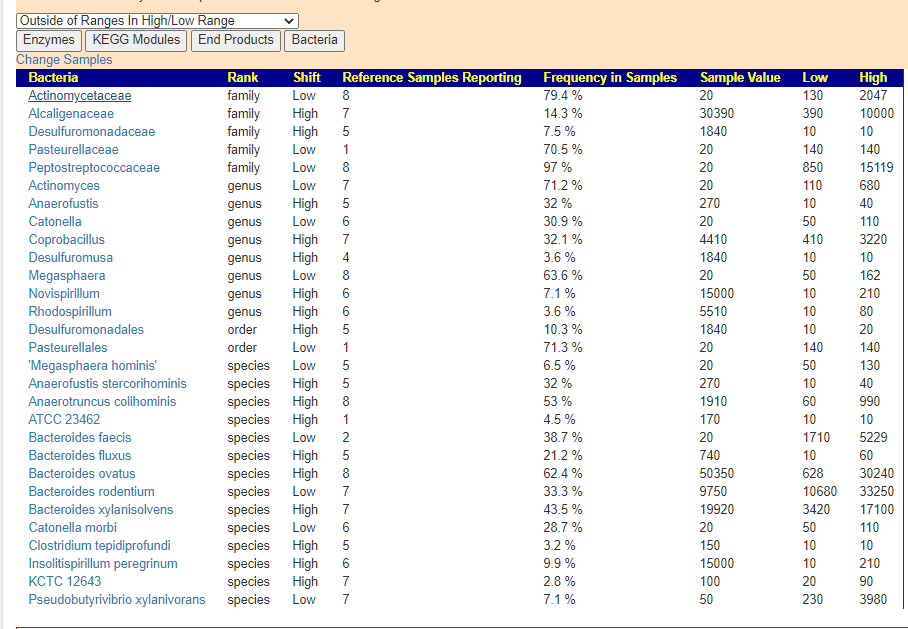
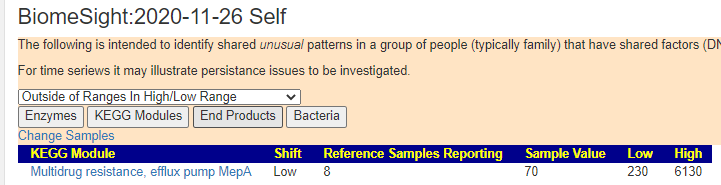
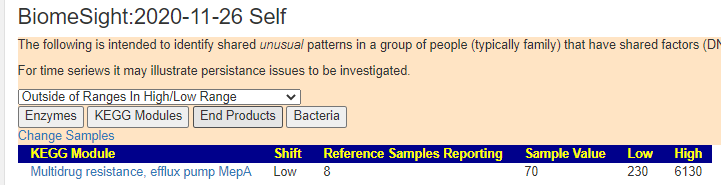
I picked several prior samples and my latest sample for comparison. Note that Reference Samples Reporting if less than all (in this case 8), it means that there were some zero values (and thus, you may wish to ignore shifts being low for those).

I tried different method and was surprise to see a long list of bacteria that have readings very different than than prior samples and also extreme values.

Note: The high and low thresholds are listed and your current values. You may need to use judgement if something is a significant change.

KEGG MODULES

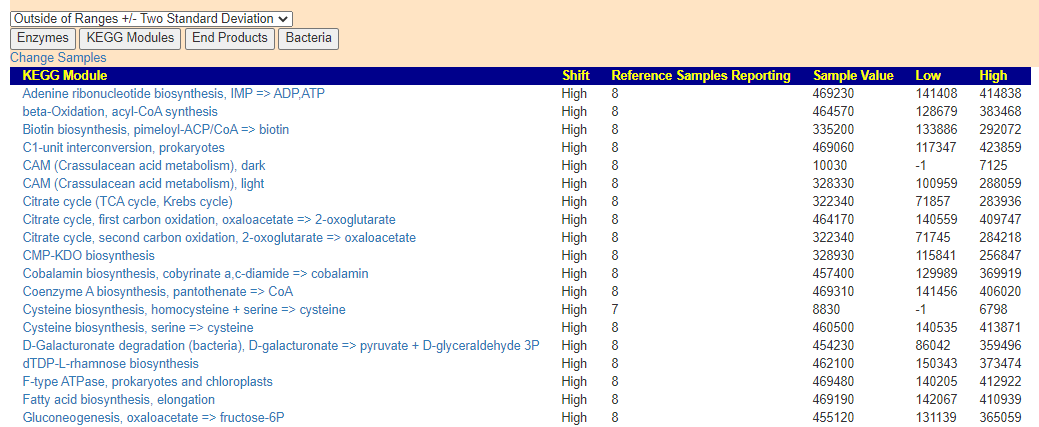
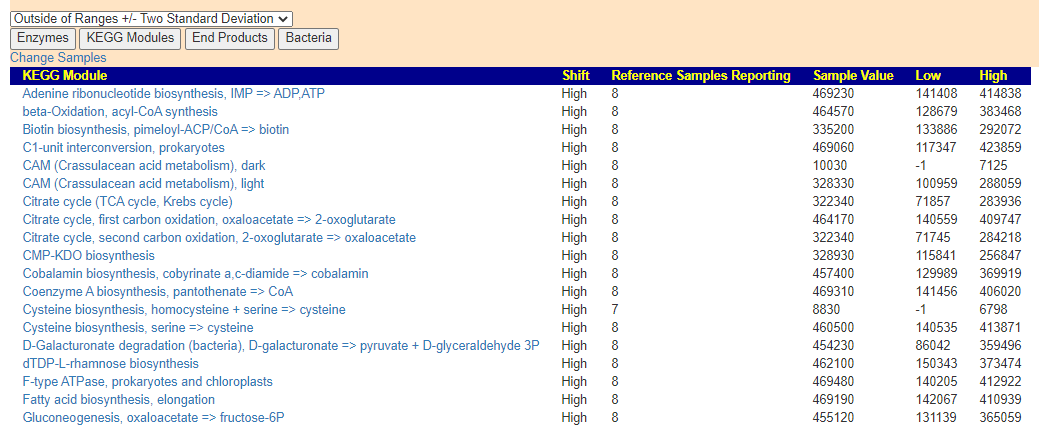
When I want to see just what shifted without restricting to high/low values also, we get a much bigger list.

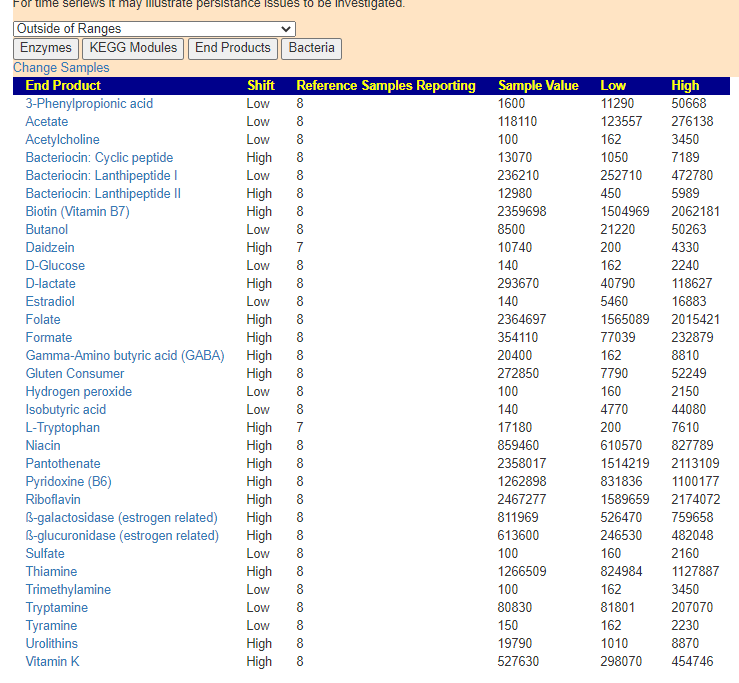
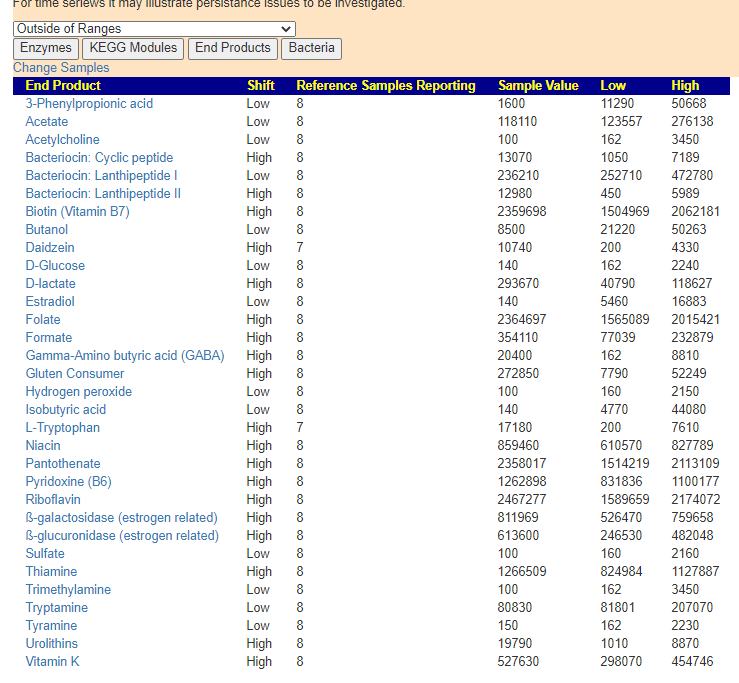
End Products

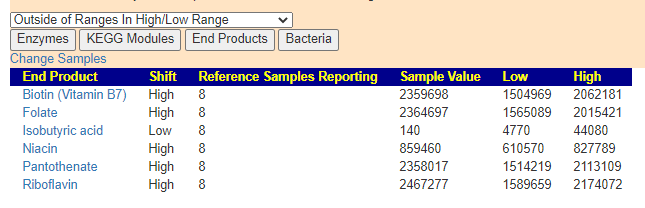
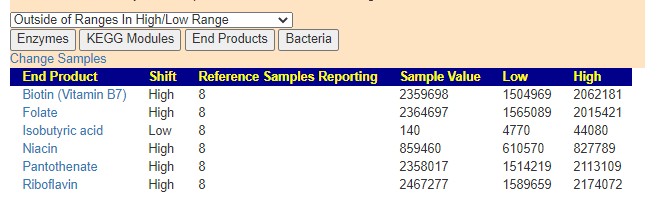
Changes that also pushed values into top and bottom of ranges
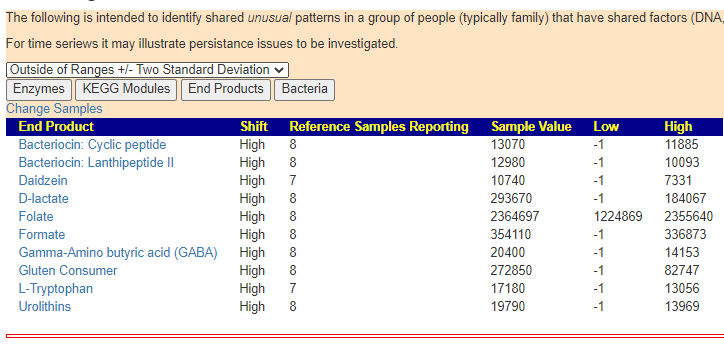
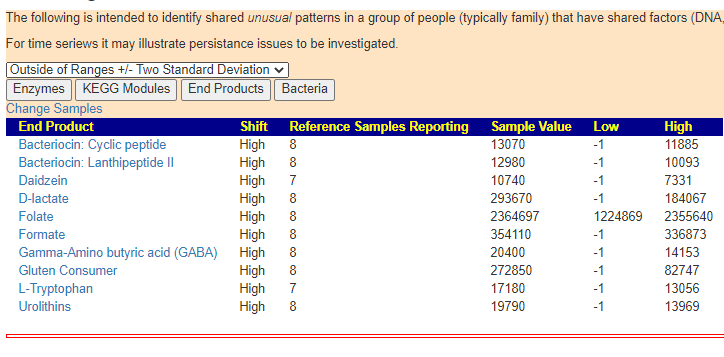
Things that significantly changed
Items with some changes

Enzymes

Change with values going to extremes

When I look at changes in general, the list became massive…

Bottom Line

This tool gives information on what changed… what it means and what to do with it is a different question. At the moment, I would suggest reading and researching items that seems to be major. The microbiomeprescription.com site gives suggestions on modifying bacteria numbers.