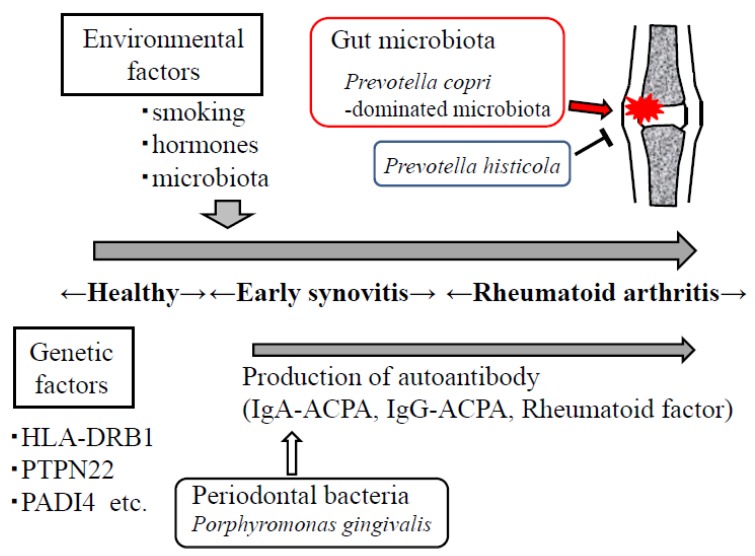
Rheumatoid arthritis and the microbiome

Several readers asked me to summarize Rheumatoid arthritis and the microbiome like I did for multiple sclerosis. The readers often cited high rates of RA in immediate family, and the risk was known since at least 1993. A followup post on mitigation is here.

“A high frequency of small intestinal bacterial overgrowth was found in patients with RA; it was associated with a high disease activity and observed in patients with hypochlorhydria or achlorhydria and in those with normal acid secretion.” [1993]

The pattern for autoimmune seem to be an interaction between DNA/SNPS/Genes and the microbiome. How the two come together determines if onset occurs, severity etc. 

DNA is not an easy to change. Microbiome is. Many successful treatments for rheumatoid arthritis have involved antibiotics before the microbiome dimension was discovered.

  • “In this article, we discussed the role of gut microbiota in the pathogenesis of rheumatic diseases based on a large number of experimental and clinical materials, thereby providing a new insight for microbiota-targeted therapies to prevent or cure rheumatic diseases.” ]2017]
  • “Altered microbiota, well described in patients affected by RA, seems associated with perturbation of certain metabolic pathways and the therapies addressed to correct gut microbiome dysbiosis could help in the maintenance of immune homeostasis of the host.” [2017]
  • From [20172017]

jcm-06-00060-g001

Rheumatoid arthritis and the Microbiome 

  • “the genus Pseudonocardia and various related OTUs were the only taxa overrepresented in RA  bronchoalveolar lavage fluid and correlated with higher disease activity and erosions.”[2016]
  • The aggravation of arthritis by periodontitis is dependent of IL-17 receptor A activation[2017].
    • “The effects of P. gingivalis-induced periodontitis on arthritis … lead to increased neutrophil infiltration into the joints.”
  • The oral and gut microbiomes are perturbed in rheumatoid arthritis and partly normalized after treatment[2015].
    • “The redox environment, transport and metabolism of iron, sulfur, zinc and arginine were altered in the microbiota of individuals with RA.”
  • Alteration of Fecal Microbiota Profiles in Juvenile Idiopathic Arthritis. Associations with HLA-B27 Allele and Disease Status[2016].
    • HS: Healthy Subjects
    • fmicb-07-01703-g001
    • “abundant taxa identified JIA patients for the HLA-B27 allele, including Bilophila, Clostridium cluster XIVb, Oscillibacter, and Parvimonas. “
    • “reduction in Clostridiaceae and Peptostreptococcaceae in JIA-ERA, and increase in Veillonellaceae in JIA-nERA, “
  • “A growing number of microbiota constituents such as Prevotella copri, Porphyromonas gingivalis, and Collinsella have been correlated or causally related to rheumatic disease. [2016]
  • “Mice susceptible to collagen-induced arthritis (CIA) showed enriched operational taxonomic units (OTUs) affiliated with the genus Lactobacillus as the dominant genus prior to arthritis onset. With disease development, the abundance of OTUs affiliated with the families Bacteroidaceae, Lachnospiraceae” [2016]
  • An expansion of rare lineage intestinal microbes characterizes rheumatoid arthritis [2016].
    • “A taxon-level analysis suggested an expansion of rare taxa, Actinobacteria, with a decrease in abundant taxa in patients with RA compared with controls. Prediction models based on the random forests algorithm suggested that three genera, Collinsella, Eggerthella, and Faecalibacterium, segregated with RA. The abundance of Collinsella correlated strongly with high levels of alpha-aminoadipic acid and asparagine as well as production of the proinflammatory cytokine IL-17A. A role for Collinsella in altering gut permeability and disease severity was confirmed in experimental arthritis.”
  • “reducing the concentration of Bacteroides spp., Bifidobacterium spp., Lactobacillus spp. populations, typical strain E. coli. But over growth of populations Klebsiella spp., Proteus spp., Staphylococcus spp., atypical forms of E. coli, Candida spp. ” [2014]


Treatment Options

Bottom Line

The first item is a refrain from older posts —   start by getting your mouth in shape!

  • “The association between rheumatoid arthritis (RA) and periodontitis is well established.” [2016]

During the survey found several probiotics having symptom relief of RA, the ones that are easy to obtain are:

  • Lactobacillus  casei
  • Lactobacillus plantarum
  • Bacillus  coagulans

In my next post, I will do the same type of theoretical analysis that I did for multiple sclerosis.

The gem of knowledge that I found interesting was “Gastrointestinal and urogenital infections, but not respiratory infections, are associated with a significantly lowered risk of RA. “. A hundred years ago, this information could have lead to the intentional causing of a gastrointestinal infection to treat RA — similar to the willful infection of Cowpox to prevent Smallpox [History]. I would not be surprise to read of people recovering from CFS after a bout of stomach flu (viral gastroenteritis) — it’s theoretically possible.

As always, this is intended as an educational post and not intended to treat any condition. Always consult with a knowledgeable medical profession before modifying supplements, diet, etc.

Impacting Multiple Sclerosis bacteria genus

This is a theoretical post. Working from high bacteria and low bacteria cited in this earlier post, I went to DataPunk.Net and extracted information about each genus. Several readers with MS in immediate family requested this list.

I have struck thru items that appear on both sides. We do not know if these items will help or make things worst…. i.e. these are should avoid for safety items.

The Increase or Decrease are what you in theory would reduce high bacteria and enhance low bacteria. In some cases, the same item will decrease the high bacteria and increase the low bacteria; in general, we have limited knowledge from published articles.

High Bacteria Low Bacteria
  1. Acinetobacter calcoaceticus (species) 
  2. Akkermansia muciniphila (species) 
  3. Euryarchaeota (phylum) 
  4. Bilophila (genus) 
  5. Blautia (genus) 
  6. Clostridium perfringens (species) 
  7. Desulfovibrio (genus) ,
  8. Desulfovibrionaceae (family) 
  9. Dorea (genus) 
  10. Haemophilus (genus) ,
  11. Christensenellaceae (family) 
  12. Mycoplana (genus) ,
  13. Pseudomonas (genus) 
  14. Sarcina (genus) 
  15. Streptococcus (genus) ,
  1. Adlercreutzia (genus) 
  2. Clostridia IV Clusters,
  3. Clostridia XIVa
  4. Faecalibacterium (genus) 
  5. Fusobacteria (phylum) 
  6. Lachnospiraceae (family) 
  7. Parabacteroides (genus) 
  8. Prevotella (genus) 
  9. Ruminococcaceae (family) 
  10. Sutterella (genus) 
To Improve
Decrease Intake of
To Improve
Increase Intake of
  • (+)-Catechin  L8
  • Barley H4
  • Berberine H5 H7
  • Bile salts H4 L4
  • Carboxymethyl cellulose (CMC) H2
  • Chemotherapy L4
  • Chicory  L8
  • Cholic acid H5
  • Cranberry bean flour H2
  • Cranberry polyphenols H2
  • Daesiho-tang (DSHT) H2
  • Dopamine  L8
  • Epicatechin  L8
  • Fasting H2
  • Flaxseed H6 L4 L6
  • Fructo-oligosaccharides  L4
  • Gallate L4 L9
  • Grapes (table) H2
  • Green tea H2
  • Heme H2
  • High animal fat diet  L4
  • High animal protein diet L4 H4
  • High fat diet H6 L4 L6 L9
  • High meat diet H4
  • High processed foods diet  L4
  • High protein diet H2 H4
  • High sugar diet L4 L6 L9
  • Inulin  L8
  • Iron supplements H6
  • Jerusalem artichoke  L8
  • Lingonberries H2
  • Low carbohydrate diet  L8
  • Low fiber diet  L4
  • Low FODMAP diet  L4
  • Low processed foods diet H2
  • Melatonin H2
  • Metformin H2
  • Milk-derived saturated fat  H4
  • Navy bean (Cooked) L4 L5 L8
  • Polysorbate 80 H2
  • Pomegranate ellagitannins H2
  • Proton-pump inhibitors (PPI) H7 H10 H15
  • Pyruvate  H4
  • Resistant starch (type II) H5
  • Resistant starch (type IV) H5 L4 L8
  • Resveratrol H2 L8
  • Rhubarb H2
  • Saccharin H11
  • Saccharomyces boulardii  H5 H9
  • Walnuts H5 H9
  • Whole-grain barley L5 L8
  • β-Glucan H6 L5 L8
  • Aloe vera  H15
  • Arabinogalactan  L4
  • Berberine L4 L9 H13 H15
  • Chemotherapy L10
  • Chicory H4 L4
  • Chondrus crispus (red seaweed) H6
  • Cinnamon bark oil H10 H15
  • Coriander oil H10
  • Cranberry bean flour H6
  • Dopamine L4 L7
  • Epinephrine L4 L7
  • Ethanol H2
  • Fasting L4
  • Flaxseed H2 H5 H9
  • Garlic (allicin) H13 H15
  • Grapes (table) H4
  • High fat diet H2 H11
  • High fiber diet  L4
  • High protein diet L10
  • High sugar diet H11
  • Hyocyamine H13 H15
  • Inulin L4 H4
  • Jerusalem artichoke  L4
  • Lavender (spike) oil H10
  • Lemongrass oil  H10 H15
  • Low animal protein diet  L4
  • Low processed foods diet  L4
  • Methyl gallate H6
  • Navy bean (Cooked) H6 H15
  • Omega 3 fatty acids H2
  • Oplopanax horridus H13
  • Oregano essential oil H13
  • Peppermint oil H10 H15
  • Perilla oil H10
  • Polymannuronic acid H6 H9
  • Propyl gallate H6
  • Proton-pump inhibitors (PPI) L7
  • Quercetin H6
  • Red wine  L4
  • Resistant starch (type II) H6
  • Resistant starch (type III)  L4 H13
  • Resistant starch (type IV) H2 H15 L7
  • Saccharin L6 L9
  • Saccharomyces boulardii L4 L6 L9
  • Sarcodiotheca gaudichaudii (red seaweed) H6
  • Sialic acid L5
  • Stevia H15
  • Tannic acid H6
  • Thyme oil H10 H15
  • Trametes versicolor H6
  • Vitamin D H13
  • Walnuts H5 L4 L6 L9
  • Whole-grain barley H13

Bottom Line

Some items matches the literature — for example low Vitamin D levels increases risk and severity [Vitamin D as an early predictor of multiple sclerosis activity and progression [2014].. Other items that appear on one side only — Omega 3 [Association of fish consumption and Ω 3 supplementation with quality of life, disability and disease activity in an international cohort of people with multiple sclerosis.[ 2013] “Those consuming fish more frequently and those taking omega 3 supplements had significantly better quality of life, in all domains, and less disability. ”

Other items like garlic has evidence suggesting they may help, Dose-dependent S-allyl cysteine ameliorates multiple sclerosis disease-related pathology by reducing oxidative stress and biomerkers of dysbiosis in experimental autoimmune encephalomyelitis[ 2017]. and Cinnamon ameliorates experimental allergic encephalomyelitis in mice via regulatory T cells: implications for multiple sclerosis therapy. [2015]

As always consult with your medical professional before changing diet or supplements.

FC-Cidal and Dysbiocide

A reader mentioned FC-Cidal and Dysbiocide in a message. They were prescribed by a well known CFS physician. As usual, I am curious to know about such.

FC-Cidal

FC-Cidal is a product produced by Biotics Research Corporation. It contains the following:

  • French Tarragon (Artemisia dracunculus) (leaf),
    • ” These compounds did not affect the growth of test lactic acid-producing bacteria (Bifidobacterium adolescentis, Bif. breve, Lactobacillus acidophilus and Lact. casei) and Escherichia coli, whereas weak growth inhibition towards Bif. bifidum was observed.” [2003]
  • Indian Tinospora (Tinospora cordifolia) (stem & root),
  • Horsetail (Equisetum arvense) (whole herb),
  • Thyme (Thymus vulgaris) (leaf),
  • Pau D’ Arco (Tabebuia impetiginosa) (inner bark),
    • ” no adverse effects were observed on the growth of Bifidobacterium adolescentis, Bifidobacterium bifidum, Bifidobacterium infantis, Lactobacillus acidophilus, and Lactobacillus casei at 1000 microg/disk.” [2005]
  • Stinging Nettle Extract (Urtica dioica) (root),
  • Olive (Olea europaea) (leaf).
    • “Six bacterial strains (Lactobacillus plantarum 6907, Lactobacillus paracasei 9192, Lactobacillus casei, Bifidobacterium lactis BO, Enterococcus faecium 32, Lactobacillus LAFTI 10) were tested… on Olive Oil and grew well [2012]
    • ” The results obtained using a selected olive sample demonstrated that bifidobacteria and one strain of L. rhamnosus (Lactobacillus GG) showed a good survival rate, with a recovery of about 10(6) CFU g(-1) after 30 days. The Lactobacillus GG population remained unvaried until the end of the experiment, while a slight decline (to about 10(5) CFU g(-1)) was observed for bifidobacteria. High viability, with more than 10(7) CFU g(-1), was observed throughout the 3-month experiment for L. paracasei IMPC2.1. ” [2005]

Their product literature is here.

Dysbiocide

Dysbiocide is another produce produced by Biotics Research Corporation. It contains the following:

  • Dill (Anethum graveolens) (seed),
    • reduces lactic acid bacteria Lactobacterium buchneri [1975]
  • Stemona (Stemona sessilifolia) (root) (powder and extract),
  • Wormwood (Artemisia absinthium) (shoot & leaf) (extract),
  • Java Brucea (Brucea javanica) (fruit) (powder & extract),
  • Chinese Pulsatilla (Pulsatilla chinensis) (rhizome) (powder & extract),
  • Jamaic a Quassia (Picrasma excelsa) (bark) (extract),
  • Cutch Tree (Acacia catechu) (heartwood & bark) (powder & extract),
    •  inhibited …. L. acidophilus. [2016]
  • Hedyotis (Hedyotis diffusa) (aerial part) (powder & extract),
  • Yarrow (Achillea millefolium) (leaf & flower) (extract).
    • Reduces Lactobacillus rhamnosus [2014]

Analysis

I dislike combinations because they usually contain good and bad items. Second, it is hard to rotate when you are “taking the kitchen sink”.

I did a spot check and annotated the items above. Dysbiocide appears to be contra-productive for our goals. FC-Cidal has two which do not effect lactobacillus, bifidobacteria and do impact other organism, and one that could be inferred to encourage the growth of the same.

Bottom Line

I would suggest rotating between:

  • French Tarragon (Artemisia dracunculus) (leaf) .. or/and other Artemisia
  • Pau D’ Arco (Tabebuia impetiginosa)
  • Olive (Olea europaea) (leaf).

Instead of mixture containing herbs and spices that we do not know what their impact may be.

Multiple Sclerosis and microbiome

Prologue

This blog main theme is Chronic Fatigue Syndrome. I have diverged in a few posts into other autoimmune diseases. One reason is simple: once a microbiome dysfunction happens, the dysfunction may progress into other autoimmune diseases. A friend started with IBS, then went to CFS followed by remission to be followed over a decade later with atypical Crohn’s disease.

What conditions develop is like a combination of microbiome (which appears to be inherited) and DNA. Some people may ask … what microbiome and dna are both inherited? The answer is pretty simple to understand — like all complex environments — they interact.

A long winded summary from 2011
“The mutualistic relationship between the host and its intestinal microbiota (microbial community) plays a major role in mammalian immunomodulation and metabolism (14). Outstanding examples of this are Crohn’s disease (CD) and ulcerative colitis (UC), chronic human disorders that are collectively designated as inflammatory bowel diseases (IBDs). Growing evidence supports the hypothesis that these entities develop secondary to a genetic predisposition for an exaggerated mucosal immune response against components of the intestinal microbiota, and that this process is modulated by environmental factors (56). The microbiota and the host may simultaneously and/or interdependently respond to such factors. These responses are likely affected by the genetic composition of the host. With regard to this relationship, epigenetic mechanisms (molecular processes that can influence gene expression without a change in the genetic code) are environmentally responsive and have been implicated in the pathogenesis of IBDs (67). An increasing number of observations reveal associations not only between genetic and epigenetic variation (8), but also between intestinal pathogens and mucosal epigenetic changes (9). However, these interactions have rarely been addressed in regard to IBD susceptibility genes, bacteria, and host-specific epigenomic modification, such as DNA methylation (methylation of cytosines in CpG dinucleotides; ref. 8). Meanwhile, environmentally sensitive nongenomic alterations are likely significant in the development of these diseases (6), and relevant intestinal epithelial epigenetic modification can occur in response to bacterial components (10).”

“Furthermore, a growing body of evidence suggests that the gut microbiota plays a role in the development of a range of autoimmune diseases including inflammatory bowel disease, multiple sclerosis, type one diabetes and rheumatoid arthritis.” [2016]

Multiple Sclerosis and the Microbiome

Bottom Line

Many people with CFS had EBV and are low in Vitamin D – thus increase risk of evolving to MS.  Having SIBO may increase the risk of MS by a factor of 5.

While it is not possible to “unget” EBV, it is very possible to increase Vitamin D levels (IMHO at the top of the normal range is desired, not just inside of the bottom of the normal range).

Above there are many bacteria genus associated with MS — if you have had your uBiome done, you may wish to do comparisons and if heading towards the MS profile — you may wish to consider aggressive actions to alter you microbiome away from this profile.

As always, this is an educational post and not intended as medical advice.


Rosehip, Pomegranate and other teas — Biome impact

A reader forward Antimicrobial activities of widely consumed herbal teas, alone or in combination with antibiotics: an in vitro study[2017]

This study found “Of the 31 teas (24 different herbs and seven bag teas), as shown in Table S1, only 15 teas showed inhibition zones against one or more microorganisms in the disk diffusion assays, while the others: linden, lemon balm, hibiscus, rosemary, nettle, chamomile, bay, yarrow, eucalyptus, lavender, galangal, orange, sage, ginger, herb bennet, and echinacea teas did not show any activity.”

It then presents this lovely table. S. Aureus is a suspected maintainer of CFS(see post). The smaller the number, the less is needed.

teas

Among the tables is one that suggests you need to have cups of teas every 8 hours and the effect may take up to 4 hrs, at least for rosehip tea bags. (RB)

rosetea.PNG

Note, ” The combinations of herbal teas with antibiotics showed synergistic, additive, or antagonistic effects, depending on the antibiotic or type of tea. ” So if you are doing teas and antibiotics — you need to read this article in full.  The tea may reduce the effect of the antibiotics (or increase it!).

Bottom Line

Rosehip (Rosa canina) tea (and soup?) looks like a excellent item to take 3 times per day — assuming you are not taking E.Coli probiotics at the same time.

  • “Among the tested bacteria, Pseudomonas aeruginosa and Salmonella typhimurium were the most susceptible to the activity of R. canina leaf extract with MIC and MBC values both 0.009 mg mL(-1). For most of the bacterial strains investigated the extract showed significantly higher activity compared to the used standard compounds streptomycin and ampicillin. [2015]
  • In vivo anti-inflammatory effect of Rosa canina L. extract.[2011]

Rose hips contain the carotenoids beta-caroteneluteinzeaxanthin and lycopene.

It has been used in some IBS Studies [2000] [2009]. A 2008 technical paper on rose hip is here.

A rose hip preparation (not clear whether it was rose hip or rose hip and seed) was investigated in a randomized double-blind study including 60 patients suffering from irritable bowel syndrome. They started to register their intestinal complaints 2 weeks before the administration of the products by means of a questionnaire. Patients receiving the proprietary rose hip drink as placebo pro-fited less than those receiving additional Lactobacillus plantarum 9843, but abdominal pain was reduced in both groups (Nobaek et al., 2000).

According to WebMd:

“Rose hips are also used for stomach disorders including stomach spasms, stomach acid deficiency, preventing stomach irritation and ulcers, and as a “stomach tonic” for intestinal diseases. They are also used for diarrhea, constipation, gallstones, gallbladder ailments, lower urinary tract and kidney disorders, fluid retention (dropsy or edema), gout, back and leg pain (sciatica), diabetes, high cholesterol, weight loss, high blood pressure, chest ailments, fever, increasing immune function during exhaustion, increasing blood flow in the limbs, increasing urine flow and quenching thirst.”

We do not know a great deal about which bacteria it kills or encourages — so this is definitely an item for “the art of microbiome manipulation“.

Discuss with your medical professional trying 3 cups of tea (every 8 hrs) for a week and see if there is any significant change. Do not substitute “rose hip capsules” , you want actual tea (and yes, it is a bit of an acquired taste).