Black Walnut Leaf

As with my last post, I have not done a specific post on black walnut leaf (Juglans nigra). It was cited as reducing peroxynitrite which is suspected to cause environmental illness/multiple chemical sensitivity.

  • “the most valuable and cited medicinal plant species [for dental problems] used by the traditional drivers are Juglans regia”[2016]
  • “The medicinal plant species with highest fidelity level was of  … Juglans regia … each cited 100% for ..easy digestion …” [2016]
  • “The essential oils from three different samples of. J. nigra contained (E)-caryophyllene (17.3%-20.4%) and germacrene D (7.1%-22.5%) with smaller amounts of juglone (1.0%-8.8%), alpha-hydrojuglone (1.0-9.5%), and delta-cadinene (3.8%-8.7%). J. regia leaf oil, devoid of juglone, showed allelopathic activity, while J. nigra leaf oil was less phytotoxic.” [2013]
  • “The essential oil and its major components exhibited broad spectrum inhibition against all the bacterial strains with Gram-positive(Staphylococcus epidermidis MTCC-435, Bacillus subtilis MTCC-441, Staphylococcus aureus) being more susceptible to the oil than Gram-negative bacteria.(Proteus vulgaris MTCC-321, Pseudomonas aeruginosa MTCC-1688, Salmonella typhi, Shigella dyssenteriae, Klebsiella pneumonia and Escherichia coli).” [2012]
  • Walnut leaves selectively inhibited the growth of Gram positive bacteria, being B. cereus the most susceptible one (MIC 0.1mg/mL). Gram negative bacteria and fungi were resistant to the extracts at 100mg/mL.” [2007]
  • “The zones of inhibition due to the … Juglans regia leaf extracts ranged from 17.6 mm against P. acnes, 15.7 mm against S. aureus and 15.5 mm against S. epidermidis, respectively….These zones of inhibition were… less… to those obtained from doxycycline or clindamycin…. may be beneficial in treating acne especially when they are known to have anti-inflammatory activities. ” [2005]
  • “derum (Juglans regia; walnut tree) …The most sensitive organisms were A. viscosus, followed by S. mutans, S. salivarius, with L. casei being the most resistant.” [2006]

Bottom Line

Black Walnut Leaf (actually Walnut Leaf) is far more effective against a variety of Staphylococcus than the Lactobacillus tested. Folklore from tribal area in India and Pakistan had it helping with digestion and with bad teeth bacteria.

It continues to be in the recommended list of herbals.

Note: There are no studies for FM/CFS/IBS.


Pau D’Arco for CFS

Pau D’Arco (Tabebuia spp) was cited by a reader in a recent post. I had listed it in my post for herbs for treating CFS in 2015 but have not done a post focused on it. β-Lapachone (β-LAP) is a major part.

Bottom Line

Pau D’Arco (Tabebuia spp) continues to be acceptable list for the following reasons:

  • Does not inhibit Lactobacillus or Bifidobacterium.
  • Minor effect against E.Coli
  • Effective against S. aureus – which is implicated as being a significant bacteria with CFS (see this earlier post).
  • Effective against Candida

Note: No PubMed studies with CFS/FM/IBS were found. There are many some forum posts indicating it helps with candida.

Pau d’arco. While herbalists do use pau d’arco for CFS treatment, it hasn’t proven to be very effective. People on blood-thinner medications should not take pau d’arco.” [source]

Caprylic Acid Supplementation

In my last post, a reader cites taking caprylic acid or octanoic acid which I have not covered yet in any post.

  • “Taken together, these results indicate that combined treatment with low concentrations of caprylic acid and citric acid, which are of biotic origin, can eliminate microorganisms from unpasteurized carrot juice.” [2015]
  • “The levels of medium-chain fatty acids (MCFAs: pentanoate, hexanoate, heptanoate, octanoate and nonanoate), and of some protein fermentation metabolites, were significantly decreased in patients with CD, UC and pouchitis.” [2015]
  • “the 4 fatty acids : caproic acid, caprylic acid, capric acid and lauric acid in vitro. All four inhibited not only the mycelial but also the yeast-form growth of Candida albicans. In particular, capric acid and caprylic acid inhibited Candida mycelia growth at very low concentrations.”
  • “The data indicate that exposure to lauric acid (C12) was the most inhibitory to growth [of Clostridium difficile] (P<.001), as determined by a reduction in colony-forming units per milliliter. Capric acid (C10) and caprylic acid (C8) were inhibitory to growth, but to a lesser degree.” [2013]
  • Caprylic Acid reduces enteric campylobacter colonization in market-aged broiler chickens but does not appear to alter cecal microbial populations [2010].
  • “Results indicated that caprylic acid, monocaprylin, and sodium caprylate could potentially be used to treat Dermatophilus congolensis infections.” [2011]
  • Antibacterial effect of caprylic acid and monocaprylin on major bacterial mastitis pathogens [2005].

Clear impact on Lactobacillus, Bifidobacteria and Enterococcus could not be found. It was effective in reducing bad E.Coli strains. There are no results for fibromyalgia, chronic fatigue syndrome or irritable bowel syndrome.

Bottom Line

There is nothing that explicit said that you should not use it. On the other side, there is nothing that clearly says that you should use it (unless you have candida). It does not appear to alter the microbiome in any significant method.

Bottom Line: No opinion.


AHCC and the microbiome 

A reader posted a comment on AHCC. He reported improvement from it and add it to his other rotating antimicrobials.

“Antimicrobials were wormwood, black walnut, olive leaf extract, curcumin, turmeric/piperine, monolaurin, thyme, oregano oil, Pau D’Arco, neem, caprylic acid, boswellia and now AHCC. Most I have done a couple of rotations. I may have forgotten one or two. In the early days I did one at a time, but later on did two at a time.”

Ken did a post a few months ago on amino acids. I have benefited from supplementing them as well.” – Reader

I was curious on what it is known about AHCC.

  • Active hexose correlated compound (AHCC) is a product prepared from the mycelium of edible Basidiomycete fungi that contains oligosaccharides…rats treated with AHCC had higher aerobic and lactic acid bacteria counts as well as higher bifidobacteria counts, whereas clostridia were reduced when compared with the TNBS group. ” [2007]
  • the oral treatment with AHCC protected mice from lethal infection with Pseudomonas aeruginosa and intraperitoneal one also protected mice from infection with methicillin-resistant Staphylococcus aureus (MRSA).” [2000]
  •  administration of AHCC… increased ability to clear bacteria. ” [2003]
  •  AHCC may display a protective role against opportunistic fungal infection” [2003]
  • suggest that AHCC protects mice in this model by restoring the immune and other systems negatively affected by trauma, infection, and food deprivation. ” [2006] – which may also include mal-absorption.
  • AHCC appears to induce an early activation of the immune response, leading to an effective clearance of bacteria and rapid recovery.” [2008]
  • Supplementation with AHCC appears to modulate immunity and increase survival in response to acute infection (including influenza virus, avian influenza virus, Klebsiella pneumoniae, Candida albicans, Pseudomonas aeruginosa, and methicillin-resistant Staphylococcus aureus)  and warrants further investigation.” [2008]
  • Enhanced immune function observed with AHCC could be caused by attenuated concentrations of stress hormones and catecholamines.” [2013]


Bottom Line

AHCC looks very promising for CFS.  It shifts bacteria in the right direction and kills off and clears many pathogens. 

Cholesterol in CFS and Microbiome

Overall cholesterol has been reported normal with CFS, but HDL (the good cholesterol) is significantly low. This can result in MDs doing symptom/lab results treatment instead of addressing the root cause.

  • “Plasma lathosterol was decreased in both males and females with CFS (Tables 2 and and3).3). Total plasma cholesterol, desmosterol, cortisol, and aldosterone were normal in both males and females with CFS….Our data are consistent with increased flux through the desmosterol pathway to maintain normal cellular levels of cholesterol. The desmosterol pathway corresponds to the stress-inducible arm of de novo cholesterol and sterol synthesis.” [2016] While total cholesterol was normal, the mechanism of production was not.
    • “Plasma chenodeoxycholic acid (CDCA) was decreased in females (Table 3, Females). CDCA is a primary bile acid made from cholesterol. Decreased cholesterol flux can result in decreased substrate for bile acid synthesis needed for normal fat digestion and microbiome signaling (24). The absence of adequate bile acid delivery can lead to a loss in intestinal mucosal integrity and leaky gut via a cascade of events stemming in part from disrupted farnesoid X receptor signaling”
    • “These facts suggest that CFS is an evolutionarily conserved, genetically regulated, hypometabolic state similar to dauer that permits survival and persistence under conditions of environmental stress but at the cost of severely curtailed function and quality of life.” – except the stress in this case is caused by bacteria shifts.
  • “The CFS group had higher levels of triglycerides (p = 0.03), MDA (p = 0.03) and CO (p = 0.002) and lower levels of HDL cholesterol (the good cholesterol) (p = 0.001) than the control group. There were no significant differences in the levels of total protein, total cholesterol or LDL cholesterol...The CFS group had an unfavorable lipid profile and signs of oxidative stress induced damage to lipids and proteins. ” [2012]
  • “a control group of 40 healthy women and 40 CFS women. Levels of total cholesterol (TC), triglycerides (TG), LDL cholesterol (LDLc), HDL cholesterol (HDLc), and malondialdehyde (MDA) levels were measured. There was a negative correlation between HDLc and MDA levels (r=0.3; P=.046), a positive correlation between TG and MDA levels (r=0.4; P=.006), and lower levels of HDL cholesterol in the CFS group (P=.036). [2010]
  • “Bacteroidetes showed positive correlation with LDL- and HDL-cholesterol levels, whereas Firmicutes showed negative correlation with total cholesterol, LDL- and HDL– cholesterol.” [2016]

Concurrent Treatment

Or should I say, how to help correct the shift of bacteria and improve HDL cholesterol. There were sufficient human studies to just use those.

“Recent population-based association studies have shown that the gut microbiota composition can explain a substantial proportion of the inter-individual variation in blood triglycerides and HDL-cholesterol level and predict metabolic response to diet and drug.” [2016]

  • Almond Oil – “almond oil elevating the levels of so-called ‘good cholesterol’, high-density lipoproteins (HDL), whilst it reduces low-density lipoproteins (LDL).” [2010] I suspect eating almonds may be as good or better.
    • ” replaced half of their habitual fat (approximately 14% of approximately 29% energy) with either whole almonds (WA) or almond oil (AO) for 6-wk periods… whereas HDL cholesterol increased 6%.” [2002]
  • The use of probiotic L. fermentum ME-3 containing Reg’Activ Cholesterol supplement for 4 weeks has a positive influence on blood lipoprotein profiles and inflammatory cytokines: an open-label preliminary study[2016]. “HDL cholesterol level rose from 1.60 to 1.67 mml/l,”  i.e. 4%.
  • “a probiotic containing… L. Casei, B.Bifiudu and L. Fermentum .. significantly increased HDL-cholesterol levels (2.7 from 0.9 ) compared with the placebo after 12 weeks.”  [2016] – a 200% increase in HDL.
  • “Previous clinical studies have reported mixed results regarding the effect of probiotics on lipid metabolism…Subjects treated with probiotics demonstrated reduced total cholesterol and LDL cholesterol compared to control subjects by 7.8 mg/dL (95% CI: -10.4, -5.2) and 7.3 mg/dL (95% CI: -10.1, -4.4), respectively. There was no significant effect of probiotics on HDL cholesterol or triglycerides.” [2015] L. Fermentum appears not to be included in this review.

The Gut Microbiome Contributes to a Substantial Proportion of the Variation in Blood Lipids [2015].

  • “we identified 34 bacterial taxa associated with body mass index and blood lipids; most are novel associations. Cross-validation analysis revealed that microbiota explain 4.5% of the variance in body mass index, 6% in triglycerides, and 4% in high-density lipoproteins, independent of age, sex, and genetic risk factors. A novel risk model, including the gut microbiome explained ≤ 25.9% of high-density lipoprotein (HDL) variance, significantly outperforming the risk model without microbiome. Strikingly, the microbiome had little effect on low-density lipoproteins or total cholesterol.”
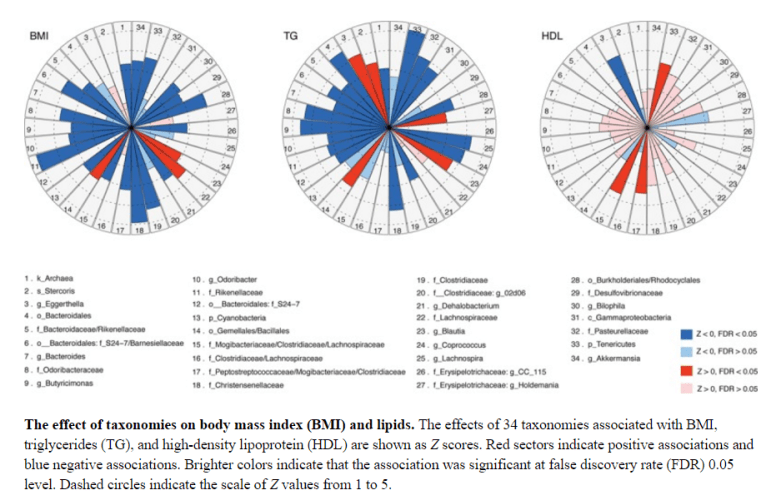
hdl

AkkermansiaChristensenellaceae (phylum Firmicutes; N18) and the phylum Tenericutes and higher levels of HDL (P=0.0047 and P=0.0006, respectively) [RED in chart above]… genus Eggerthella (N3) with  decreased HDL (P=6.3×10⁻⁵), [BLUE in chart above]”

“We observed that the gut microbiome makes a significant contribution, beyond that of clinical risk factors and genetics, to the individual variance seen in BMI and to the blood levels of triglycerides and HDL,but that it has little effect on LDL or TC levels. ”

Bottom Line

While the bacteria cited above are not currently available as a probiotics, we do have L. Fermentum available as a probiotic that has significant effect after 4 weeks and major effect after 12 weeks. Adding almonds as a regular part of your diet would also help.