Review of Low dose naltrexone

A reader asked if this might be suitable with my model. Information was sparse but a 2010 studies suggests that the harm aspect may be greater than the good.

Low dose naltrexone: side effects and efficacy in gastrointestinal disorders. [2010] [Full Text]

  • 58 of 121 had one or more neurological complaints  – almost 50%
  • In 13 patients with idiopathic irritable bowel syndrome, 2 were markedly worse.
  • . In 85 patients with irritable bowel syndrome-small intestinal bacterial overgrowth, 15 were markedly improved, 32 were moderately improved, 11 were mildly improved, 23 were unchanged, 3 were moderately worse, and 1 was markedly worse. – Odds of getting better instead of worst is 14.5:1 .

As a treatment, yes — some improves, many have no change, and more became worst than better. This does not seem like a rational choice – it’s playing craps with loaded dice.

It has been studies in terms or Crohn’s Disease, a more severe disruption of the microbiome,  “Currently, there is insufficient evidence to allow any firm conclusions regarding the efficacy and safety of LDN used to treat patients with active Crohn’s disease… is not without potential for side effects. Future use of methylnaltrexone may be better tolerated since it does not cross the blood brain barrier. ” [2014]

In terms of Fibromyalgia (FM) [2013], it appears to help — remember that FM is likely due to DNA factors — which suggest that its impact may be connected to this. Before taking it,  your  baseline erythrocyte sedimentation rate[ESR] should be taken to see if you are likely to be a responder, see table below.[2009]. Also, the effect decline within a week once you stop.
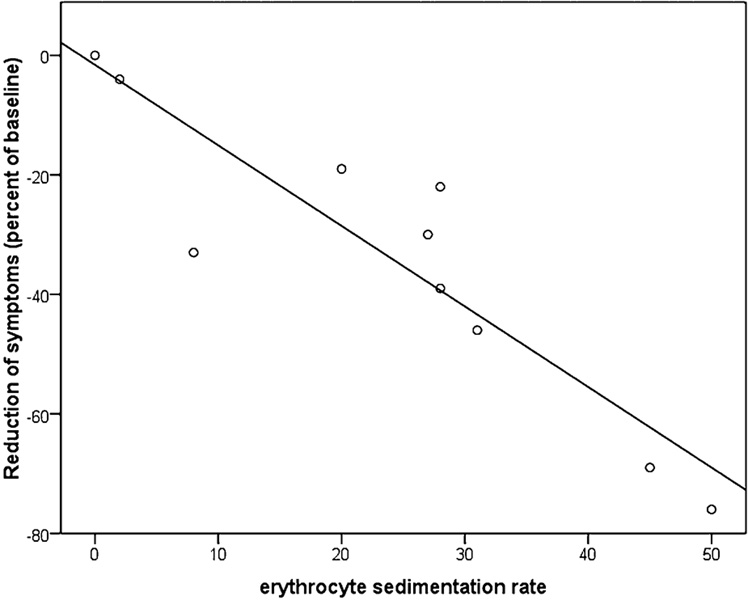
NIHMS209741.html


Like milnacipran, a related drug (which some suggest is better for FM), adverse effects can happen in 20-30% of patients [2009] “. “milnacipran 100 mg or 200 mg is effective for a minority in the treatment of pain due to fibromyalgia, providing moderate levels of pain relief (at least 30%) to about 40% of participants, compared with about 30% with placebo.” [2015]  So only 10% improved more than those with a placebo…

There is no clear pattern of ESR for IBS[2015], FM [2016]. It appears to apply to a subset only (likely DNA associated) which can be determined from the ESR. With CFS, browsing web pages you will find normal ESR is reported by some and low by others. One subset has low SED rates (hence LDN will likely have no positive effect for them)

  • According to Dave Berg, Hemex (hypercoagulation theory):
    “The ESR (erythrocyte sedimentation rate – red blood cell sed rate) is called SED RATE for short. We are close to having enough data to publish that the normal range for SED RATES should start above 3 or 4. Values below this are correlated with high SFM values. As the Soluble Fibrin Monomer (SFM) goes up in the plasma, these molecules form dimers (2 stuck together). This physically blocks the RBCs from settling out of the plasma, thus a low sed rate.” [Townhall] – this is just ONE of the coagulation defects that he found in CFS. So some will be low and some normal and some high…
  • This happens to be true for me with non-prescription items effective to lower SFM.

This leads to the possible mechanism of action, it’s does impact one form of anticoagulant!! There are many forms of coagulation. Coagulation reduces oxygen level to tissue, and this is well recognized as a major source of pain – cells screaming for oxygen.

  • “The fibrinogen levels declined sharply with abstention and an additive effect was noted with the administration of naltrexone,” [1994]

Bottom Line

There is no clear evidence of it being effective with microbiome disruptions. Yes, a small percentage of patients improved (which many MD’s see emotionally and then start prescribing it to all of their CFS patients). Many CFS MDs may discount or ignore the patients that became worst (unfortunately) because they are focused on positive results instead of evaluation of this drug. With a non-fatal disease, a physician tossing a drug that is more likely to worsen a patient than improve the patient raises some  fundamental ethical questions.

If you have taken LDN and improved, don’t take exception with this post — I agree that you improved, the studies say that. You are the lucky ones…. others are not the same.

As a side note during my research I found “” With the exception of weak nonspecific DNA damage observed in an E. coli DNA repair test and possibly with WI-38 cells as well, Naltrexone did not demonstrate significant potential for the induction of gene mutations or chromosomal aberrations under the conditions of this evaluation.” indicating that there may be some long term risks. Damage to your microbiome DNA and your own DNA.

A fresh look at process…

I work off a model which means that I know what needs to happen. It does not determine what the sequence is, or even fix the substances to use. This is actually good because what we are dealing with depends on three items: inherited DNA, inherited microbiome  (body bacteria, gut, mouth, etc) and likely the specific infection that triggered it.

Recently my perspective have shifted and this is my current suggestion for a new person kick-starting a run at remission. Since such a person likely has brain fog and a lack of executive decision making — I will restrict my self to 4 supplements (taken at the same time — no need to rotate, keep on them) and a list of 5 probiotics that should be taken in rotation. The rotation has two advantages — cuts cost, discourages resistance of the bad bacteria.

NOTE: Everything that is listed (with one exception) is documented as helping on PubMed National Institute of Health database of clinical studies. These are not reasoned recommendations, but recommendations based on actual human clinical study  experience that have been reviewed.

Supplements to mitigate symptoms

These are items that normally would be absorbed or transformed by a population of healthy bacteria. With the shift to the dark side, these are mal-absorbed or not produced to the same levels.

Having die-off / herx from these very rarely occurs.

Supplement Daily Sample Study
Magnesium 600 mg [1992]
Vitamin D3 25,000 IU [2009]
Vitamin B1 100 mg x 3 times [2013]
Vitamin B12  injections is the usual recommendation of CFS MDs [2015]

Starting Probiotics

Today, we actually have an increasing number of suitable probiotics available over the internet. Most will not be found at your local health food store.

Probiotics are bacteria that often produce antibiotics against other species and strains. Whether you herx depends very much on the dysfunction bacteria that you have. If you have a low herx tolerance, then when a herx shows up — move along to the next one.

Probiotic Duration (dosage per bottle) Rationale Sample Study
Typically for IBS
General Biotics Equilibrium 1 week Appears to be best tolerated. Kick start with 115 strains None, just anedotal reports of improvement
Prescript Assist 1 week Adds 29 more strains [2007]
Symbioflor-2 1 week This is one of the few probiotics that been documented to establish itself [2009]
Miyarisan 1 week Converts lactic acid to butyric acid [2015].
Align 1 week Bifidobacterium infantis [2009]

If a probiotic seem to help, fell free to continue for up to 2 more weeks (then you need to rotate it) and add in the next one on schedule (taking 2-3 concurrently). You will have to feel your way into these.

We do not know how well they play with each other. Some probiotics like Lactobacillus will not play nice with some of the above probiotics….

The above list delivers some 152 distinct named strains in the hope of kick starting bio-diversity that is very lacking in the FM/CFS/IBS gut.

I have some on order for my wife’s Crohn’s and will likely try some myself (since I am in remission, I do not expect significant effect).

GeneralBiotics probiotics

A reader referred me to this product and he cites good result for himself. While there are no appropriate studies on it publish so far — it makes my theoretical good list. Why?

  • No lactobacillus in it at all!
  • A lot of species — with documentation on many in isolation

EU Buyers

Some readers have reported issues with customs and duties (or 3rd party charging outrageous rates). The direct European distributor is amitra nutrition in the UK.

Strains list

  1. Bacterium 36B NCBI UniProt
  2. Bacterium 72B NCBI UniProt
  3. Bacterium AK-MB25 NCBI UniProt
  4. Bacterium AK-MB30 NCBI UniProt
  5. Bacterium AK-MB34 NCBI UniProt
  6. Bacterium AK-MB37 NCBI UniProt
  7. Bacterium BM0102 NCBI UniProt
  8. Enterobacteriaceae bacterium BM0118 NCBI UniProt
  9. Eubacteria bacterium BM0181 NCBI UniProt
  10. Enterobacteriaceae bacterium BM0196 NCBI UniProt
  11. Enterobacteriaceae bacterium BM0248 NCBI UniProt
  12. Enterobacteriaceae bacterium BM0266 NCBI UniProt
  13. Enterobacteriaceae bacterium BM0269 NCBI UniProt
  14. Enterobacteriaceae bacterium BM0270 NCBI UniProt
  15. Enterobacteriaceae bacterium BM0271 NCBI UniProt
  16. Aeromonadaceae bacterium BM0272 NCBI UniProt
  17. Enterobacteriaceae bacterium BM0277 NCBI UniProt
  18. Enterobacteriaceae bacterium BM0287 NCBI UniProt
  19. Enterobacteriaceae bacterium BM0294 NCBI UniProt
  20. Pseudomonadaceae bacterium BM0295 NCBI UniProt
  21. Enterobacteriaceae bacterium BM0298 NCBI UniProt
  22. Enterobacteriaceae bacterium BM0301 NCBI UniProt
  23. Enterobacteriaceae bacterium BM0305 NCBI UniProt
  24. Enterobacteriaceae bacterium BM0315 NCBI UniProt
  25. Aeromonadaceae bacterium BM0318 NCBI UniProt
  26. Enterobacteriaceae bacterium BM0321 NCBI UniProt
  27. Enterobacteriaceae bacterium BM0324 NCBI UniProt
  28. Enterobacteriaceae bacterium BM0326 NCBI UniProt
  29. Enterobacteriaceae bacterium BM0329 NCBI UniProt
  30. Enterobacteriaceae bacterium BM0335 NCBI UniProt
  31. Enterobacteriaceae bacterium BM0336 NCBI UniProt
  32. Enterobacteriaceae bacterium BM0344 NCBI UniProt
  33. Enterobacteriaceae bacterium BM0348 NCBI UniProt
  34. Enterobacteriaceae bacterium BM0354_1 NCBI UniProt
  35. Enterobacteriaceae bacterium BM0357 NCBI UniProt
  36. Enterobacteriaceae bacterium BM0363 NCBI UniProt
  37. Enterobacteriaceae bacterium BM0371 NCBI UniProt
  38. Comamonadaceae bacterium BM0374 NCBI UniProt
  39. Enterobacteriaceae bacterium BM0377 NCBI UniProt
  40. Aeromonadaceae bacterium BM0380 NCBI UniProt
  41. Enterobacteriaceae bacterium BM0381 NCBI UniProt
  42. Enterobacteriaceae bacterium BM0382 NCBI UniProt
  43. Enterobacteriaceae bacterium BM0383 NCBI UniProt
  44. Aeromonadaceae bacterium BM0387 NCBI UniProt
  45. Comamonadaceae bacterium BM0412 NCBI UniProt
  46. Comamonadaceae bacterium BM0414 NCBI UniProt
  47. Enterobacteriaceae bacterium BM0436 NCBI UniProt
  48. Enterobacteriaceae bacterium BM0441 NCBI UniProt
  49. Pseudomonadaceae bacterium BM0443 NCBI UniProt
  50. Pseudomonadaceae bacterium BM0446 NCBI UniProt
  51. Enterobacteriaceae bacterium BM0570 NCBI UniProt
  52. Enterobacteriaceae bacterium BM0573 NCBI UniProt
  53. Enterobacteriaceae bacterium BM0574 NCBI UniProt
  54. Enterobacteriaceae bacterium BM0575 NCBI UniProt
  55. Enterobacteriaceae bacterium BM0576 NCBI UniProt
  56. Enterobacteriaceae bacterium BM0577 NCBI UniProt
  57. Enterobacteriaceae bacterium BM0585 NCBI UniProt
  58. Aeromonadaceae bacterium BM0587 NCBI UniProt
  59. Enterobacteriaceae bacterium BM0595 NCBI UniProt
  60. Enterobacteriaceae bacterium BM0602 NCBI UniProt
  61. Enterobacteriaceae bacterium BM0603 NCBI UniProt
  62. Enterobacteriaceae bacterium BM0609 NCBI UniProt
  63. Enterobacteriaceae bacterium BM0610 NCBI UniProt
  64. Bacterium KGJ-3-1 NCBI UniProt
  65. Bacterium KGJ-3-10 NCBI UniProt
  66. Bacterium KGJ-3-14 NCBI UniProt
  67. Bacterium KGJ-3-16 NCBI UniProt
  68. Bacterium KGJ-3-18 NCBI UniProt
  69. Bacterium KGJ-3-22 NCBI UniProt
  70. Bacterium KGJ-3-23 NCBI UniProt
  71. Bacterium KGJ-3-5 NCBI UniProt
  72. Bacterium KGJ-3-6 NCBI UniProt
  73. Bacterium OC 16 NCBI UniProt
  74. Bacterium AM_gF1DD01_08 NCBI UniProt
  75. Bacterium AM_gF1DD01_14 NCBI UniProt
  76. Bacterium AM_gF3SD01_02 NCBI UniProt
  77. Bacterium AM_gF3SD01_03 NCBI UniProt
  78. Bacterium AM_gF3SD01_04 NCBI UniProt
  79. Bacterium AM_gF3SD01_06 NCBI UniProt
  80. Bacterium AX_gF1DD01_04 NCBI UniProt
  81. Bacterium AX_gF3SD01_11 NCBI UniProt
  82. Bacterium AX_gF3SD01_12 NCBI UniProt
  83. Bacterium AX_gF3SD01_17 NCBI UniProt
  84. Bacterium AX_gF3SD01_25 NCBI UniProt
  85. Bacterium AX_gF3SD01_29 NCBI UniProt
  86. Bacterium AX_gF3SD01_33 NCBI UniProt
  87. Bacterium AX_gF3SD01_39 NCBI UniProt
  88. Bacterium AX_gF3SD01_48 NCBI UniProt
  89. Bacterium CA_gF2-3DD01_02 NCBI UniProt
  90. Bacterium CA_gF2-3DD01_03 NCBI UniProt
  91. Bacterium CA_gF3SD01_04 NCBI UniProt
  92. Bacterium CA_gF3SD01_10 NCBI UniProt
  93. Bacterium CY_gF1DD01_05 NCBI UniProt
  94. Bacterium CY_gF1DD01_09 NCBI UniProt
  95. Bacterium CY_gF1DD01_10 NCBI UniProt
  96. Bacterium CY_gF1DD01_14 NCBI UniProt
  97. Bacterium PE_gF1DD01_04 NCBI UniProt
  98. Bacterium PE_gF1DD01_06 NCBI UniProt
  99. Bacterium PE_gF1DD01_11 NCBI UniProt
  100. Bacterium PE_gF3SD01_05 NCBI UniProt
  101. Bacterium PI_gF3SD01_19 NCBI UniProt
  102. Bacterium A1Q1_fos_2300 NCBI UniProt
  103. Pseudomonadales bacterium HF0500_12O04 NCBI UniProt
  104. Bacterium HF130_AEPn_2 NCBI UniProt
  105. Bacterium HH1107 NCBI UniProt
  106. Bacterium HHV216 NCBI UniProt
  107. Bacterium HHV35 NCBI UniProt
  108. Bacterium MID12 NCBI UniProt
  109. Bacterium pAB2 NCBI UniProt
  110. Bacterium A1Q1_fos_2300 NCBI UniProt
  111. Bacterium HF130_AEPn_2 NCBI UniProt
  112. Pseudomonas sp. R2SpM1P1C10 NCBI UniProtalso eats mustard gas!
  113. Pseudomonas sp. UMAB-62 NCBI UniProt
  114. Pseudomonas sp. cn4902 NCBI UniProt
  115. Pseudomonas stutzeri NCBI UniProtNCBI study

You can order it directly from the manufacturer, and they ship to Europe for just an extra $3.00!!!

This is the kicker — full refund if you are not happy!!!!!

“We want to make you happy. Try Equilibrium and see if you like it. If you do, awesome! If you don’t, just email us and we’ll refund you completely. Max 10 bottles refunded per person, within 180 days of purchase.” — also applies to international orders!

If you are new to probiotics, I would suggest one capsule of the above at breakfast and one of Prescript Assist at bedtime snack — some 150 species (and not a single lactobacillus in either!)

The have a good, well documented read, at http://www.generalbiotics.com/science/

Experiences

  • ” I was hoping to see noticable improvement and relief of IBS symptoms. I would say while on this product I noticed UP TO 20% benefit/improvement from this product.” [Source]
  • “I found this to be the most effective digestive aid that I’ve used to date. All the typical digestive signs were present – more regular bowel movements, no bloating or gas, and overall just a more normal sense of fullness and digestion between meals. While most of this is anecdotal, I do firmly believe that this proved more effective at over-all wellness than other probiotics that seemed to simply flush my system and make me fart alot.” [Source]
  • ” Equilibrium is at the top of the price range. This could quite easily be a ‘you get what you pay for’ scenario however, as I mentioned above, no other probiotic has worked for me like this one.” [Source]


Probiotic Biofilm Breakers.

A year ago, I did a post on herbs and supplements that are biofilm breakers. A reader raised a question about probiotics that could do the same…. interesting question! Warning: there are many types of biofilms! That is,  a biofilm created by one bacteria is different from the next bacteria.

I found a very good article on the concept published in Nature

Probiotics to counteract biofilm-associated infections: promising and conflicting data[2014]. [Full Text]

  • “In recent years, the ability of other commonly used probiotic strains (Lactobacillus acidophilus DSM 20079, Lactobacillus paracasei DSMZ 16671, Lactobacillus plantarum 299v, Lactobacillus rhamnosus GG [Culturelle], Lactobacillus reuteri strains PTA 5289 and L. reuteri SD2112, etc.) to hamper S. mutans growth and biofilm formation in vitro has been evaluated, and these results suggest that the antimicrobial activity of Lactobacilli seems to be strain-specific and pH-dependent
  • “probiotic L. salivarius W24 was able to affect the compositional stability of the microbial communities derived from individual saliva and appeared to have a cariogenic potential
  • “On the one hand, there are studies reporting that probiotics are able to inhibit biofilm formation of intestinal pathogens, but on the other hand different experimental data seem to support the enhancing of enteropathogens biofilm biomass in the presence of probiotics.”
  • “In 2010, Hancock and coworkers investigated the biofilm-forming capacity of Nissle 1917[Mutaflor] and found that this strain was a significantly better biofilm former than enteropathogenic, enterotoxigenic and enterohaemorrhagic E. coli strains, with the exception of being able to out compete such strains during biofilm formation”
  • “three probiotic strains (L. rhamnosus GG, B. longum NB667, and Bifidobacterium animalis IPLA-R1) have been demonstrated to increase the adhesion of Enterobacter sakazakii ATCC 29544 and E. coli NCTC 8603, Salmonella enterica serovar Typhimurium ATCC 29631 and Clostridium difficile ATCC 9689”
  • “However, data are still scarce and not always consistent to look at probiotics as tool to avoid biofilm formation and/or to disperse pre-formed pathogenic biofilms.”

I found a few newer articles, but the full text version cited above gives far more detail on which probiotics (and mixtures) increases or decreases biofilm – the data is very very fuzzy. On the plus side:

  • Mutaflor does not destroy biofilms, it just create it’s own biofilms better!
  • Lactobacillus rhamnosus GG [Culturelle] appears to be a breaker (of some biofilms)


Thiamine Vitamin B1

This is the fourth of a series looking at the supplements in Driscoll’s Theory Patented Supplement Parasym Plus.  Only the specific ratio is patented — you can take the items freely, and even replicate the ratios (likely at much lower cost!) — just don’t sell it!

This supplement had an unexpected surprise — it reduces lactic acidosis in some situations.

From 1999, “These data provide preliminary evidence of reduced functional B vitamin status, particularly of pyridoxine, in CFS patients.”

  • [1999] “, a recent dietary survey yielded no evidence that such patients had low intakes of pyridoxine, riboflavin, thiamine or various other vitamins and micronutrients1 … A placebo controlled double-blind study of a polynutrient supplement including pyridoxine, riboflavin and thiamine has shown significant improvements, particularly fatigue scores, after six weeks’ treatment”
  • “The absence of blood thiamine deficiency and the efficacy of high-dose thiamine in our patients suggest that fatigue is the manifestation of a thiamine deficiency, likely due to a dysfunction of the active transport of thiamine inside the cells, or due to structural enzymatic abnormalities.” [2013] The last phase would include dysfunctional microbiome.
  • “The patient and his family responded to treatment with high doses of riboflavin and thiamine with a remarkable and sustained fatigue and muscle symptoms improvement” [2015]
  • High-dose thiamine improves the symptoms of fibromyalgia.[2013]
  • Aggravation of thiamine deficiency by magnesium depletion. A case report[1985]. — so magnesium supplementation concurrent is imporant
  • “We report 5 cases of acute vitamin B-1 induced lactic acidosis in surgical patients receiving parenteral nutrition. In all patients treatment with vitamin B-1 induced a dramatical improvement of clinical findings.” [1990]  I include this citation because lactic acidosis is common in CFS. These citations are NOT for CFS.
    • Thiamine replenishment at intravenous doses of 100 mg every 12 h resolved lactic acidosis and improved the clinical condition in 3 patients.” [1997]
    • “After thiamine administration, the patient very quickly recovered with dramatic reestablishment of the acid-base balance.” [2004]
    • “patients were subsequently diagnosed as having thiamine deficiency-induced lactic acidosis.” [1993]

Benfotiamine

This is a synthetic version of B1 – chemically slightly different (see earlier post). So whether it has the same impact as thiamine on lactic acidosis is an unknown (i.e. not studied)

Bottom Line

As with our last supplement, labs will likely show normal levels BUT supplementation results in significant improvement of symptoms. What is particularly interesting is that thiamine reduces/reveres lactic acidosis, a very significant factor for CFS patients.

You should supplement with magnesium (which I hope every one is doing already) when taking it.  Dosage, “100 mg  two- three times daily”. Three times per day cited on National Institute of Health for another condition. Two times for above cases of lactic acidosis.