TNF-alpha Reducers – a deeper look

A reader forwarded me a page where TNF-alpha reducers are listed “HOW TO INCREASE PERFORMANCE AND IMPROVE HEALTH BY INHIBITING TNF-ALPHA“.   TNF-alpha is strongly connected with inflammation and reducing inflammation is very desired in most auto-immune diseases.

As the last few posts showed, many of the substances have side effects on gut-bacteria that may not be good if you are dealing with a microbiome dysfunction.

  • ” specific bacterial abundances were directly proportional to measures of anxiety or cognition”[2014]

Top 16 Ways To Inhibit TNF

The list below comes from the above page, I will go through his other recommendations in latter posts. The goal is to identify TNF-alpha reduces with know impacts on gut bacteria.

  • point to an involvement of Bacteroides fragilis in the formation of fistula in patients with Crohn‘s disease[1986]
Recommendation Positive Negative
Elemental diet (R)

–Concerns–

.Elemental diet is a Crohn’s Diet

  • Bacteroides fragilis significantly decreased, Enterococcus significantly increased [2012]
  • Species diversity not changed [2012]
  • Lactobacillus reuteri and L. johnsonii decreased and Enterococcus faecalis and E. durans increased in the ED group [2009]
Calorie restriction (R)

–Inconclusive–

  • life-long calorie restriction on both high-fat or low-fat diet, but not voluntary exercise, significantly changes the overall structure of the gut microbiota…positively correlated with lifespan [2013]
  • Total bacteria, B. fragilis group and Clostridium leptum group, and Bifidobacterium catenulatum group counts were significantly higher (P<0.001-0.036) while levels of C. coccoides group, Lactobacillus group, Bifidobacterium, Bifidobacterium breve, and Bifidobacterium bifidum were significantly lower [2009] -i.e. mixed results
.
Fasting (R)

–Fine–

  • Faecalibacterium prausnitzii increases (good for Crohn’s),  an increase in microbial diversity  [2015]
  • feeding/fasting rhythms contribute to the diversity of gut microflora [2014]
  • Needs to be tailored.[2015]
  • Alterations in relative abundances of microbial taxa varied across hosts [2014]
  • Age and health may impact nature of change [2014]
Exercise

-Inconclusive–

.See full article — complex changes [2014] voluntary exercise attenuates, while forced treadmill exercise exacerbates, intestinal inflammation and clinical outcomes [1985]
PQQ (R) Pyrroloquinoline Quinone
–Inconclusive–
.No PubMed Literature
Resveratrol (500mg, with 5g leucine),

–Fine–

  • increasing the Bacteroidetes-to-Firmicutes ratios, significantly inhibiting the growth of Enterococcus faecalis, and increasing the growth of Lactobacillus and Bifidobacterium [2014]
  • Resveratrol increased lactobacilli and bifidobacteria as well as diminished the increase of enterobacteria[2009]
  • Resveratrol metabolism by human gut microbiota shows pronounced interindividual differences [2013]
Curcumin 2g (R)…powerful (R)

–Fine–

  • fewer pro-inflammatory enterobacteria and enterococci but also higher anti-inflammatory lactobacilli and bifidobacteria loads [2010]
Jasmine Tea (R)

–Inconclusive–

.No PubMed Literature
Cinnamon
–Fine–
  • Staphylococcus, Enterococcus, Enterobacter and Acinetobacter genera were susceptible to Cinnamon [2014]
Black Cumin Seed Oil….powerful (R)

Nigella sativa

–Inconclusive–

  • Reduces Staphylococcus aureus [2014]
  • antimicrobial impact on the growth of S. aureus, E. coli, L. monocytogenes and S. enteritidis[2014]
  • highly effective against Gram-positive bacteria [2014]
Rooibos

–Inconclusive–

.No PubMed Literature
Carob

–Inconclusive–

..No PubMed Literature
Licorice (R),

–Fine–

  • .improved both bowel habit and IBS symptoms [2010]
Niagen NAD+  (R),

–Inconclusive–

. NAD+, NADH, etc are all precursors to Niacin which natural production can be reduced by bacteria dysfunction.
Kombucha(R)

–Concerns–

  • .Effectively: Lactobacillus casei and Lactobacillus plantarum [2015]
No control over strains and thus tossing a dice in effect.
2g Hops (xanthohumol) (R)

–Inconclusive–

  • .does not affect the composition of rat intestinal microbiota [2010]
Impact vary greatly from individual to individual.[2006]

.

By Diet Type

Diet Type Changes Source
Carbohydrate ↓ Bifidobacteria ↓ Clostridium ↓ Bacteroidetes ↓ [2014]
Protein ↑ .Bacteroidetes ↑ Lactobacillus ↑ Bifidobacterium ↑ oooooo
Mediterranean ↑ .Prevotella ↑ Enterococcus ↑ Bifidobacteria ↑ Lactobacillus ↑ Bacteroides ↑ Clostridium ↓ PUFA: Lactobacillus ↑ oooooo

Revisiting Walking Pneumonia – Mycoplasma pneumoniae

My first round of CFS was diagnosed as antibiotic resistant walking pneumomia. This was back in the early 1970’s when many MDs thought that it was caused by a virus and thus when antibiotics failed, there was nothing to do but de-stress and wait and pray — which I did. Subsequent round had the one effective family of antibiotics (tetracycline) against mycoplasma pneumoniae(MP) as part of the treatment. MP produces neurologic issues [2013]. The fastest recovery was the last time where tetracycline had a slow impact, but the user of appropriate herbs and probiotics resulted in a much faster recovery.

Recently there has been wave after wave of stressful issues hitting me for the last 6+ weeks and my classic “stress cough” has re-appear. This means that the mycoplasma pneumoniae(MP) has prospered from the stress. Needless to say, I have been very aggressive in reducing/eliminating stress — this means that I will become rude or upsetting to others if need be. I cannot afford to “put up with” or “hope for the best”. Stress must be eliminated.

Time for a review of treatment options

I have been on and off tetracyclines so much over the years that the MP is likely resistant by now, the general level of resistance may be about 25%[2014]. The last time with CFS, there was no major herx or other clear signs of impact. Reading about mycoplasma, it become clear that treatment is not trivial because it lacks cell walls and can mimic normal cells. The following appear to have potential.

  • azithromycin, erythromycin and gamma globulin combined aspirin[2013]
  • There are some chinese herbs ( Radix Isatidis, Radix Angelicae Dahuricae – Bai Zhi (白芷)., Cortex Phellodendri – Huáng bǎi (, Radix et Rhizoma Rhei – Rhubarb, Fructus Kochiae – Di Fu Zi, 地肤子 and Herba Houttuyniae – Yu Xing Cao) which may be effective [2005]
  • aspirin [2015]

Reducing stress – specifically the physiological response to stress which I suspect encourages MP growth:

  • Ashwagandha (and appears to positively impact pneumonia [2009])

Recently, I have been using Align, Culturelle and L.Reuteri with a significant lessening of symptoms after 5 days. Keeping with the model that the active infection alters gut bacteria, then by counter balancing with probiotics may weaken the infection. It’s rest and taking it easy until MP symptoms are gone.

Stevia inhibits the L.Reuteri and should be avoided

A reader contacted me and ask “What about Stevia and gut bacteria?” After discovering that Sorbitol causes gut problems, the reader wondered if other “healthy alternatives” may have issues if you are dealing with a gut bacteria dysfunction. Yes, they have some healthy aspects — but they may also have issues to people with microbiome challenges.

The dominant bacteria is health individuals is Lactobacillus reuteri, which can be low (or non-existent) in patients with CFS and other conditions.

“it was found that lactobacilli and bifidobacteria tested were able to utilise [stevia] steviol glycosides as a carbon source only to a very limited extent.” [2014] – in other words, does not encourage these species 😦 it does not kill them — just starves them,

“Taking into consideration the broad application of Lactobacillus reuteri in functional foods, the aim of the research was to evaluate the influence of stevia glycosides on its growth. Six Lact. reuteri strains were tested for their ability to grow in the … impaired the growth of analysed strains… it is necessary to evaluate the influence of stevia glycosides on other groups of micro-organisms in further research.” [2014]

Antimicrobial potential of extracts from Stevia rebaudiana leaves against bacteria of importance in dental caries… against 16 bacterial strains of the genera Streptococcus (n= 12) and Lactobacillus (n=4) [2012]

“bacteroides were the most efficient in hydrolyzing Stevia sweeteners to steviol” [2003]


The bottom line seems to be that stevia is utilized by very few bacteria which for cavity fighting is ideal. On the flip size, it appears to starve or inhibits some beneficial bacteria. The literature is no clear if this is good or bad for microbiome dysfunction.

There is one last study [2007]  that raises a concern, “. Among patients with allergic diseases, allergy to stevia and stevioside was found in 16.0% AR patients, 34.0 % BA patients, or 64.0 % AE patients. Avoidance of stevioside-containing foods significantly decreased sensitization to stevia and stevioside in patients.”  which is a concern because Allergy is a big player in inflammatory bowel disease.

Additionally, with an up regulated immune system we find that “Immune up regulatory response of a non-caloric natural sweetener, stevioside” [2008] which adds more fuzziness.

The importance of from scratch food in treating CFS, IBD and Crohn’s

There are many that argue, on philosophical grounds often, that processed food should be avoided. Nature recently published an article that found “even relatively low concentrations of two commonly-used emulsifiers frequently found on processed food ingredient labels — carboxymethylcellulose[E466] and polysorbate-80[E433] — both have been found to induce low-grade inflammation and obesity/metabolic syndrome in wild-type hosts and to promote “robust” colitis in mice with a predisposition to that disorder.” [Link] [2015]

“Carboxymethylcellulose induces bacterial overgrowth and small bowel inflammation in susceptible animals. Because of its ubiquity in products and its unrestricted use in food of the industrial world, CMC is an ideal suspect to account for the rise of IBD in the 20th century.”[2009]

Note: ” CMC is one of the important raw material in the toothpaste production, it can mix liquid ingredients with solid materials evenly in the toothpaste” [link] as well as wine and beer, bakery products like breads and cake preparation, ice cream and candy.[Wikipedia].

Polysorbate-80 [Wikipedia] is in ice cream, powdered drink preparations such as hot cocoa mix, and mouthwashes. A small number of people may be sensitive to polysorbate 80,[ 2005 ] and it may be harmful to people with Crohn’s disease.[2009][2013 ]

I view Crohn’s Disease as one of the paths that CFS/IBD/UC can lead to (based on the premise that all are microbiome dysfunctions)

In Europe and America, people eat about 100 mg of polysorbate foods per day on average.


Sorbitol – glucitol

Most of the studies have been on short term impact of oral bacteria and not gut bacteria.

“sorbitol diets exerted a strong influence upon gut microbiota patterns… sorbitol and FOS intake increased L. reuteri cell numbers, and sorbitol also contributed to maintaining the levels of Lactobacillus sp. AD102. Analysis of organic acid concentrations showed that sorbitol intake significantly increased colonic and cecal butyrate levels.”[2007]

However, with  “Long-term use of xylitol-containing chewing-gum can reduce the growth of… lactobacilli-type bacteria in saliva, even if xylitol is used only on school days. The results also suggest that xylitol gum use can have a long-term, delayed growth-retarding effect on these micro-organisms, since reduced bacterial growth was still observed 15 months following the termination of xylitol use.” [2008]

“Fructose-sorbitol (F-S) mixtures can provoke symptoms in irritable bowel syndrome (IBS) patients,”[1998] [1992]

“Recent studies [of IBS] indicate that a diet restricted in fermentable, poorly absorbed carbohydrates, including fructose, fructans (present in wheat and onions), sorbitol, and other sugar alcohols is beneficial, but confirmatory studies are needed [2009]

“Recently, polymerized forms of fructose (fructans) also were implicated in symptom production in patients with irritable bowel syndrome (IBS). Evidence from uncontrolled and controlled challenge studies suggests that malabsorbed sugars (fructose, sorbitol, lactose) and fructans may act as dietary triggers for clinical symptoms suggestive of IBS.”[2009]

Another site/tool for DNA Health Risk

In my last post I did used DNA to evaluate if a person was a good candidate for using Infliximab aka  Remicade. During the research I discovered a free tool and site to further ease DNA analysis. This site is actually easily to use than https://livewello.com/

The gotcha is you need to use the Safari Browser [Install here] and the site is http://www.eupedia.com/genetics/autoimmune_diseases_snp.shtml. It will prompt you to install  SnpTips Add On: https://addons.mozilla.org/en-US/firefox/addon/snptips/

What do you get then?

Before the above (or on a different browser) you will see

Screen Shot 2015-03-29 at 3.43.09 PM

You will see:
Screen Shot 2015-03-29 at 3.47.38 PM

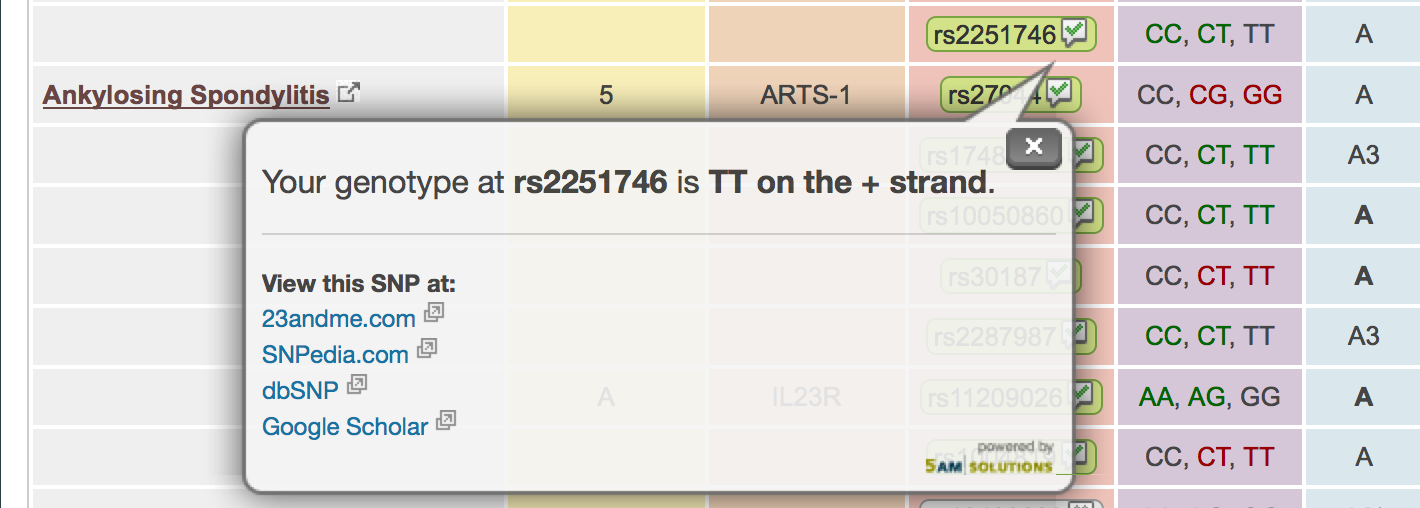
Clicking on this change item will show your values, plus quick links..

Screen Shot 2015-03-29 at 3.50.08 PM

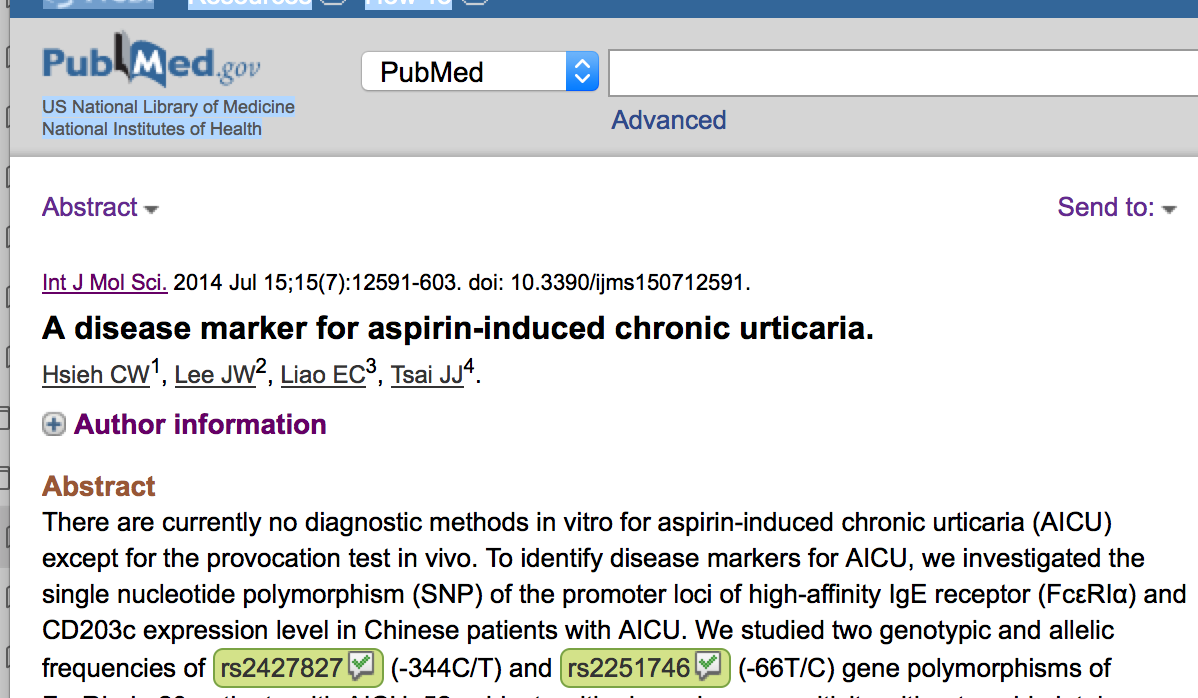
The extra sweet thing is that this applies to ANY PAGE. For example, while browsing Pub Med pages

Screen Shot 2015-03-29 at 3.55.01 PM

This can save a lot of time, for example, for the SNPs above, I immediately know if I have the SNPs that are being investigated — in this case, I have one of them, so further reading may be worth while.