CoQ10 and gut bacteria

I noticed an article that mentioned both NADH and CoQ10 helping with fatigue. NADH is produced by E.Coli which has been reported as low in CFS patients (1998 Manly Conf). I thought that I should investigate CoQ10 connection with gut bacteria (in the hope of identifying species that may be good probiotic candidates).

What I found was 100+ articles on PubMed. This text identifies some species as:

During my digging into CoQ10, I discovered a 2010 article finding that grapefruit juice significantly enhances the absorption of CoQ10 300 mg/day – Studies in this post..

Methylation Cycle, Gut Bacteria and Chronic Fatigue Syndrome

Rick Van Konynenburg’s passing was very unexpected and unfortunate, not only for the community but because he had just agreed to review a draft book on the Gut Bacteria model that I was working on. I had sent him a draft just 7 days before he passed.

In terms of recent papers, this [2012] paper appears to support the premise — especially if you consider the frequent co-morbid conditions of IBS and IBD with CFS.

“The gut microbiota, the intestinal mucosa and the host immune system are among the large biological networks involved in the development of inflammatory bowel disease (IBD), which includes Crohn disease (CD) and ulcerative colitis (UC). Host genetics and environmental factors can significantly modulate the interactive relationships among these biological systems and influence predilection toward IBD… Epigenetic changes, such as DNA methylation (the methylation of cytosines followed by a guanine in CpG dinucleotides) can be modified by environmental influences [gut bacteria].  Mucosal DNA methylation can also react to changes in the commensal microbiota, underscoring the intercalating relationships among the large biological systems involved in gastrointestinal disorders.

A [2000] paper on IBD states a situation of suspected infections factor similar to that seen with CFS: “A great number of bacterial and viral factors has been suspected of being infectious factors in IBD, mostly in CD. Mycobacteria, Yersinia, Campylobacter, Clostridium, Clamidias, etc. as well as bacteria and some viruses such as herpes and rotavirus and the primary measles virus. None of them has been proven as a real and exclusively pathogenic factor.

Returning to CFS specifically, from the Aussie 1998 conference report, we know that escherichia coli populations is very low in CFS patients. E.Coli produces NADH, and this would account for the benefits of NADH supplements for CFS that have been reported from several studies.

E.Coli also impacts other metabolites. I did a query on PubMed for “Escherichia coli Methylation” and got 3244 hits today!

One paper from 1973 was very interesting:
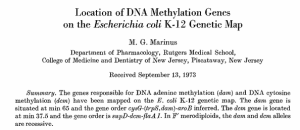
Location of DNA methylation genes on the Escherichia coli K-12 genetic map

Location of DNA methylation genes on the Escherichia coli K-12 genetic map

So E.Coli is involved with methylation!

Another study from [1972] found that Bacillus subtilis is also involved. B.subtilis was used in WW2 to treat dysentery (as was E.Coli Nissle in WW1). It should be noted that the use of such fell out of favor with the introduction of antibiotics. It is very interesting to note that Nattokinease is produced by a member of B.subtilis family (Bacillus subtilis natto).

My conclusion is that methylation issues in CFS could be explained as a result of a gut bacteria alteration. The methylation issues are down-stream from the gut (i.e. it would be much harder to argue that methylation issues causes gut bacteria alteration).

I find myself asking the same question that I ask of antibiotics use and CFS:

  • When success occurs, are the antibiotics dealing with infections in the blood and tissues OR are they altering gut bacteria that allows re-activation of prior infections?
  • When success occurs, are the change of diet etc. correcting/compensating the methylation issues OR are they altering gut bacteria that interfere with methylations issues?

“Chronic illness can be physiologically due to blocked biochemistry of methylation.” – the question is What is blocking the methylation? It could be DNA, but I believe the greatest factor (which happens to also be correctable!) is gut bacteria…

Vitamin A: Pulses and Gut Bacteria

For years, we have done Vitamin A (beta-carotene) pulses as a method of heading off an infection. The reason is experience and this statement from Springboard:

Vitamin A seems to stimulate the immune system and the production of white blood cells. Often when some kind of infection like the flu or a cold hits an intake of 100,000 to 150,000 IU for not more than three days will effectively turn on the immune system to the extent that the infection is stopped. The implications of this for other health problems should be obvious adequate supplementation of vitamin A on a daily basis will keep the immune system up and ready to fight back, although it is certainly no miracle cure for all the ills and abuses of the body.” springboard4health.com as well as other alternative health sites [evitamins, herbalhut].

I recently appear to start a cold (which the wife appear to have brought home) and could feel something developing — in fact, I noticed a shift in digestion. I did a pulse and things appear to return to normal. This left me with an interesting question because of recent readings…

Studies have found that gut bacteria distribution can be used to reliably predict what infections a person has (at least for the set of infections that the study was tried on). This raises the question — is the impact of vitamin A a disruption of a new invasive (infection related) set of gut bacteria?

As usual, I decided to check out PubMed studies and see what I could find:

  • ” a reduction in the intestinal microflora resulted in an increased storage of beta-carotene, alpha-carotene and vitamin A in the liver.” [1998]
  • “an association between carotenoid-rich food intakes with a low incidence in chronic diseases” [2006]
  • “Retinoic acid (RA), a well-known vitamin A metabolite, mediates inhibition of the IL-6-driven induction of proinflammatory Th17 cells and promotes anti-inflammatory regulatory T cell generation in the presence of TGF-beta….  RA deficiency altered gut microbiome” [2010]
  • ” deficiency in retinoic acid-related orphan receptor c(-/-) mice resulted in a complete failure to control the [fungal] infection”[2013]
  • ” mitochondria participate in innate immunity to viral infection through the pattern recognition receptor retinoic acid inducible gene-I and are involved in inflammasome activation.” [2012]
    Translation: Vitamin A increases the body ability to recognize infections…
  • ” However, stimulation of dendritic cells via TLR2 increases the expression of host genes associated with generation of the immunoactive form of vitamin A (retinoic acid) while enteric infection has been linked to vitamin A deficiency ….  vitamin A has the potential to modulate immune responses through direct interactions with immune cells, or indirectly by modulating the composition of the microbiota.” [2011]

While not finding an ideal study, we do find that Vitamin A has been documented to change the microbiota (gut bacteria) as well as causing the immune system to be more active against infections.

Going through notes (from pubmed articles), I see:

  • Availability affected by microfloras
  • Decreased in Fibromyalgia patients
  • Decreased with Lyme and symptoms worst with lower levels
  • Deficiency associated with susceptibility to infection and altered microfloras
  • Deficiency increases IL-12 production
  • EBV and CMV alters Vitamin A metabolism
  • Low intake seen with IBS/IBS patients
  • Low level in active Crohn’s disease, but normal when inactive
  • Retinoic acid down-regulates colon inflammatory responses in patients with IBD
  • Supplements may reduce inflammation

Thus vitamin A levels should be checked, and if not in the top 75%ile, supplementation may be of significant help.

Thyroid and the gut

A correspondent raised some interesting questions about thryoid and gut bacteria. She wrote
Thyroid disease is known to slow down the digestion” I find that I must ask the question, perhaps digestion slowed down FIRST, and the thyroid disease was a result! I don’t know the answer, but know that if we don’t examine both directions — we may miss a significant treatment approach.
Looking at some pubmed articles,

thyroid hormones increase intestinal motility and transit rate, administration of cholecystokinin increases small bowel motility, diarrhoea occurs in adrenal failure, while mineralocorticoids increase salt and water absorption from the colon.Indeed aldosterone secretion may be increased by the loss of sodium in diarrhoea. The balance between the biochemical regulators is clearly complex, but study of certain endocrine abnormalities has demonstrated their importance in the control of intestinal function.” [1971]

Later studies report “Thyroid diseases may be related to gastrointestinal motility symptoms. Such symptoms can vary in degree and, sometimes, are the only clue of athyroid disease or, at least, the first…. thyroid diseases may be related to symptoms due to digestive motility dysfunction.” [2004]

In terms of demonstrating that the absence or prescence of a single bacteria species in the gut can cause thyroid problems is mentioned in this 2008 article.

Perhaps the most celebrated example of the difference a single species can make is the ‘mimosine story’ in ruminants. Mimosine is a toxic amino acid found in the leguminous plant, Leucaena leucocephala. Mimosine can cause thyroid problems by being converted to the goitrogen, 3-hydroxy-4(1H)-pyridone, in the rumen.  Observations that mimosine-containing plants were toxic to ruminants in some countries but not others led to the discovery of Synergistes jonesii, which metabolises 3-hydroxy-4(1H)-pyridone and protects animals from toxicity.”[2008]

In other words,  a single species makes a major difference: Synergistes jonesii!

The sweetish article that I found comes from, BMJ in 1923: THE INFLUENCE OF INTESTINAL BACTERIA UPON THE THYROID GLAND, which is well worth a read.

I have talked with people that have thyroid issue run in their family.  Since both gut bacteria and DNA are inherited — (which means that the cross product[interaction between DNA and gut bacteria]  is also inherited) — this suggests the inheritance could be altered by gut flora alteration (speculation)


If this is the correct approach, then the question arises — how do we alter it? The 1923 articles suggest that lactose is not effective (and this implies that Lactobacillus species may not be effective), thus this leads us to the unusual probiotics. The easiest to obtain is Prescript-Assist which I have referred to earlier in this blog.

Autoimmune and Vitamin 1,25D

I thought that I should put together a collection on conditions that have been documented to have a high Vitamin 1,25D result(Calcitriol) when tested.

  • ” Results showed a strong positive association between these autoimmune conditions[ multiple sclerosis, lupus, psoriasis, osteoporosis, osteoarthritis, metabolic syndrome, fibromyalgia and chronic fatigue syndrome] and levels of 1,25-D >110 pmol/L. However, there was little association with vitamin D deficiency or the other inflammatory markers, meaning that the results challenge the assumption that serum levels of 25-D are a sensitive measure of the autoimmune disease state.” [2009]
  • “In granulomatous disease such as lymphoproliferative disorders, sarcoidosis, tuberculosis, and inflammatory bowel disease,”[emedicine]
  • “postural orthostatic tachycardia syndrome” – remission with calcitriol treatment [2012]

General Vitamin D level and symptoms

  • “A significant negative correlation between vitamin D level and widespread pain index was found.”[2012]
  • ” improvement became more significant when their blood level of 25(OH) D exceeded 50 ng/ mL.”[2011]
  • ” a positive association of vitamin D deficiency with a variety of nonspecific bone pain, particularly in women” [2010]
  • “Musculoskeletal pain is associated with very low levels of vitamin D in men” [2010]
  • “Resolution of hypersomnia following identification and treatment of vitamin d deficiency.” [2010]
  • “Vitamin D deficiency is a major risk factor for central nervous system (CNS) demyelinating diseases including multiple sclerosis (MS)” [2012]
  • “This study demonstrates for the first time a direct antiviral effect of vitamin D in an in vitro infectious virus production system.”[2011]
  • “vitamin D can suppress intracellular growth of M tuberculosis in vitro. Vitamin D also induced the expression of cathelicidin, which is involved in the first line of defense in TB patients” [2011]
  • “Vitamin D(3) skews cytokine responses toward an antiinflammatory profile,.. Candida albican” [2011]
  • Interesting that Epstain-Barr interfers with Vitamin D actions!!!! [2010]

For general information on Vitamin D and autoimnmune disease:

  • Studies have shown evidences of 1,25(OH)D in inhibiting disease induction in autoimmune encephalomyelitis, thyroiditis, type-1 diabetes mellitus, inflammatory bowel disease (IBD), systemic lupus  erythematosus, and collagen-induced arthritis and Lyme  arthritis, as reported by Hayes et al and Adorini et al.  Vitamin D deciency could accelerate the occurrence of autoimmune encephalomyelitis” [2007]