A chat with former child in Dr. Bell’s Lyndonville Outbreak

I had lunch with one of the kids touched by the Lyndonville outbreak. She still has CFS but it is less then when it was most severe. During the conversation she mentioned that Dr.Bell was using antibiotics long term with his patients until he was threatened with his medical license being pulled if he did not stop.

The person also mentioned the best year of her life, she was being treated for a sinus infection. The sinus infection did not clear, so she ended up spending a year trying different antibiotics every few weeks. The sinus infection did not respond to any of them — but she really felt a lot better…

She related a very interesting story on a temporary cure for CFS symptoms. Lyndonville is a rural area with many farmers — many of which came down with CFS. When it came to harvest time, the harvest had to come in and they had to do it.  Someone discovered that rolling in poison oak caused the CFS symptoms to clear for a while and this became a regular practice for some of the farmers. The pain of poison oak or poison ivy was much less than the financial pain of loosing the harvest.

The chemical in this plant is Urushiol. Looking at this compound I found that it impacts cytokines in some interesting ways [Technical articles: 1988, 1989, 1996]. One of the ways was that the production of IL-2 and gamma-interferon was much lower. Dr. Bell recorded his observations in this article. He laments that there have been no followup on these observations by others.
 

A chat with former child in Dr. Bell's Lyndonville Outbreak

I had lunch with one of the kids touched by the Lyndonville outbreak. She still has CFS but it is less then when it was most severe. During the conversation she mentioned that Dr.Bell was using antibiotics long term with his patients until he was threatened with his medical license being pulled if he did not stop.

The person also mentioned the best year of her life, she was being treated for a sinus infection. The sinus infection did not clear, so she ended up spending a year trying different antibiotics every few weeks. The sinus infection did not respond to any of them — but she really felt a lot better…

She related a very interesting story on a temporary cure for CFS symptoms. Lyndonville is a rural area with many farmers — many of which came down with CFS. When it came to harvest time, the harvest had to come in and they had to do it.  Someone discovered that rolling in poison oak caused the CFS symptoms to clear for a while and this became a regular practice for some of the farmers. The pain of poison oak or poison ivy was much less than the financial pain of loosing the harvest.

The chemical in this plant is Urushiol. Looking at this compound I found that it impacts cytokines in some interesting ways [Technical articles: 1988, 1989, 1996]. One of the ways was that the production of IL-2 and gamma-interferon was much lower. Dr. Bell recorded his observations in this article. He laments that there have been no followup on these observations by others.


Probiotic Herxheimer Reactions

Jarisch-Herxheimer reaction (JHR or ‘herx’) is an acute febrile reaction which may complicate the initiation of an effective treatment against infections due to intracellular microorganisms. JHR can also be expressed as the worsening of symptoms or the appearance of new symptoms. JHR is traditionally associated with antibiotics and antivirals but may appear from taking anything that impacts the immune response or infections.

When it comes to probiotics, the usual Herx pattern is different. With an antibiotics induced herx, the herx will usually start when the concentration of the antibiotic approaches it’s maximum concentration and then ease off as the antibiotic leaves the system. The pattern is illustrated below.

Example of tissue concentration from an antibiotic taken twice a day

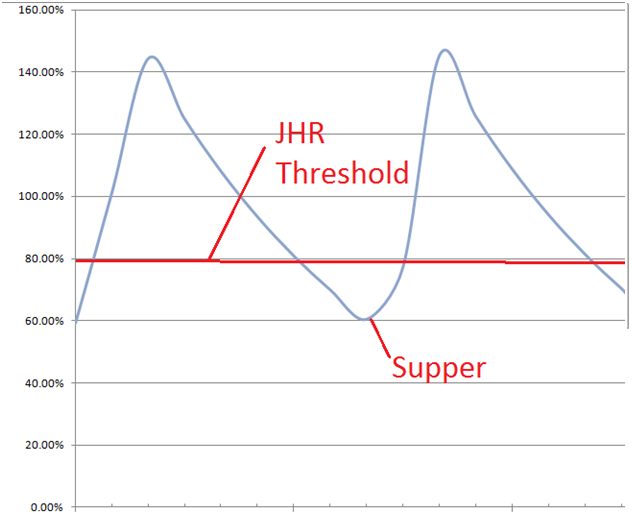
With a biological agent, each probiotic capsule increases the amount of it’s species that is alive and living in the gut. Probiotics have friend-foe identification and produce ‘antibiotics’ against other species.  When the population of the probiotics species reaches the JHR threshold (may be a week or more in some cases), then a herx may start from killing off foe-species. This is where the challenge begins in handling the herx. If the herx gets too severe, then stopping will not result in a quick ebbing (as happens with antibiotics), but may continue until one of two states are reached:

  • Most of the foe-species producing the toxin causing the herx are killed, so there is insufficient toxins to produce a herx.
  • The population of this probiotics is reduced / out-competed so it is not producing sufficient foe-antibiotics to create a herx.

The time to take this may be days….  the herx just keeps going and going…


Vitamin D

Vitamin D is very important for patients. Studies have found that 22% – 65% of CFS patients are technically deficient ( less than 20 ng/mL) . While for Fibromyalgia 61%- 80% of Fibromyalgia patients are deficient.

In terms of results, significant improvement is seen when blood level of 25(OH) D exceeded 50 ng/ mL (125 nmol/L). What type of improvement do studies report?

  • Decrease or elimination of headaches
  • Decrease or elimination of hypersomnia
  • Decrease or elimination of orthostatic intolerance
  • Decrease or elimination of impaired memory
  • Decrease or elimination of palpitation
  • Decrease or elimination of mood disturbance
  • Decrease or elimination of restless leg syndrome
  • Treatment with high-dose vitamin D resulted in clinical improvement in all FM patients
  • There are also studies finding some patients went into remission seen with 2000-10000 IU/day (with magnesium and phosphate)

A level of at least 50+ ng/mL (125 nmol/L) appears to be a critical threshold for improvement. This is in the normal range, but towards the upper end.

Vitamin-1,25D (Calcitriol)

A related vitamin D measure, that of 1,25 D, is usually not done — but evidence suggest that it should be monitor as an ongoing status of  CFS, FM and other autoimmune diseaase. A 2009 study found for most autoimmune disease, this is High: 1,25-D > 110 pmol/L. The top of the normal range is about 75. It appears to be a good clinical indicator that someone has CFS/FM/IBS/chronic Lyme or other autoimmune conditions.

The higher the level, the more severe the symptoms. Getting this measure monthly may help monitor treatment.

In general, minimum supplementation should be 5000 IU or more. The older you are, the higher the dosage needs to be.


D-Ribose

D-Ribose is a simple sugar that is a precursor for tryptophan(low in CFS patients) and histidine. There has been no studies on histidine levels in CFS or FM patients.

D-Ribose was postulated to help CFS/Fibromyalgia in 2004 in several papers. Recently it has been demonstrated to help 66% of CFS/Fibromyalgia patients. It is a neuroprotective (protects the brain and will likely help with brain fog).

See also these posts

In terms of microfloras, several gut bacteria appear to require/prefer this sugar according to PubMed. It has been explicitly identified as being used by the healthful Escherichia Coli Nissle 1917 in a 2007 study. Whether this is part the mechanism of action is unclear at present.

Since this is a simple sugar, all sources should be equivalent, so the best buys are shown below.

The dosages used in the studies was 5gm done 3 times a day.

Remember, 1 in 3 will see no help from this. The reason may be variation in microflora between responders and non-responders.

(c) 2012 Ken Lassesen