Magnesium and Malic Acid

Malic Acid and Magnesium was reported effective in this 1995 study, Treatment of fibromyalgia syndrome with Super Malic: a randomized, double blind, placebo controlled, crossover pilot study.Russell IJ, Michalek JE, Flechas JD, Abraham GE., May;22(5):953-8. J Rheumatol. 1995. The study recommended further study which has not happen over the last 17 years.

Various internet sites cite studies that are not on PudMed, for example

Many studies have found that magnesium is low in Fibromyalgia and Chronic Fatigue Syndrome patients. Low levels are associated with low levels of glutamine. Taking magnesium supplements have reduced symptoms according to studies.

In terms of microfloras, magnesium is required by Bacteroides which are very low in 25% of patients. Bifidobacterium (also low in patients) plays an important role in extracting it from food. A cascade.

At this point I must point out that studies found only 50% of CFS patients are deficient in magnesium. The improvement reported was on the average of the study group. Not every person will have an improvement. Given the low cost and no apparent down side risk, it should be tried — especially when symptoms flare. Dosages may depends on the degree of deficiency seen.

Magnesium and Malic Acid are both pure chemicals and thus any supplement grade source is adequate.

I tend to favor Magnesium Malate because it is a needed for the Krebs Cycle.
 

Treatment: Symptom Mitigation

CFS/FM/IBS are difficult conditions to treat. One of the major challenges for physicians is that patients often hyper-react to drugs, do not react at all, or react contrary to the results with normal patients.

Microflora changes may be the source of this unpredictability.  A difference of microfloras can result in a half life of a drug changing from 6 days to 100 days as found by this 1988 [study]. This would explain the observed difficulty  in predicting how patient actually responds.

Assuming this is true, then mountains of “reasoned recommendations” for CFS / FM / IBS become illogical because the core assumption is that the absorption and processing will be like normal patients.

Stale Recommendations and Knowledge

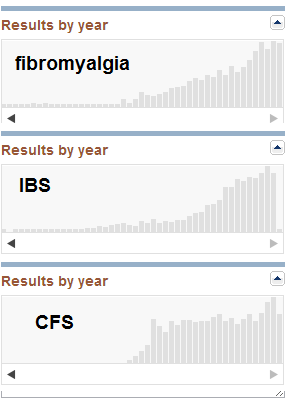
Often I see patient refer to books that were written 15 years ago. Our knowledge have greatly increased and are not in these old books. To Illustrate this look at the following charts from PubMed.

Number of new Articles on PubMed by Year  - each bar is 1 year

Our knowledge on CFS/FM/IBS has exploded. Most MDs are unable to keep current. Each Year is One Bar

Recommended Books

There are two recent books that should be on most patients’s bookshelf (or tablet). They are recent and reasonably complete.

While these books are current and of value, I often find that they recap information only without a critical analysis. Since both authors have CFS, weakness in executive decision making is normal. While I have this weakness also (for the same reason), I created a simple rule for evaluating supplements:

“The supplement must be documented by human studies to improve symptoms with no contradictory reports. Contradictory reports include no effect found.”

In the next series of posts, I will summarize the supplements that meet this criteria and explore the mechanisms of each supplement. There are many recommendations that I have seen in CFS/FM/IBS books that recent studies found negative effects when the earliest study had positive effects. Often the reason was poorly constructed studies earlier that ended up measuring placebo effects.

Stay tune for the first supplement tomorrow!

Antibiotics: Rifaximin -An antibiotic that only enters the gut…

Most antibiotics enter the blood and circulated throughout the body. One antibiotic does not enter the blood and only reaches the gut. This antibiotic requires bile acid to become activated, restricting it to the gut. What is this wonder drug?

Rifaximin is a non-systemic antibiotics that resulted in improvement or remission in IBS. This antibiotic inhibits a broad spectrum of bacteria in the bile-rich small bowel and susceptible bacteria in the aqueous colon, and alters microbial virulence and epithelial cell function. The different mechanisms of action of rifaximin potentially explain the use of the drug in widely varied diseases and syndromes. For Crohn’s Disease, it has resulted in 69% remission and for ulcerative colitis, 76% remission. It is being trialed for IBS with significant success.

Rifaximin resulted in 70% of patients with abnormal lactulose breath test becoming normal. Since the mechanism to keep it in the gut depends on the presence of bile acids, taking Bishop Weed (Ajwain Seeds) to increase bile acids seems appropriate. Lastly, studies found that Rifaximin lowered the viability and virulence of the bacteria even though they developed resistance to the compound.

Why should we consider it for CFS and FM? The answer is simple, up to 90% of CFS and FM patients have IBS. It is very likely that all three have a common cause with variations. The common cause is altered microfloras. The variation of symptoms is caused by the unique bacteria that each person has.

(c) 2012 Ken Lassesen

Remission from just changing Gut Flora

Evidence for the major role that gut flora has in maintaining CFS/FM/IBS and other autoimmune diseases comes from documented remissions from fecal transplants. This was reported in 2001 by Richard Schloeffel, MD in Australia [Read Report], It was also reported recently in the New Scientist journal in 2010 [Read Report].

I have corresponded with a patient in Australia who has had two transplants. In both transplants, remission of all symptoms lasted about six months and then a relapse happened. After the last relapsed, extensive pathogen testings was done and a member of the Rickettsia family was found.  I believe the continuing RNA fragments and other chemicals from the Rickettsia infection allowed the symptom-causing microflora to get re-established.

Gut Flora appears to be (partially) genetic

Researching fecal transplants, I found that transplants from blood relatives are needed. Unrelated transplants have a poor success rate. As I mentioned in an earlier post, most humans have about 150 out of 1000 possible bacteria in their gut. From lectures on virus and bacteria mutations that I have attended, I can go further and state that it is not just sub-species that are unique; but individuals will likely have different DNA in these subspecies. A flu virus DNA may mutate 6 times in a year. A person’s gut flora will likely also mutate. The mutation that survive will be those that other microfloras permit to exist.

Implication for Treatment

I wish I could say, just find a healthy family member (by blood) and head down to the clinic for a transplant. There is great resistance to this approach. I would suggest reading Wendy Glauser’s article in CMAJ. 2011 March 22; Risk and rewards of fecal transplants for more background.

(c) 2012 Ken Lassesen

A Mathematical Model for CFS/FM/IBS Onset and Remission

During my research for a forthcoming book, I came across similar information in several studies. The information result in a model that appears to be consistent with CFS/FM/IBS being an alteration of microfloras that persisted.

In probability modelling there are semi-stable processes that are have a random chance of  occurring. A good example is radio-active decay. The pattern that I saw was similar and would be consistent with alteration of microfloras by virus RNA.

The reported data when people with acute onset were followed is shown below. The conditions were technically different, but the onset rates for CFS were surprisingly similar. If we take a view that the infection RNA enters the stomach and result in microfloras mutations, then these mutations will be eliminated over time for most people — however some mutations take a long time to eliminate.

Infection Type Percentage going into CFS-like state at 6+ months
Ross River Virus 11% [583]
Lyme Disease 10-20%[2390]
EBV 11-13% [1651] [1652]
Sarcoidosis 47% [160]
Giardia 50% [1653]
Acute bacterial enteritis patients 7- 33% of IBS [1801]

Some studies tracked people after acute EBV and reported the following rates of these patients moving into CFS. Failure to recover rates for EBV over time

Time after EBV % Failed to Recover
6 months 11%-12%-13%
12 months 7%-9%
24 months 4%

Applying a little mathematical curve fitting to this data, we end up with the result shown below.

Recover Period Percentage Remaining that Recover Patients remaining
6 – 12 Months ~ 50% ~14%
12 – 24 Months (2 yrs) ~ 50% ~7%
24 – 48 Months (4 yrs) ??? 50% ~4%
48 – 96 Months (8 yrs) ??? 50% ~2%
96-192 Months (16 yrs) ??? 50% ~1%

Does this directly helps treat CFS? No — but it suggests that intentional attempts to destabilize microfloras may be beneficial.

(c) 2012 Ken Lassesen