

For latest codes, see https://cfsremission.wordpress.com/top-microbiome-providers-with-discount-codes/
Author Archives: lassesen
Using GI Map, Viome and BiomeSight
A reader asked me to take a look at their results from these three. This is not a fun exercise because the data is not machine processable, time consuming and thus prone to more significant errors. The best way to proceed is to use one of these providers.
- Biome Sight with “MICRO” as discount code,
- Thryve Inside
- Nirvana Biome (which also reports on virus and fungi)
GI Map Results
The following abnormalities were reported. We cannot get the percentile ranking from MicrobiomePrescription.com because they give counts without declaring what 100% is, it appears to be over 3.3E12 i.e. 3,300,000,000,000, since that is the upper limit for one of the phyla. I attempted on computation below with nonsense results.
- Clostridia (class) – 200% above their upper limit
- Enterobacter spp. – 60% above their upper limit
- Akkermansia muciniphila – 3700% above their upper limit
- Firmicutes – 29% above their upper limit
- Bacteroidetes – 29% below their lower limit
- Bacillus spp. – 433% above their upper limit
- Enterococcus faecalis – 800% above their upper limit
- Streptococcus spp. 550% above their upper limit
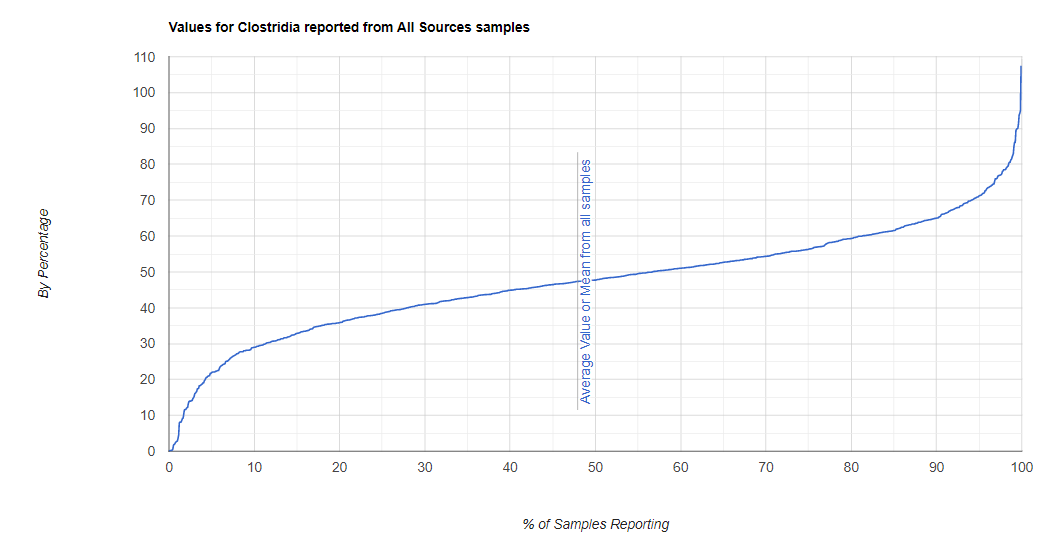
So, their numbers are useless. We can do manual entry of highs/lows on this page and get very coarse suggestions.
Viome Results

I did a tally of their evalutaions:
- Not Optimal: xxx or 16%
- Average: xxxxxxxxxxxxxx or 74%
- Good: xx or 10%
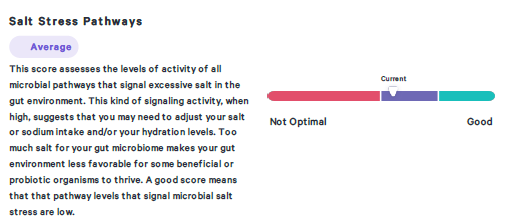
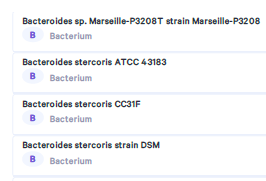
They list the bacteria found but with no percentages or other quantities…
Bottom Line
IMHO. Viome is not worth anything, at least nothing that can used with microbiome prescription data sources.
Redemption
This person did a biomesight.com test which was one-button-pushed transferred over (thank you Rose again for making life easier for many people).
Starting with Enzyme production,

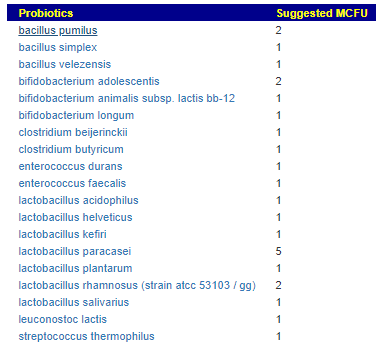
We get core probiotics suggestions with lactobacillus paracasei again being dominant (as it was in the last posts).
For EndProduct Outliers, we have only one item being low, Urolithins. Nothing under KEGG Module.
Next we look at Core Supplements suggested (these are items that your bacteria may be producing less of due to dysfunction)

Looking at Hawrelak recommended levels we see that Akkermansia is LOW, but GI-MAP reported a massive overgrowth!
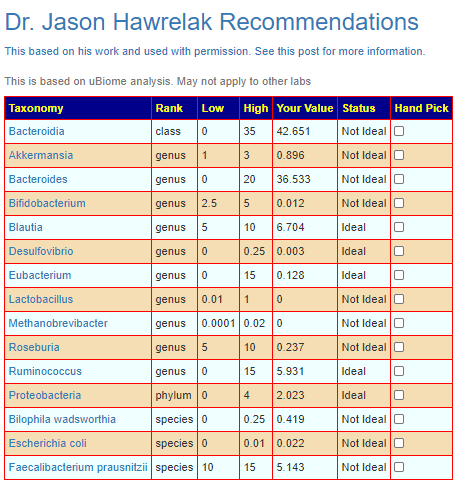
The next item in my current pro-forma analysis is looking at quick suggestions and the diagnosis specific suggestion. This person’s diagnosis is Rosacea Sub-Type 2 (Inflammatory / Papulopustular/ Acne rosacea) which I do not have in my database. Going over to pubmed to see if there is any appropriate studies, I only found skin studies.
- The role of small intestinal bacterial overgrowth in rosacea: A 3-year follow-up.
- The association between cigarettes smoke, small intestine bacterial overgrowth and rosacea
- Topical probiotics: the unknowns behind their rising popularity.
- An altered fecal microbial profiling in rosacea patients compared to matched controls [2021]
- Bacterial and fungal microbiome characterization in patients with rosacea and healthy controls [2020]
- Characterization of the facial microbiome in twins discordant for rosacea.
- The fungal flora of the digestive tract in patients with acne rosacea
- Microbiota in Rosacea
From those and similar, I create a database entry.
Quick Suggestions
Remember, this is done without any reference to conditions or symptoms.


Advanced Suggestions
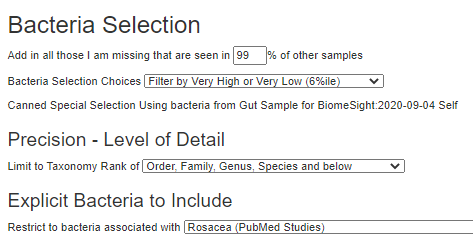
With the new medical condition and studies added, I no results with the tightest selection and ended up expanding the selection as shown below.


Bottom Summary
We have two probiotics that should definitely be considered, lactobacillus paracasei and B. longum. Holigos was an interesting item to appear, and I have heard very favorable reports on it. I would suggest getting Vitamin D level, and unless you are in the top 20% of the normal range, supplement appropriately. For other supplements: selenium, magnesium, GABA.
These are suggestions to discuss with your knowledgeable medical professional before starting. Frequently items require to be balanced with other supplement which such a resource may help you with.
I also used the GI Maps results alone with the page cited above and got the following list, with Holigos being at the top. We also see lactobacillus paracasei appearing close to the top of the list.


Analysis of an atypical Crohn’s Microbiome
After the last post on Gene base probiotic selection, another friend asked me to look at her results. I will follow the same pattern as my last post doing an analysis of a ME/CFS person.
The sample was done by Thryve (721 taxonomies identified) and the FASTQ file also processed by BiomeSight.com ( 523 taxonomies identified). This is in the middle range of samples processed there.

Why did I double process? Many people will ask, “Which one is right?” The answer is neither and both. For the technical details see this post from a year ago, The taxonomy nightmare before Christmas… alternatively, see the story of Blind men and an elephant. The description of each gives a better overall understanding.
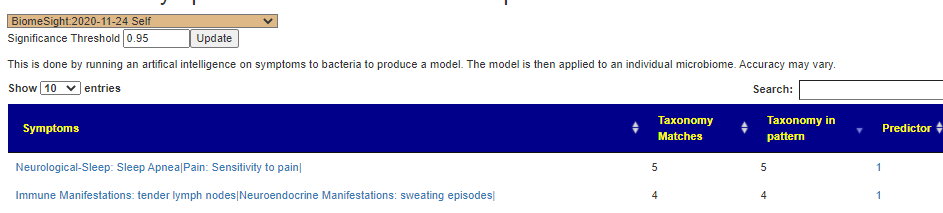
The most probable predicted symptoms from the microbiome samples are below — they are very correct except for age.

Step 1 – Enzymes Issues
As in the prior post, we will show both processing of the data.
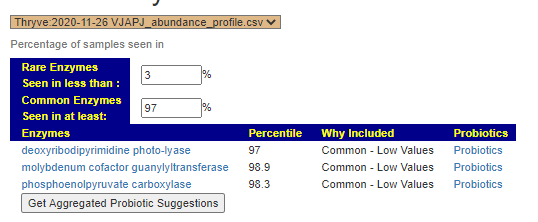

From this we click the button on the bottom and get the two lists below. For one item we have 5 items —lactobacillus paracasei has a count of 5 indicating that it helped 5 of the 15 enzyme aboves. In other words, this is the highest priority probiotics.
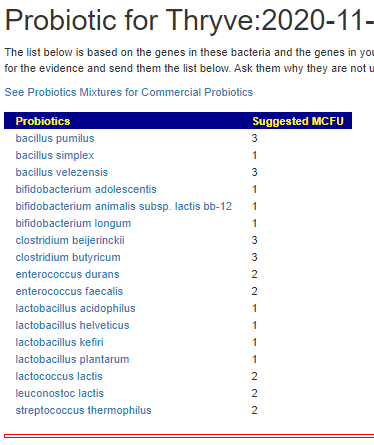

In comparing the two sets of suggestions, we see some similar items with a count of 3/3 or 15/15. These are probiotics that produces all of the low enzymes
- clostridium butyricum
- Second place goes to:
Clostridium butyricum and streptococcus thermophilus are also the ones we had strongly recommend in our last post for a ME/CFS patient (which has some symptom overlap with this person).
Using Quick Suggestions, we see that the probiotic containing b.pumilus was rated as a should be take
- enviromedica terraflora sbo probiotic : impact 2.6.
- miyarisan (jp) / miyarisan : impact 2.4
- danactive drink : impact 2.3
- aor / probiotic-3 : impact 5 clostridium butyricum – and enterococcus faecium
- as well as some bacillus (unfortunately most of the bacillus cited above are not available yet as probiotics)
Comparing Core Supplements
This is based on the end products data (similar to enzymes but done by manual review and entry — so more incomplete).


This a interesting:
- We have consensus on low Gamma-Amino butyric acid (GABA)
- Lower levels of Lactobacillus Probiotics (D-lactate) and Lactobacillus Probiotics (Lactate)
- For the rest, results are not in general agreement. It is interesting to note this one:
- DAO Producing (diamine oxidase) 0% on one — this person is a regular DAO user.
- Back tracking into the KEGG Enzyme database, diamine oxidase and this page also. I was unable to identify any bacteria by gene.
Remember: In no aspect do we have complete knowledge — only fragmentary information.
Advance Suggestions – Filtered by Crohn’s
As we did with ME/CFS, we filter to the official diagnosis

Again, we will do side by side analysis with a threshold of 0.5, rounded (to be consistent with the last post)


We see this probiotics is tied with 3 others for first choice.
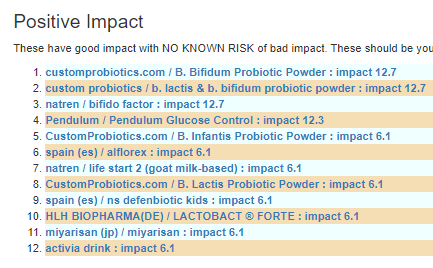
Probiotic Suggestions
Again, we have overlap — often with the same impact estimates seen

Flavonoids
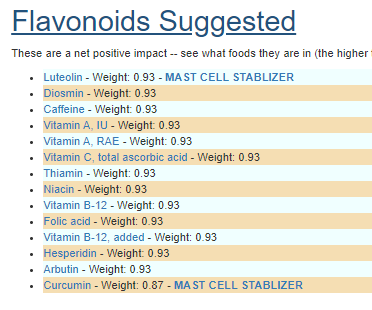
Here, we almost have identical lists with Flaxseed, meal on both, and Cumin – on just one

Bottom Line
The reader can go to the site and make the same advance suggestions pick shown above. I could go off into more complex analysis approaches, but this gives a solid starting protocol.
What we have discovered is that there is general convergence of suggestions from the two different processing of the same sample. Neither is clear better. A user has two main paths: go with items that only both processing are suggesting, or go with the super-set (merge combination).
One path is to do the items in agreement for 3 weeks and then add in the superset items for 3 more weeks. After 6 weeks, I would usually recommend a new sample to see what has changed.
Looking at common outliers
This person has multiple samples processed by biomesight (most are from ubiome), and we can see persisting commonality


Looking at this sample versus the prior samples, we see some changes. For example, L-lactate dehydrogenase has decreased which implies lactic acid increases (and thus cognitive issues — which agrees with reported symptoms).
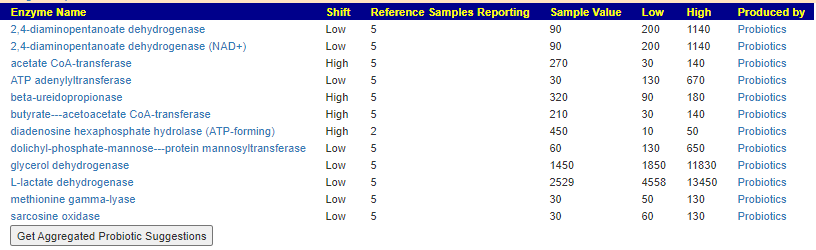
We also note an increase is a few items, like diadenosine hexaphosphate hydrolase (ATP-forming). This increases production of ATP (adenosine triphosphate). As often happens, our knowledge of these enzymes is often limited and evolving (Work on ATP resulted in a Nobel Prize in 1997), so we are still on the learning curve. We can identify issues — but may not know the meaning or consequences of the issues.… IMHO, we should strive to reduce abnormal enzyme levels.
I have a concern — the microbiome, especially in terms of enzymes, has not changed that much. This may be due to lack of consistency, or the dosages being too low to alter the status quo.
Dosage Problem
In general, dosages / amount of supplements needed is unknown. For ME/CFS, I have tracked down some dosages from human studies but in general, ideal dosage is a mystery. This is compounded by some people almost taking a homeopathic attitude. “Well, all of the items listed are in my one-a-day vitamin. The suggestions did nothing for me!” The same person’s lab test for Vitamin D will show very low (instead of being around the 95%ile, the level I advocate for ME/CFS patients) and they will cite that “I drink milk with Vitamin D, and my one-a-day also have it! I take Vitamin D !!!!!!!”
The reality is that the absorption of Vitamin D depends on gut bacteria and decreases with age. Studies have shown that to get up to mid-range for people in care homes, often 15,000 IU/day is needed. Mayo cites an RDA of 800 IU/day at present, twice the earlier RDA.
This issue can become even more complex. They may take a B-100 because it has all of the Vitamin B recommendations — unfortunately, many of the fillers in it are in the not recommended list. This happens very often with probiotics: people focus on a mixture having most of the recommended probiotics and assume that the others included and the prebiotics included will do nothing or be helpful.
For the person above, look at their avoid list!


Analysis of a ME/CFS Microbiome
After the last post on Gene base probiotic selection, an old ME/CFS friend asked me to look at her results. Usually I avoid doing individual analysis (not enough time) but when it comes to ME/CFS — I tend to make an occasional exception because of the severe cognitive challenges.
The same was done by BiomeSight.com and had 777 taxonomies identified. This is in the high end of samples processed there. My personal observations of ME/CFS is that over-diversity is a characteristic of ME/CFS
The predicted symptoms from the microbiome sample are below:


Step 1 – Enzymes Issues
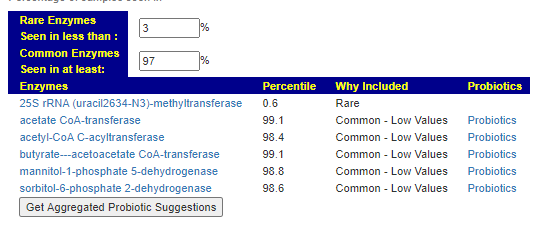
From this we click the button on the bottom and get the list below. We have 5 items above and lactobacillus paracasei has a count of 5 indicating that it helps every enzyme above. In other words, this is the highest priority probiotics.
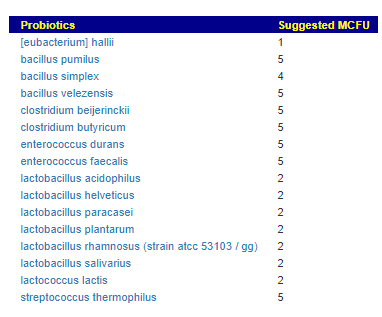
Let us see what is suggested by other routes.
Using Quick Suggestions, we see it has a positive value

Going to Advance Suggestions and filtering to bacteria associated with ME/CFS (as shown below)
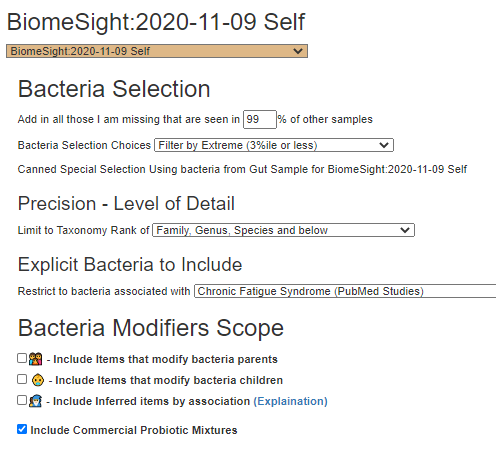
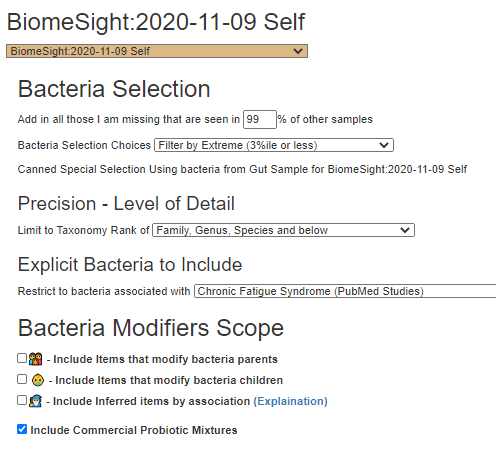
We see this probiotics is tied with 3 others for first choice.

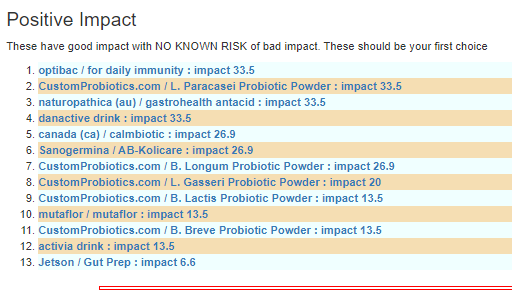
What this suggests is that the enzyme route for probiotics agrees with other paths. The only thing they have in common is the microbiome that they are working on. The logic and algorithms for each is totally different and use different data with no overlap. Many of the enzyme suggested probiotic species lack any significant studies so they do not appear in the usual suggestions list (because those are based on pubmed studies only). My gut feeling is that these enzyme suggested probiotics are very likely good choices.
Other Suggestions
I often cut suggestions off at a probability estimate of 0.5. The main reason is to stop information overload and over-complexity in life and supplements.


Apples, Coconut, Almond, oolong tea and buckwheat are the de-duplicated list over 0.5
Bottom Line
The reader can go to the site and make the same advance suggestions pick shown above. I could go off into more complex analysis approaches, but with the intended reader having ME/CFS, it is more likely to confuse.
What we have discovered is one particular probiotic species is well recommended by two different paths.
This happens to be the only probiotic strain in DanActive which I believe is available where she lives. Read more in this pubmed study. Note “Study patients received a probiotic yogurt drink, Danactive® (Danone, Boucherville, QC, Canada) containing 10 billion cfu of Lactobacillus casei sp. Paracasei CNCM I-1518 (formally DN-114 001) ” It is sometime cited in the advertising as Lactobacillus casei. At the gene level there are a few differences between generic L.Casei and L. Paracasei. The Enzyme recommendation was done at the gene level.
There is a question of potential dosage, above we have 10 BCFU cited. My usual probiotic supplier, CustomProbiotics.com recommended adult dosage is 320 BCFU. From the above study, we know that 10 BCFU is sufficient to get some results — the question is unclear on what dosage is needed to have a significant impact for ME/CFS.
The reader got back to me, because she has this sitting on her shelf.

Gene based Probiotic Suggestions
Using the KEGG: Kyoto Encyclopedia of Genes and Genomes, I have implemented suggestions based on the enzymes being produced according to your microbiome results on MicrobiomePrescription. If you are far below normal for production of one of the enzymes, then we lookup which probiotics also produces those enzymes from those known to be commercially available (our current master list is here – some may not be available in your country). The result is a probiotic mixture that should, theoretically, help to increase those enzymes and reduce symptoms.
To use this tool you need a uploadable report from one of the companies listed here. Note: NirvanaBiome.com uses CosmosId and thus may also be used.
Example on my last sample:

In some cases, there may be none. If there are no low level, there is nothing to increase. The probiotic suggestions are available enzyme by enzyme, or aggregated across the complete sample.


Where do you find this information? There may be up to three places, depending on how many samples you have.

At the bottom there is a button for the aggregate, and on the right, a link for individual enzymes.


Have fun! Be Safe!
A video walkthru
 CFS Remission