EBV, HHV5 and other virus in CFS

I have just finished reading “Viruses, A very Short Introduction” by D.H. Crawford, Oxford University Press, 2011. It has been 30 years since I taught biology classes in high school and thought it would be good to get current.

Many virus are associated with CFS, and there have been no success in finding any specific one responsible. I found this table very interesting because it lists many of the virus associated with CFS — actually, to be clearer. Most of these viruses are in a latent state in the normal population and CFS patients have a far greater percentage in an active state.

Name Common Name Prevalence Percentage
HHV-1, HHV-2 Herpes Simplex (Cold Sore) >  80%
HHV-3 Varicella zoster (VZV) ~ 90%
HHV-4 Epstein-Barr (EBV) ~ 90%
HHV-5 Cytomagalovirus (CMV)  ~ 50%
HHV-6    ~ 90%
HHV-7   ~ 90%
HHV-8   < 5%

So the question is: does the virus cause CFS or is the virus activation a result of the CFS, that is a side effect.

The author writes “The trigger for .. activation in an individual carrier are often quite clear and recognizable: decrease immunity due to drugs or illness, fever, increased levels of ultraviolet light (classically precipitated by a skiing trip), or menstruation and stress, but the molecular mechanisms involved are not understood.

Probiotics and Viruses

We find that some bacteria (probiotics) inhibits viruses. If there are not there, then virus reactivation becomes more likely. A microbiome shift may result in latent viruses becoming active.

“Based on experimental studies, probiotics may exert antiviral effects directly in probiotic-virus interaction or via stimulation of the immune system.” [2014]

probiotics decreased the presence of picornaviruses after 3 months, which may imply that probiotics play a role against viruses causing common cold.” [2014]


Erythrocyte Sedimentation Rate – SED

I expanded my post on low dose naltrexone  and SED came up — I thought that it is time to look at SED and the microbiome — is there a relationship?

According to Dave Berg, Hemex (hypercoagulation theory):
“The ESR (erythrocyte sedimentation rate – red blood cell sed rate) is called SED RATE for short. We are close to having enough data to publish that the normal range for SED RATES should start above 3 or 4. Values below this are correlated with high SFM values. As the Soluble Fibrin Monomer (SFM) goes up in the plasma, these molecules form dimers (2 stuck together). This physically blocks the RBCs from settling out of the plasma, thus a low sed rate.” [Townhall]

That is, if your SED rate is 0,1,2 you have a high probability of having excessive soluble fibrin monomer. This results in one (of several types) of  hypercoagulation (thick blood). It can be treated. SED rates are common taken (with MDs focused on high SED rates instead of low — just like they are focused on high temperature and not low temperatures)

So, to PubMed, as usual.

  • “Clumping reaction, using standard suspension of Staphylococcal aureus Newman D-2-C strain and various substrates, was quantitatively tested. It has been shown that clumping occurs in fibrin lysate containing soluble fibrin monomer complexes unclottable by thrombin.” [1967]
  • ” One hundred eleven strains of S. haemolyticus, 10 strains of viridans group Streptococcus, … were clumped by human plasma.” [1979]
  • ” Purified fibronectin was capable of clumping Staphylococcus aureus strains in concentrations identical with concentrations of fibronectin in human plasma” [1981]

It is interesting that Staphylococcus aureus which I covered in an earlier post showed up so often (there could be others bacteria also). A vaccine against this resulted in significant remission of CFS.

Staphylococcus aureus is notorious for its ability to become resistant to antibiotics. Infections caused by antibiotic-resistant strains often occur in epidemic waves initiated by one or a few successful clones.” [2010]

Staphylococcus aureus can exemplify better than any other human pathogen the adaptive evolution of bacteria in the antibiotic era, as it has demonstrated a unique ability to quickly respond to each new antibiotic with the development of a resistance mechanism, starting with penicillin and methicillin, until the most recent, linezolid and daptomycin. Resistance mechanisms include enzymatic inactivation of the antibiotic (penicillinase and aminoglycoside-modification enzymes), alteration of the target with decreased affinity for the antibiotic (notable examples being penicillin-binding protein 2a of methicillin-resistant S. aureus and D-Ala-D-Lac of peptidoglycan precursors of vancomycin-resistant strains), trapping of the antibiotic (for vancomycin and possibly daptomycin) and efflux pumps (fluoroquinolones and tetracycline). Complex genetic arrays (staphylococcal chromosomal cassette mec elements or thevanA operon) have been acquired by S. aureus through horizontal gene transfer, while resistance to other antibiotics, including some of the most recent ones (e.g., fluoroquinolones, linezolid and daptomycin) have developed through spontaneous mutations and positive selection. Detection of the resistance mechanisms and their genetic basis is an important support to antibiotic susceptibility surveillance in S. aureus.” [2007]

\

3 Biomarkers and the Microbiome Model

The joy (and bane) of having a model is that when new information arrives, you can see if it supports or disagrees with the model. In some cases, it become a neutral — not sufficient information to make a determination.

The National ME/FM Action Network did an announcement of three bio markers, from Australia, Canada and the United Kingdom (i.e. the British Commonwealth!)

Testing against the model

Looking at miRNA

  • “Our results suggest that 68 bacterial RNAs predicted from 37 different bacterial genomes have predicted secondary structures potentially able to generate putative microRNAs that may interact with messenger RNAs of genes involved in 47 different human diseases.” [2014] i.e. bacteria DNA is adopted into the human cells, producing miRNA.
  • “a third mycobacterial species, M. marinum, did express an ∼23-nt small RNA that was bound by RISC and derived from an RNA stem-loop with the characteristics expected for a pre-microRNA.” [2014]

Bottom Line

One set of markers is strongly associated with microbiome shifts. The second with Vitamin D levels.  miRNA can cross from bacteria (including gut bacteria) into human cells. All of these tests appear consistent with the microbiome model

While the tests may help with getting a faster diagnosis, they do not appear to lead to treatments.


Sorry folks, eating what marketing wants is a very bad idea.

I have a friend in the 80’s who for years have been eating using food banks, a lot of prepared/microwaveable meals. Recently a change of circumstance resulted in him moving into a place where food is all made from scratch, often organic.  A lot of his lab tests went from concerning to healthy over 6 months. He does not have CFS, but this does illustrate that diet can have a very major impact. I know that many CFSers survive on food banks in various countries around the world.

Often, one of compounding problems is that a CFS patient is so tired, that all they can do is put a package into the microwave (which can reduce the vitamin and other good content by 50%). Even boiling vegetables in soft water, strips remove nutrients. Overcooked, does the same.

One of the irony that I see is that people will spend money on Inulin capsules, instead of using natural sources (and often bringing other minerals and vitamins with it), for example: Banana, Garlic, Chicory root, Globe artichoke, Jerusalem artichole, Jicama, Onion, wild yam [wiki]

I have posted individually in the past and will attempt to reduce this to a simple reference page without citation (see links below for citations)

Avoid

Take

Try to

  • maltodextrin (MDX),
  • polysorbate 80
  • carboxymethylcellulose[E466]
  • Sodium stearoyl lactylate 
  • Soft drinks
  • Fried foods
  • Pasta
  • Mustard
  • Tomatoes (cooked and raw)
  • Sugar beets
  • Prepared foods
  • fish
  • porridge
    • wheat bran
    • oat meal
    • rice bran
  • Dark green vegetables
    • Brussels sprouts
    • Cabbage
    • Kale
    • Spinach
    • Broccoli
    • Parsley
  • Turnip
  • Sweet Potatoes
  • Boiled potatoes
  • Goat Milk
  • Pumpkin
  • Nuts (but not “butters”)
  • Cabbage
  • Rice bran
  • Cheese(reduce milk at same time) – Traditional/Artisan is likely best. Commerical factory is suspect.
  • Reduce  emulsifier consumption
  • Reduce omega-6 fatty acids
  • Reduce meat
  • Reduce sugar (fructose, sorbitol, lactose)
  • Reduce Olive oil
  • Reduce Margarine
  • Reduce Alcohol (move from wine to beer)
  • Reduce Inulin
  • Reduce Wheat Bread (move to 100% rye and barley breads)
  • do not go strict vegetarian

What is my daily diet?

I do not keep religiously to it, but this is my ideal pattern

  • Breakfast: Either rye bread with butter/ cheese/ and eggs OR porridge with bran added (Not pasturized milk or goat milk)
  • Lunch: Crisp break or rye bread with cheese, a banana or other fruit
  • Supper: 4 oz of fish or meat, salad (I like Kale) with nuts, one or two of the greens above
  • Snacks: Mixed Nuts

References:


Review of Low dose naltrexone

A reader asked if this might be suitable with my model. Information was sparse but a 2010 studies suggests that the harm aspect may be greater than the good.

Low dose naltrexone: side effects and efficacy in gastrointestinal disorders. [2010] [Full Text]

  • 58 of 121 had one or more neurological complaints  – almost 50%
  • In 13 patients with idiopathic irritable bowel syndrome, 2 were markedly worse.
  • . In 85 patients with irritable bowel syndrome-small intestinal bacterial overgrowth, 15 were markedly improved, 32 were moderately improved, 11 were mildly improved, 23 were unchanged, 3 were moderately worse, and 1 was markedly worse. – Odds of getting better instead of worst is 14.5:1 .

As a treatment, yes — some improves, many have no change, and more became worst than better. This does not seem like a rational choice – it’s playing craps with loaded dice.

It has been studies in terms or Crohn’s Disease, a more severe disruption of the microbiome,  “Currently, there is insufficient evidence to allow any firm conclusions regarding the efficacy and safety of LDN used to treat patients with active Crohn’s disease… is not without potential for side effects. Future use of methylnaltrexone may be better tolerated since it does not cross the blood brain barrier. ” [2014]

In terms of Fibromyalgia (FM) [2013], it appears to help — remember that FM is likely due to DNA factors — which suggest that its impact may be connected to this. Before taking it,  your  baseline erythrocyte sedimentation rate[ESR] should be taken to see if you are likely to be a responder, see table below.[2009]. Also, the effect decline within a week once you stop.
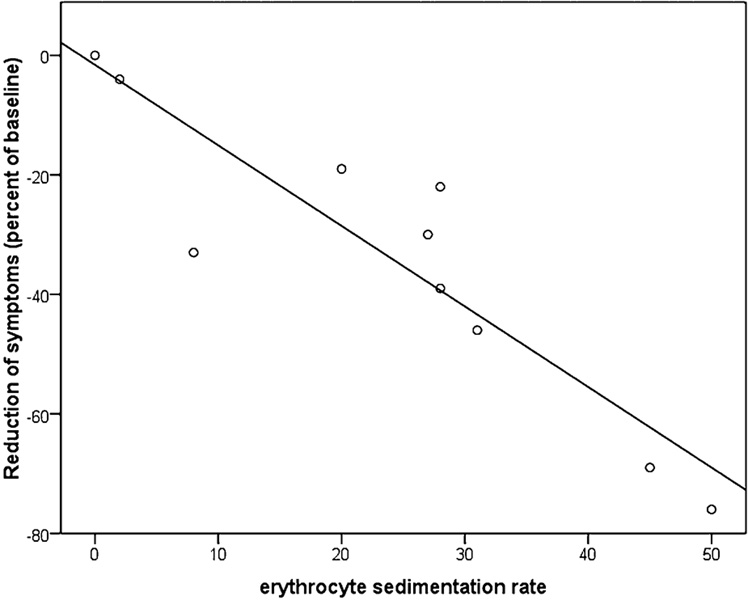
NIHMS209741.html


Like milnacipran, a related drug (which some suggest is better for FM), adverse effects can happen in 20-30% of patients [2009] “. “milnacipran 100 mg or 200 mg is effective for a minority in the treatment of pain due to fibromyalgia, providing moderate levels of pain relief (at least 30%) to about 40% of participants, compared with about 30% with placebo.” [2015]  So only 10% improved more than those with a placebo…

There is no clear pattern of ESR for IBS[2015], FM [2016]. It appears to apply to a subset only (likely DNA associated) which can be determined from the ESR. With CFS, browsing web pages you will find normal ESR is reported by some and low by others. One subset has low SED rates (hence LDN will likely have no positive effect for them)

  • According to Dave Berg, Hemex (hypercoagulation theory):
    “The ESR (erythrocyte sedimentation rate – red blood cell sed rate) is called SED RATE for short. We are close to having enough data to publish that the normal range for SED RATES should start above 3 or 4. Values below this are correlated with high SFM values. As the Soluble Fibrin Monomer (SFM) goes up in the plasma, these molecules form dimers (2 stuck together). This physically blocks the RBCs from settling out of the plasma, thus a low sed rate.” [Townhall] – this is just ONE of the coagulation defects that he found in CFS. So some will be low and some normal and some high…
  • This happens to be true for me with non-prescription items effective to lower SFM.

This leads to the possible mechanism of action, it’s does impact one form of anticoagulant!! There are many forms of coagulation. Coagulation reduces oxygen level to tissue, and this is well recognized as a major source of pain – cells screaming for oxygen.

  • “The fibrinogen levels declined sharply with abstention and an additive effect was noted with the administration of naltrexone,” [1994]

Bottom Line

There is no clear evidence of it being effective with microbiome disruptions. Yes, a small percentage of patients improved (which many MD’s see emotionally and then start prescribing it to all of their CFS patients). Many CFS MDs may discount or ignore the patients that became worst (unfortunately) because they are focused on positive results instead of evaluation of this drug. With a non-fatal disease, a physician tossing a drug that is more likely to worsen a patient than improve the patient raises some  fundamental ethical questions.

If you have taken LDN and improved, don’t take exception with this post — I agree that you improved, the studies say that. You are the lucky ones…. others are not the same.

As a side note during my research I found “” With the exception of weak nonspecific DNA damage observed in an E. coli DNA repair test and possibly with WI-38 cells as well, Naltrexone did not demonstrate significant potential for the induction of gene mutations or chromosomal aberrations under the conditions of this evaluation.” indicating that there may be some long term risks. Damage to your microbiome DNA and your own DNA.