Where to start…

As a result of some comments on another post, I realized that there appears to be a logical sequence for some of the supplements and probiotics. I suspect that this may be a good first sequence for many people because it should improve symptoms within a month.

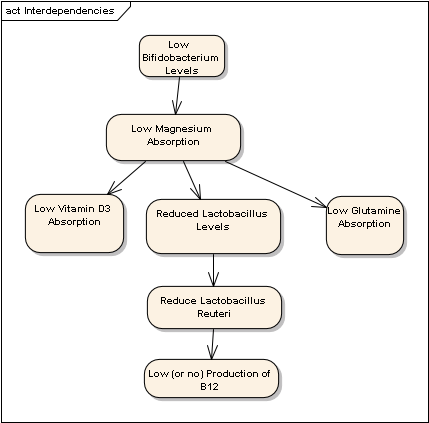
  1. Magnesium deficiency is common with CFS patients. A 2012 study revealed that one bacteria is significant for the release of magnesium from food: Bifidobacterium :   http://www.ncbi.nlm.nih.gov/pubmed/22047159.
    1. This agrees with studies finding that Bifidobacterium are low in CFS patients.
  2. Low Magnesium levels inhibits the absorption of two items where higher levels have been found to have less symptoms:
    1. Vitamin D3
    2. Glutamine
  3. Magnesium is needed by some Lactobacillus species according to http://www.ncbi.nlm.nih.gov/pubmed/23082775 [2013]
    1. Thus low magnesium levels contribute to the low Lactobacillus levels seen in CFS patients.
    2. L.Reuteri is dependent on magnesium levels  — so low or no B12 production
      1. Enhancement of alpha- and beta-galactosidase activity in Lactobacillus reuteri by different metal ions. [2010]

This suggests that taking a magnesium supplement (like Magnesium Malate), eating magnesium rich food, and taking a pure  Bifidobacterium probiotics for the first 1-2 weeks, followed by adequate Vitamin D3 (15000 IU?) and Glutamine should reduce symptoms in 4 to 6 weeks.

  • NOTE: Align is a single strain Bifidobacterium that has been shown to put IBS into remission.  I found other pure Bifidobacterium at Walgreen’s — they are often label as digestive probiotics, for example Ultimate Flora RTS – Colon Care Probiotic which has six different ones and no Lactobacillus! 🙂   (
    • Bifidobacteria species.
    • Bifidobacterium lactis (A)
    • Bifidobacterium lactis (B)
    • Bifidobacterium bifidum
    • Bifidobacterium breve
    • Bifidobacterium lactis (C)
    • Bifidobacterium longum)
    • These are different then the Bifidobacterium infantis in Align. So there are seven species at least available.
  • Remember: The more species that you take the better your odds are finding one that “clicks with your DNA and takes up residence!” and “takes an attitude to the CFS causing cartel of bacteria”
  • “Bifidobacteria, naturally present in the dominant colonic microbiota, represent up to 25% of the cultivable faecal bacteria” (http://www.ncbi.nlm.nih.gov/pubmed/16167966 2005)…. reminder: there are myths about Lactobacillus being the dominant one… it’s false. Futhermore, L.Reuteri is the dominant one of all Lactobacillus in healthy mammals (including humans) — not L.acidophilus which just flows thru your bowels (and does NOT take up residence)!

This is all theoretical.  I do know that I was taking a lot of Magnesium Malate during my second onset to moderate symptoms (and it worked) as well as 20,000 IU of vitamin D3.

To put it together as a picture:
Interdependencies

References of interest:

Emotional Lability and moderating it

Reduced ability to control emotions  may be diagnosed as pseudobulbar affect, pathological laughter and crying, emotional lability, emotionalism, emotional dysregulation, or, more recently, involuntary emotional expression disorder (IEED) is a characteristic of several conditions. including Chronic Fatigue Syndrome, Alzheimer’s disease, and brain injury. Brain injury includes many types of neurological disease, including stroke, tumors, and neurodegenerative gray and white matter disorders[2006].  It is also associated with complications of disorders of the adrenal glands[2014] which likely includes andrenal fatigue [2014].There are no US Food and Drug Administration-approved treatments for this[2006].

The depression  that comes from CFS may be associated with less severe injury or injury in other locations. Studies have found that it appears to be associated with certain areas of the brain being impacted [2008] other studies believe it is a disruption of the  pathways involving serotonin and glutamate[2013].

Checking on PubMed for “Emotional Lability herbs” found nothing. I have experienced this and found that the following herbs dampen the emotional swings.

It was interesting to note that a Chinese Medical Guide gives only one mixture for treating emotion lability, “Strenght Heart”  containing

  • Chinese salvia root (dan shen)
  • jujube seed
  • schisandra fruit
  • lophatherum leaf & stem
  • ophiopogon tuber
  • polygala root
  • Chinese licorice root
  • lotus seed
  • lotus plumule
  • Asian ginseng

Jujbe seed alone,  is reference on other chinese medicine pages for this condition. I was unable to find any Ayudevia pages citing which herbs to treat it with.

Taking Turmeric – Why and How

What are the benefits

The active ingredient of this kitchen spice is curcumin. Turmeric may be more effective than curcumin(the extract). Curcumin has anti-inflammatory, anti-oxidant, pro-apoptotic, chemo preventive, chemotherapeutic, anti-proliferative, wound healing, anti-parasitic, anti-malarial and anti-bacterial activity. Although inexpensive, apparently well tolerated and potentially active, curcumin has not been approved for the treatment of any human disease. According to PubMed articles the following benefits exists for CFS patients:

  • Normalizes Choline levels
  • Benefits IBS
  • Bioactivity is increased by adding 1% black pepper
  • Increases fibrinolytic activity
  • Inhibits platelet aggregation, increases coagulation time
  • Inhibits EBV, antiviral
  • Inhibits H. pylori
  • Inhibits inducible nitric oxide synthase (iNOS)
  • Neuroprotective
  • Reduces high level of fibrinogen
  • Reduces IL6, IL8, TNF
  • Antifungal activity
  • Inhibits biofilm formation

And recently:

How to take it?

The best (and cheapest) way is to make your own “00” capsules from organic turmeric powder (often $11 for 1 lb), i.e.

Starwest Botanicals Organic Turmeric Root Powder – 1 lbs by Starwest Botanicals

To this, add 1% black pepper (about 1/8 of an oz).

Dosage: 500 mg of turmeric four times daily is deemed safe by NIH. “To maximize its absorption, it is recommended that patients accompany curcumin[turmeric] with fatty foods or ideally used simultaneously with fish oil supplement.”[site]  If you are taking other anticoagulants, you may wish to take a lower dosage or stop the other anticoagulants.

Review: Rhodiola Rosea Root (Rosavin)

This is the third adaptogen that I am reviewing — I’m starting to suspect that adaptogen may indicate a herb that alters gut bacteria by reducing those that produce stress chemicals. There is no effective medical definition of adaptogen so inclusion is largely by popular allegation.  Tinospora cordifolia [Guduchi], Asparagus racemosus [ a species of asparagus], Emblica officinalis[ Indian gooseberry], Withania somnifera[Ashwagandha], Piper longum[Indian long pepper] and Terminalia chebula were deemed to be adaptogens in Adaptogenic properties of six rasayana herbs used in Ayurvedic medicine[1999]

Rhodiola rosea L. modulates inflammatory processes in a CRH-activated BV2 cell model. [2019] – “counteract the neuroinflammatory effect ” Implies reduction of brain fog and cognitive issues.

Rhodiola Rosea has a short monogram available with several reviews finding contradictory results.

Dosage: ” indicating that the intake of 2 capsules after breakfast is more effective than the intake of 1 capsule after breakfast and 1 after lunch.”  Efficacy and tolerability of a Rhodiola rosea extract in adults with physical and cognitive deficiencies [2007] which also stated “statistically highly significant improvement  in physical and cognitive deficiencies” (in other words some improvement).  “Rhodiola extract at a dose of 200 mg twice daily for 4 weeks is safe and effective in improving life-stress symptoms to a clinically relevant degree” Therapeutic effects and safety of Rhodiola rosea extract WS® 1375 in subjects with life-stress symptoms–results of an open-label study.[2012]

Comment: While I have often used this, both Ashwagandha and Magnolia Bark seem to have significiant greater impact on me.

Review: The poop on Fecal Transplants

This is a periodic review of what is known reliability about fecal transplants in general, as well as for Chronic Fatigue Syndrome.  Fecal transplants is one way to rapidly correct the gut bacteria. I have corresponded with an Australian with CFS who went into remission twice for 6 months after a fecal transplant and then relapse —  so it is not a guarantee persisting remission by itself. It is definitely an approach that warrants review.

First, the FDA, true to tradition, has attempted to restrict this treatment but was forced to back down [article]. The rational was the same for preventing the over the counter use of Mutaflor(E.Coli Nissle 1917) in the US — it’s a biologic product (in fact, yogurt and keifer would also qualify technically) and thus needs regulation and testing before use. Yogurt and Keifer were probably exempted because they were grandfathered in, Mutaflor, not being a usual AMERICAN probiotics was not grandfathered…. this is a topic in itself.

Let us get back to the poop. There are 60+ articles on PubMed. A recent survey is available in full here. First, the polite name is “fecal bacteriotherapy” or FMT and appear to have been known for some 1600 years. For one condition:

  • 81% remission after one
  • 93% remission after two (89.6% reported in this 2013 study, 92% in 2012 study)

Neurodegenerative and neuro-immunologic disorders improves after FMT.  The summary also states that “studies with germ-free animals or animals given specific gut infections iatrogenically have implicated the fecal microbiome in certain mood disorders, cognition, and pain syndromes ” which suggests that FM may be connected with a dysfunction gut flora.

For CFS and FM, there is one published statistics on the use of FMT. The GI microbiome and its role in Chronic Fatigue Syndrome: A summary of bacteriotherapy, Dec 2012, reported 70% initially responded and 58% had a sustained response (no relapse after 3+ years).

Who is the best donor? According to this Medscape article  ” 75% of donors are first-degree relatives or spouses, and the donor is screened as vigorously as you would screen a blood donor.” I recall reading that the success rate for blood-relatives as donors was 50+% better than strangers. This same article states “A word of caution from Brandt and colleagues is that 2 of their patients had improvement in preexisting diseases, including rheumatoid arthritis and sinusitis. Four patients had subsequent complaints of development of rheumatoid arthritis, idiopathic thrombocytopenic purpura, or neuropathy. Whether these effects are related to fecal transplant remains to be seen.

A further word of caution: The variety of bacteria decreases with age, so a younger donor would be preferred over an old donor. A very healthy donor is ideal.