The Rosetta Stone for Microbiome Correction

This week I applied an old technique to microbiome analysis which I remember using to solve some messy problems that I was dealing with professionally back in 1982. The solution was to return to the question or assumption without going down the path mostly travelled.

Almost all of the microbiome analysis studies that I have read contains wording such as shown below. The study focused on ratios of bacteria and not relative distribution patterns of bacteria.

demonstrated that the dysbiosis could be characterized as directed alteration of the microbiome composition leading to greater disparity between relative abundance of two phyla, Bacteroidetes (Z = 4.77, q = 1.59 × 10) and Firmicutes (Z = -3.87, q = 5.83 × 10). 

Characteristic dysbiosis of gut microbiota of Chinese patients with diarrhea-predominant irritable bowel syndrome by an insight into the pan-microbiome. [2019]

I will jump into the real world to explain a bit how we do this.

In the non-microbiome world

Suppose the question is whether there is wage disparity between Canadians and Australians working in Silicon Valley. The classic test is to find the average wage of each and see if there are significantly different. This is the approach done in microbiome studies.

Instead, a clever data scientist decides to get the actual wage from everyone and then divide the wages into the lowest quarter (25%), low quarter (25%), high quarter(25%) and top quarter (25 %). You would expect the number of Canadians and Australians to be roughly equal in each — but it is possible (with the same average) for them to be very different, for example:

  • 0-25%: Australian 40, Canadians 60
  • 25-50%: Australian 90, Canadians 10
  • 50-75%: Australians 30, Canadians 70
  • 75% up: Australian 40, Canadians 60

Clearly, Australians tend to end up in 25-50% – 45% of them, and only 5% of Canadians. Some of the top pay went to Australians — resulting in the same average. Looking at it this way, we see a salary dysfunction. Not only do we see it, but we can actually determine the odds of this happening at random by doing a chi-2 test, and find that the odd > 1/10,000,000. There is a statistical significant bias in salaries.

The ability for the common person to see the issue

Below is an example for a mixture of conditions.

Bacteria Distribution Example

We see shifts towards higher values, but not the highest range. The expected amount in each quantile is between 4 and 5 (add the numbers and divide by 4). We see the highest values are often close to expected values, the dysfunction is an upward shift, but not a clear overgrowth. Looking only for overgrowths or undergrowths is why the patterns were not seen by researchers.

When I applied it to this problem, I was literally blown away with the massive number of associations exposed.

See this page for more information on doing this.

A Massive list of relationships

If you go to the full listing of relationships – relationships discovered when you combine multiple symptoms, you will find some 15000 items have been discovered. Fortunately, I have ordered the list in alphabetical sequence to make it easier to view. Click here to go to this page.

All of the above are sleep related, but sleep is not connected to a single bacteria. Sleep issues are likely a side-effect of the other symptoms.

The thing that I really like is the ability to click on any symptom combination and see the actual numbers.

Correcting the Microbiome

This actually gives us, in theory, a much more targeted approach. Using the microbiome and the symptoms, we can infer which bacteria are needing to be increase or decrease. We are no longer talking about high values and low values, but correcting minor shifts.

If you have the symptoms for ‘Bacteria Distribution Example’ above, and we have your microbiome, we can ask the question: Are you in Quantile3 for Flavonifractor? If so, we want to change it. We can go up or down, well, downwards has a greater difference from the expected — so we should go in that direction. KEY CONCEPT: You may not be actually in the high group for
Flavonifractor, your values indicate that this was more likely an upward shift.

This becomes a very nuisance adjustment of the microbiome.

New Suggestion Page in the works

This may take me a few days to code uo and test. To use it, you will need to upload your microbiome AND also enter your symptoms/characteristics when the microbiome was taken. Both are essential for the new suggestions page in the works.

I have revised the site finding where to enter symptoms is clearer.

and made the symptom page easier to use.

Eureka! Specific bacteria are associated with specific conditions and symptoms!

I have just pushed a new update to the
http://microbiomeprescription.com/ website. The new page lists bacteria associated with specific symptoms and conditions.

Finding Gender specific bacteria shown above agrees with research

Right Thinking

Almost all published studies report “found average of patients X bacteria is statistically {higher|lower} than the controls”. If you look through my Condition templates, you will see that for some conditions, one study reported high and another low — dilemma!

Not dilemma, but a hint to the nature of the problem.

Repeating the old gospel

Over the last 6 years, I have been ascribing ME/CFS ets to a microbiome dysfunction – that is, a complex shifting of bacteria that alters the metabolites that the body receives. The key work is complex shifting. It is not, too high or too low — which is a naive simplistic thinking of the issue.

Statistical tests on averages on less sensitive than using the classic Chi2 test. My revision to use the logic of BoxPlot shifted my mind to use quantiles. With quantiles, you can apply Chi2 … and suddenly relationships appear!

How do I do this, first, I look over all microbiome samples, sort each and then divide them into four parts of equal size – recording the range of values. Now for a specific subset that has a condition, I count how many fall into each range — then I apply Chi2 to see if this is statistically significant.

Constructed Example.

We have 16 samples, so 4 in each group but for those suffering from Monty Pythonism, we see that we have 8 in the lowest and 8 in the highest. The result may be that the average between these patients and the control are identical. No Significance.

In this case we see two shifts happening that has a 1/1000 odds of being random

This does not make life simpler…. you cannot say “I have symptom X, I need to reduce bacteria Y”, You can say that the balance of bacteria Y is off and needs to be adjusted (as well as things it communicates with)

For people with EBV, we see lower levels of one species in general:

In other cases, the shifts are more complex.

If a single Symptom shows no Eureka moments…

It is likely one of two situations:

  • Not enough samples
  • There are multiple symptom subsets. You need to add more symptoms to isolate the subset.

Symptom – Bacteria Explorer Updated

As a side effect of starting a new blog on just the microbiome,
https://microbiomeprescription.wordpress.com/ , I am revisiting many of the pages that I have tossed up / evolved over the last 17 months.

This page is now updated to be easier to use as well as doing better statistics (well keeping things understandable). The initial page shows some random bacteria that is flagged at the 5% by chance level, but not truly significant (Eureka!). 5% of a thousand bacteria is 50!.

Clicking on one of the buttons will show the symptoms under a grouping and the number of people reporting this symptom. Clicking on one of these will add it to the filtering and recompute everything.

I clicked on No Health Issues to see there are common bacteria seen with those and not everyone else. We found one. Note that we change the color or the row.

The system automatically records these and they will be available on a new page in the future.

If you want to start a different path, just click the reset:

I went back and tried a different path, finding another bacteria. In this case we have 15+6+9 = 30, divide by 4 and we have 7 in each. So the result is that a shift towards lower values but no low values appears to be the association.

If you filter to less than 16 samples for this of symptoms, the page will inform you of this. Time to start over with a different path.

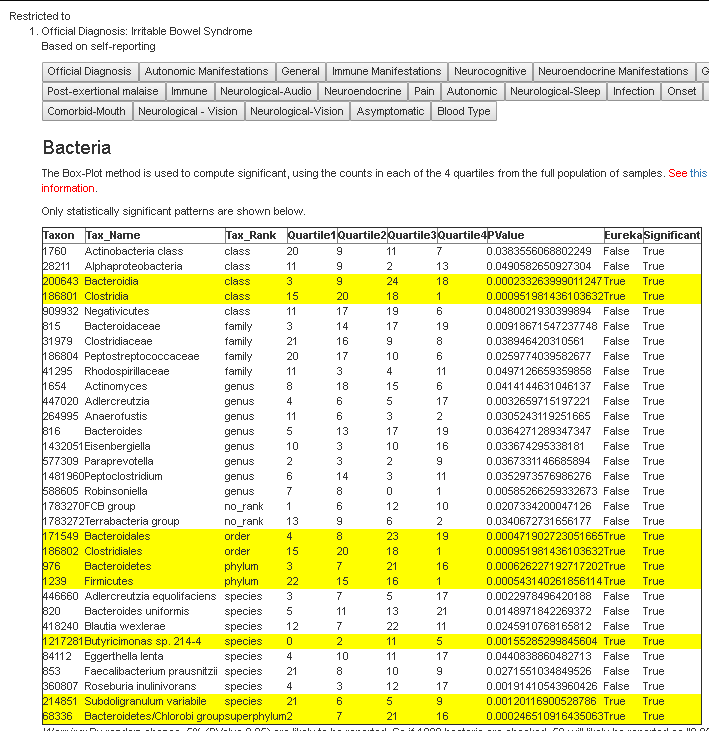
Some Real Results for IBS

As data is added, more things may appear

This is based on data to date, next on my list is making it easier to provide your symptoms. The link is there but many people are not seeing it.

The Math

This is by comparing this subset against the entire population by quantiles (all positive counts sorted and divided into quarters). If we have 64 readings, each of these quarters will have 64/4 = 16 readings. Looking at the filtered group, we look at how many falls into the same ranges of values and the perform a Chi2 computation to obtain significance.

For Eureka!~ we divide the number of bacteria we examined into 1 to get the PValue that would result in just ONE by random chance. We then divide this by 2 to raise the odds to just 50%.

To reduce the number of bacteria examined, we must have at least 16 non-zero readings. At the bottom of the page, we show how many bacteria and the Euraka PValue. In this case, it is 0.0014 and we found 0.000188 above, so we are almost 10x below this value and likely have found something.

Seeking Medical Professions willing to help with Microbiome results

In the past I have always kept myself under medical supervision. I have both a naturopath and a nurse practitioner. Both have prescribing authority in my jurisdiction — so if I can make a case for antibiotics, I can get them from at least one of them (I have not needed that for a few years).

The process is pretty simple with both of them:

  • Show them the science, that is:
    • Ubiome Results
    • PubMed articles if needed
  • Show them my action plan (I do NOT ask them to produce plan usually, and when there was a Lyme diagnosis for me, we negotiated which antibiotics).
  • Ask them to review the plan. In some cases, they want to run tests. Two examples:
    • 15,000 IU/day of Vitamin D — they wanted to make sure that I did not go out-of-bounds on the high level. 15,000 IU/day with malabsorption frequently results in modest raising of levels.
    • 2 gms of flushing niacin/day – they wanted to check liver function. (Pub Med)

For me, the key thing is to find professionals that accept that they do not know everything, do not have an ego problem and willing for patients to self-treat based on actual medical literature (as opposed to random information acquired from some user group), but under supervision to keep them out of trouble!

I have had medical professionals contact me for insights and to understand what I am trying to do with my http://microbiomeprescription.com/ site. I am very willing to spend time with professionals in this area to further their education.

Bottom Line

Over the last week, I have gotten two asks for who to contact about microbiome results. Many of my readers are ‘bio-hackers’ and are often self-guided (for better or worst).

If you are a medical professional willing to do telephone or email consultation with patients using their microbiome results — please drop me an email, or add a comment below.

I cannot guarantee the quality of these people — but medical professionals willing to try this area are very few.

InflamaZyme – review

A reader asked:
“Do know anything about the vitamin InflamaZyme by Biogeneis , my doctor told me to take it for thick blood, I have high fibrinogen. Thank you so much.”

90 capsules is 30 days. Serving is 30 capsules .
Amazon: $52 or $2/day

Requestor Beware

  • If you are trying to sell a product, I am likely the last person you want to be reviewing — I will try to find cheaper equivalents as well as challenge implications not backed up by science.

Ingredients

In the ingredient list are many of the known anticoagulant ones.

  • Pancreatin 4X Amylase (100,000 USP units/g), Lipase (8,000 USP units/g), Protease (100,000 USP units/g) 400 mg
  • Acid Protease (1,000 SAP/g) 300 mg
  • Bromelain (2,400 GDU/g) 250 mg
  • Bacterial Protease (100,000 PC/g) 240 mg
  • Papain (2,000,000 FCC PU/g) 120 mg
  • Superoxide Dismutase (SOD) (8,000 MFU/g) 100 mg
  • Cellulase (1,000 FCC CU/g) 100 mg
  • Nattokinase (20,000 FU/g) (soy) 50 mg
  • Trypsin (75,000 USP units/g) 40 mg
  • Chymotrypsin (25,000 USP units/g) 20 mg
  • Serrapeptase (2,000,000 SPU/g) 2 mg

My initial concern is that this may be the equivalent of a multivitamin formulation — that is maintenance dosages for healthy people but insufficient to be therapeutic for people with conditions. A few spot checks:

A few spotchecks

  • Bromelain: (2,400 GDU/g @ 250 mg –> 600 GDU, or 40% of single capsule [$0.09/day for same dosage via Amazon]
  • Nattokinease: (20,000 FU/g @ 50 mg –> 1000 FU, 50% of a single capsule [$0.05/day for same dosage via Amazon]
  • Serrapeptase (2,000,000 SPU/g @ 2 mg (2/1000 g) –> 4000 SPU. We see 10 times as much in individual capsules. [$0.11/day for same dosage via Amazon]
  • Pancreatin 4X Amylase: [Same dosage: $0.33/day]

I can go on, but the expected cost per day buying individually will likely be a bit over $1/day. They are selling at $2/day – so now the question becomes, is $1.0/day worth just taking 3 capsules from one bottle versus capsules from a dozen bottles.

The flip side is — do you know the precise nature of your coagulation and thus only need certain ones? Are those in this mixture? For example there is no Lumbrokinease (About $0.50/day) or Piracetam — items that I tend to use for my own coagulation issues.

Bottom Line

It’s a reasonable mixture if you have possible coagulation issues and do not know the specific nature of those issues.

In this case the reader states “high fibrinogen” which makes it easy to evaluate each of the ingredients by searching on PubMed. Some examples:

  • Pancreatin – nothing.
  • Bromelain – “unexpectedly Bromelain showed dual action on blood coagulation: at low concentration showed procoagulant effect and at high concentration anticoagulant effect.” [2016] – risk
  • Papain – nothing
  • Superoxide Dismutase ” show a complex covariation with many of the conventional cardiovascular risk factors.” [1997]
  • Cellulase – nothing
  • Nattokinase – valid for this.
  • Serrapeptase – nothing
  • Chymotrypsin – valid for this

My own take is simple: do the research, find the best ones and use them — change the MD to produce studies or evidence for their ‘cookbook guidance’ – often their cookbooks are out of date.