Family and diet specific healthy microbiomes

Microbiomes are subject to great variety due to DNA, diet, health etc.

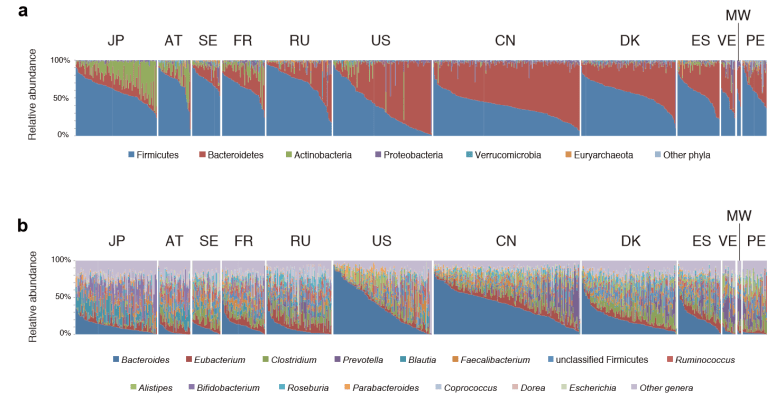
In my early post, There is no normal or reference microbiome!  I showed the results of populations from different countries.

Dealing with a sick family member, there is a desire to correct their microbiome…. but to what!

Different Paths to correcting microbiome

The microbiome site now has 3 paths available:

  •  Comparing your microbiome against a reference microbiome derived from ubiome ‘normal’
  • Working off high values or low values as reported by some lab (using their standards).
  • NEW: Working off the values seen by healthy family members that hopefully are eating similar. This is the subject of this post.

Comparing to healthy family members

After you log on, you are taken to the sample page. There is a new element there:

new panel

This takes you to a page where you can select one Unhealthy person and as many healthy people as you have.

Make a selection and click on. You now see a display of the differences. You may adjust the depth up or down (i.e. looking at bacteria families only or classes etc).

You may adjust by taxonomy level, and also by excluding very low count bacteria — whether these are significant is unclear. Once you are happy, just click the “Use for Suggestions” and you will be moved to the usual suggestions page –but using your family members for the norm!

Bottom Line

This gives a better and far more specific to the individual approach for adjusting the microbiome or identifying where a shift has occurred.

For many of you with health issues — you now have a reasonable estimate of what is healthy for your DNA and your diet using those around you who do not have health issues. 

Whose Best to compare to?

I would rank them in the following order:

  1. A healthy child that lives in the same house – 50% same DNA, same diet – more biodiversity due to being younger
  2. A healthy sibling that lives in the same house – 50% same DNA, same diet
  3. A healthy  parent in the same house – 50% same DNA, same diet – but less biodiversity due to age
  4. A healthy cousin who eats similar – 25% same DNA, similar diet
  5. A healthy spouse – no shared DNA (hopefully 😉 ) but same diet

This is an education post to facilitate discussing this approach with your medical professionals. It is not medical advice for the treatment of any medical condition. Always consult with your medical professional before doing any  changes of diet, supplements or activity. Some items cites may interfere with prescription medicines.

Epilepsy – DNA and the microbiome

Over the last few weeks, I have been having a dialog with a very intelligent parent of a child with epilepsy. There appears to be a combination of SNP mutations and microbiome shifts involved which are largely not explored by conventional researchers.

This post attempts to document what is available on PubMed. I am also adding Epilepsy to the conditions listed on the http://microbiomeprescription.azurewebsites.net site in the hope that other parents can upload the microbiome of people with epilepsy  and citizen scientists use the data to find associations.

“Seizures and epilepsy are not the same. An epileptic seizure is a transient occurrence of signs and/or symptoms due to abnormal excessive or synchronous neuronal activity in the brain. Epilepsy is a disease characterized by an enduring predisposition to generate epileptic seizures and by the neurobiological, cognitive, psychological, and social consequences of this condition. Translation: a seizure is an event and epilepsy is the disease involving recurrent unprovoked seizures.”

https://www.epilepsy.com/article/2014/4/revised-definition-epilepsy 

 PubMed and Microbiome

  • “Specifically, patients with four seizures per year or fewer showed an increase of Bifidobacteria and Lactobacillus than those with more than four seizures per year.” [2018]
  • “The timely work by Zhang et al. [1] suggests that there are differences in intestinal bacterial composition between pediatric patients with refractory epilepsy that do and not respond to the ketogenic diet. This study raises several questions: 1) How does gut bacteria affect epileptogenesis? 2) Can monitoring gut bacterial composition be used as a marker for treatment efficacy and, as is seen in mouse models, 3) Can altering bacterial composition be used as a therapeutic strategy? ” [2018]
  • “After 6 months of treatment, 2 patients were seizure free, 3 had ≥ 90% seizure reduction, 5 had a reduction of 50-89%, and 10 had < 50% reduction. All 10 responders showed an improvement in EEG. Compared with baseline, fecal microbial profiles showed lower alpha diversity after KD therapy and revealed significantly decreased abundance of Firmicutes and increased levels of Bacteroidetes. We also observed that Clostridiales, Ruminococcaceae, Rikenellaceae, Lachnospiraceae, and Alistipes were enriched in the non-responsive group.” [2018]
  • Ongoing clinical trial with “twice a day for 4 months (Streptococcus thermophilus, Lactobacillus acidophilus, L.plantarum, L. paracasei, L. delbrueckii subs bulgaricus, Bifidobacterium breve, B.longus y B.infantis. y CD2).”  [2018]
  • Can epilepsy be treated by antibiotics?  “
    “We present six patients with drug-resistant epilepsy who attained temporary seizure freedom during antibiotic treatment.”
  • “Enrichment of, and gnotobiotic co-colonization with,
    ketogenic diet(KD)  -associated Akkermansia and Parabacteroides restores seizure protection. Moreover, transplantation of the KD gut microbiota and treatment with Akkermansia and Parabacteroides each confer seizure protection to mice fed a control diet…  Overall, this study reveals that the gut microbiota modulates host metabolism and seizure susceptibility in mice.” [2018]
  • Intestinal Microbiota as an Alternative Therapeutic Target for Epilepsy.[2016]
  • Fecal microbiota transplantation cured epilepsy in a case with Crohn’s disease: The first report [2017].

Ketogenic diet poses a significant effect on imbalanced gut microbiota in infants with refractory epilepsy

DNA – SNP variations:

It is important to remember that DNA and the microbiome are strongly associated. FMT transplant from people with close DNA similarity are more successful than with strangers.

Bottom Line

Recent research has found that about every autoimmune disease are strongly associated with microbiome dysfunction.

The research focused on 12 major autoimmune diseases, and all of these autoimmune diseases were found to be correlated with a high predisposition for epilepsy. 

Intestinal Microbiota as an Alternative Therapeutic Target for Epilepsy [2016]

Alas, there is not enough research published yet to create a microbiome profile for epilepsy — but given the number of studies from 2018, I suspect it will be possible in a few months. I have started a profile and will expand it as new material comes in

Smarter reduction of some bacteria

or, smarter increasing of some bacteria — depending on your goal. After writing the last post and coding up the comparison page, I took our corgis for a walk. On the walk I realize that I can borrow some of the code to assist people whose goal is to reduce a specific bacteria, for example, Staphylococcus aureus.

The dogs warrant a pictorial mention:

Process

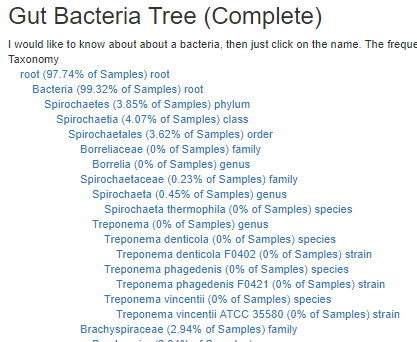
Go to the full list of bacteria found in human guts as reported by ubiome.com and others at: http://microbiomeprescription.com/Library/Tree, 

tree

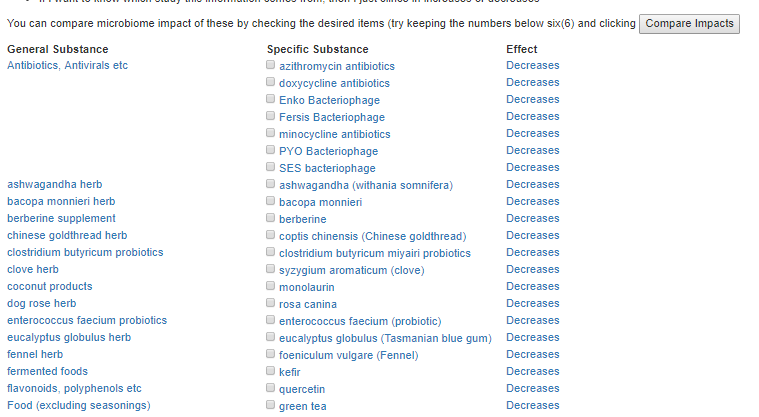
Find the bacteria you are interested in, and click it. It will show a list of known modifiers and the direction of modification, with one new addition — a checkbox by each!

modifi

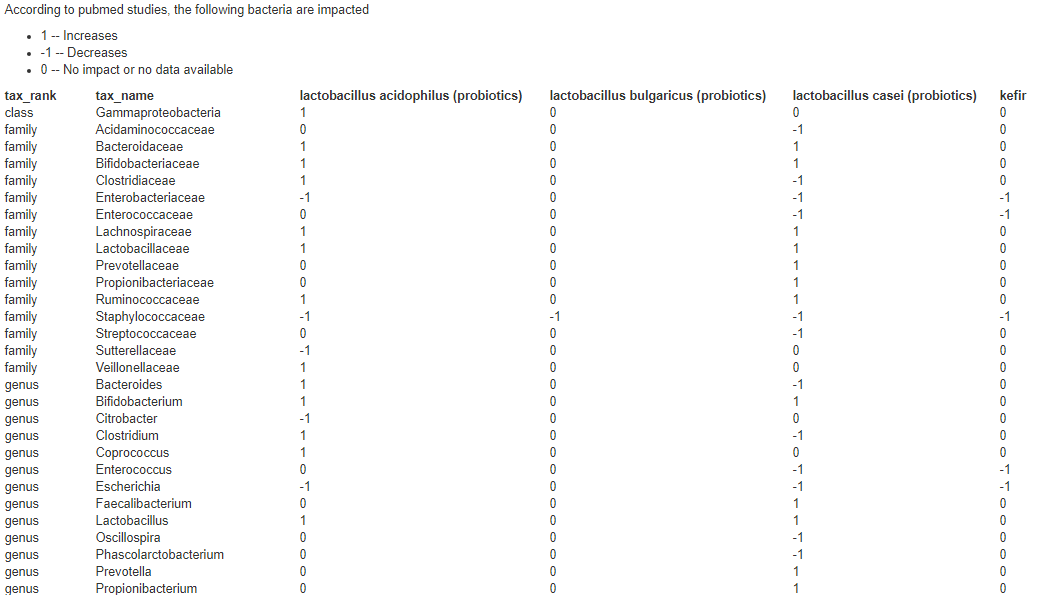
Check the ones that you are interested and click compare impacts.

side

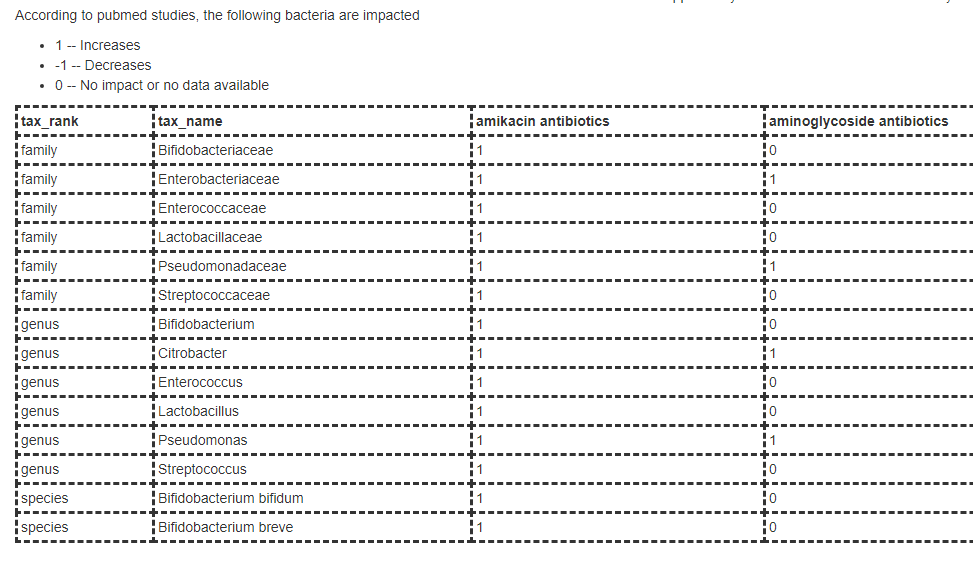
What this does is really makes you aware of the side-effects on other bacteria that various substances may have.

Bottom Line

This exposes some of the internals of my AI engine that produces suggestions. The number of factors that this engine handles is far more than most people can handle — but it does give you  better control of decision making within a limited scope.

This is an education post to facilitate discussing this approach with your medical professionals. It is not medical advice for the treatment of any medical condition. Always consult with your medical professional before doing any  changes of diet, supplements or activity. Some items cites may interfere with prescription medicines.
Compare Drugs, Supplements impact on Microbiome

As a result of the last post, I have added the ability to compare the impact of some 1,700 different items that I have entered into my AI engine.

If you go to: this page , you will see an updated UI. We have a large number of substances, so we implemented a search and add in place of the original list all.

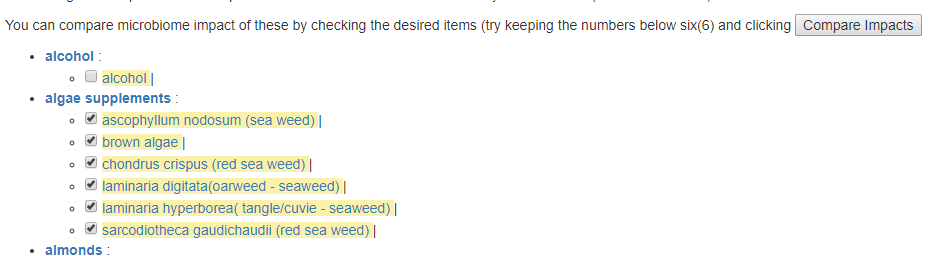
Click on any of these, will display a page listing items in this class of modifiers. Each item has a checkbox beside them. Simply check the items you wish to compare and then click the compare button.

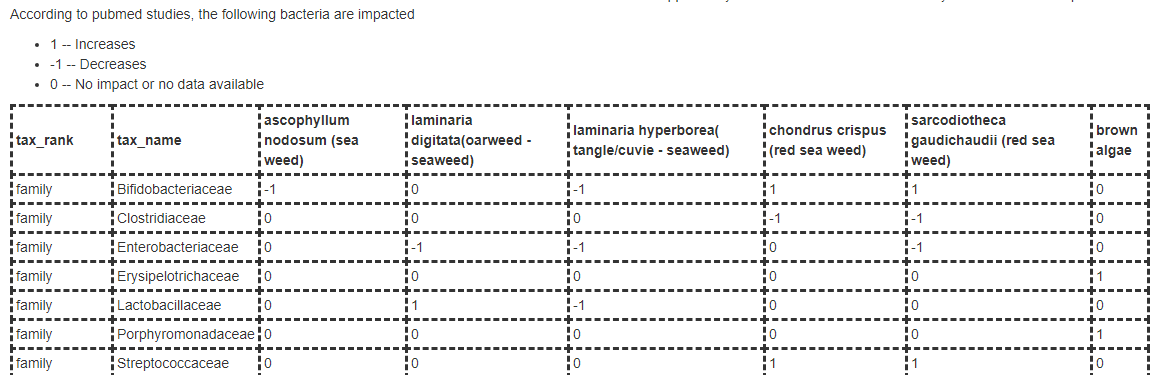
For example, you want to compare impact of different algae supplements.

comp1

Example of results

As you can see below — different algae has different responses.

compar2

comp

Bottom Line

This tool will give you more information when there are alternatives to determine the best one (theoretically).

This is an education post to facilitate discussing this approach with your medical professionals. It is not medical advice for the treatment of any medical condition. Always consult with your medical professional before doing any  changes of diet, supplements or activity. Some items cites may interfere with prescription medicines.

Benadryl, Histamines, Mast cells and Microbiome

A reader who has been very very limited in what they can eat due to histamine response — so limited that a good day is just 500 calories. She has stated taking benadryl once a day with major improvement.

She started taking it on the suggestion of a physician when she shared with the physician that she may have a mast cell dysfunction. I must emphasis, that she was careful to ‘share a suspicion‘ — informing a physician of your self-diagnosis often leads to labelling by medical professional and poor cooperation.

Benadryl is diphenhydramine. It is also known as  Benadryl, Banophen, Diphenhist, Wal-Dryl, Nytol, Unisom, ZzzQuil, Diphen, Benadryl Allergy, Aller-G-Time, and more

Why Benadryl and not some arbitrary antihistamine?

“Diphenhydramine is a sedating peripheral H1 receptor antagonist. It is used for symptomatic relief of allergic symptoms caused by histamine released in response to allergens.”[eMedicine]  H1 receptor antagonist is the fancy way of saying H1-Blocker.

As with most things biological, there are multiple paths to a reaction. In some cases a H2 blocker is a better choice. [eMedicine] lists these as other H1 blockers and sedating (quieting the release of histamines):

There are other H1 blockers but they are not poor sedating or selective.  These include:

In short, all antihistamines are not the same in how they are acting. Finding the right one if you are dealing with histamine and mast cell issues is essential.

But Wait! Let us examine the difference in Microbiome impact!

I tend to be a firm believer that some medicines and drugs also owe their effectiveness to changes of the microbiome they cause.These changes alter metabolites/chemicals the the microbiome produces and the body reacts to. Unfortunately, information on the expensive diamine oxidase (DAO) that is used also, is not available.

In time, I have a page to allow readers to do this themselves on my http://microbiomeprescription.com/ site – that is, examine microbiome impact when there are multiple candidate drugs to treat an issue.

Table below in Excel: Antihistamines

  • -1 : decreases
  • 1 : increases
  • 0 : no impact
tax_rank tax_name Hydroxyzine_hydrochloride Diphenhydramine Cyproheptadine Loratadine Desloratadine Fexofenadine Cetirizine
family Bacteroidaceae -1 -1 -1 -1 -1 -1 -1
family Bifidobacteriaceae -1 -1 -1 0 -1 -1 -1
family Clostridiaceae -1 -1 -1 -1 -1 -1 -1
family Coriobacteriaceae -1 -1 -1 -1 -1 -1 -1
family Desulfovibrionaceae -1 -1 -1 -1 -1 -1 -1
family Enterobacteriaceae -1 -1 -1 -1 -1 -1 -1
family Eubacteriaceae -1 -1 -1 0 -1 -1 -1
family Fusobacteriaceae -1 -1 -1 -1 -1 -1 -1
family Lachnospiraceae -1 -1 -1 -1 -1 -1 -1
family Peptostreptococcaceae -1 -1 -1 -1 -1 -1 -1
family Porphyromonadaceae -1 -1 -1 -1 -1 -1 -1
family Prevotellaceae -1 -1 -1 -1 -1 -1 -1
family Ruminococcaceae -1 -1 -1 -1 -1 -1 -1
family Streptococcaceae -1 -1 -1 -1 -1 -1 -1
family Veillonellaceae -1 -1 -1 -1 -1 -1 -1
family Verrucomicrobiaceae -1 -1 -1 -1 -1 -1 -1
genus Akkermansia -1 -1 -1 -1 -1 -1 -1
genus Bacteroides -1 -1 -1 -1 -1 -1 -1
genus Bifidobacterium -1 -1 -1 0 -1 -1 -1
genus Bilophila -1 -1 -1 -1 -1 -1 -1
genus Blautia -1 -1 -1 0 -1 -1 -1
genus Clostridium -1 -1 -1 -1 -1 -1 -1
genus Collinsella -1 -1 -1 0 -1 -1 -1
genus Coprococcus -1 -1 -1 0 -1 -1 -1
genus Dorea -1 -1 -1 0 -1 -1 -1
genus Eggerthella -1 -1 -1 -1 -1 -1 -1
genus Escherichia -1 -1 -1 -1 -1 -1 -1
genus Eubacterium -1 -1 -1 0 -1 -1 -1
genus Fusobacterium -1 -1 -1 -1 -1 -1 -1
genus Odoribacter -1 -1 -1 -1 -1 -1 -1
genus Parabacteroides -1 -1 -1 -1 -1 -1 -1
genus Peptoclostridium -1 -1 -1 -1 -1 -1 -1
genus Prevotella -1 -1 -1 -1 -1 -1 -1
genus Roseburia -1 -1 -1 -1 -1 -1 -1
genus Ruminococcus -1 -1 -1 -1 -1 -1 -1
genus Streptococcus -1 -1 -1 -1 -1 -1 -1
genus Veillonella -1 -1 -1 -1 -1 -1 -1
species Akkermansia muciniphila -1 -1 -1 -1 -1 -1 -1
species Bacteroides caccae -1 -1 -1 -1 -1 -1 -1
species Bacteroides fragilis -1 -1 -1 -1 -1 -1 -1
species Bacteroides ovatus -1 -1 -1 0 -1 -1 -1
species Bacteroides thetaiotaomicron -1 -1 -1 -1 -1 -1 -1
species Bacteroides uniformis -1 -1 0 -1 -1 -1 -1
species Bacteroides vulgatus -1 -1 -1 -1 -1 -1 -1
species Bacteroides xylanisolvens -1 -1 -1 -1 -1 -1 -1
species Bifidobacterium adolescentis -1 -1 -1 0 -1 -1 -1
species Bifidobacterium longum -1 -1 -1 0 -1 -1 -1
species Bilophila wadsworthia -1 -1 -1 -1 -1 -1 -1
species Collinsella aerofaciens -1 -1 -1 0 -1 -1 -1
species Dorea formicigenerans -1 -1 -1 0 -1 -1 -1
species Eggerthella lenta -1 -1 -1 -1 -1 -1 -1
species Escherichia coli -1 -1 -1 -1 -1 -1 -1
species Fusobacterium nucleatum -1 -1 -1 -1 -1 -1 -1
species Lactobacillus paracasei -1 -1 -1 0 -1 -1 -1
species Odoribacter splanchnicus -1 -1 -1 -1 -1 -1 -1
species Parabacteroides distasonis -1 -1 -1 -1 -1 -1 -1
species Parabacteroides merdae -1 -1 -1 -1 -1 -1 -1
species Peptoclostridium difficile -1 -1 -1 -1 -1 -1 -1
species Roseburia hominis -1 -1 -1 -1 -1 -1 -1
species Roseburia intestinalis -1 -1 -1 0 -1 -1 -1
species Streptococcus parasanguinis -1 -1 -1 -1 -1 -1 -1
species Streptococcus salivarius -1 -1 -1 -1 -1 -1 -1
species Veillonella parvula -1 -1 -1 -1 -1 -1 -1
species_group Lactobacillus casei group -1 -1 -1 0 -1 -1 -1

Bottom Line

I hope this post will educate people that “all antihistamines are not the same” – both in terms of known mechanism as well as impact on the microbiome.

I am hoping to have a page done by next weekend that will allow the impact of various medications and drugs (as far as is known and published) on the microbiome.

Addendum

The reader is also taking the following in addition to help with  the suspected mast cell issues:

This is an education post to facilitate discussing this approach with your medical professionals. It is not medical advice for the treatment of any medical condition. Always consult with your medical professional before doing any  changes of diet, supplements or activity. Some items cites may interfere with prescription medicines.