Analysis of uBiome Results for a CFS Patient

A reader asked me to review and comment on their uBiome results (site).  Finally, I have a few hours from excessive support activity to do it.

The Results Summary
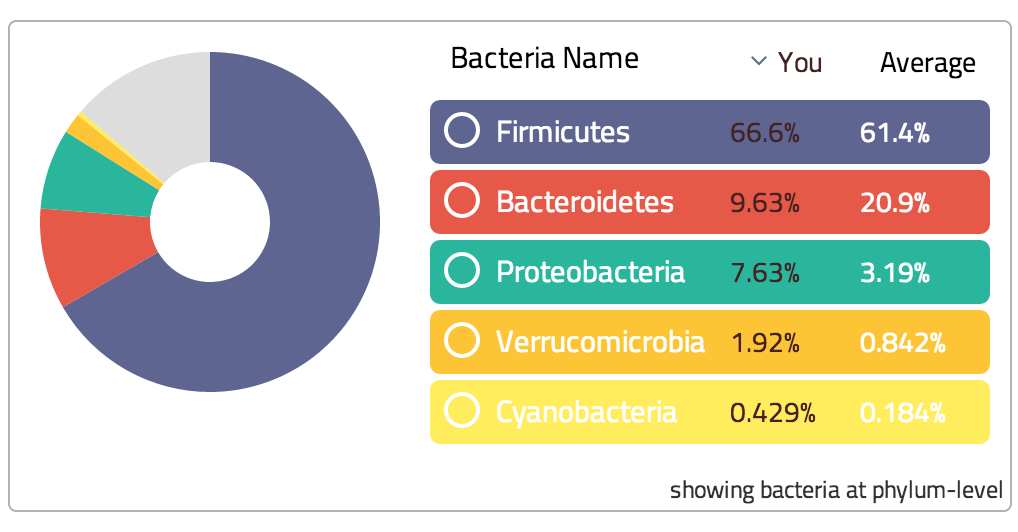
Screen Shot 2014-10-26 at 10.06.27 AM

As you can see above, at a phylum level many groups have altered by a factor of 2 from normal healthy people:

  • Bacteroidetes are 1/2x
  • Proteobacteria, Verrucomicrobia, Cyanobacteria are  2.4x, 2.8x and 2.3x
  • For smaller phylums the numbers can be worst, up to a 7x difference.
  • Firmicutes are normal ( bifidobacterium and lactobacillus belongs to this family)

Clearly there is a dysfunction of the microbiome. This is not caused by diet, none of the diet groups are anyway close to this distribution. Nor is this causes by antibiotics (which some MDs would claim to dismiss dealing with this shift), uBiome provides a handy table to exclude this speculation.

Sample Site Group Bacteroidetes
1

gut

CFS Patient X 9.63%

gut

Vegetarians 19.03%

gut

Paleo Diet 20.61%

gut

Healthy Omnivores 20.67%

gut

Vegans 20.91%

gut

Heavy Drinkers 21.89%

gut

Weight Loss 21.17%

gut

Weight Gain 23.08%

gut

Antibiotics 18.31%

gut

All Samples 20.89%

Weight

The first item of interest is Bacteroides, which are significant for those CFS that have weight problems. “Bacteroidetes are the most prominent gut microbes in much of the world. They are thought to help protect against obesity because they do not digest fat well….Bacteroidetes are under represented in the guts of Europeans and North Americans” So not only are they low by world standards, they are low by the lowest population! Ok, my audience is brain-fogged so I will not go further into technical analysis but move on to the real concern — treatment! (Assuming that this patient is not vested in CFS and want to move towards remission)

Treatment

We will start with the biggest phylums that have shifts and proceed towards the smaller ones.

Increasing Bacteroidetes

This is a bit of a challenge because normally research is done on how to reduce bacteria (for this family, bad oral members of bacteroidetes). Bacteroides consists of three classes, with the class bacteroidia being the one is measured which breaks down into the following families:

One of the challenges is that most research is centered on killing/decreasing bacteria — not increasing them! I did find a video with suggestions on how to modify it by increasing the intake of polyphenols (for example, Rutin, Quercetin, Ginger ), for example:

  • Blueberries
  • Wine Vingears
  • Fruit

See wikipedia for a list of known foods.

Take

  • probiotic Prevotella bryantii 25A [2012] – this is an animal probiotic, may not be available in “human grade”
  • Probiotic Lactobacillus casei BL23 [2014]
  • Lactobacillus mucosae Dairy Product Culture Collection(DPC 6426) [2014]
  • Oligosaccharides 2-fucosyllactose and 3-fucosyllactose [2014] (found in human breast milk). Commercial source may be available soon (article)
  • Growth rates on polymerized carbohydrates were as fast or faster than on corresponding simple sugars,” [1990] aka polysaccharides: Chitin(chitosan), Pectins

Avoidance

  • Don’t take rhubarb root (Rheum officinale) [1987]
  • Simple Sugars “Growth rates on polymerized carbohydrates were as fast or faster than on corresponding simple sugars,” [1990]
  • ALL bacteriocin-producing probiotics know to impact the above, they include:
    • Lactobacillus salivarius [2013]
    • Bifidobacterium breve strain Yakult [2011]
    • Bifidobacterium longum [2011]
  • Antibiotics:
    • metronidazole; imipenem; amoxicillin/clavulanate and clindamycin [2014]

 Bottom Line:

The best single item after reading the literature is adding gum arabic to your diet (Recipes: ifood.tv) or make pills of it and take daily (up to 30 gm/day is reported safe! – I would suggest limiting to 8 gm) . There seems to be a significant number of articles on PubMed supporting this suggestion. It is also very affordable! Chicory forage (if available) seems very effective [2014, 2006] as well as high dietary fiber, xylose and non-starch polysaccharides. Tomorrow, I will move on to the next phylum.

As always, this is educational only — any changes of supplements, food, medications should be done in consultation with a knowledgable medical professional.

A Probiotic advertising as helping CFS Probiozym/HLC Mindlinx

A reader forwarded me a link to  Probiozym (in the US and Canada, it is called HLC Mindlinx). He indicated that he has heard that people are reporting an improvement from it. With CFS, I tend to be wary of “reported improvements” over the social networks — too often it turns out to be a placebo effect. I actually like placebo effects because often they reduce stress in the individual (which helps ameliorate symptoms).

So the key questions about this new offering should be:

  • Is there any objective evidence that it may be effective?
  • If the cost is above the price of “equivalent probiotics” is the premium warranted?

What is in this probiotic?

The product was developed in Norway. Unlike many probiotic manufacturers, they are open about the contents:

  • Lactobacillus rhamnosus NEU 427 50.0 mg
  • Lactobacillus crispatus NEU 458     50.0 mg
  • Lactobacillus acidophilus     50.0 mg
  • Bifidobacterium bifidum      2.5 mg
  • Fructooligosaccharides (FOS)          137,5 mg

On first look, it should help because it contains Bifidobacterium bifidum as cited in earlier posts [1],[2]. There is a species that I have not seen before, Lactobacillus crispatus. This and Lactobacillus Jensenii are predominant species found in the female lower genital tract. 13% of the genome is novel and not found in other species. It is considered to be one of the strongest H2O2-producing Lactobacilli.

Object Evidence

I found no PubMed articles on this probiotic (either name). There was nothing for either of the strains cited (NEU 427 or NEU 458). I focused on Lactobacillus crispatus and found no studies for the usual IBS, CFS, etc. All of the trials were treatment with bacterial vaginosis.

Cost Effectiveness

I found it on Amazon.com at $40 for 60 capsules which is comparable to the pricing of Align. IMHO, pricing is reasonable. Pricing is better than Seroyal Gammadyn Mn-Cu 30 Unidoses which contains only Lactobacillus crispatus (unknown dosage).

Summary

My reading on Lactobacillus Crispatus suggests that it is definitely worth a try — while I tend not to be favorable to Lactobacillus acidophilus containing probiotics — balancing everything, there is more likelihood for positive than negative consequences. A key factor is that it is a major hydrogen peroxide producer.

Unlike Lactobacillus case  and Lactobacillus delbrueckii subsp. bulgaricus (common in yogurts) which are histamine producers this appears to be low producers.

Memory Issues, Vitamin D and Chronic Fatigue Syndrome

I tend to view some of the processes involved with CFS to parallel (but are not identical) to Alzheimer’s Disease. Memory issues with CFS can remit with remission, AD has no remission.

Recently, the role of vitamin D with AD has had some research published (Journal Neurology, August 6, 2014). Low or very low Vitamin D levels double the risk of AD.  CFS research has found that the severity of symptoms increases with low levels of vitamin D and greatly reduce when patients are at the top of the recommended range (or slightly beyond).

One form of vitamin D, 1,25D (not normally tested for) appears to go up or down depending on severity of CFS symptoms.  By up, I mean very far above the normal range. When the lab did their first test of my 1,25 levels, it was so high they assumed a lab error. They repeated the test with the same result. With remission, I dropped down to the normal range of 1,25D.

A few years ago, there was a fad treatment, the Marshall Protocol, that promised remission if you pushed your Vitamin D level down to zero.  Bad idea. I know many people who tried it that are still addressing side-effects that arose during their attempt to do this protocol (under MD supervision).

And many many more!


How much, technically that needs to be done in consultation with your MD.  Most MDs will just want to get people into the bottom of the normal range. My physician wanted me to be near the top of the normal range. How much was I taking, around 20,000 IU of Vitamin D3 per day (as you get older, it takes more to maintain a level).


.

The Gut and Exercise

Exercise and Chronic Fatigue Syndrome tends to be a “hot button”  to many patients. The reality is that mild exercise is important. I have (and continue to) use WII Fit to track weight and monitor activity levels. There are some extremely mild exercises — just shifting balance, and progression up to yoga and step exercises.  The key is never to progress aggressively — just add a minute a day at most, or move up one more step for one exercise in their exercise scale for one exercise.

What does the literature say about Gut Bacteria and Exercise?

The first article of interest is not listed on PubMed, but may be read hereThe gut microbiota, dietary extremes and exercise  9 June 2014 doi:10.1136/gutjnl-2014-307305 which found “ The results provide evidence for a beneficial impact of exercise on gut microbiota diversity but also indicate that the relationship is complex and is related to accompanying dietary extremes.


  • Exercise induction of gut microbiota modifications in obese, non-obese and hypertensive rats. Petriz BA, Castro AP, Almeida JA, Gomes CP, Fernandes GR, Kruger RH, Pereira RW, Franco OL. “These data indicate that non-obese and hypertensive rats harbor a different gut microbiota from obese rats and that exercise training alters gut microbiota from an obese and hypertensive genotype background.” [2014]
  • Exercise attenuates PCB-induced changes in the mouse gut microbiome. Choi JJ, Eum SY, Rampersaud E, Daunert S, Abreu MT, Toborek M. [2013] “Our results show that oral exposure to PCBs can induce substantial changes in the gut microbiome, which may then influence their systemic toxicity. These changes can be attenuated by behavioral factors, such as voluntary exercise.” – this is significant to those who suspect some chemical like organo-phosphates is a contributing factor.

  • Exercise-induced splanchnic hypoperfusion results in gut dysfunction in healthy men. van Wijck K, Lenaerts K, van Loon LJ, Peters WH, Buurman WA, Dejong CH. [2011] “Splanchnic hypoperfusion is common in various pathophysiological conditions and often considered to lead to gut dysfunction. While it is known that physiological situations such as physical exercise also result in splanchnic hypoperfusion, the consequences of flow redistribution at the expense of abdominal organs remained to be determined. This study focuses on these effects” — this is double significant because hypoperfusion is seen in SPECT scans of CFS patients, as well as being the major part of Hemex/Berg model of CFS. Hypercoagulation contributes to the shift of gut bacteria!

So, hypercoagulation will make it harder for the gut to return to normal — and it will also cause you to tire faster when exercising.  Even mild short daily activity (I would not say exercise in the usual sense), will have a slow and positive effect on gut bacteria,

Microbiome: Doctor’s Data Lab Analysis 2014-05-14

Another reader asked me to review and provide comments for their CFS MD (who is also well known in the community). As always, these are suggestions based on my model and my own experience and intended to be review by a knowledgeable professional before implementing.

Person Symptoms

“My story is similar to yours, including an eventual Lyme diagnosis, but antibiotics only helped somewhat. I still have chronic fatigue, inability to exercise, and pain. My biggest complaints are neurological. My brain fog is so intense most days, I haven’t worked steadily in years. I used to be a full time writer and internet consultant, even doing some light programming. Now everything is like Greek to me.

What’s interesting is that my sickness started with IBD and a Chron’s diagnosis, but both were later deemed false after tons of testing. Around 2003 I lost 40 pounds and couldn’t eat anything without diarrhea and extreme pain and nausea. But all of my gastro symptoms were healed by diet, some short rounds of antibiotics and pancreatic enzymes. I haven’t had GI complaints in ages, almost eight years now of almost perfect GI health. Every other symptom has been on a gradual decline leaving me pretty disabled, especially in the brain functioning area.”

Initial Comments

I know people who had a CFS diagnosis, treatment and then ended up with “atypical Crohn’s Disease”, complete with fistulas.  My belief is that we are talking often about a microbiome dysfunction that evolves over time with the population in the gut determining symptoms, etc.  The symptoms are likely determined by the specific strains of species which is well beyond current medical knowledge — but with further improvements of microbiome testing and Big Data analysis could be realized within 10 years if well funded.  Ten years is tooooo long to wait for me (and others), so we have to go back to old school approach and infer and do the best that we can given limited knowledge and even more limited treatment options.

Test Results

  • Lab: Doctor’s Data (same lab as the prior review)
  • Expected/Beneficial flora
    • 4+ Bacteroides fragilis group
    • 3+ Bifidobacterium spp.
    • 3+ Escherichia coli
    • 1+ Lactobacillus spp.
    • 1+ Enterococcus spp.
    • 3+ Clostridium spp.
  • Commensal Flora
    • 1+ Alpha hemolytic strep
  • Normal flora
  • Secretory IgA – borderline low

First thoughts

This is not the typical CFS shift.

Our own friend after antibiotics: Clostridum

This seems to be best ascribed as a side-effect of antibiotics. First thought is Prescript Assist  (no studies, but some MD’s appear to believe it helps).  There are no clear results on the effectiveness “the authors of this study chose to omit any trials involving the use of probiotics for the prevention or treatment of CDI.”[2014] Other choices are:

Bacteroides Fragilis

This species has been associated with neurological changes:

Bifidobacterium longum BB536 appears to reduce the bad ones, this is the species available in Japan.

In terms of herbs:

Suggestion based on my own experience with Cognitive Issues

When I was starting to suffer loss of cognitive issues, I hit the fibrinolytic and anti-hypercoagulation supplements hard, and that kept me working for several months. When I stopped them, the cognitive collapse was quick and severe. I stopped because I was starting to bruise very easily.  My belief is that the coagulation was cause by gut bacteria. I seem totally free of coagulation issue today.

During the recovery, there was a dramatic improvement over two weeks of cognitive issues from taking Haritaki,  Neem and Tulsi. One of the studies I found indicated that some of these was used by traditional Indian medicine men (tribals) for cognitive issues with their patients — so I speculate that it is effective against some of the bacteria causing cognitive issues.

I’m going to run on the herb – cognitive issue tangent here.

Web References:

My general impression is that the following herbs should be tried (one per week, working up to 6 “00” capsules per day if tolerated), noting any cognitive or mode changes from each (if you have a significant other — ask them to record their observations and not report to you until you are done.

  • Haritaki
  • Neem
  • Tulsi
  • Ashwangandha
  • Rosavin
  • JuJu
  • Magnolia Bark

All of them appear to impact bacteria that alter mode or cognitive functions. I have noticed that some probiotics can also alter mood on occasion — however, since we are dealing with overgrowth — I believe the use of herbs may be a wiser course.

Once the cycle has been done — you may wish to cycle with the ones that had the most desired impact.


As always, review with your medical professionals, take detail notes, and best wishes on whatever experiments you proceed with.