Getting a measure of your Escherichia coli

A reader emailed

“We wanted to take a test like from uBiome, but when we looked at how the test results are broken down, there is no indication about the E. Coli population.
Our question is: is it possible to still obtain useful information about the E. Coli population for the other data provided by the uBiome test, or is there another company that gives actual % for E. Coli in their tests?”

This is actually a challenging issue to get results. For myself, I went off research studies and naively assumed that I was a match and did not do the testing.

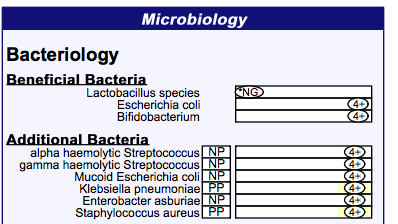
Genova Stool results

This test(latest edition) does give information, as shown below:

Screen Shot 2015-04-24 at 12.17.55 PM

This can lead to inferring the state by looking up the bacteria hierarchy and seeing what the level of Proteobacteria Phylum  is. The uBiome shows the results for Proteobacteria, as shown from this CFS blog post

Screen Shot 2015-04-24 at 12.39.41 PM

Unfortunately, the results of the total was up, instead of the hoped for lower (suggesting lower levels of E.Coli by inference).

Note, that this does not indicate it the strains are good or bad ones.

On the older tests (2006), we see it also listed.

Screen Shot 2015-04-24 at 12.24.50 PM

And older probiotic news

  • A nice newsletter [Syntrophy] describing dysbioaia – repairing dystfunctional host-microbiota
  • Your microbiome changes thru out the day.
  • Imbalance in Gut Bacteria can lead to cancer [article]
  • Gut bacteria Impacts blood-brain barrier [article] [article] [article]
  • VSL#3 probiotic reduces Liver Disease Severity[article]
  • Research on the chemicals in farts to diagnosis disease [article]
  • Retinoic acid [Vitamin A metabolite] as a dietary intervention restored lactobacilli that were downregulated in lupus-prone mice, and this correlated with improved symptoms.” [article]
    • “Clostridiaceae and Lachnospiraceae, both harboring butyrate-producing genera, were more abundant in the gut of lupus-prone mice at specific time points during lupus progression.”
  • “Frozen poop probiotics” [article] – 70% improved after 2 days/20 capsules. 90% [article]
  • Christensenella minuta, led to reduced weight gain.[article]
  • Gut bacteria impacts whether you get an infection [article]
    • “Individuals who became Campylobacter positive had a significantly higher abundance of Bacteroides (P = 0.007) and Escherichia (P = 0.002) species than those who remained culture negative. Furthermore, this group had a significantly higher abundance of Phascolarctobacterium (P = 0.017) and Streptococcus (P = 0.034) sequences than the Campylobacter-negative group, which had an overrepresentation of Clostridiales (P = 0.017), unclassified Lachnospiraceae (P = 0.008), and Anaerovorax (P = 0.015) sequences. Intraindividual…The relative abundances of Escherichia coli and Bacteroides species have been pointed out as important determinants of susceptibility to Gram-negative pathogens in general and Campylobacter infection in particular. “
  • “bacteria protect against infection by altering the composition of bile acids in the gut.” [article]
  • “Clostridium scindens, a bile acid 7á-dehydroxylating intestinal bacterium, is associated with resistance to C. difficile infection” [Article]
  • Jet lag impacts gut bacteria – “jet-lagged microbes from either mice or humans into germ-free mice, the rodents became more susceptible to glucose intolerance and diabetes.” [article]

Latest News on Probiotics

My irregular review on recent probiotics news:

Increasing Biodiversity of the Microbiome/Gut Bacteria

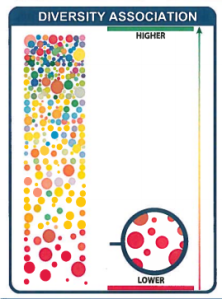
A reader forwarded his Genova Stool results and I want to focus on one aspect of it that is shown below. Low biodiversity of gut bacteria, as show below.
Bio

A flippant answer would be “Stop washing you fruit,vegetables, hands and have a tablespoon of good organic living soil every day!”  In other words, extreme Hygiene Hypothesis! Instead, I will do a conservative, pubmed based analysis.You may also wish to read this post by Dr. Lipman

Probiotics

The obvious first choice is Prescript-Assist with some thirty species, followed by Floracol probiotics which is similar, but in theory should have different strains. As well as Microflora Restore and any other soil based probiotics that you can fine, In some cases, you may have to search overseas to find such offerings.

Foods

The first food that comes to mind is what I use to encourage biodiversity, 100% rye bread [2012]. Rye was the stable of most North European diet until only a few hundred years ago. Our gut bacteria far better evolved to live off rye instead of wheat. There are usually two choices – both imported from Europe (US Rye bread is usually made with a little rye and a lot of wheat!). Loafs form Germany and Poland (for example Mestemacher Whole Rye Bread) and Sweden/Norway Crisp breads).

Exercise also improves diversity[2014] and as a corollary, less obese people have better diversity[2013]. Fasting also increases diversity [2015]

Going over to AmericanGut.Org, they reported in 2014

  • How much of the microbial diversity participants shared with other participants depended greatly on how recently they had taken antibiotics. Those participants who had taken antibiotics within the last year tended to have less shared diversity with other participants.
  • Alcohol imbibers tended to have greater microbial diversity than those that don’t drink alcohol at all.
  • Spikes in microbiome populations seem to occur around holidays: in July, and in November through January.
  • There is no single organism that is found in every person, but some are more common across the population than others.
  • People who sleep more and who exercise outdoors have more diverse microbiomes.
  • The microbiomes of the elderly resemble those of infants in certain respects, as seen in other studies

Most of the other articles dealt with increasing the amount (that is already there) and not diversity.

Speculation: Eating a wide variety of ethically different (and not “americanized”) foods would also increase diversity.

And the last way, horrible horrible way, long deep french kisses with healthy young things! [80 million living units per kiss! – [2014] … new pick up line, “Kiss me — I don’t want your body, just the bacteria in your body!!”

Anti-TNF Supplements – Part 2

I am continuing the review of items listed at  “HOW TO INCREASE PERFORMANCE AND IMPROVE HEALTH BY INHIBITING TNF-ALPHA“ to identify items with good and bad impacts on microbiome. While taking TNF-alpha reducers is a good intent to reduce inflammation, some have adverse effects, similar to what I found is anticoagulant supplements.

He has a long list so I will not be doing deep searches and excluding items with no information. I have NOT verified if his assertions are backed by PubMed articles.

  • Bile (R)
  • Glycine (R)
    • L. plantarum HEAL 9 increase it [2014]
    • Elevated can indicate bile issues  [2014]
    • Improves sleep [Wikipedia]
  • Chromium  (R)
    • Increases  Actinobacteria and Acidobacteria [2012]
  • Sialic Acid (RR2)
    • A relative rise in Prevotella and Lactobacillus species was accompanied by a corresponding reduction in the genera Escherichia/Shigella, Ruminococcus and Eubacterium [2015]
    • Increase Clostridium difficile [2013] – especially if antibiotic taken at same time
  • Arginine (R),
    • shift in the Firmicutes-to-Bacteroidetes ratio to favor Bacteroidetes [2014]
  • Bromelain (R),
    • Inhibits enterotoxigenic Escherichia coli[1996]
  • Berberine (RR2), — NOT recommended for CFS
    • Decrease Clostridium difficile [2015]
    • Increased the generation of bile acids [2015]
    • lower counts of Escherichia coli but greater Lactobacillus[2013]
    • Blautia and Allobaculum, were selectively enriched, [2012]
    • berberine has demonstrated highly significant activity againstStaphylococcus, Streptococcus, Salmonella, Klebsiella, Clostridium, Pseudomonas, Proteus, Shigella,Vibrio, and Cryptococcus species [2011]
  • Apple polyphenols (R)
    • Increases Bifidobacterium [2015] – studies deal with Systemic Lupus Erythematosus Patients Microbiota, an interesting read
    • Decrease Lactobacillus spp, increase Bifidobacterium spp..[2014]
  • Silymarin (R), – Nothing
  • Honokiol  (R), – Nothing
  • Chinese Skullcap (R)/Baicalin (R), – Nothing
  • Ginkgo (R), – Nothing
  • Hespderidin (R), (in Citric) see apple literature above [2015]
  • Carnosine (R), – Nothing clear
  • Phytosterols (R),
    • Reduces  lactobacilli [1999]
  • Tart Cherry  (R) high in sorbitol, not recommended for some conditions.
  • Astaxanthin (R), – nothing
  • Astragalus  (R), -Not recommended for CFS
    • lactobacilli and Bacillus cereus increases,  Escherichia coli decreases [2009] [2012]
    • increases Bifidobacterium longum subsp. longum (two strains), B. longum subsp. infantis (three strains), Lactobacillus acidophilus , B. lactis,[2013]
  • Cat’s claw (R), – Nothing
  • Artemisinin (R)
    • Reduces  Aggregatibacter actinomycetemcomitans, Fusobacterium nucleatum subsp. animalis, Fusobacterium nucleatum subsp. polymorphum, and Prevotella intermedia.[2015]
  • Carnitine (R) – Nothing clear
  • Genistein (R) – Nothing clear
  • Amla/Gooseberry (R)
    • Increases  lactobacilli and bifidobacteria, decreases  Clostridium spp. and Bacteroides spp were decreased [2014]
  • CoQ10 (R), – Nothing significant
  • Magnolol (R) – Nothing
  • Echinacea (R) – Nothing
  • Chaga/Betulin (R) – Nothing
  • Bitter melon (R) – Nothing
  • Mastic gum (R),
    • reduces Mutans streptococci[2014]
    • Reduces Porphyromonas gingivalis, Prevotella intermedia, Fusobacterium nucleatum, and Parvimonas micra [2014]
  • Oxymatrine (R) – Nothing clear
  • Red clover (R) – Nothing clear
  • NAG,
  • Quercetin (R)
    • Reduces  Firmicutes/Bacteroidetes ratio, reduces Erysipelotrichaceae, Bacillus, Eubacterium cylindroides [2015]
    • Feeds Escherichia coli, Stretococcus lutetiensis, Lactobacillus acidophilus, Weissella confusa, Enterococcus gilvus, Clostridium perfringens and Bacteroides fragilis [2014]
    • Inhibits  R. gauvreauii, B. galacturonicus and Lactobacillus sp [2012]
  • Rutin  (R) – no impact [2008]
  • Myricetin (R)
    • Increases B. adolescentis [2013]
  • Ashwagandha,
    • Inhibits Streptococcus mutans and Streptococcus sobrinus[2013]
    • Inhibits Escherichia coli, Salmonella typhi, Citrobacter freundii, Pseudomonas aeruginosa and Klebsiella pneumonia [2012]