Another site/tool for DNA Health Risk

In my last post I did used DNA to evaluate if a person was a good candidate for using Infliximab aka  Remicade. During the research I discovered a free tool and site to further ease DNA analysis. This site is actually easily to use than https://livewello.com/

The gotcha is you need to use the Safari Browser [Install here] and the site is http://www.eupedia.com/genetics/autoimmune_diseases_snp.shtml. It will prompt you to install  SnpTips Add On: https://addons.mozilla.org/en-US/firefox/addon/snptips/

What do you get then?

Before the above (or on a different browser) you will see

Screen Shot 2015-03-29 at 3.43.09 PM

You will see:
Screen Shot 2015-03-29 at 3.47.38 PM

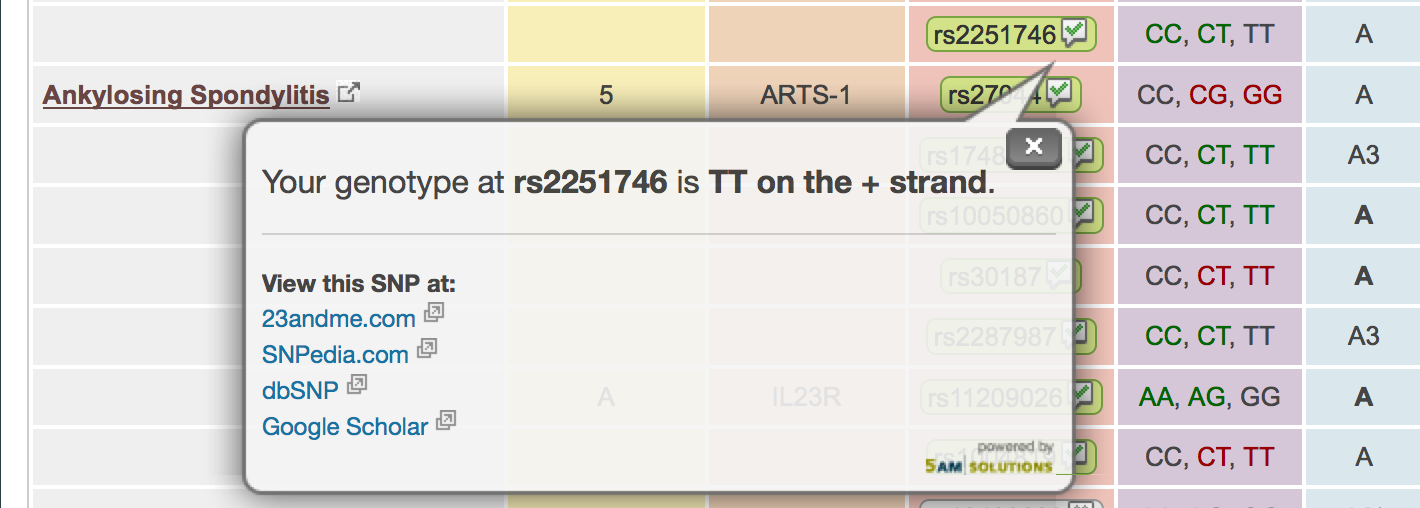
Clicking on this change item will show your values, plus quick links..

Screen Shot 2015-03-29 at 3.50.08 PM

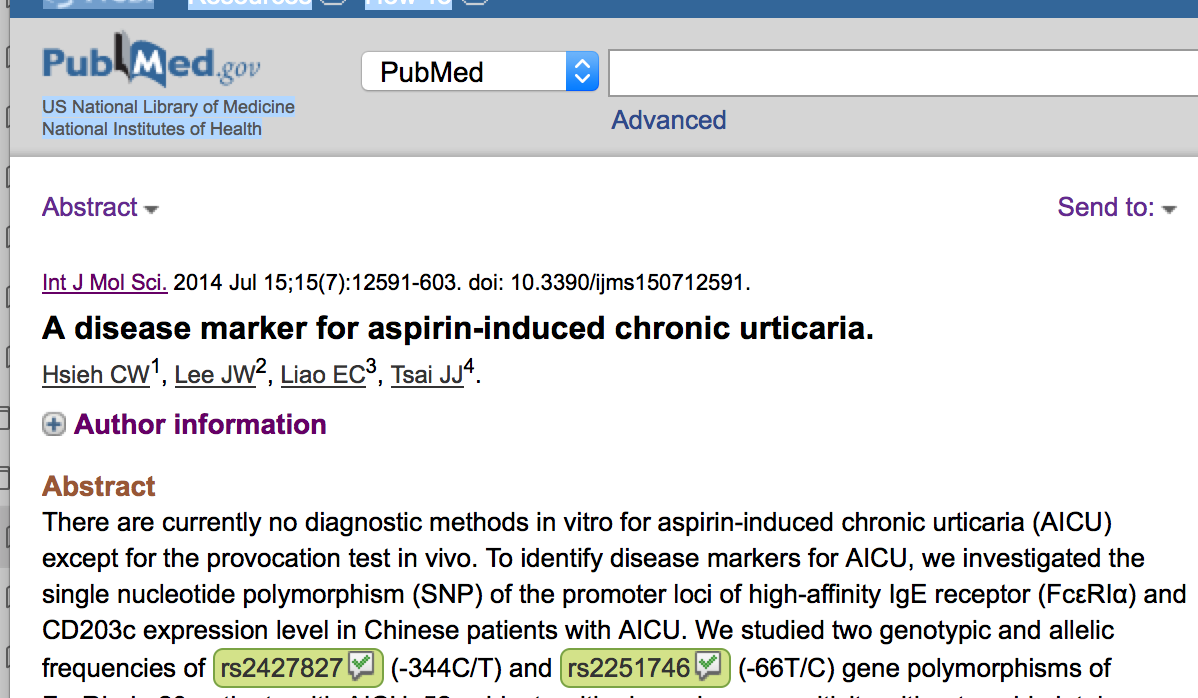
The extra sweet thing is that this applies to ANY PAGE. For example, while browsing Pub Med pages

Screen Shot 2015-03-29 at 3.55.01 PM

This can save a lot of time, for example, for the SNPs above, I immediately know if I have the SNPs that are being investigated — in this case, I have one of them, so further reading may be worth while.

Honesty in informing Patients

As a statistician I like to know the actual odds so I can make a rational decision. I have encounter situations where the operation was successful and there was a 40% risk of patient death within 6 months — and that was never disclosed to the patient or the family. Personally, I would love to see printed risk statement required to be given with each drug (and compulsory reporting of any or odd reaction — typically MDs will dismiss them and not report them). – the patient reports  (giving the MD’s name) and the MD reports giving patient name.

“There is a low risk of ….”  is misinformation.. numbers are needed!

” Idiosyncratic DILI is like other adverse effects of drugs underestimated and under reported in most epidemiological studies.” [2015]

Another post from a different blogger that found studies suggesting that the risk of cancer was 12x higher with some anti-TNF drugs. (i.e. from a 0.4% risk to a 5% risk of cancer [source])

Case Study: Infliximab

Infliximab aka  Remicade, Remsima, Inflectra has been cited in the immediate prior posts and is likely a good example because it has been heavily used — including for:

So what are the risks if you use it? A PubMed search returned over 3000 articles dealing with adverse effects.

  • “Infliximab caused liver injury in 8.3% of treated patients” [2015]
  • “10~20 % of patients was Remicade-resistant.” [2014]
    • “primary-non response” 22% [2014]
    • “65.5%/69.4% for clinical response”[2014]
      • high pre-treatment hemoglobin was also a predictor of good response [2014]
      • The sensitivity and specificity in predicting response to IFX based on this gene profiling was 95% and 85%, respectively.[2014]
      • all of these studies more severe disease was associated to adverse outcomes and less favorable response to anti-TNF [2014]
  • “Chronic sinusitis.. approximately 2%”[2014]
  • infusion reactions and delayed hypersensitivity 10% [2014] 27% [2014]
    • Mild and moderate IR occurred in 17% [2014]
  • Adverse drug reaction: 41.4% [2014] 35%[2014]
  • Serious adverse events: 67.9% [2014]
  • 48.48 % of patients who received infliximab presented (ANA, ENA, anti-dsDNA) autoantibodies [2014]
  • Infections and elevation of transaminases occurred in 28.40% [2014]
    • severe infections 6%  [2014]
  • [2014]
    • Anaphylaxis:  6%
    • mild acute infusion reaction in 6%
    • hypotension in 6%
    • respiratory distress 6%
    • skin rash and eruptions 6%
    • hypertension 3%
    • tightness in the chest 3%

No statistics on, but..

  • ” an increase in weight” [2015]
  • “an association between focal mucinosis and thyroid dysfunction, as well as possible adverse effects of biological therapy with TNF-α antagonists.”[2014]
  • ” probably exert a direct, toxic effect on the bone marrow”[2014]
  • Mycobacterium chelonae bacteremia [2014]
  • Hepatitis [2013]
  • Herpes zoster[2014]
  • Aseptic meningitis [2014] – 5 cases at least reported
  • a significant association with lupus [2014]

Bottom Line

While the analysis is not complete, we may sum it up as: This drug as a 70-80% response (and for many diseases it is used for, less than 25% chance of remission) with probablity a 10% of having liver damage (regardless of outcome), 30% change of getting an infection (with the immune system depressed), 70% chance of adverse reaction. The odds of taking it and everything going “fine” is about 1 in 15. 14 in 15 people will have problems.

As a side note, I found two of the studies found success (or issues, such as developing APS) was predictable from DNA. I really doubt that more than 1% of patients prescribe this are testing for DNA, exposing patients to needless risks with little chance of success.

Addendum

After the above article, someone who was about to take  aka  Remicade, contacted me and allow access to their DNA (from 23andMe.com ).  I found a beautiful table at: http://www.nature.com/tpj/journal/v13/n4/fig_tab/tpj201253t2.html (Gene polymorphisms that can predict response to anti-TNF therapy in patients with psoriasis and related autoimmune diseases (Aug 2013) R Prieto-Pérez, T Cabaleiro, E Daudén and F Abad-Santos) and both created a LiveWello.com panel from it and walked their DNA SNPS. The result was a strong prediction that they would be a non-responder (i.e. 6x more ↓ than ↑). I wonder how the MD is going to respond to “According to the latest studies (2013), my DNA says that I am going to be a non-responder to Infliximab and other anti-TNF-Alpha drugs. What do you suggest next?”

The sweet thing would be for Insurance Companies to demand DNA testing before approving the use of Remicade — it will save them money (and cut premiums too!) and save patients side-effects!

Immunosuppressions, Herbs/Supplements and Probiotics.

A reader recently asked if CFS patients are  immunocompromised. If they are taking no herbs, prescriptions or supplements — then the answer is clear: No, their immune system is generally regarded to be up-regulated, the opposite of immunocompromised. The problem comes when the patient starts to take things to reduce the up-regulation. Then the problem becomes where does the patient ends up. The other side is extremely long term CFS patients that can become  immunocompromised because their immune system has become exhausted.

Looking at a TNF-Alpha Suppressor (Infliximab)

Trying to find literature of immunosuppressing herbs and probiotics is a challenge. In an earlier post, I had given some known TNF-Alpha reducing herbs (Turmeric, Alpha Lipoic Acid, Ashwagandha, Boswellia, Tulsi (Ocimum sanctum) [2014],Neem [many studies]), I am going to drill down on Infliximab, a prescription drug (and “one of the most widely used anti-tumor necrosis factor-α molecules”)


“According to a review of cases of infections caused by bacteria of the genus Lactobacillus from 2005 (collected by J.P. Cannot’a), 1.7% of infections have been linked directly with intensive dairy probiotic consumption by patients.” [2014]

“We describe a case ofLactobacillus bacteremia in a 17-year-old boy with ulcerative colitis managed with systemic corticosteroids and infliximab, who presented with fever to 102°F, flushing, and chills 1 week after starting Lactobacillus rhamnosus GG probiotics. Initial blood culture on day 2 of his fever was positive forLactobacillus, however, subsequent blood cultures on day 3 and 5 were negative. He was treated empirically with antibiotics for 5 days and defervesced by day 8 of his illness. 16 S rRNA sequence analysis identified the organism from the patient’s blood culture and probiotic capsule as L. rhamnosus with a 99.78% match for both the strains. This case report highlights the potential risk of Lactobacillus bacteremia in immunosuppressed patients with severe active ulcerative colitis.” Lactobacillus bacteremia associated with probiotic use in a pediatric patient with ulcerative colitis.[2013]

“Six cases of bacteraemia in hospitalized patients, 5 with a depressed immune status, were caused by lactobacilli. Sodium dodecyl sulfate-polyacrylamide gel electrophoresis of whole-cell proteins and API 50 CH carbohydrate patterns assigned the causative agents to the speciesLactobacillus rhamnosus, Lactobacillus curvatus, Lactobacillus delbrueckii subsp. lactis and Lactobacillus paracasei subsp. paracasei.” –Six cases of Lactobacillus bacteraemia: identification of organisms and antibiotic susceptibility and therapy.[2003]

” a case of meningitis due to Lactobacillus rhamnosus in a child undergoing allogeneic hematopoietic stem cell transplantation” [2010]

” we documented 2 cases of Bifidobacterium longum subspecies infantis bacteremia in newborns receiving probiotics. By comparative genomics, we confirmed that the strains isolated from each patient originated from the probiotics.” Bifidobacterium longum Bacteremia in Preterm Infants Receiving Probiotics.[2015]

“The occurrence of bacteremia with bifidobacteria after its prophylactic administration in VLBW infants” – Case series of Bifidobacterium longum bacteremia in three preterm infants on probiotic therapy. [2015]

There were over 100 articles listed on Pub Med.

 Bottom Line

The risk of bacteremia (unhealthy bacteria growth that could be potentially fatal) appears significant if the immune system is suppressed too much either by supplements, drugs or immune-system exhaustion. This is not a total surprise because many of the studies on the health benefits of probiotics were done on “near-normal” populations. There are documented cases for all of the families of bacteria that have been recommended on this site (with the exception of Mutaflor – E.Coli Nissle 1917, and the lack of studies does not imply that it is safe).

This complicated things for long term CFS patients — if you are prone to infections, gum disease, etc then your risk of problems from probiotics are likely higher. Consult with a knowledgeable medical professional (and make sure you quiz them to verify they are knowledgeable and not pompous!).


Short and Long Term CFS and other autoimmune conditions

This last week there has been much news about CFS and markers, “Columbia University’s Mailman School of Public Health, looked at 51 proteins, also known as cytokines, released by cells involved in the immune system. Among 646 patients studied, including CFS patients and healthy controls, people who were ill for three years or less had higher protein levels than the others, the researchers found.” Wall Street Journal To me this is just confirmation of a pattern that I have seen reported in related diseases where fatigue persisted after a technical recovery. The typical onset scenario consists of two items: a probable viral infection with stress. This is not only true for CFS but for many co-morbid conditions such as:

Going through a series of studies that looked at fatigue after a severe stomach infection, I derived the table below.

Recover Period Percentage Remaining that Recover Patients remaining
6 – 12 Months ~ 50% ~ 14%
12 – 24 Months (2 yrs) ~ 50% >~7%
24 – 48 Months (4 yrs) ? 50%> ~4%
48 96 Months (8 yrs)

? 50%

>~2%
96-192 Months (16 yrs) ? 50% ~1%

My take of the mechanism is that infection setups a gut alteration that keeps triggering production of cytokines. The alteration was an appropriate response when the infection occurred. The normal gut flora did not suppress it after the infection was take care of. Recently I had a bug, and after I recovered from it, I found that my psoriasis flared and I had post-infection signs of inflammation. My wife reminded me of a reader reporting that her psoriasis disappeared like magic from taking the probiotic Align (which she tried after I posted about it). I took it, and hit the probiotics hard for 2 weeks (almost all of them were bifidobacterium) and these post-infection symptoms faded. This is echoed in some recent studies:

Doing a PubMed search for the main cytokine reference and microbiome found over 120 articles.

New Probiotic on Market: L Reuteri NCIMB 30242 (ONLY)

There are eight PubMed studies on this strain.

  • Significantly changes the size and composition of the circulating bile acid [2015]
  • a greater proportion of L. reuteri-treated subjects showed improved general GI health status (p = 0.042) and improved diarrhea symptoms (p = 0.03). [2013]
  • the first report of increased circulating 25-hydroxyvitamin D in response to oral probiotic supplementation[2013]

For general information about L.Reuteri see my earlier post.

Available from manufacturer and on Amazon.

This stain is also sold as Cardioviva on amazon

I have just ordered some myself.