“The probiotic Symbioflor 1 is a historical concoction of 10 isolates of Enterococcus faecalis. Pulsed-field gel electrophoresis revealed two groups: one comprising eight identical clones (DSM16430, DSM16432, DSM16433, DSM16435 to DSM16439) and a further two isolates (DSM16431, DSM16434) with marginally different profile” [2016]
“A double-blind, placebo-controlled multicenter study in 157 patients with chronic recurrent sinusitis investigated the occurrence of acute relapses during treatment of patients with a bacterial immunostimulant (3 x 30 drops/day), comprised of cells and autolysate of human Enterococcus faecalis bacteria (Symbioflor 1, n = 78) in comparison to placebo (n = 79)…. the occurrence of relapses (50 incidents) was about half (56%) the number observed under placebo (90 incidents)” [2002]
“the time span until occurrence of the first relapse was clearly longer under verum[Symbioflor-1] (699 days) than under placebo (334 days) and after the end of the observation period 91% of patients under verum experienced only one relapse compared to 62% in the placebo group (p = 0.01). ” [2001]
From PubMed
“Compared with the controls, probiotic intervention significantly upregulated the level of IL-10 and TGF-β, downregulated levels of IFN-γ, and increased progesterone level that reversed the trend of being Th1 predominance state ” [2020]
“1. E. faecalis stimulates the liberation of interleukin 1 (IL-1 beta) and interleukin-6 (IL-6) in a dose-dependent manner; the E. faecalis induced liberation of IL-1 beta and IL-6 is inhibited by dexamethasone (Dm) but not by cyclosporin A (CsA).” ” 2. E. faecalis stimulates the liberation of gamma-interferon (IFN-gamma) in a dose-dependent manner, which is inhibited by both Dm and CsA.” “3. Phytohemagglutinin (PHA)-induced liberation of gamma-IFN and interleukin-2 (IL-2) is inhibited by E. faecalis in a dose-dependent manner. ” [1994]
“For instance, Escherichia coli Nissle 1917 was a poor inducer of iNOS gene expression compared to the other E. coli strains, while Enterococcus faecalis Symbioflor-1 was more potent in this respect compared to all the eleven Gram-positive strains tested. ” [2014]
Personal Experience
I have used this for sinus issues in the past and it has been effective in clearing them.
A reader forwarded this to me with the following comment..
My mother is a health 58 years old women a little bit over weight she started to have after 2 weeks of use: headaches and feeling very fatigued so I think she has die-off, The interesting thing that happen she has swollen lymph nodes under her arm pits for about 25 plus years, the lumps started to regress, I cannot find the microbiome condition associated with this and this strain of probiotic she started to use.
Entero Satys
This is available from France. Link here. International availability is unknown. “Hafnia alvei is a psychrotrophic bacterium, it originates in raw milk and continues to grow in cheeses such as Camembert. abundant levels of Hafnia alvei can be found in raw milk cheese ” [Wikipedia]
“In conclusion, the present study showed that a daily provision of the H. alvei HA4597™ strain in genetically obese and hyperphagic ob/ob mice with HFD-exacerbated obesity decreased body weight gain, improved body composition, decreased food intake, and ameliorated several metabolic parameters, including plasma glucose and total cholesterol levels. “
“Finally, the low abundance of ClpB gene expressing Enterobacterales species found in the microbiota of obese subjects in the present in silico analysis may indicate insufficient anorexigenic signaling from the gut microbiota to the host, further providing the rationale for supplementation of commensal bacteria expressing the ClpB protein with an α-MSH-like motif. “
There was no detail microbiome information cited in studies above. The mechanism of operation was increase production of a metabolite from this bacteria that alters the number of meals and result in weight loss.
The daily dosage is 50 million CFU ** / 100 billion cells, i.e. 5 x 10^7. Some (made in France) Camembert are reported to exceed this level in 1 gram (especially the surface).
The last item does not have any studies that I could find, I did find that with seasonal allergies that “The pollen season induced a reduction in Bifidobacterium, Clostridium and Bacteroides which could not be prevented by the [Lactobacillus, Bifidobacterium] probiotic intervention. “[2009]. The study did not try Miyarisan (Clostridium butyricum), which the wife found helped quickly.
Bottom Line
Encouraging or supplementing Bifidobacterium and Clostridium as probiotics should reduce severity. Most of the studies used Bifidobacterium.
Hemex was subsequently purchased and David Berg’s ISAC panel was subsequently dropped. His studies found that over 70% of CFS/ME patients have hypercoagulation which was often a major factor for symptoms and for successful treatment.
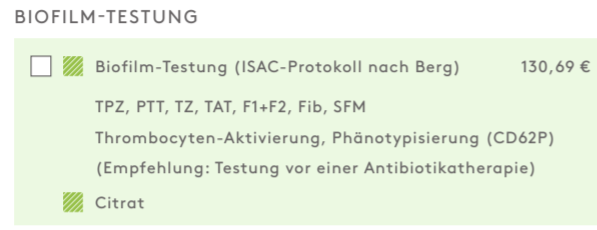
A reader surprised me this week because a German lab had worked with David Berg and implemented the ISAC panel — and continue to offer it.
Antibiotic therapy and no recognizable improvement in symptoms?
In more than 60% of all bacterial infectious diseases, the pathogens form biofilms, which protect them from attack by the immune system. The hematologist D. Berg has developed the “ISAC” protocol to recognize a biofilm. (ISAC: Immune System Activation of Coagulation). When a biofilm is detected, he recommends the use of lumbrokinase for removal. The new formation of a biofilm during the therapy is prevented eg. by low molecular weight heparin. The Dedimed Europarc Laboratory carries out the biofilm testing, which we recommend before any lengthy antibiosis.
I talked to Dr. Waldherr for 45 minutes he is unbelievable good informed about almost everything and he said to me, that he and his colleagues reached up to Dr. Berg to finde out how to perform the tests. The actual test is done in Berlin from Dr. Sucker and the treatment is then given low molecule Heparin etc. he also knows all the enzymes used like Nattokinase, Lumbrokinase etc. he also speaks English which is also a good thing if people don’t speak german.
The cost is much less than what I paid in 1999!
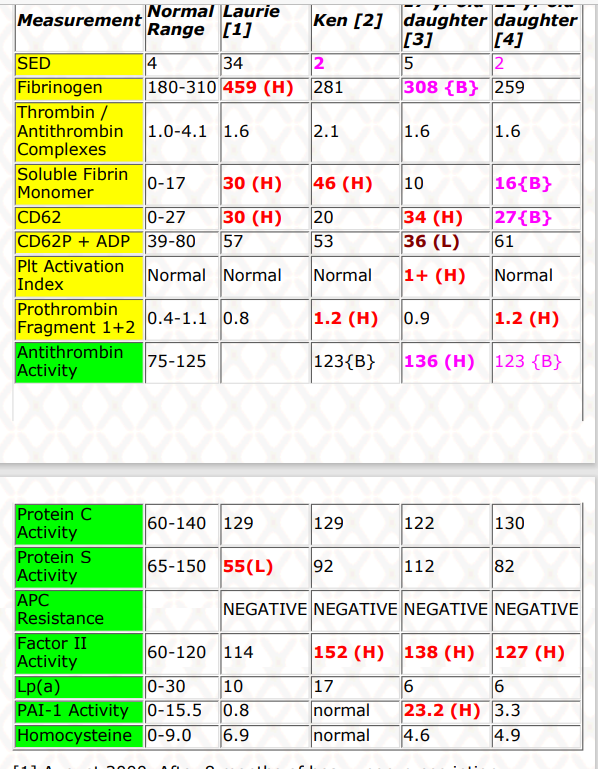
An example of my family’s labs from 2000. Note the large number of items tested and it only takes one to cause problems.
On Feb 15th I was running a high temperature, definitely coming down with something and the next day I had a seizure (my first one ever). I was sent to hospital and stayed there for several days. This post record some interesting observations both as a ME/CFS person and a person with an unknown virus (not COVID-19) that echo some aspects reported for COVID-19.
Onset
I happened to be wearing a watch (Cheap $18 watch from China) that records my pulse and blood pressure every hour. This is what was recorded. Impressive changes
Tests
The symptoms presented like sepsis, so I was placed on multiple high dosage antibiotics. Testing found nothing (Flu, bacteria, and even a spinal tap to check for meningitis). Many CRT and MRI scans. Nothing was found so the most likely cause was a viral infection of unknown type.
The fever lasted for about 3 days. I was given beta blockers, heparin etc.
Blood Sugar
It was measured by the ambulance crew and was at the high end of the normal range. For the next three days it was quite high outside of the normal range. On day 4 it returned to the middle of the normal range.
This is significant for COVID-19, because people with high blood sugar (diabetes) have a higher fatality rate. I suspect that the same increase of blood pressure pushes things still higher to the lethal range in some.
My Glucose levels — it was below 100 when the ambulance picked me up
C-Reactive Protein
If your examine my post on another blog on symptoms, you will see that high values of c reactive protein are associated with higher death rates for Covid-19 [PubMed]
C Reative Protein levels
Blood Pressure and Pulse
These stayed high and were still abnormally high at discharge. I started on supplements proven in studies to lower blood pressure, and they helped quickly but BP stayed erratic (jumping from normal to high for 2 hrs and then back), just less so over time.
A reader referred me to this study of MERS-CoV, another Coronavirus. The item that helped was resveratrol, which also lowers blood pressure (may be the mechanism it works thru).
Discharge
The moment that I got home, I did a microbiome test (Thryve) with a primary focus on correcting changes from the antibiotics. For the abnormal high blood pressure, I hit it with literally everything that was documented (see here for the list). Blood pressure and pulse initially went back to normal and then started jumping around with no apparent explanation at the time.
Oops on Supplements
I received my Thryve microbiome results and was not surprise to see the chart shown below. It indicated that the jump of blood pressure was a result of microbiome changes induced by the virus.
BP jumped due to virus induced changes of the microbiome
I then identified which shifts were key:
The interesting thing was that comparing the recommendations for this mixture and the studies, we had good overlap — but a few appear on the avoid list. I removed those from my supplements, and things improved more.
It illustrates that results from the general population may not apply to an individual. I had a subset of the high BP bacteria and being specific to those bacteria is preferred.
Hypercoagulation vs Pulse and Blood Pressure
One of the things that I noticed was that my 02 saturation was not the normal 99%. A rock steady 99%.
When my pulse and BP went to normal for a few hours, O2 dropped to 94%
When my pulse and BP went high, my O2 returned to 99%
Conversations with Dave Berg, Hemex Labs, came back. Infections often trigger coagulation (blood thickening). The light went on! The increase of both pulse and blood pressure may be a response to the low O2 level and an attempt to restore O2 levels.
As a side note, the hypercoagulation is suspected by some to play a role in postural orthostatic tachycardia syndrome (POTS). The thick blood results in delay of blood pressure in the body resulting in mis-signalling. The rapid increase in heartbeat seen with POTS is an attempt to compensate.
Heart rate and blood pressure work together to keep the blood flowing at a healthy pace, no matter what position the body is in. People with POTS cannot coordinate the balancing act of blood vessel squeeze and heart rate response. This means the blood pressure cannot be kept steady and stable….. Patients may develop POTS after a viral illness,
I know from ME/CFS days that I have an inherited coagulation defect [Prothrombin G20210A or factor II mutation]. I am one of the lucky ones because there are known substances that will compensate for my particular defect: Piracetam, with tumeric being a secondary choice. I proceeded with 1200 mg of Piracetam with each meal. O2 levels went up, pulse and BP went down more. See below
BP and Pulse stayed in sync
I have a follow up in 2 weeks with my MD and hope to get some heparin to take sublingually (under tongue, not by needle) to further clear the hypercoagulation.
It was interesting to see that this unknown virus caused changes in blood sugar and blood pressure. For COVID-19, there are higher death rates (about 9-10%) for people with diabetes (high glucose) and hypertension (high blood pressure) – I suspect that COVID-19 pushes these to potentially fatal levels.
Takeaways: reducing BP and blood sugar proactively and aggressively may be a good strategy. High BP may be connected with hypercoagulation (which may be sub-clinical, i.e. not severe enough for physicians to take action).