Parkinson’s Disease and Gut Bacteria

Receiving a diagnosis of “Early Alzheimer’s” from a SPECT scan cause me to suspect several neurodegenerative diseases may be associated with microbiome dysfunction. My SPECT (and memory issues) disappeared with alteration of gut bacteria.

A reader forwarded a link to a talk about gut bacteria and Parkinson’s — this area was a known because I recall reading an association of the two. This blog will examine the current medical literature on this — there is not much, just 20+ articles.

  • “Recently, it has been recognized that the brain-gut axis interactions are significantly modulated by the gut microbiota via immunological, neuroendocrine, and direct neural mechanisms.Dysregulation of the brain-gut-microbiota axis in PD may be associated with gastrointestinal manifestations frequently preceding motor symptoms, as well as with the pathogenesis of PD itself, supporting the hypothesis that the pathological process is spread from the gut to the brain.” [2015]
  • “The interaction between the host and its gut microbiome is a complex relationship whose manipulation could prove critical to preventing or treating not only various gut disorders…, but also central nervous system (CNS) disorders, such as Alzheimer’s and Parkinson’s diseases.”[2015]
  • “this is the first review of the key issues involving both the altered gut microbiota and impaired tissue barriers in the pathophysiology of Parkinson’s disease (PD) and amyotrophic lateral sclerosis (ALS)” [2015]
  • “At the taxonomic level of genus, putative, “anti-inflammatory” butyrate-producing bacteria from the genera Blautia, Coprococcus, and Roseburia were significantly more abundant in feces of controls than PD patients…Bacteria from the genus Faecalibacterium were significantly more abundant in the mucosa of controls than PD.Putative, “proinflammatory” Proteobacteria of the genus Ralstonia were significantly more abundant in mucosa of PD than controls.”[2015] Which hints that Miyarisan may have effect on PD patients: There have been no trials on this yet.
  • “These changes were associated with a shifted profile of the intestinal microbiome, including reduced levels of Butyrivibrio Fibrisolvens, Escherichia coli, and Fermicus, in G93A[ALS model] mice” [2015] – So Mutaflor is also a possible candidate for PD.
  • “The relative abundance of Enterobacteriaceae was positively associated with the severity of postural instability and gait difficulty..On average, the abundance of Prevotellaceae in feces of PD patients was reduced by 77.6% as compared with controls. Relative abundance of Prevotellaceae of 6.5% or less, had 86.1% sensitivity and 38.9% specificity for PD.”[2015] i.e. this is a potential test for PD!!!
    • “The presence of Prevotella in the human gastrointestinal tract is inversely correlated with Parkinson’s Disease.”[2] (i.e. low levels – severe PD, high levels – mild PD)
  • “lactulose hydrogen breath test positivity for small-intestinal bacterial overgrowth [SIBO] (present in two thirds of PD patients) is associated with the same subsets:” [2015]
  • “Case reports of fecal microbiota transplantation (FMT), have also shown favorable outcomes in Parkinson’s disease, multiple sclerosis, myoclonus dystonia, chronic fatigue syndrome, and idiopathic thrombocytopenic purpura.”[2015]
  • “it was recently speculated, that the associations between smoking, coffee, and PD risk could be mediated by gut microbiota.” [2015]
  • “a prominent role for the gut microbiota in these gut-brain interactions. Based on studies using rodents raised in a germ-free environment, the gut microbiota appears to influence the development of emotional behavior, stress- and pain-modulation systems, and brain neurotransmitter systems.” [2015]
  • “they are consistent with hypotheses of a causative role for the gut microbiota and gastrointestinal immune response in PD.”[2014]
  • “We propose an alternative third hypothesis, in which both cigarette and coffee consumption change the composition of the microbiota in the gut in a way that mitigates intestinal inflammation…Strong epidemiologic evidence suggests that smokers and coffee drinkers have a lower risk of Parkinson’s disease (PD).” [2014]

Bottom Line

The studies above hints that two probiotics that may help PD:
“Restore for Gut Health” – DANGER Will Robinson!!!

This product is strongly being marketed via FACEBOOK advertisements to any one showing interest in IBS, Chronic Fatigue Syndrome etc. Be warned and pass the warning on to others!

An update: DNA damage and increased Cancer risk are possible.

If you have a medical condition, you may wish to try this look up page to identify the best probiotics and supplements. Just click on the condition(s) on the page.


A better approach for restoring gut health is to get tested for the bacteria shift and then adjust your diet appropriately. The cost of getting the best test, uBiomeExplorer is $90, does not require a doctor prescription and provide details of your gut bacteria down o the species level (I have no affiliation to them). From this specific recommendations can be made to fix the gut, based on your own specific gut bacteria and published scientific studies. These suggestions have been automated are freely available at: http://microbiomeprescription.com/ 

Hundreds of different substances that are capable of modifying the thousands types of bacteria involved are used (with the medical study supporting it).


A reader sent this to me and looking at the contents caused me to ask two questions:

  • What is this about a coal extract and the gut?
  • Is there any possibility that there may be something behind it?

The later question means that I am willing to consider edge cases for treatment — I just need to find evidence to support it.

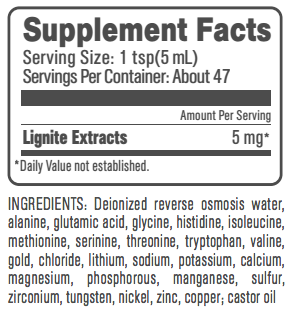
Why do I say coal extract? The label reads:

Screen Shot 2015-12-05 at 4.19.28 PM

I am an ex Science Teacher and I know what Lignite is… It is brown coal,the lowest rank of coal and is a soft brown combustible sedimentary rock formed from naturally compressed peat. So we may actually be looking at a peat extract. The ingredient list read like a fine laboratory analysis of just that! Coal!

On the negative size, this type of extract is linked to endemic nephropathy [2013]. Further more, “Polycyclic aromatic hydrocarbons (PAHs) [from raw coal] are considered to be a group of compounds that pose potential health hazards since some PAHs are known carcinogens.” [2000].

I emailed the company because they claimed to be FDA regulare

  • “With supplements not requiring research by the FDA, most supplements lack scientific evidence to back up any claims…Look through the testimonial page for people”[site] i.e. No studies, just testimonials which could easily be 100% fake.
  • “In compliance with the FDA/FTC regulations of the supplement industry, Restore has not been evaluated or approved to diagnose, treat, or change the course of a disease.”[site] – talk about spin doctoring! “In compliance with the FDA/FTC regulations” causes most people to believe that it is FDA/FTC approved. It is not.

I have yet to receive any response except an acknowledgement of receipt:

Screen Shot 2015-12-05 at 4.35.29 PM

Bottom Line

This appears to be a dangerous supplement. Avoid!!!!! Their advertisements, YouTube etc. are often correct is describing problems — however their solution lack any clinical studies,  and is potentially seriously dangerous.

This product is a rebranding of “New Earth Dynamics” done in early 2015 [Press Release]. The company behind it registered in Delaware in October 2014. Delaware is famous for being used by scam artists, “”When you’re an officer or a director, many other states impose liability on you for making bad decisions, whereas in Delaware you’re protected by the Delaware Business Judgment Rule,” [source] – is it not odd for a group of people living in Virginia to form a LLC in a different state???? (why are they seeking such protection by forming a LLC in THAT state instead of Virginia).

Their chief scientific advisor, John Gildea PhD,  appear to have written no papers in this area and is focused on cancer [his publications].

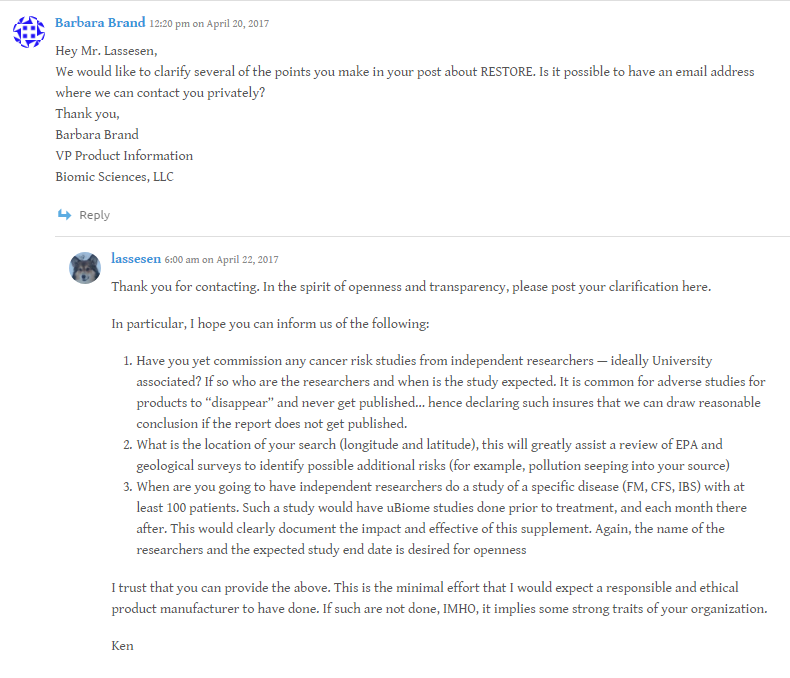
Refusal To Discuss Publicly

Restore for life contacted me, and I responded that I would love to have a conversation. After 5 weeks, they are still silent.  The silence speaks for itself IMHO.

restore

Interleukins, CFS and Microbiome

Today I came across a new study that stated “To our knowledge, we are the first to test for levels of IL-16 in ME/CFS patients.”[Nov 2015] and found “our work suggests that the clustered reduction of IL-7, IL-16 and Vascular Endothelial Growth Factor A(VEGF-A) may have physiological relevance to ME/CFS disease. This profile is ME/CFS-specific since measurement of the same analytes present in chronic infectious and autoimmune liver diseases, where persistent fatigue is also a major symptom, failed to demonstrate the same changes.”

This new finding presents an opportunity to put my model to the test. Could one or more of these changes be ascribed to changes of the microbiome  (gut bacteria) seen in CFS patients?

For IL-16,  we find that “Gut BalanceTM, which contains Lactobacillus paracasei subsp paracasei (L. casei 431®), Bifidobacterium animalis ssp lactis (BB-12®), Lactobacillus acidophilus (LA-5®), Lactobacillus rhamnosus (LGG®),… increases in the concentration of serum IL-16″. [2012] CFSers are low in both Lactobacillus and Bifidobacterium and thus would be low in IL-16. This study also found that acacia gum (gum arabic) increases IL-16 more (a good thing), which matches research reported earlier:

  • “Ten grams of gum arabic may produce a prebiotic effect in humans by boosting gut populations of specific bacteria”[2008]

For IL-7, “Lactobacillus reuteri..modulate human cytokine production (tumor necrosis factor, monocyte chemoattractant protein-1, interleukin [IL]-1β, IL-5, IL-7, IL-12, and IL-13) by myeloid cells” [2014] “probiotic potential of a large number of autochthonous lactic acid bacteria isolated from fruit and vegetables…Stimulation of IL-12, IL-2 and IL-7 was strain dependent” [2012]

For Vascular Endothelial Growth Factor A(VEGF-A), “Lactobacillus rhamnosus GG… significantly stimulated together with the induction of vascular endothelial growth factor (VEGF) expression.”[2007] “VEGF expression was significantly increased in rats administered Lactobacillus beverage-A” [2009Plantaricin A synthesized by Lactobacillus plantarum induces in vitro proliferation and migration of human keratinocytes and increases the expression of TGF-β1, FGF7, VEGF-A and IL-8 genes [2011].

Bottom Line

All of the decreases of the above anti-inflammatory interleukins and VEGF-A could be logically ascribed to the low Lactobacillium and Bifidobacterium seen in CFS patients. Gum arabic is re-inforced as a good pre-biotic to help with correcting the gut bacteria (and also increasing IL-16 production, thus reducing symptoms).gum

Enterogermina – Update

In my prior post on Enterogermina probiotic. I have since been directed to an online version of their package insert (Latest revision of the package leaflet by the Italian Drug Agency: December 2008). And noticed the following statements:

  • “Enterogermina is used to cure and prevent intestinal bacterial flora disorders. Enterogermina restores the intestinal flora balance upset during treatment with antibiotics or chemotherapeutic products, helping to correct consequent dysvitaminosis conditions (that is, anomalous vitamin production and assimilation). “
  • “During treatment with antibiotics, we recommend Enterogermina be administered during the interval between antibiotic administrations.”
  • Enterogermina bottles have a shelf life of 2 years. Enterogermina capsules have a shelf life of 3 years.
  • It is manufactured in France and Italy. It is available in India Clinical Study in India. Morocco. UAE. Mexico. Trinidad and Tobago. Pakistan. (It is imported from France). And ebay (with very high shipping cost, hopefully multiple packages at the same shipping cost) –
    • HINT: Any CFSer in Italy care to set up an ebay account that offers it with reasonable shipping cost???? It does not need to be sent “Express” but can be sent via parcel post.
    • Sinuberase” in Mexico contains Bacillus clausii in similar packages.

13046040-250x250

Going over to MicrobeWiki, we find:

  • Bacillus clausii is found in the soil where it can reduce nitrate to nitrite.”
  • “strains from Enterogermina were found to release antimicrobial compounds and modulate immune activity by increasing production of secretory immunoglobin A.[IgA]”
    • “IgA limits penetration of commensal bacteria back through the epithelium and shapes the density of different bacterial species in the intestinal lumen”[2007]
  • “846 base pair erm-related gene in Bacillus clausii that confers resistance to certain antibiotics… such as erythromycin, azithromycin, spiramycin, lincomycin, clindamycin, and pristinamycin I.” – Macrolides and aminoglycosides [2014]
  • B. clausii in Enterogermina can in fact colonize for brief periods of time on the intestinal wall of the gut, and provoke immune response in mice to rid of pathogenic bacteria.”
  • “originally noticed as a novel species upon the characteristics of ability to hydrolyze casein, ability to reduce nitrate, and ability to grow at 50°C. Further tests showed Bacillus clausii were able to use multiple sources of carbon including: L-aribose, xylitol, galactose, dulcitol, sorbitol, methyl a-D-mannoside, mannose, N-acetylglucosamine, D-tagose, 2-ketogluconate.” i.e. the above sources should be taken with it to encourage further growth of the probiotics.

More testing of what is in Commercial Probiotics

A new study on Commercial Probiotics

A few posts ago, I reported

“A new study by scientists at the University of California has found that contents of many bifidobacteria probiotic products differ from the ingredients listed….16 products.. only one matched the ingredient list .. Some products also contained non-label species” [Source 2015] –OUCH!

I then found a site that tests some commercial probiotics for actual Community Forming  Units (CFU). Doing a general search I found this site is helpful for finding CFU in various probiotics: https://labdoor.com/rankings/probiotics 

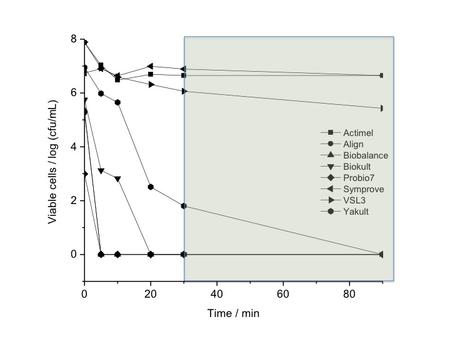
This morning email found a link to a new study published [Telegraph] [UCL] [PubMed 2015]. I have extracted a table below from this study:

Brand CFU as Claimed Survived Pig Stomach fluids Thrive in 10 hrs
Actimel
L.Casei DN-114001
Yes NO Yes
Symprove Yes Yes Yes
Align
B. Infantis
NO NO NO
Bio Balance (?)
L.Reuteri
NO NO NO
Bio Kult
Multi strains
NO NO NO
Yakult L.Casei Shirota Yes Partially (10 min) NO
VSL#3
8 strains
NO Yes Yes

slide1_sg_news_item

There are several factors that need to be considered looking at studies with the above. We do not need a grain of salt, but we may need a blob of fat!

  • If there have been well constructed human studies with the above probiotics with strong results — then that trumps the results of any tests such as those performed above.
  • In my prior post(When to take probiotics), we found research that probiotics taken with food or immediately before survived much better than on an empty stomach (a little fat with probiotic is a must IMHO). These tests were done with the “empty stomach” model — the worst case scenario.
  • Many studies use animals — in those cases, transit time may be far faster than that seen in humans, resulting in results that may not replicate in humans.
  • Diet impact transit times. A high bulk/fiber diet may result in 6+ stool movements a day. Other diets may be just once a day. Thus the results for pig stomach acid may not apply.
  • It is unclear is the tests were were ALL of the strains in a multi-strains, or ANY of the strains.

Symprove

Available in UK only. Contains (as ordered on label):

  • L. Rhamnosus
  • E. Faecium
  • L. Plantarum
  • L. Acidophilus

Why did it do so well? While they claim (based on beliefs)

  • “Critically, Symprove is water-based so it doesn’t trigger digestion, meaning it SURVIVES the hostile environment of your stomach.”
  • I believe that the “germinated barley” is the equivalent of “with food”. “Barley is one of the best starchy foods which makes it very suitable for the treatment of problems such as:…” [source]
Symprove has a *single* pubmed study [2014] on it. When I read “a statistically significant improvement in overall symptom severity” it means that the improvement is so slight that they have to use statistics to detect it. “There was no significant improvement in the IBS quality of life .”
So, it is very unlikely to be worth the expense.

Bottom Line

For human use, the CFU findings are valid. The results seen were using the empty stomach model which we know maximize the non-survivability of probiotics; a little fat with, and immediately prior to meals are how we know (now) that probiotics should be taken. The results of two L.Casei strains are significantly different — this reinforces that strains are very significant.

So, YES – check out the CFU results on the above sites, in selecting probiotics … and remember to take probiotics with some form of fat (milk, lard, etc).