D-Ribose revisited

I wrote about d-ribose in a post from 2012. I recommend it strongly then. Dr. Myhill writes favorably on her website – “Therefore I recommend that my CFS patients use 5 grams (1 scoop) three times a day”.

  • Ribose was added to the existing treatment regimen of a woman with fibromyalgia, resulting in a decrease in symptoms.” [2004]
  • D-ribose significantly reduced clinical symptoms in patients suffering from fibromyalgia and chronic fatigue syndrome.” [2006]

A reader asked me today “Is d-ribose bad for leaky gut and candida?”.  I can understand the logic leading to the question:

  • Sugar is bad for leaky gut and candida.
  • D-Ribose is a sugar.
  • Thus D-Ribose may be bad!

The fallacy is that “All sugars is bad” is an over generalization! The statement is true for normal household sugar, we need to be careful not to extend this without evidence.

See also these posts:

” These excretion patterns correlated well with the excessive oral ingestion of dairy products, artificial sweeteners and sucrose. Eliminating excessive use of these foods brought about a dramatic reduction in the incidence and severity of Candida vulvovaginitis.” [1984]

According to WebMD, “Ribose is a kind of sugar that is produced by the body. It is used as a medicine… it has also been used to improve symptoms of chronic fatigue syndrome (CFS), fibromyalgia, and coronary artery disease.

WikiBooks writes ” D-ribose supplements improved their conditions [CFS,FM] because it helps the patients produce more ATP in the body, because their body cannot produce a sufficient amount of ATP needed…D-ribose is a molecule that is naturally produced by the human body and is not found in food sources. However riboflavin[B2], a component of d-ribose that helps aid in the production of d-ribose, is found in a plethora of food… Convert B6 vitamin into a form the body can use.

According to WikipediaIn biology, D-ribose must be phosphorylated by the cell before it can be used. Ribokinase catalyzes this reaction by converting D-ribose to D-ribose 5-phosphate. Once converted, D-ribose-5-phosphate is available for the manufacturing of the amino acids tryptophan and histidine, or for use in the pentose phosphate pathway. The absorption of D-ribose is 88–100% in the small intestines (up to 200 mg/kg/h)

Answers to the Questions

  • If almost 100% is absorbed, then it feeding candida is very suspect. I could find nothing  supporting that it increases candida.
  • Reduced levels of histidine is associated with IBD flares [2015] as is Tryptophan [2010], both would be expected to increased with d-ribose. So reduced leaky gut would be expected from adding d-ribose.

There can be side-effects, it is used by E.Coli (low in CFS patients) so a shift in the microbiome may happen — which could produce  diarrhea, stomach discomfort, nausea, headache. When you add it, add is slowly!

D-Ribose continues to be on my recommended list — especially with Mutaflor (E.Coli Nissle 1917) [2007]. It is on my frugal list of supplements – although I cite just 1 gm/day instead of the 15 grams/day of Dr. MyHill ($66/month).


Depression, Confusion, Fear – the protocol disrupters

A reader wrote today the following

“I know this will and does seem like an excuse to anyone who hasn’t suffered from CFS / Lyme and related illnesses, but I’ve been feeling so depressed and so tired and so dumb the last six plus months that following a complex protocol feels impossible. I don’t know if depression or total lack of motivation is something you’ve dealt with personally, but I would truly appreciate any advice you have. I’m hoping that if I can get some relief in that area that I will feel motivated and less defeated and more clear when trying to start and follow a protocol. “

This is not unfamiliar to people dealing with CFS patients. A lot of the problems stem from the decrease of executive function coupled with difficulty processing information. If you go to any CFS forum, you will hear dozen of opinions often with concerns about taking too much of ABC.

A classic example is concerns about taking above the recommended daily allowance (RDA). The RDA for Vitamin D is 600 IU/day but this level will never result in Vitamin D levels in the body reaching the level that has been shown to reduce symptom severity for Chronic Fatigue Syndrome and Fibromyalgia (prior post). A 2015 study found IBS quality of life improves with increase of Vitamin D. Even Doctor  Mercola states “The Institute of Medicine’s (IOM) recommended dietary allowance(RDA) for vitamin D underestimates the need by a factor of 10″ [2015] and recommend 9000 IU. Because of mal-absorption that occurs with CFS, I advocate 15,000 IU. What happens? You walk into your medical professional and tell them you are taking 9000 – 15000 IU/day and they freak out, pressuring you to reduce it to just 600 IU — because that is what is in the official literature.

Most CFS patients ends up having to make their own decisions on what to take and dosages — and with limited cognitive abilities, that is a challenge.

Dealing with Depression

This is a good point to start a list of daily supplements.

  • ” evidence of decreased depression risk among women with higher intakes of vitamin B6 from food, which was dependent on total energy intake, and among men with higher intakes of B12 from food” [2015]
  • vitamin B consumption and serum vitamin B12 and folic acid levels were low …among patients with depression.” [2015]
  • ” men with deficient vitamin D status were more likely to have current major depressive disorder… Associations among women were not significant” [2015]

So three vitamins should be taken daily

  • Vitamin D3: 9000-15000 IU/day
  • Folate (B9) – 6,000-13,000 mcg – See this post for studies.
    • “. A remarkable 81% of CFS patients experienced subjective improvement of their symptoms after treatment with folinic acid” [2006] [Full Text] [Amazon] 800 – 1600 mcg /day – The folinic acid form is biologically active, not plain folate.
  • B12 – 1000 mcg/ 1 mg seems to be the effective ongoing dosage, see this post
  • B6 supplementation have been reported to be problematic, I need to do more research

To Avoid: Lactobacillus Acidophilus, a recent study found that higher levels were associated with depression

To Take: See CFS Depression, Diet and the Microbiome

Confusion

Every decision that you must deal with, adds confusion. I have seen patients selecting pills to be exhausting.

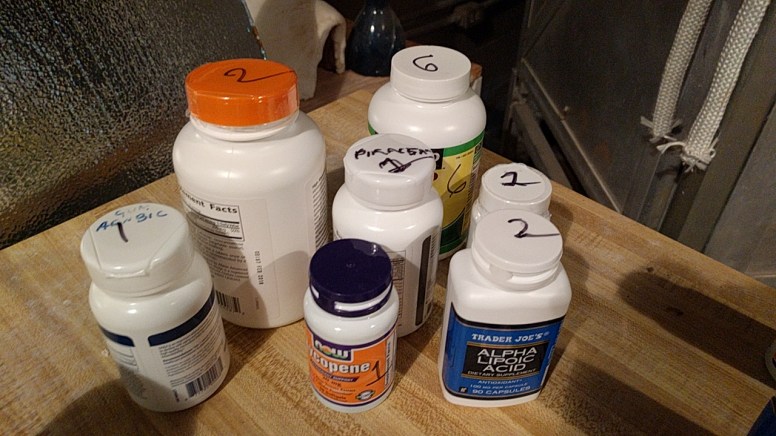
One approach that I have done with people that are irregular in taking supplements is to prepare 7 zip-lock bags labelled (Monday, Tuesday, … Sunday). Sorting and selecting pills only need to be done once a week.

Combining these bags with a marker pen that writes the number of capsules from each bottle (as shown below), eliminates the decisions to be made. For many supplements (except anti-infection ones), keep taking the number specified until the bottle is empty.  Many CFSer end up with 1/2 or 3/4 filled bottle of supplements that they stop taking (which does not help a tight budget!).  When the bottle is done, consider a different one OR refill OR BOTH!

IMG_20160223_193646

Fear

Fear is a harder item to deal with.  One resolution of not having a cure from the MDs is to simply wait until a cure is found.  Will a specific treatment make me worst?  An adverse reaction associated to something reported on a forum can result in significant fear about taking something — even when studies have found strong positive effects.

For me, when I was in relapse with CFS, I kept to items with demonstrated positive effects according to PubMed, if some one (even a MD) suggestions something contrary I asked for a pubmed article supporting their belief. If they cannot provide one, then I ignore them — End of influence.  Information from forums, while emotionally nice and supportive, are often coming from people with cognitive impairment, poor memory etc etc etc. The information actually comes with significant costs to a CFS patient — a lot of noise that can be very difficult to sort thru.

Where do you go from here?

Three vitamins should decrease depression significantly as well as improve symptoms. If you have been eating yogurt or probiotics high in L. acidophilus, you may wish to stop.

You want to simplify pill taking — do 7 days of pills and do it by only figuring out the dosages ONCE instead of every day.


Temperature and CFS

Temperature in CFS is often reported as low, or very very low. This tends to be ignored by most medical professionals — they have been trained to deal with high temperatures (fever) and not low temperatures.

  • “Adolescent patients with chronic fatigue syndrome have abnormal catecholaminergic-dependent thermoregulatory responses both at rest and during local skin cooling” [2007]

This is sometimes called Wilson’s Temperature Syndrome (reading Wikipedia is recommended, his model is suspect). A study on 7 CFS patients in 1998, found that the temperature was normal during the study (37C or 98.6F ) but with CFS patients having almost twice the variation of controls. This increased variability was reported again in 2001. A 1996 study found  “the CFS patients showed no significant correlation between the timing of the temperature acrophase and the melatonin onset (P < 0.5), whereas the normal significant correlation was observed in the controls (P < 0.05).”

Another blogger (Dr. Hansa) has written about temperature in CFS, so I will not repeat their material here. Cites like WebMD does cite low body temperature ((below 97.6F or 36.5C) as a common symptom which occurs in some patients. Also it is in Dr. Berne’s Symptom Checklist on Phoenix Rising.  It appears to apply only to a subset of CFS patients.

One Model

First, let us understand how body temperature works:

Chronic stress is known to affect serotonin (5HT) neurotransmission in the brain and to alter body temperature. The body temperature is controlled in part, by the medial preoptic area (mPOA) of the hypothalamus.” [2015]

Looking at hypothalamus and “chronic fatigue syndrome”, we find over 150 articles on PubMed. On serotonin “chronic fatigue syndrome” , we find over 100 articles. Both aspects have abnormalities with CFS.

No effect found The effect of ondansetron, a 5-HT3 receptor antagonist, in chronic fatigue syndrome: a randomized controlled trial.[2010] For a more detail [technical] description see this 2011 article.

Interesting, there are sexual differences with 5HT which may be connected with the difference of incidence of CFS between males and females. [2015]

My Experience

I am one of those patients whose temperature decrease with increased severity of symptoms. A temperature of 95.5 F (35.3C) was not unusual. As I recovered, the temperature slowly increased. The key is to make sure that you record the temperature at the same time and in the same circumstance each day. There is daily variation in temperature as the day goes on.

The bacterial translocation as a factor does bring us back to gut bacteria dysfunction. The low temperature is a symptom that can be used to monitor you state.


Review of recent news on Chronic Fatigue Syndrome

I have a news feed on items dealing with CFS.  Below are interesting notes from scanning the feed:

Brain

  • “We did not note increased all-cause mortality in people with chronic fatigue syndrome, but our findings show a substantial increase in mortality from suicide.” [2016]
  • “The spontaneous brain electrical activities in CFS patients were significantly reduced. The abnormal changes in the cerebral functions were localized at the right frontal and left occipital regions in CFS patients.” [2016] Prior SPECT studies found hypoperfusion (low oxygen) in the brain which may be the cause.
  • ” differences between FMS patients and controls in the insula, amygdala, anterior/mid cingulate cortex, superior temporal gyrus, the primary and secondary somatosensory cortex, and lingual gyrus.” [2016]
  • ” Our results demonstrate altered functional connectivity of several regions associated with cognitive, affective, memory, and higher cognitive function in ME/CFS patients. Connectivity to memory related brain areas (para-hippocampal gyrus) was correlated with clinical fatigue ratings, providing supporting evidence that brain network abnormalities may contribute to ME/CFS pathogenesis.” [2015]

DNA

Supplements And Treatment

  • ” Results from this study indicated that supplemental guanidinoacetic acid can positively affect creatine metabolism and work capacity in women with CFS, yet GAA had no effect on main clinical outcomes, such as general fatigue and musculoskeletal soreness.” [2016]  – in other words, better labs, no symptom change.
  • “Changes in patients who showed a clinically significant change in faecal Streptococcus after treatment[erythromycin 400 mg b.d. for 6 days] (responders; defined as post-therapy distribution<6%) were compared to participants who did not respond to treatment. In the seven responders, there was a significant increase in actigraphic total sleep time (p=0.028) from baseline to follow up, compared with non-responders…Improved vigour scores were associated with a lower Streptococcus count …  poorer mood was associated with higher Lactobacillus …. Short term antibiotic treatment appears to be insufficient to effect sustainable changes in the gut ecosystem in most CFS participants.” [2015]

Symptoms

Helminth theraphy for CFS?

A reader asked my opinion on helminth theraphy for CFS? “Helminths , also commonly known as parasitic worms, are large multicellular organisms, which when mature can generally be seen with the naked eye. They are often referred to as intestinal worms …” Wikipedia. The question came from reading this article in the Guardian.

Since the goal of this blog is to get rid of a stable dysfunction microbiome — the use of intestinal worms has a conceptual logic. So, what evidence is there to support it use, either direct or indirect?

Human Studies

Impact on Microbiome

  • “a significant increase in the abosamal pH was observed in infected goats…, the infection altered the abundance of approximately 19% of the 432 species-level operational taxonomic units (OTU) detected per sample. ….A total of 30 taxa displayed a significantly different abundance between control and infected goats.”[2016]
  • ” The results suggest that in clinically heathy dogs and cats, helminths and protozoa are associated with different microbiomes and possibly variable gut microbiota functions.” [2015]
  • microbiota compositional shifts during helminth infection contribute to the multifaceted ways that helminths modulate host immunity.”  [2015]
  • “Recent studies reported that the presence of helminth infection alters the composition of the bacterial intestinal microbiota and, conversely, that the presence and composition of the bacterial microbiota affect helminth colonization and persistence within mammalian hosts.” [2015]
  • Suppression of inflammation by helminths: a role for the gut microbiota? [2015]

Bottom Line

The approach appears viable and with the right species [2014], there is a hint that it will normalize an unhealthy microbiome. I suspect that it is not a “single treatment magic silver bullet”, it should be part of a systematic plan to correct and maintain a healthy microbiome.