Background on how suggestions are made

Creating suggestions on http://microbiomeprescription.com/ is an art and not a science. I recently added choice of algorithms:
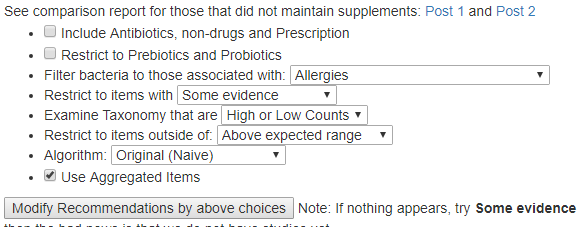
algor

To illustrate, you have 4 bacteria:

  • A 2x normal
  • B 8x normal
  • C 1/2 normal
  • D 1/100 of normal

If A is normally  0.1% of bacteria and B is 10% of bacteria – do you treat them the same? B produces 100x more metabolites than A… so likely it is better to reduce B than reduce A.

Some herb reduces B (10% of population) and also reduces D which is 0.001% of the normal population and only 10% of patients have any of this bacteria. Do you take the herb or not?

The process of balancing factors such as:

  • Percentage of total bacteria
  • How often do people have this bacteria
  • Side-effects on other bacteria
  • How much shift we see

is what algorithms are about. If you restrict items to only what reduces your high bacteria OR encourages your low bacteria… you will have nothing in the suggestions.

A simple algorithm could be something like this for each substance

  • Sum up all of the high bacteria it reduces and the low bacteria it increases and use this to rank suggestions.
    • Problem: you are ignoring the low bacteria that may also be reduced and the high bacteria that may be further increased!
  • Sum up all of the high bacteria it reduces and the low bacteria it increases. Then subtract the high bacteria that it increases and the low ones that are reduced. Use this to rank suggestions.
    • Problem: A bacteria that is 10% of the bacteria is given equal weight to one that is just 0.00001% of the bacteria.
  • Sum up all of the high bacteria  it reduces and the low bacteria it increases using the expected percentage of the population. Then subtract the high bacteria that it increases and the low ones that are reduced using the expected percentage of the population. Use this to rank suggestions.
    • Problem: We are ignoring if the overgrowth is 10% or 800%!

Then we hit the question of — do we know anything abiut what this bacteria does? If this bacteria is not associated with any known condition and only occurs in 10% of the population…

Take: Propionibacteriaceae (14.35% of Samples) family a recent paper explains why — only 14% have it… so do we need to reduce or increase it??? Honestly, we do not know and I would exclude it from adjustments.

“For example, for SNP rs2297345 in the gene PAK7, we detected a correlation between genotype and a single microbial taxon, Propionibacteriaceae”
https://www.ncbi.nlm.nih.gov/pmc/articles/PMC5740987/

Formal Statement

  • S() returns a vector of factors
    • Output vector including, but not limited to
      • Taxonomy
      • Estimate of change for each taxonomy
      • Reliability of change for each taxonomy
      • DNA Snp factors
    • Input matrix including, but not limited to
      • Study
      • Study size
      • Study statistical significance
      • Shift reported by the study
      • Species involved
      • Background diet
      • Existing conditions or DNA
  • B() is a person matrix including, but not limited to
    • Taxonomy
    • Population size
    • Statistical error factors
  • R() is a reference matrix including, but not limited to
    • Taxonomy
    • Population size
    • Statistical error factors
    • Distributions broken down by:
      • Medical conditions
      • DNA
      • Age
      • Lab results
  • H() is a matrix of a person (the target), including, but not limited to
    • Medical conditions
    • Laboratory results
    • DNA
      • Ethnic background/heritage
    • Age
    • Normal Diet

Predictions are the output vector from   P(H(…),B(…), S(….), R(….))

The algorithms that I have implemented are Trade Secrets, do not ask me to disclose them.

Bottom Line

Suggestions come out of algorithms that attempts to balance a ton of different factors. The sequence of suggestions will likely change between algorithms and it is unlikely something would move between the take and avoid list.

There are two algorithms there at the moment, I will likely add more. Which one is best? We do not know.
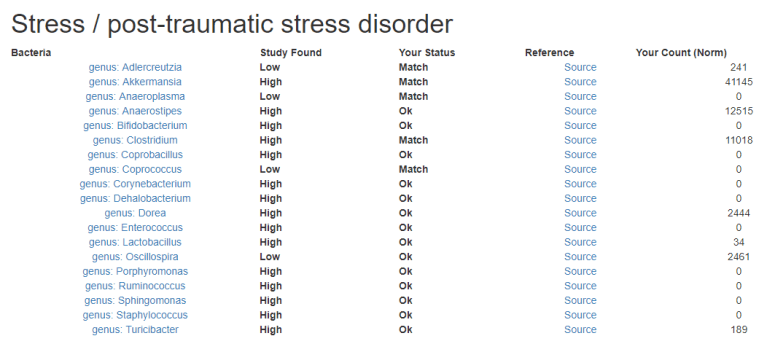
Stress / PTSD Microbiome Profile Added.

There was a recent article, Altered fecal microbiota composition in all male aggressor-exposed rodent model … which reports shifts seen from stress. I have converted the information reported to a new profile.

There were a few surprises — for example high Akkermansia which I would expect to be low. In reflection, stress is the start of the cascade — putting things in motions.

stress

This is an education post to facilitate discussing this approach with your medical professionals. It is not medical advice for the treatment of any medical condition. Always consult with your medical professional before doing any  changes of diet, supplements or activity. Some items cites may interfere with prescription medicines.


Online Statistics on Symptoms, Metabolism and Bacteria

I have created a sharable collaborative workbook using data uploaded to http://microbiomeprescription.com/ . 

The data is ready for processing using Python/Panda, R or other packages. The datasets are available at

The shared workbook is at:

Quick walkthru

When you open the link, you will see:

stats1

Click the [###] to execute the code and put into a cloud based virtual machine the data.

The next section shows some basic number. Again click the [###] to execute it.

stats2

The next section lists all of the columns in the dataset. There are many!

stats3

The next section shows how to test or put some science behind what you think may be associated. I do not intend to try teaching statistics to the brain fogged, just make the data easy to access for significant others and researchers.

stats4

Bottom Line

The data is now available to explore online using virtual machines and shared work books.

The data files will be updated once a week.


Candida and Probiotics

A reader wrote:

“Ken, I need to repopulate my microbiome. I have been treating candida overgrowth on my own and it is working but I think I need to take more or different probiotics. I have used a number over time in and effort to get a variety into my system but I can’t get rid of the candida to the point of normalcy. 

I can’t eat the anti candida diet due to gastroparesis. Is there a specific product or strain and what find of Dr might deal with this. None of the drs I see think it is a real thing. The 100lbs I have lost with the only change being natural anti fungals says otherwise. Thank you.”

There are actually two questions:

  • Controlling candida
  • Restoring a microbiome.

So today, I will review what we know from studies on PubMed on the first one. For the second, I suggest getting a ubiome done and then reviewing the suggestions (which will likely include probiotic suggestions).

Studies

Bottom Line

Three specific genus of Lactobacillus seem to be demonstrated to be effective.

  • Lactobacillus paracasei [high potenancy, lowest $ per CFU: CustomProbiotics]
  • Lactobacillus rhamnosus [high potenancy, lowest $ per CFU: CustomProbiotics]
  • Lactobacillus fermentum [See this post  for sources]

Remember, we are likely talking therapeutic dosages.

This is an education post to facilitate discussing this approach with your medical professionals. It is not medical advice for the treatment of any medical condition. Always consult with your medical professional before doing any  changes of diet, supplements or activity. Some items cites may interfere with prescription medicines.


Doing a medication review against ubiome results

After my last post, a brain fogged reader asked about items she has available. She has ubiome results from 2018-02-12 for reference.

AGAIN: This is all theoretical using the best information available. The quality of the information could be objective to.

Process is simple: Go to http://microbiomeprescription.com/Library/GutModifiers

then search for each drug. After getting the full list, add &seq=###### to the address to get it refined for a specific ubiome result. In some cases, you may find two entries (due to how data was entered), so do both.

lal1

lal2

lal3

ciprofloxacin  – no impact (good or bad)

lal4

lal7

lal5

lal6

lal8

Oat Meal

lal9

No information found for:

  1. Lorazepam

Bottom Line

This person has a MD that wishes to helpful (hence the wide range of antibiotics available to her) but does not know what to suggest.

The above analysis suggests that the following be reviewed and discussed with her MD

  • Continued eating oatmeal
  • Take Metronidazole (only one group with caution – more good than harm)
  • Stop bacillus coagulans probiotics
  • Azithromycin seems reasonable to include.
    Note: Protobacteria is increased in one study and decreased in a different study

This is an illustration of how the site can be used to review what you are taking against your microbiome.  In a few cases, things are complete cleared (everything lines up), but in most cases we have to weight the plus and minuses.

As always — review it with your medical professional. Many will see that the logic above many be better than picking random suggestions off the internet.

This is an education post to facilitate discussing this approach with your medical professionals. It is not medical advice for the treatment of any medical condition. Always consult with your medical professional before doing any  changes of diet, supplements or activity. Some items cites may interfere with prescription medicines.
