A reader ask about anxiety and panic attacks. I was delighted to find a lot of interesting material published this year, 2019.
Pro-inflammatory members of Clostridiales such as Lachnospiraceae and Ruminococcaceae have also been associated with social avoidance behaviors in mice … In particular, strains of Lactobacillusand Bifidobacterium are found to exert a profound anxiolytic influence through the production of γ-aminobutryic acid (GABA), 5-HT, and SCFAs, and by dampening HPA adrenergic reaction [26,34,38,41,42]. Moreover, the regression of anxiety after treatment in these studies was often associated with positive neurological changes such as increased BDNF, altered expression of PFC and hippocampal GABAA and GABAB receptors, increased circulating glutathione, and a reduction in inflammatory markers. … Through the gut microbiota, it is apparent that GABA and 5-HT are produced by specific bacterial strains [42], and that supplementation with these bacteria correspondingly attenuates presentation of anxious behaviors in animal models.
“Of 91 intestinally derived bacteria assessed, one Lactobacillus strain and four strains of Bifidobacterium produced GABA. Lactobacillus brevis DPC6108 was the most efficient of the strains tested, converting up to 90% [corrected] of MSG to GABA.” [2014]
“Further biological testing and purification led to the isolation of GABA as the growth factor produced by Bacteroides fragilis. GABA” [2019]
We conclude that the anxiolytic and antidepressant effects of B. adolescentis are related to reducing inflammatory cytokines and rebalancing the gut microbiota. [2019]
“The anxiolytic-like effect of Bifidobacterium adolescentis IM38 was comparable to that of buspirone (1 mg/kg). Moreover, this anxiolytic-like effect was blocked by treatment with flumazenil (3 mg/kg, i.p.), ” [2018]
“The probiotics ( Lactobacillus acidophilus ATCC 4356, Bifidobacterium lactis DSM 10140, Lactobacillus fermentum ATCC 9338) were obtained from Zist Takhmir Company, Tehran, I R Iran. Different studies have shown that this composition of the probiotics alleviate anxiety-like behaviors, improve spatial memory and decrease corticosterone and adrenocorticotropine hormone (37–39).” [2019]
” We find that more than half of the studies included showed it was positive to treat anxiety symptoms by regulation of intestinal microbiota. There are two kinds of interventions (probiotic and non-probiotic interventions) to regulate intestinal microbiota, and it should be highlighted that the non-probiotic interventions were more effective than the probiotic interventions. ” [2019]
” Probiotics were observed to improve panic anxiety, neurophysiological anxiety, negative affect, worry, and increase negative mood regulation. Furthermore, post hoc analyses revealed that the CFU (colony-forming unit) level was more effective than species counts in accounting for the number of significant improvements ” [2019]
” This study reveals that these commonly used food additives ( Dietary emulsifiers carboxylmethylcellulose (CMC) and polysorbate 80 (P80) ) may potentially negatively impact anxiety-related and social behaviors and may do so via different mechanisms in males and females. ” [2019]
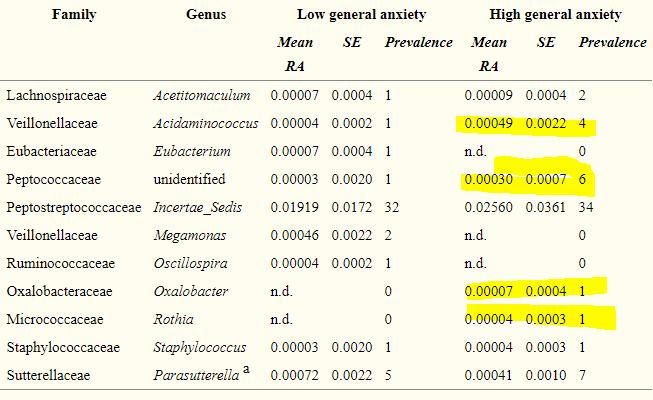
Association between Psychosocial Stress and Fecal Microbiota in Pregnant Women. [2019] Yellow indicate high levels with anxiety, n.d. in right indicates absence with high anxiety
Bottom Line
Low Veillonellaceace family shows up again, it seems to be haunting my recent posts. This time it is the Megamonas genus which is only seen in 10% of samples uploaded. Remember that the above is using averages, thus a n.d. means that no one with high anxiety had any!
My main take away is that MOST lactobacillus and bifidobacteria will have no effect. The probiotics targeting mood are the best option.
The next take away is simple: the higher the CFU, the better. I would be inclined to target 100 BCFU if I had to deal with it.
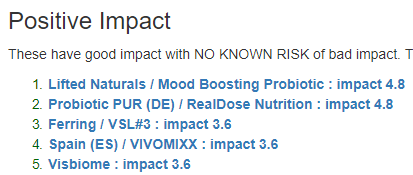
I also went to my site page that allows Genus changes to be directly entered. To my amusement, #1 was Lifted Naturals! The Jarrow’s was only 1.2 with a lot of others with the same rating.
Why amused? We put in the above genus shifts associated with high anxiety and the AI system determined that the best out of 137 probiotics in the database was one that was branded for Mood (whose bacteria were found in independent studies to help moods). It suggests that the AI system is doing a very respectable job of coming up with suggestions!
A reader messaged me the following summary(in full). This interests me and as a result, this is a long post as I explore her before and after microbiomes.
Case History: 4hr Biochemically Mediated Spontaneous Remission of Environmental Sensitivity CFS Symptoms
I experienced a total remission of the brain fog/environmental sensitivity and sensory sensations that accompanies severe CFS for ~4 hours on April 23rd, 2019 and then slowly slipped back in.
It was a biochemical/microbiome spontaneous remission which occurred following treatment with probiotics (VSL#3) and BCAAs as part of a liquid meal drink (ghee, MCT oil) (thus affecting gut signaling of tryptophan) after I used antibiotics (Amoxicillin And Clavulanate) to treat an infected dental abscess.
It was unintentional as I was just trying to repopulate my microbiome after 3 day antibiotic use and was trying to get high quality nutrients in liquid form as the wound in my mouth made it difficult to eat. The ‘fog’ lifted within about 10 minutes. It was shocking and scary and wonderful. I realised just how sick i was/am and this was a massive shock. I could feel the world again, wanted to feel the world again, and at the same time was overwhelmed with just how different i felt from my usual sick state. It felt like a miracle – and it was, a biochemically triggered miracle.
I was in this state for about 2 hours and then slowly started slipping back into the fog and illness. I took more VSL#3 and a tryp-lowering drink (mix of honey or agave, coconut milk, mct oil or ghee, vegan protein powder, and turmeric or matcha) but i continued to sink back into the CFS state.
The next day i took the same mix of substances but no phase shift occurred. I knew what happened was amazing but also dangerous and that i should try and re-stabilize to baseline. Ironically, I had watched Robert Phair’s talk that morning on springing the metabolic trap through the tryptophan-kynurenine pathway.
I have been following Ron Davis’ group/Robert Phair/Robert Naviaux the Open Medicine Foundation’s research and understood the basics of the metabolic trap hypothesis but was not trying to ‘spring the trap’, i knew that this could actually very dangerous and got scared and contacted Dr Phair-he confirmed the likely timescale of the event and was not worried about trying to re-create it.
This experience provided a case history w/ clinical evidence for the role of the tryp-kyn pathway in springing the metabolic trap. It is hard to assess the severity of one’s own CFS but i would guess that i am in the bottom 25% in terms of severity but am only 95% bedridden (I get out for specialist MD appts but that is about it). So not the worst of the severe cfs patients but maybe on the cusp. I am obviously excited about this event and think it will be of interest to cfs researchers but am also quite scared that i could accidentally make myself worse.
I am very much hoping that my case could be of interest and use to cfs research and others. I have had my genome sequenced (WGS thru Veritas – I have ID02 mutations) and extensive biochemical workups have shown high 5-HIAA and serotonin as well as high levels of VLCFAs suggestive of mitochondrial and peroxisomal dysfunction.
I believe the CFS component was triggered initially in 2002 after getting dengue fever. in 2008 and 2013 traumatic life events occurred which led to steadily progressive fatigue and pain. By 2016 i was on 100% disability leave and i was dx’d with hEDS in 2017. I have tried to spring the trap since without success.
I had a ubiome sample pack the day the remission occured and took a stool sample the next morning.
This is the model/hypothesis that the reader is attempting to apply to CFS/ME. There is a good overview article (2017).
The microbiome model fits around this model (and other models), because the amount of tryptophan, etc, is recognized to be influenced by the microbiome. This is well stated in the 2018 article below (and others)
The gut microbiota is a crucial actor in human physiology. Many of these effects are mediated by metabolites that are either produced by the microbes or derived from the transformation of environmental or host molecules. Among the array of metabolites at the interface between these microorganisms and the host is the essential aromatic amino acid tryptophan (Trp). In the gut, the three major Trp metabolism pathways leading to serotonin (5-hydroxytryptamine), kynurenine (Kyn), and indole derivatives are under the direct or indirect control of the microbiota. In this review, we gather the most recent advances concerning the central role of Trp metabolism in microbiota-host crosstalk in health and disease. Deciphering the complex equilibrium between these pathways will facilitate a better understanding of the pathogenesis of human diseases and open therapeutic opportunities.
My take is to keep the view simpler, instead of trying to determine the complex equilibrium — just identify which bacteria combinations are causing the equilibrium to be off. How do we do this? By identifying combinations strongly statistically associated with symptoms! (see this post) Once the bacteria are identified, then proceed to alter their population with modifiers (supplements, diets, prescription drugs, probiotics, flavonoids, etc). With this view, we can take action today. The alternative is to wait until they have deciphered it, then wait again while they attempt to determine and test strategies to adjust the equilibrium…. actions may be years, it not decades off.
Initial Overview
There were no lab measurements of items in the Tryp-Kyn pathway before and at this remission. So using that model would be speculation. There are microbiome measurements and thus we have some concrete lab results to look for an explanation of this short term remission. Hopefully, we will also get microbiome results after the relapse to see more of the pattern. Going to the sample pages and then clicking compare samples takes us to a bunch of useful pages.
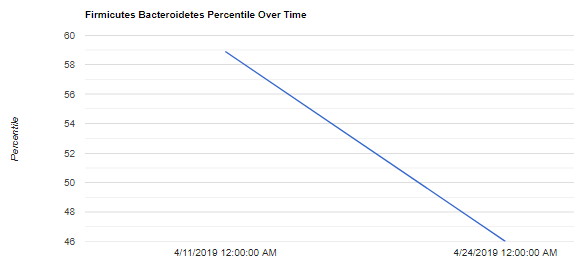
At a high level we see a significant change of Firmicutes to Bacteroidetes ratio
What else has changed at a high level? Walking thru the Class level we see the following major changes:
Alphaproteobacteria went from down to 1/36 (from high to very low percentile)
Epsilonproteobacteria went up 30x (from median to high percentile)
Gammaproteobacteria went from nothing to very high percentile
Opitutae went from high percentile to none
Tissierellia went up 30x (from high to very high)
Verrucomicrobiae moved from none to the median levels
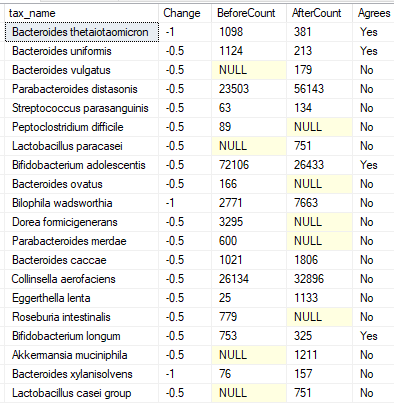
There was a lot of changes at each of the different taxonomy ranks. Not unexpected as a result of Amoxicillin And Clavulanate (these are linked to details of what they changed). A lot of changes makes interpretation complex.
Manual Data Analysis
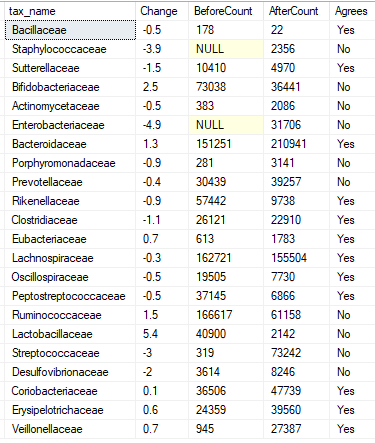
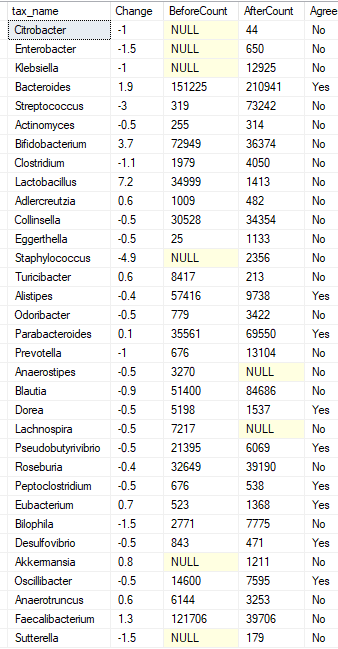
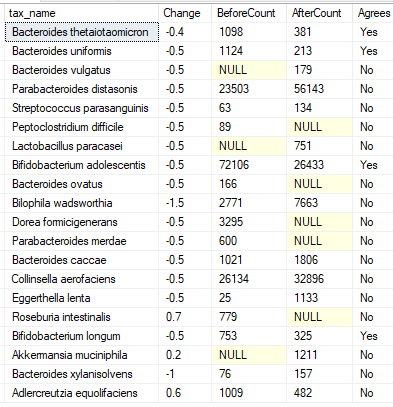
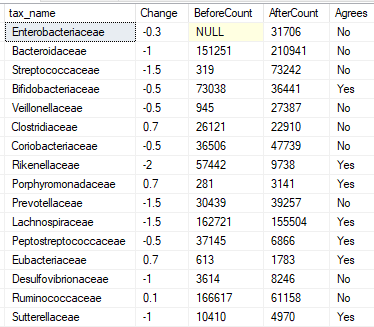
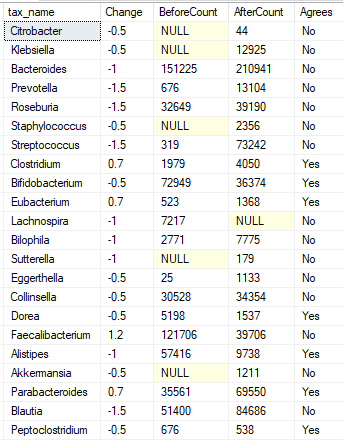
Since the antibiotic impact data is at species, genus and family only, I decided is to see how the predicted shifts (from pub med studies) match up with actual shifts in two ways:
Most of the data on the impact on bacteria by antibiotics came from one study. This study has a known weakness of excluding interplay between bacteria. A second factor to consider is that there can be a time delay for shifts to appear. With my own flare, I saw some immediate drops, other bacteria did a slow decline and still others did not start to decline until 2-3 weeks later. Bacteria behavior and population will change only when the circulating level of metabolites changes. It is a long supply chain. Applying tariffs on lumber leaving on ships to India does not immediately cause the price of lumber in India to jump. As ships arrive and existing supplies are consumed, we will see the price increase.
The remission microbiome sample was done on day 5 after starting antibiotics, and 2 days after stopping. We need to check the half life for these antibiotics to see if they are still active. We find that they should be almost zero left when the remission started..
IMPORTANT NOTE: The antibiotics may have started a cascade (destabilizing the microbiome) – from observations on my own microbiome, these can continue on for weeks until a new stable state is realized. Think of supply chains!
Amoxicillin,Clavulanate and VSL#3
Reminder: the numbers are created by summing up the number of studies reporting increases and decreases. They do not represent the magnitude of the changes (which is rarely given). A number like 0.1 suggests that one of the above increase it in some studies, another one may decreases it (or a different study reported different results). Yes, it s@cks, but that is the state of the medical literature. We do the best with what we have.
Family Rank
54% accurate prediction of shifts
Genus Rank
27% accurate prediction of shifts
Species Rank
20% Correct Predictions
Amoxicillin,Clavulanate
Family
44% Accurate
Genus
32% Accurate
Species
16% Accurate
Review of the Above
One item that stood out for me was the increase of Veillonellaceae family, this is the family that is very high in world class athletes (see this post). It increased by 27x times (and moved into the top 75%ile). This bacteria consumes lactate [ The technical difference between lactate and lactic acid is chemical. Lactate is lactic acid, missing one proton]. Lactic acidosis is often reported for ME/CFS and that is strongly associated with brain fog).”This bacteria turn lactate into propionate, a short-chain fatty acid that’s a source of energy and can also be an anti-inflammatory ”
This change alone could account for the temporal relapse. A subsequent microbiome is in the works — if Veillonellaceae has dropped down to prior levels — we have a viable model for why the remission happen. The logical thing would be shift to a Veillonella friendly diet and supplements. Note that the VSL#3 inclusion shifted the predicted impact from negative to positive.
Keeping with the probiotic approach, we find the following reported to increase Veillonella (other probiotics decreases it):
There is an interpretation challenge because of the short duration of the remission. It is unclear if we are actually measuring the remission microbiome or post-remission microbiome.
De-Lactic Acidosis happening?
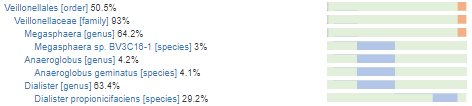
The Veillonellales shift interests me. We do not see any actual Veillona genus, but do see other members. The Dialister propionicifaciens interests me because the name implies it produces very significant propionate (likely from lactic acid as does its cousin, Veillona). I was unable to find more definitive information about it.
BeforeIn Remission
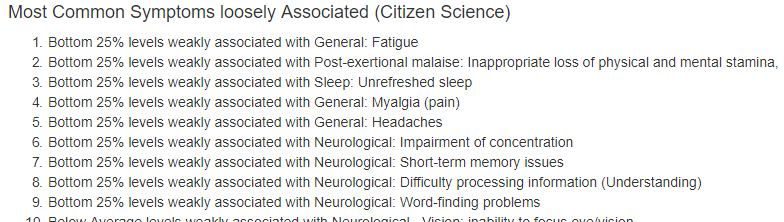
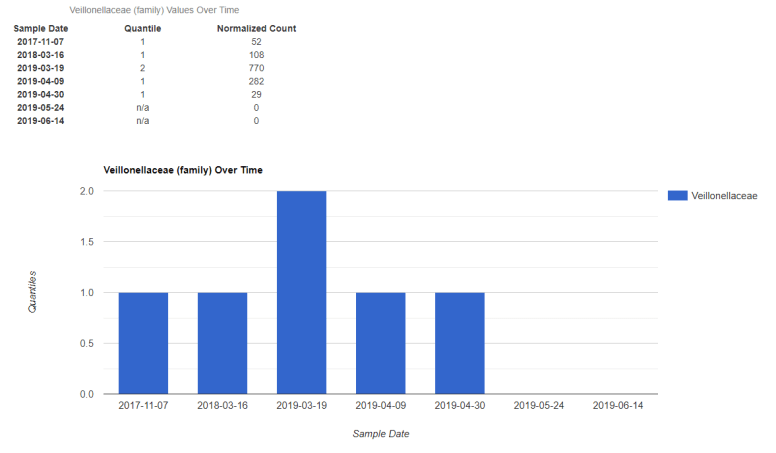
Checking out this family, we see that many CFS associated symptoms occur with the lowest levels. When we had our short remission — the numbers were at the top.
Running with the Veillonella vector
I am almost totally recovered from a flare — except for one very frustrating issue: I have 10-20 minute of physical activity limits (walking ~ 4 blocks, driving ~ 20 min). No brain fog. No apparent GI issues etc. This was not there at the start of the flare and really became pronounced around May 14th. I decided to pull up my own history and behold! My levels hit zero and stayed at zero at that point. Low levels have also been reported in a 2018 PubMed study.
Bottom Line
I spent a day trying to tease other information out. There are some wild swings, From bottom outlier to top outliers!) for items like Streptococcus I reach the point that I was trying to force the analysis too much.
This post demonstrate that antibiotics can really shake up the gut. As shown above, some bacteria taxonomy may vanish and other may appear.
My impression is that in the chaos caused by the antibioitics, VSL#3 supported one faction in the massive chaos of bacteria sufficiently for a short lived ‘functional government’ to come into existence before the neighboring chaos overwhelmed it.
The key thing is to remember that the microbiome function as a supply chain. A long supply chain. Impacting one species alters the environment which then respond, causing more changes that may take weeks to stabilize.
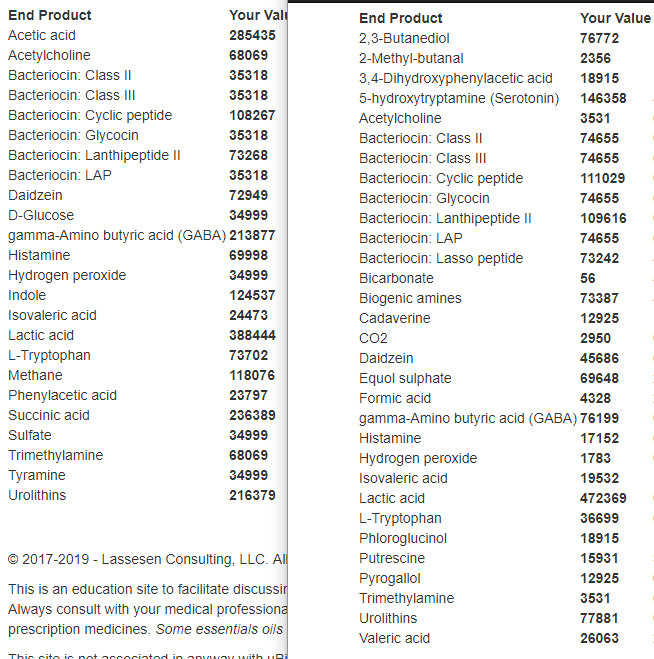
This appears to be confirmed by the dramatic change in different end products (experimental page) seen between the two samples:
Left side is before, right side is in the brief remission
I speculate that this short remission happened because lactic-acid production dropped (granting relief to lactic acidosis) with a sudden increase in lactic acid consumers that produce propionate giving energy.
This study suggests a probable link between intestinal colonization of Gram positive facultative anaerobic D-lactic acid bacteria and symptom expressions in a subgroup of patients with CFS. Given the fact that this might explain not only neurocognitive dysfunction in CFS patients but also mitochondrial dysfunction, these findings may have important clinical implications.
Do an email subscription — see top right of this page.
Why not do the sample anyway?
The microbiome is always changing and evolving. The shorter the time from the sample to the report to the changing supplements and diet, the better it is. By better, I mean a more accurate set of suggestions for your current microbiome.
But I need results NOW!
Then there are several alternatives that my site supports:
I have also emailed XenoGene, in Spain, about getting their report downloadable as JSON. No response yet.
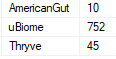
If you go with other companies — ask for an example of their download as JSON or CSV before ordering the test. Then send it to me and I will see how easy it is to make uploadable. American/British Gut was a bit of a pain. Below is how many uploads from each at present:
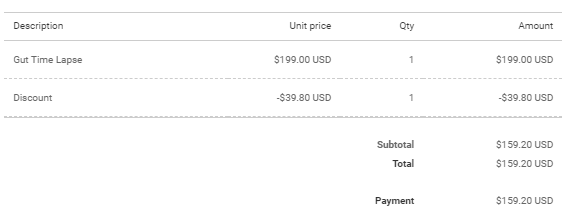
As a FYI on cost: I usually buy the uBiome Three pack, apply discount codes, and average around $53 per test. Much cheaper than the two above.
Bottom Line
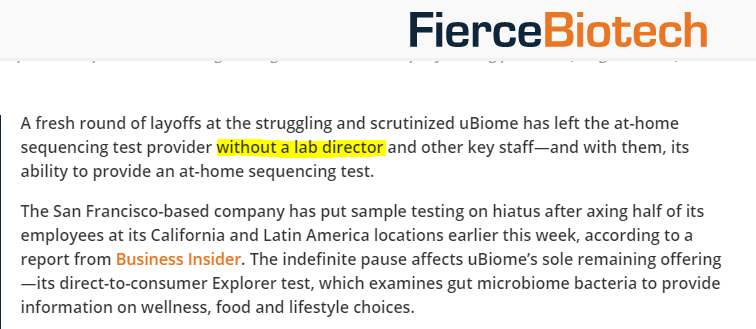
uBiome is in recovery mode. It was originally a citizen science startup that went commercial. Worst case scenario, some one will replace them.
I have been doing non-parametric analysis of relationships between bacteria and came up with statistically very significant relationships. Unfortunately (and as expected) not simple straight line ones always.
The result is that there are now two Why? pages available.
Why? – based on reported in the literature
Why? Citizen Science – generated by my analysis of relationships
On Your Select Sample Page
How do they compare?
I thought that doing a few charts each way may be informative
Conventional StudiesCitizen Science
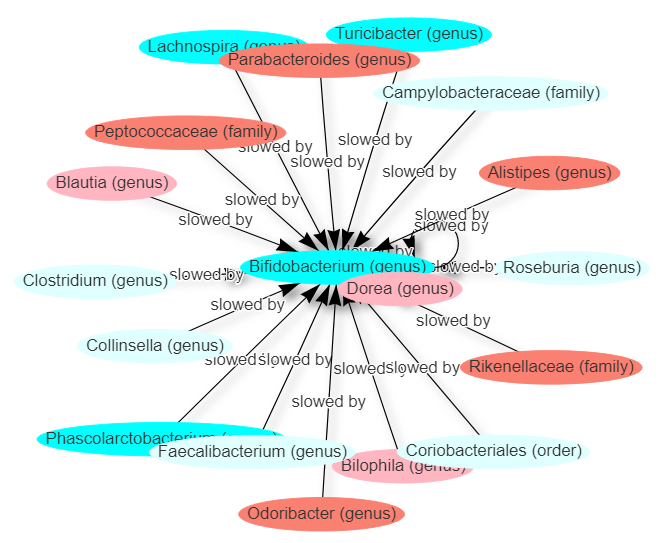
Bifidobacterium
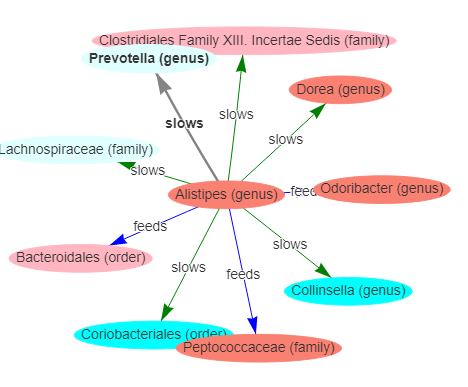
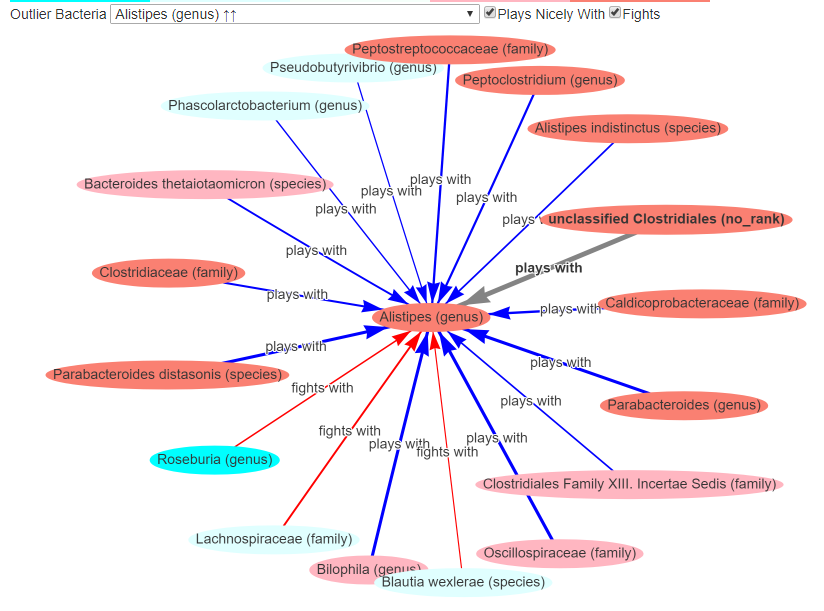
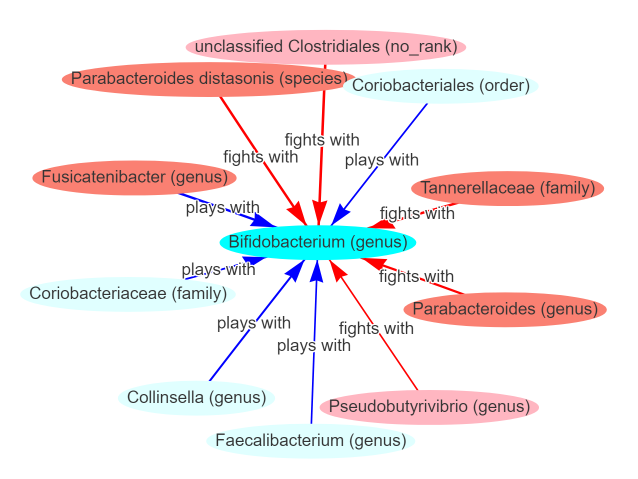
For this one, conventional science only reports what inhibits/fights with it. Citizen Science show bacteria that cooperate with it also. In some cases, we have opposite reports: Faecalibacterium slows Bifidobacteria in one case, and plays with it in the other case!
Conventional StudiesCitizen Science
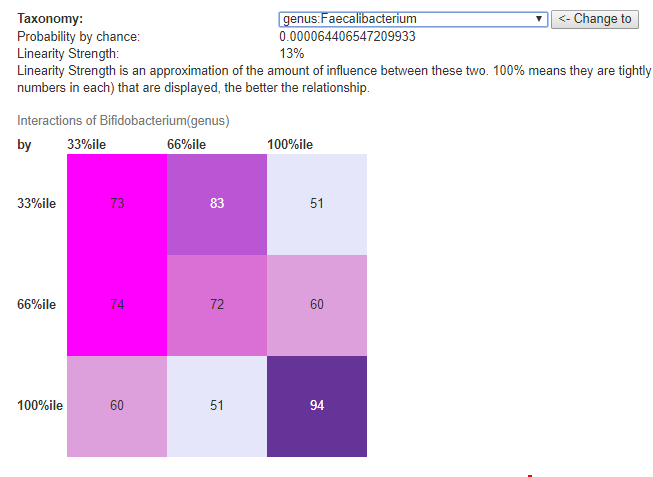
Going over to the new heatmap feature, we see a weak relationship, but the two tend to increase together and both are happiest when they are both high
Note the numbers in each column and each row add up to approximately the same value (205-207). If things were random, we would get almost the same number in each cell.
Bottom Line
I find the citizen science version cleaner. Convention studies can report A inhibits B with B having no impact on A (often because no study was done). With citizen science we deem it to always be two way… they increase/decrease together (plays well) or increases when the other decreases (fights with).
I will leave it up to readers to explore more on the site.
Below is a video with some more explanation of the process used with citizen science.
A reader emailed me with the report below and granted permission to share it.
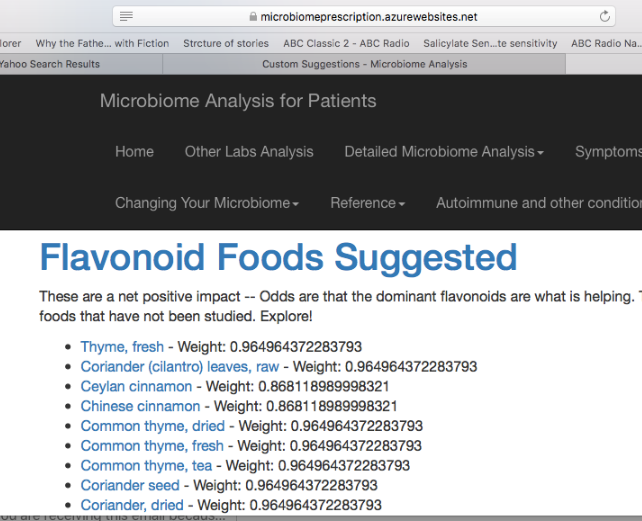
Dear Ken, I write to report our early success through your new site, tailor-made for followers who log on. My daughter (CFS 5-6 years, house-bound) rigorously follows the diet suggestions. Four weeks ago she began on the Jadin regime for a first cycle of two weeks of Doxycycline with miserable results, and straight after, giving up on probiotics because she reacts to all the fillers, went on her tailor-made Flavonoids suggestions (as in screenshot) and after a week of lashings of Thyme,(tea, raw and as a herb), began to “wake up”, staying awake most if not all of the day, chatty, sociable, clear-headed, able to more fully participate in ordinary life , and suddenly showing more physical strength than she’s had for years put together. We live on a muddy river, boat-access only, and coming home on a dark night, she, the only person in the appropriate place, strained out to reach our jetty and single-handedly pulled our 18 foot cabin cruiser across the mud to its berth! She had no punishing delayed exhaustion next day. Who would’ve predicted those tiny leaves could do so much good? (She also has lashings of D ribose to counter the bitterness of the Thyme). It’s not remission yet, but I want to thank you.
Emailed sent Tuesday Jul 9th, 2019
Image included in the email
Walk thru to the Flavonoid page
Before starting I should clarify that flavonoid do NOT mean chemicals related to flavor. The two words sound similar.
Flavonoids are a large family of polyphenolic plant compounds. Six major subclasses of flavonoids, namely anthocyanidins, flavan-3-ols, flavonols, flavanones, flavones, and isoflavones, flavonols are the most widespread in the human diet. Many of the biological effects of flavonoids appear to be related to their ability to modulate a number of cell-signaling cascades. Flavonoids have been shown to exhibit antiinflammatory, antithrombogenic, antidiabetic, anticancer, and neuroprotective activities through different mechanisms of action in vitro and in animal models.
The reason is simple: usability! Studies will often give the name of the flavonoid with no information on what food it occurs naturally in. I prefer natural food sources for supplements over prepared commercial supplements with all sorts of risky fillers. By adding a database of foods with associated flavonoids to the site, it means people can see the related food or spice . We know from studies that specific flavonoids has specific impacts. Often, there has been no studies on the food(s) containing that flavonoid — so we are inferring the benefit from eating foods with those flavonoids will have a similar effect on the gut.
So, instead of seeing a chemical name that you have no clue about, further down the page you will see the name of foods etc. containing those chemicals.
The Walk Thru
Bottom Line
These are person specific suggestions based on THIS individual’s personal microbiome (often 600 -1300 bacteria involved). The above suggestions may not work for you, or may do you harm. You need to have a ubiome or thryve (or American/British Gut) analysis available and uploaded to get the best suggestions.
There are other labs that can be used. They report a lot less information and thus not as specific to your needs. These include:







 CFS Remission