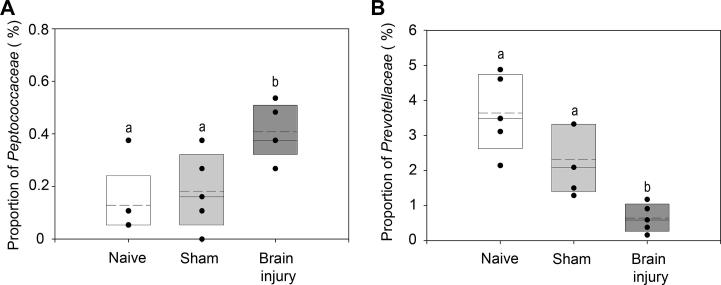
Brain Trauma’s Microbiome

On my commute today I had a conversation with an old colleague whose teenage daughter had a physical brain trauma(included cerebral ischemia) in January. As she described her symptoms, I recognized a lot of symptoms that are often seen with CFS. I also recall reading some articles about gut shifts seen with physical trauma.

Cognitive impairment is common with CFS and other autoimmune conditions.

Bottom Line

The number of bacteria taxonomy identified is lower than with other conditions but it is definitely work creating a profile on. An example with the demo ubiome result is shown below.
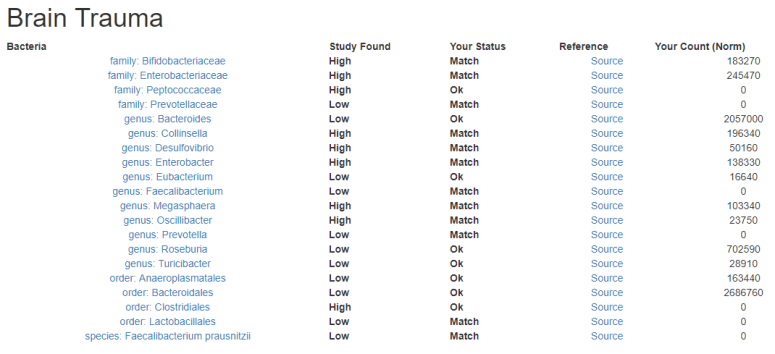
BT

Analysis Web Site:  http://microbiomeprescription.azurewebsites.net

This is an education post to facilitate discussing this approach with your medical professionals. It is not medical advice for the treatment of any medical condition. Always consult with your medical professional before doing any  changes of diet, supplements or activity. Some items cites may interfere with prescription medicines.
Hashimoto’s thyroiditis Microbiome Profile Added

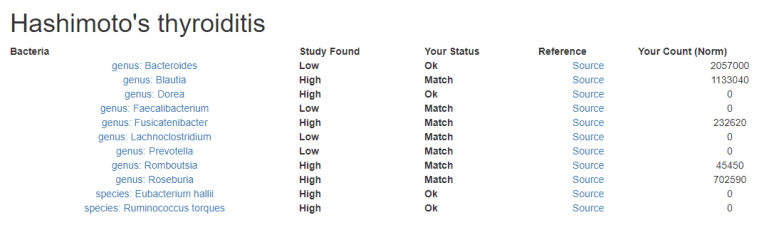
Today I got a comment from someone with Hashimoto’s thyroiditis, often co-morbid with CFS, IBS etc.  I thought that I would check to see if there had been any microbiome work done on this condition. I was delighted to see a February, 2018 article, “Alterations of the Gut Microbiota in Hashimoto’s Thyroiditis Patients.”  and converted it results into a profile that can be applied to uBiome results.

ht

This is added to the existing series shown below

  • ADHD – Attention-deficit syndrome
  • Alzheimer’s Disease
  • Autism
  • Autoimmune Disease
  • Chronic Fatigue Syndrome
  • Diabetes Type 2
  • Crohn’s Disease
  • Depression
  • Fibromyalgia
  • Gout (Arthritis)
  • Hashimoto’s thyroiditis
  • High Blood Pressure
  • Histamine Issues
  • Inflammatory Bowel Disease
  • Irritable Bowel Syndrome
  • Metabolic Syndrome
  • Mood Disorders
  • Rheumatoid arthritis
  • Schizophrenia
  • Systemic Lupus Erythematosus
  • Ulcerative colitis


Analysis Web Site:  http://microbiomeprescription.azurewebsites.net


Reader’s microbiome changes following suggestions.

A reader wrote gave me access to their latest uBiome

“I’ve been following your probiotics protocol. I’ve been taking L. Reuterii, a mix of bifidobacterium and symbioflor 2.

I get an improvement in my brain fog and cognition, my bowel movements have become much smaller and I’m over all way more constipated. Any theories on why this might be happening? I have been taking them for months, so it’s not an adjustment period. 
I’ve tried taking them on their own. Symbioflor on it’s own doesn’t do much for me. L. Reuterii on it’s own still gives me constipation, same with the bifidobacterium.” 
The older recommendations he followed was focused on reducing high bacteria only.

Comparing the Before and Now Samples

Overall, there have been a significant improvement is the all profiles with Gout being the sole item with significant increase.

All Profiles 125 104
Allergies 6 5
ADHD 6 7
Alzheimer’s disease 5 5
Autism 9 9
Autoimmune Disease 3 3
Chronic Fatigue Syndrome 10 10
Crohn’s Disease 9 4
Depression 8 8
Fibromyalgia 1 1
Gout 3 7
High Blood Pressure 3 2
Histamine Issues 0 0
Histamine Issues From Ubiome 4 4
Inflammatory Bowel Disease 10 4
Irritable Bowel Syndrome 6 4
Metabolic Syndrome 7 4
Mood Disorders 4 3
Rheumatoid arthritis 7 7
Schizophrenia 0 0
Systemic Lupus Erythematosus 11 9
Type 2 Diabetes 8 6
Ulcerative colitis 5 2

Bacteria Shifts

Apart from two phylum (small populations usually), things have improved. As I have mentioned before — recovery is not a straight line recovery. It is moving from one island to the next until you back to your original harbor.

(phylum)Actinobacteria 0 % 0 %
(phylum)Bacteroidetes -25 % 0 %
(phylum)Euryarchaeota -44 % 104979 %
(phylum)Fibrobacteres 0 % -99 %
(phylum)Firmicutes 7 % 0 %
(phylum)Lentisphaerae 0 % 3 %
(phylum)Proteobacteria 35 % 0 %
(phylum)Synergistetes 0 % -3 %
(phylum)Tenericutes 0 % 0 %
(phylum)Verrucomicrobia -35 % -33 %

Class

Moving down to the class level, we see better clarity. Remember the criteria was to focus on items > 150%.  All of them went down

(class)Actinobacteria 0 % 0 %
(class)Alphaproteobacteria -88 % -30 %
(class)Bacilli 0 % 0 %
(class)Bacteroidia -26 % 0 %
(class)Betaproteobacteria 202 % -65 %
(class)Clostridia 9 % 0 %
(class)Deltaproteobacteria 48 % 271 %
(class)Epsilonproteobacteria 0 % -98 %
(class)Erysipelotrichia 0 % 0 %
(class)Fibrobacteria 0 % -99 %
(class)Flavobacteriia 0 % 0 %
(class)Gammaproteobacteria -96 % -90 %
(class)Lentisphaeria 0 % 9 %
(class)Methanobacteria -43 % 104979 %
(class)Mollicutes 0 % 0 %
(class)Negativicutes 0 % 59 %
(class)Synergistia 0 % 35 %

Looking at High Family items we see that we succeed in reducing them.

(family)Clostridiaceae 180 % 96 %
(family)Oscillospiraceae 96 % 0 %
(family)Sutterellaceae 203 % -83 %

So where do we go next?

The latest result have good list of changes:

Item    Action    Confidence value
coconut products Take 8.372
antiseptics Take 5.107
resveratrol Take 4.764
gallic acid and tannins Take 4.242
inulin prebiotics Take 3.764
bacillus probiotics Take 3.606
raffinose foods Take 3.376
fodmap diet Take 3.276
fruit Take 3.162
lactobacillus kefiri probiotics Take 3.106
bile supplements Take 2.983
vitamin b3 niacin Take 2.517
gluten free diet Take 2.373
vitamin b7 biotin Take 1.815
cranberry juice, flour or raw Take 1.811
lactobacillus plantarum probiotics Take 1.684
flaxseed Take 1.631
enterococcus faecium probiotics Take 1.539
gynostemma pentaphyllum herb Take 1.497
whole grains Take 1.416
glutamine amino acid Take 1.293
chitosan supplements Take 1.078
garlic Take 1.042

As well as avoids

high fat diet Avoid -1.026
olive oil Avoid -1.163
bacillus subtilis probiotic Avoid -1.177
high fiber diet Avoid -1.177
black raspberries fruit Avoid -1.177
aspirin Avoid -1.236
dairy milk fats Avoid -1.301
saccharin sugar Avoid -1.434
low glycemic/sugar diet Avoid -1.508
bifidobacterium pseudocatenulatum probiotic Avoid -1.737
saccharomyces probiotics Avoid -1.748
mediterranean diet Avoid -1.811
nonsteroidal anti-inflammatory drug Avoid -2.013
iron supplements Avoid -2.301
barley Avoid -2.345
berberine supplement Avoid -2.365
walnuts nuts Avoid -2.719
beta-glucan foods Avoid -2.786
bisphenol a (bpa) plastic Avoid -2.944
ethinylestradiol prescription Avoid -2.944
no carbohydrate diet Avoid -4.604

It is interesting to note that bacillus probiotics is on the take list, but one specific one is on the avoid list: bacillus subtilis probiotic

Some concerns

Candidatus Saccharibacteria: 31x normal only (14.49% of Samples) phylum have this

Candidatus Saccharimonas 22x normal only (0.97% of Samples) genus

The only known item to reduce this are macrolides, for example azithromycin.

For the very high Methanobacteriaceae (35.75% of Samples) family, we see coconut (lauric acid and myristic acid) and bile are items that will decrease it


Bottom Line

It was nice to see objective improvement in the microbiome by following earlier suggestions. The suggestions were successful for reducing high bacteria (the specific goal sought).

The new analysis sight allows both high and low to be adjusted for. We will likely see in a few months what the latest recommendations caused to change.

REMEMBER: Adjust for one shift may induce other shifts.

This is an education post to facilitate discussing this approach with your medical professionals. It is not medical advice for the treatment of any medical condition. Always consult with your medical professional before doing any  changes of diet, supplements or activity. Some items cites may interfere with prescription medicines.

Microbiome shift linked to Autoimmune

I have extracted from studies the bacteria that have been associated with various autoimmune-related conditions as well as building pages to apply them to uBiome samples at: http://microbiomeprescription.azurewebsites.net .

  • Histamine Issues From Ubiome
  • Type 2 Diabetes
  • ADHD
  • Autoimmune Disease
  • Crohn’s Disease
  • Chronic Fatigue Syndrome
  • Inflammatory Bowel Diseas
  • Rheumatoid arthritis
  • Fibromyalgia
  • Gout
  • Histamine Issues
  • Irritable Bowel Syndrome
  • Depression
  • Systemic Lupus Erythematosus
  • Metabolic Syndrome
  • High Blood Pressure
  • Mood Disorders
  • Schizophrenia
  • Autism
  • Ulcerative colitis
  • Allergies
  • Alzheimer’s disease

Today, I created a “heat map” across all of these bacteria may be interesting to explore what types of shifts tend to be common/indicators.

  • B – Out of normal range (high or low)
  • H – High
  • L – Low

The last column is the count.

Phylum Level

Low Verrucomicrobia, High Fusobacteria are the most common for a shift in a single direction. A shift in Firmicutes away from the normal range is the strongest indicator of potential problems

Actinobacteria phylum B 7
Actinobacteria phylum H 7
Actinobacteria phylum L 10
Bacteroidetes phylum H 18
Bacteroidetes phylum L 11
Chloroflexi phylum H 1
Cyanobacteria phylum L 2
Euryarchaeota phylum H 3
Euryarchaeota phylum L 1
Firmicutes phylum B 5
Firmicutes phylum H 19
Firmicutes phylum L 15
Fusobacteria phylum H 10
Fusobacteria phylum L 2
Lentisphaerae phylum L 1
Proteobacteria phylum H 16
Proteobacteria phylum L 10
Synergistetes phylum L 1
Tenericutes phylum L 1
Verrucomicrobia phylum H 1
Verrucomicrobia phylum L 11

Class

Low Verrucomicrobiae again is a distinctive item

Actinobacteria class B 7
Actinobacteria class H 7
Actinobacteria class L 10
Anaerolineae class H 1
Bacilli class H 6
Bacilli class L 5
Bacteroidia class H 17
Bacteroidia class L 10
Betaproteobacteria class H 5
Betaproteobacteria class L 2
Chloroflexi class H 1
Clostridia class B 5
Clostridia class H 16
Clostridia class L 14
Deltaproteobacteria class H 3
Deltaproteobacteria class L 3
Erysipelotrichia class H 2
Erysipelotrichia class L 1
Flavobacteriia class L 1
Fusobacteriia class H 10
Gammaproteobacteria class H 13
Gammaproteobacteria class L 6
Methanobacteria class H 3
Negativicutes class H 11
Negativicutes class L 6
Verrucomicrobiae class L 10

Order

Suspects are:

  • High Fusobacteriales
  • High Selenomonadales
  • High Verrucomicrobiales
Actinomycetales order H 3
Actinomycetales order L 1
Anaerolineales order H 1
Bacillales order H 1
Bacillales order L 1
Bacteroidales order H 17
Bacteroidales order L 10
Bifidobacteriales order H 3
Bifidobacteriales order L 5
Burkholderiales order H 5
Burkholderiales order L 2
Clostridiales order B 5
Clostridiales order H 16
Clostridiales order L 14
Coriobacteriales order B 7
Coriobacteriales order H 3
Coriobacteriales order L 3
Desulfovibrionales order H 3
Desulfovibrionales order L 3
Enterobacteriales order H 13
Enterobacteriales order L 3
Erysipelotrichales order H 2
Erysipelotrichales order L 1
Flavobacteriales order L 1
Fusobacteriales order H 10
Lactobacillales order H 6
Lactobacillales order L 5
Methanobacteriales order H 3
Pasteurellales order H 1
Pasteurellales order L 3
Pseudomonadales order H 1
Selenomonadales order H 11
Selenomonadales order L 6
Verrucomicrobiales order L 10
Vibrionales order H 1
Vibrionales order L 1

Family

At this point we are starting to see some strong suspects:

  • High Bacteroidaceae
  • High Enterobacteriaceae
  • High Fusobacteriaceae
  • High Nocardiaceae
Acidaminococcaceae family H 2
Anaerolineaceae family H 1
Bacteroidaceae family H 15
Bacteroidaceae family L 5
Bifidobacteriaceae family H 3
Bifidobacteriaceae family L 5
Catabacteriaceae family L 1
Clostridiaceae family H 5
Clostridiaceae family L 3
Clostridiales Family XI. Incertae Sedis family H 1
Clostridiales Family XIII. Incertae Sedis family L 1
Coriobacteriaceae family B 7
Coriobacteriaceae family H 3
Coriobacteriaceae family L 3
Corynebacteriaceae family H 1
Desulfovibrionaceae family H 3
Desulfovibrionaceae family L 2
Enterobacteriaceae family H 13
Enterobacteriaceae family L 2
Enterococcaceae family H 2
Erysipelotrichaceae family H 2
Erysipelotrichaceae family L 1
Eubacteriaceae family H 1
Eubacteriaceae family L 3
Flavobacteriaceae family L 1
Fusobacteriaceae family H 10
Lachnospiraceae family H 10
Lachnospiraceae family L 9
Lactobacillaceae family H 4
Lactobacillaceae family L 5
Methanobacteriaceae family H 3
Nocardiaceae family H 2
Oscillospiraceae family H 4
Oxalobacteraceae family H 4
Pasteurellaceae family H 1
Pasteurellaceae family L 3
Peptostreptococcaceae family H 2
Peptostreptococcaceae family L 2
Porphyromonadaceae family H 5
Porphyromonadaceae family L 6
Prevotellaceae family H 8
Prevotellaceae family L 3
Pseudomonadaceae family H 1
Rikenellaceae family H 4
Rikenellaceae family L 2
Ruminococcaceae family B 5
Ruminococcaceae family H 11
Ruminococcaceae family L 11
Staphylococcaceae family H 1
Staphylococcaceae family L 1
Streptococcaceae family H 2
Sutterellaceae family H 1
Sutterellaceae family L 2
Veillonellaceae family H 8
Veillonellaceae family L 6
Verrucomicrobiaceae family L 10
Vibrionaceae family H 1
Vibrionaceae family L 1

Genus

More clear suspects:

  • Low Akkermansia
  • High Anaerotruncus
  • High Bacteroides
  • High Collinsella
  • High Escherichia
  • High Fusobacterium
  • High Prevotella
  • High Pseudoflavonifractor
Acetivibrio genus L 1
Actinobacillus genus H 1
Adlercreutzia genus L 1
Akkermansia genus L 10
Alistipes genus H 4
Alistipes genus L 1
Anaerostipes genus L 1
Anaerotruncus genus H 8
Bacteroides genus H 11
Bacteroides genus L 5
Bifidobacterium genus H 3
Bifidobacterium genus L 5
Bilophila genus H 2
Bilophila genus L 1
Blautia genus H 2
Blautia genus L 3
Butyricimonas genus H 1
Candidatus Soleaferrea genus L 1
Cetobacterium genus H 2
Citrobacter genus H 1
Clostridium genus H 4
Clostridium genus L 3
Collinsella genus B 7
Collinsella genus H 2
Collinsella genus L 1
Coprobacillus genus H 1
Coprococcus genus H 5
Coprococcus genus L 5
Corynebacterium genus H 1
Desulfovibrio genus H 1
Desulfovibrio genus L 1
Dialister genus L 4
Dorea genus L 2
Eggerthella genus H 1
Eggerthella genus L 1
Enterobacter genus H 2
Enterococcus genus H 2
Erysipelatoclostridium genus H 1
Escherichia genus H 10
Escherichia genus L 2
Eubacterium genus H 1
Eubacterium genus L 3
Faecalibacterium genus H 6
Faecalibacterium genus L 5
Flavobacterium genus L 1
Flavonifractor genus H 2
Fusobacterium genus H 8
Gemella genus H 1
Haemophilus genus L 3
Hafnia genus H 1
Hafnia alvei genus H 1
Klebsiella genus H 4
Lachnoclostridium genus H 1
Lachnospira genus L 1
Lactobacillus genus H 4
Lactobacillus genus L 5
Megasphaera genus L 1
Methanobrevibacter genus H 3
Mogibacterium genus L 1
Morganella genus H 1
Odoribacter genus H 1
Odoribacter genus L 3
Oscillibacter genus H 4
Oscillospira genus L 1
Oxalobacter genus H 4
Parabacteroides genus H 2
Parabacteroides genus L 4
Parvimonas genus H 1
Peptoclostridium genus H 1
Peptostreptococcus genus H 1
Phascolarctobacterium genus H 2
Photobacterium genus H 1
Photobacterium genus L 1
Porphyromonas genus H 2
Prevotella genus H 8
Prevotella genus L 3
Proteus genus H 2
Pseudobutyrivibrio genus L 1
Pseudoflavonifractor genus H 8
Pseudomonas genus H 1
Raoultella genus H 1
Rhodococcus genus H 2
Roseburia genus H 2
Roseburia genus L 3
Ruminococcus genus B 5
Ruminococcus genus H 1
Ruminococcus genus L 6
Sarcina genus H 1
Serratia genus H 1
Staphylococcus genus H 1
Staphylococcus genus L 1
Streptococcus genus H 2
Subdoligranulum genus L 1
Sutterella genus H 1
Sutterella genus L 2
Turicibacter genus L 1
Veillonella genus H 7
Veillonella genus L 2

Bottom Line

With so many bacteria involved, determining which bacteria to focus on has lacked a clear rationale.  With some people shifting from one diagnosis to another over time, it is likely best to focus on the ones that seems to the foundations for many diagnosii.

I hope to update the recommendations page in the next few weeks,  to increase the weight of correcting the above items instead of giving each bacteria equal weight. This would be done as an option.

This is an education post to facilitate discussing this approach with your medical professionals. It is not medical advice for the treatment of any medical condition. Always consult with your medical professional before doing any  changes of diet, supplements or activity. Some items cites may interfere with prescription medicines.

Systemic Lupus Erythematosus microbiome profile added

Over the years I have seen several people move from Chronic Fatigue Syndrome /ME diagnosis into a Lupus diagnosis. Today, it appears that all of these conditions share the same probable cause of a  gut bacteria dysfunction.  As the dysfunction evolves, the diagnosis may evolve – sometimes with a change of disease, other times with additional diagnosis added.

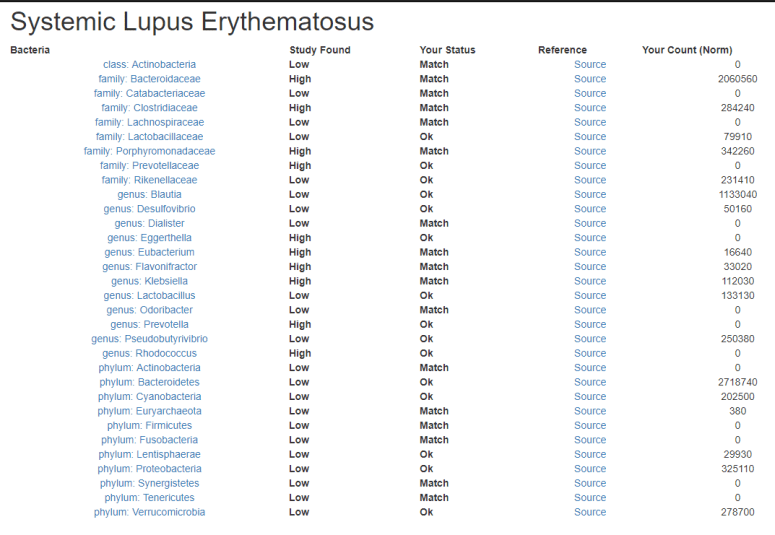
I have gathered up what has been published on PubMed for the Lupus shifts.  Having these shifts does not mean you have lupus — DNA also comes into play. The intent is give some visibility of a slide into another condition (or stepping away from).

lupus

Bottom Line

This is one more autoimmune diseases that has been associated with a ‘microbiome signature’.