Update on Autoimmune profiles

For readers that have contributed their uBiomes, we have added more profiles from studies with one important enhancement.  A sample of common symptoms are also shown with check boxes above the analysis. When you look at the results, please contribute your symptoms for those listed. There is a link to the full list, but with cognitive fatigue — that list can be too much for many people.

Remember — adding your symptoms increases the value of your uploaded ubiome for research.

Example: Gout

gout

What’s there?

As new studies are published, their information will be added and new ones added, for example for SIBO.

Is Arthrosis a microbiome condition?

A reader messaged me because a member of their family has just gotten a diagnosis of arthrosis. They asked if it could be caused by the microbiome? Arthritis  affect your bones, ligaments, and joints. Often this means joint stiffness and pain.

Arthritis is an umbrella term describing several conditions. It includes:

  • osteoarthritis (OA) also known as arthrosis
  • rheumatoid arthritis (RA), and
  • gout.

There are many conditions that distinctive microbiome profiles have been discovered. If you have a uBiome done, I have created pages to compare the ubiome against the published profiles. One of these is rheumatoid arthritis, as shown below (you must have uploaded ubiome to see the results)

ra

The studies used for this page included:

A quick search on PubMed found significant research in this direction for osteoarthritis.

I was unable to find studies reporting a specific microbiome profile for osteoarthritis.

For Gout, we find:

  • Combined Signature of the Fecal Microbiome and Metabolome in Patients with Gout.
    • “The signatures of microbiome showed being up-regulation of opportunistic pathogens, such as Bacteroides, Porphyromonadaceae RhodococcusErysipelatoclostridium and Anaerolineaceae”
    • “The LefSe method revealed that the phylum Bacteroidetes and its derivative (Bacteroidia, Bacteroidales, Bacteroidaceae as well as Bacteroidales S24_7 group and Porphyromonadaceae), the phylum Chloroflexi and its derivatives (Anaerolineae, Anaerolineales, and Anaerolineaceae), the order Corynebacteriales and its derivative (Nocardiaceae and Rhodococcus), the class Erysipelotrichia and its derivatives (Erysipelotrichales, Erysipelotrichaceae and Erysipelatoclostridium), and the class Negativicutes and its derivative (Selenomonadales) were all higher in the intestinal microbiota from the gout patients. Conversely, the family Vibrionaceae and its derivatives (Photobacterium and Vibrio), the genus Coprococcus 3, Lachnospiraceae NC2004 group, Lachnospiraceae UCG_005, Ruminococcaceae NK4A214 group and Ruminococcaceae UCG_011 were all lower in the intestinal microbiota from the gout patients.”
    • Additionally the metabolites (KEGG) found significant differences.
      Gout

Bottom Line

All of the different types of Arthritis appear to have distinctive profiles according to published studies. There are also metabolite shifts (since these are produced by bacteria — this is expected). Metabolites are the supplies for the body.

One item was very significant — two people may have similar metabolites shifts, and thus the same diagnosis — BUT have different bacteria causing this shift.  If the person has high or low Akkermansia muciniphila,will determine if they have a positive or negative response to Chondroitin Sulfate. This later reality is what I have started to suspect for all of the microbiome caused conditions:

  • The symptoms are caused by the metabolite shifts.
    • There may be many combinations of bacteria shifts that can cause a similar  metabolite shift.

This is an education post to facilitate discussing this approach with your medical professionals. It is not medical advice for the treatment of any medical condition. Always consult with your medical professional before doing any  changes of diet, supplements or activity. Some items cites may interfere with prescription medicines.


Three more compares of ubiome results

This post looks at three more people that have done 2 microbiome results over time.

Example 1

Following recommendations

Sample Id   Earlier     Later 
Metabolism Average 1.03 0.90
Metabolism Std Dev 0.47 0.29
All Profiles 127 97
ADHD 6 11 Reports more easily distracted
Autism 13 9
Autoimmune Disease 4 4
Chronic Fatigue Syndrome 18 9
Crohn’s Disease 9 7
Depression 15 17 reports increased tendency to sadness
High Blood Pressure 4 3
Histamine Issues 0 0
Histamine Issues From Ubiome 9 4
Inflammatory Bowel Disease 7 7
Irritable Bowel Syndrome 7 6
Metabolic Syndrome 8 4
Mood Disorders 4 6
Rheumatoid arthritis 9 4
Schizophrenia 0 0
Type 2 Diabetes 9 4
Ulcerative colitis 5 2

 Example 2

This was a series of ubiome done around 2016. A health professional attempted to deal with the microbiome dysfunctions with traditional conventional processes.

Sample Id   #1     #2     #3  
All Profiles 59 91 75
ADHD 6 8 7
Autism 6 9 8
Autoimmune Disease 1 4 2
Chronic Fatigue Syndrome 9 11 11
Crohn’s Disease 6 6 6
Depression 6 13 6
High Blood Pressure 1 3 2
Histamine Issues 0 1 0
Histamine Issues From Ubiome 5 5 5
Inflammatory Bowel Disease 4 6 5
Irritable Bowel Syndrome 3 6 5
Metabolic Syndrome 1 2 3
Mood Disorders 1 6 2
Rheumatoid arthritis 4 5 4
Schizophrenia 0 0 0
Type 2 Diabetes 4 4 6
Ulcerative colitis 2 2 3

Example 3

Treatment is unknown, but by the ubiome numbers, would have occurred after recommendations became available OR have been a natural / spontaneous improvement.

Sample Id   Early   Later
All Profiles 127 83
Autism 13 9
ADHD 12 8
Autoimmune Disease 4 3
Chronic Fatigue Syndrome 14 8
Crohn’s Disease 12 7
Depression 18 6
High Blood Pressure 4 2
Histamine Issues 1 0
Histamine Issues From Ubiome 4 5
Inflammatory Bowel Disease 10 8
Irritable Bowel Syndrome 6 6
Metabolic Syndrome 5 5
Mood Disorders 9 3
Rheumatoid arthritis 7 4
Schizophrenia 0 0
Type 2 Diabetes 6 6
Ulcerative colitis 2 3

Bottom Line

There is growing evidence that the recommendations appear to:

  • Normalize metabolite functions (KEGG)
  • Reduce the typical microbiome signature across multiple autoimmune like conditions.

Our base assumption is that symptoms are caused by the shifts. There is no objective way to measure symptoms (and with memory issues often being involved, it makes it a more unreliable evaluation method). We can measure the two above items, and do observe improvements.

This is an education post to facilitate discussing this approach with your medical professionals. It is not medical advice for the treatment of any medical condition. Always consult with your medical professional before doing any  changes of diet, supplements or activity. Some items cites may interfere with prescription medicines.


Microbiome Site Updates

There was been a bunch of changes over the last week (and this weekend).

  • ubiome kit 15% discount code:  BIOTICS15
  • On Apples, the Buttons do not show up well, so I have modified their presentations
  • Caught and fixed a few bugs in the Alternative Labs.
    • I tested each by setting Lactobacillus low only and compared recommendations. If you have the cycles, please re-test and report any issues.
  • Remember login information as cookies — this will making log on easier. Just return to the page and the information will be automatically filled in.
    rev1

Statistics on what data we use is now shown

We have 1600+ known items that will modify the gut, and some 76000+ relationships on how it will be modified. A lot of the items added this week were from drugs. Work is starting on expanding non-drugs data.

If you are on a prescription drug, you may find it (and it’s impact) on the updated modifiers.

http://microbiomeprescription.com/library/summary

Data Summary

Bacteria family112

Data Store Count
Bacteria class 33
Bacteria genus 331
Bacteria kingdom 2
Bacteria no_rank 32
Bacteria order 62
Bacteria phylum 22
Bacteria root 1
Bacteria species 847
Bacteria species_group 9
Bacteria strain 3
Bacteria subclass 6
Bacteria subgenus 1
Bacteria subkingdom 1
Bacteria suborder 7
Bacteria subphylum 2
Bacteria superkingdom 3
Bacteria superphylum 3
Biome Samples 194
Metabolism/KEGG added to uBiome 43
Modifier-to-Bacteria relationships 76431
Modifiers of bacteria 1664
People who Uploaded 131
Symptoms added to uBiome 79

Improved Navigation


From the sample selection pages, we have made links to other pages clearer:

rev2

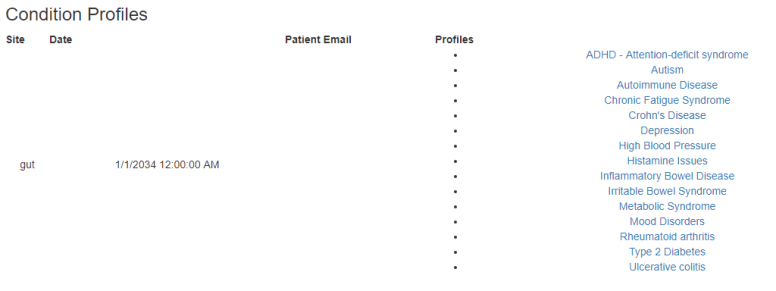
Similarly for condition profiles

rev3

Bottom Line

I hope this makes navigation easier.  I have started working with data scientists at the Allen Institute to improve the data we are using. My focus for the next few weeks will be to increase our knowledge of non-prescription ways of modifying the microbiome.

Needless to say, adding symptoms and copying the KEGG/metabolism data across to the site will both:

  • allow research to happen better
  • allow you to see objective progress over time (i.e. KEGG/ metabolism improved, autoimmune profiles improve).

This is an education post to facilitate discussing this approach with your medical professionals. It is not medical advice for the treatment of any medical condition. Always consult with your medical professional before doing any  changes of diet, supplements or activity. Some items cites may interfere with prescription medicines.

DayTwo Lab Recommendations are now available

DayTwo (https://www.daytwo.com/ ) provides a microbiome test and nutritional recommendations ($349 covering some 92 taxonomy units verus $80 for hundreds with uBiome.com). Their focus appears to be:

“DayTwo analyzes your microbiome to predict blood sugar responses to thousands of different foods. High blood sugar is linked to energy dips, excessive hunger, weight gain and increased risk of obesity and diabetes”

A reader forwarded me their report  and I have implemented a suggestions page for it at:

Selling nutritional suggestions off microbiome is a “hot area” for marketing. My concern is that the advice for more belief based recommendations instead of science based recommendations.

They score foods with A,B,C grades as shown below

day2

For the reader, an example of food recommendations from their report:

day2a

MicrobiomePrescript Recommendations

This is a healthy active individual but with some significant shifts in some of the measures.

Item    Action    Confidence value
inulin prebiotics Take 2.17
pulse / legumes Take 1.664
resveratrol Take 1.525
gallic acid and tannins Take 1.248
arabinoxylan Take 1.109
antiseptics Avoid -1.386
no carbohydrate diet Avoid -1.664

The rice and pasta suggestions above matches with the avoid a no carbohydrate diet above.

Bottom Line

This company appear to attempt a menu service based on their microbiome results which seems to be targeted at healthy people