New Comparison between 2 uBiome

Some one who been following the recommendations from http://microbiomeprescription.com/ just uploaded their latest (march, 2018) results and asked me too look at the changes. I did this earlier when I first created the page to compare: Comparing repeated uBiome results  and the first study Simple Summary of Progress between uBiome Samples

Total for all AutoImmune like Profiles

Decreased from 127 to 116. Most significant was metabolic syndrome dropping from 8 factors to 3 factors. Chronic Fatigue Syndrome dropped from 18 factors to 15 factors.

On the other side, ADHD factors increased from 6 to 11, which agrees with the observed lost of focus.

Metabolism (KEGG) has improved

Std Dev is the measure of how scattered the results are around normal. If every result was 1.0 then Std Dev would be 0.0.

  • 0.47 would be like the red line below
  • 0.23 would be like the green line below
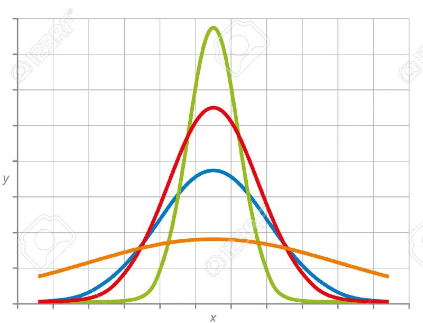
bell

Metabolism Average Sept 2017 March 2018
Metabolism Average 1.03 1.00
Metabolism Std Dev 0.47 0.23

Detail Changes

The following went up or down significantly

Secondary metabolite degradation: Fluorobenzoate degradation 0.575 0.3
Secondary metabolite biosynthesis: Stilbenoid, diarylheptanoid and gingerol biosynthesis [POST} 2.5 1.8
Secondary metabolite biosynthesis: Caffeine metabolism 1 0.575
Secondary metabolite biosynthesis: Betalain biosynthesis 0.3 1.425
Lipid metabolism: alpha-Linolenic acid metabolism 1.175 0.575
Lipid metabolism: Arachidonic acid metabolism 0.825 0.575

The above lead to some suggestions:

Bacteria Shifts

This is the percentage from the normal  ranges that I have been using. We see several phylum (high level of bacteria) has moved from very low to the normal range as the Bacteroides/Firmicutes ratio has also shifted.

(phylum)Actinobacteria -1 % -15 %
(phylum)Bacteroidetes 0 % 31 %
(phylum)Firmicutes 7 % -14 %
(phylum)Fusobacteria -72 % -97 %
(phylum)Proteobacteria 0 % 25 %
(phylum)Synergistetes -91 % 0 %
(phylum)Verrucomicrobia -97 % 0 %

Visuals

At the class level, we see that a lot of classes have increased in side, which I view as a good thing.

class

Recommendations

With the new recommendation engine,  we had 12 items on default recommendations with  the former sample, and only 1 item for the latest sample (high counts). When we switched to the low counts ONLY for current sample, we get a long list. A few examples below:

Item    Action    Confidence value
beta-glucan foods Take 5.734
mediterranean diet Take 5.353
barley Take 4.68
dairy milk fats Take 3.13
almonds Take 3.06
pulse / legumes Take 2.786
lactobacillus reuteri probiotics Take 2.742
arabinoxylan Take 2.556
raffinose foods Take 2.476
inulin prebiotics Take 2.467
coconut products Take 2.402
bacillus probiotics Take 2.331
high fiber diet Take 2.277
candida albicans yeast Take 2.131
bifidobacterium animalis lactis probiotic Take 1.98
bacillus subtilis probiotic Take 1.859
pomegranate fruit Take 1.804
fruit Take 1.702
whole grains Take 1.642
walnuts nuts Take 1.491
bacillus licheniformis probiotics Take 1.447
vitamin a retinol Take 1.425

Bottom Line

This is the second comparison that I have done [earlier one], and both had KEGG (Metabolites) improving and other improvements.

Modifying the microbiome is a complex area — do you reduce the high first, increase the low, try doing both at the same time?

The key take away is that “Yes Virginia, you can alter and improve your microbiome”. After altering it one way, the next ubiome sample may result in major changes of what to take. It is NOT a straight linear path.

This is an education post to facilitate discussing this approach with your medical professionals. It is not medical advice for the treatment of any medical condition. Always consult with your medical professional before doing any  changes of diet, supplements or activity. Some items cites may interfere with prescription medicines.

FYI: Bug in http://microbiomeprescription.com/ OtherLabs…

FYI: Bug in http://microbiomeprescription.com/ OtherLabs Analysis.
I appear to have flip a sign during my rework. last weekend. So Take and Avoid are flipped.

It will be corrected this weekend.

FYI: Bug in http://microbiomeprescription.azurewebsites.net/ OtherLabs…

FYI: Bug in http://microbiomeprescription.azurewebsites.net/ OtherLabs Analysis.
I appear to have flip a sign during my rework. last weekend. So Take and Avoid are flipped.

It will be corrected this weekend.

Comparison between labs

A reader asked for a comparison between various labs (apart from ubiome).

The table is below (also available here as a PDF file)
CompareLabs

Row Labels Bioscreen Biovis Microbiome Plus Diagnostic Solution GI-Map Genova Gi Effects Genova Parasitology Kyber Kompakt Medivere: Darm Mikrobiom Stuhltest Medivere: Darn Magen Diagnostik Medivere: Gesundsheitscheck Darm Metagenomics Stool (De Meirleir) Smart Gut Verisana Viome Grand Total
Acetanaerobacterium 1 1
Acetivibrio 1 1
Acidaminococcus 1 1
Acinetobacter 1 1
Actinobacteria 1 1 1 3
Actinomyces 1 1
Adlercreutzia 1 1 2
Akkermansia muciniphila 1 1 1 1 4
Alistipes 1 1 1 1 4
Anaerofustis 1 1
Anaerostipes 1 1
Anaerotruncus colihominis 1 1 2
Asaccharobacter 1 1
Atopobium 1 1
Bacillus 1 1
Bacteroides 1 1 1 1 1 1 1 1 1 1 10
Bacteroides fragilis 1 1 1 3
Bacteroides intestinalis 1 1
Bacteroides ovatus 1 1
Bacteroides vulgatus 1 1 2
Bacteroidetes 1 1 2
Barnesiella 1 1 1 3
Bifidobacterium 1 1 1 1 1 1 1 1 1 1 1 1 12
Bifidobacterium longum 1 1
Bilophila wadsworthia 1 1
Blautia 1 1
Butyricicoccus 1 1
Butyrivibrio 1 1
Butyrivibrio crossotus 1 1 1 3
Campylobacter 1 1 2
Catenibacterium 1 1
Christensenellaceae 1 1
Citrobacter 1 1 1 1 4
Citrobacter freundii 1 1 2
Clostridia 1 1 2
Clostridium 1 1 1 1 1 1 1 7
Clostridium butyricum 1 1
Clostridium perfringens 1 1
Clostridium sporogenes 1 1
Collinsella 1 1 2
Collinsella aerofaciens 1 1
Coprobacillus 1 1
Coprococcus 1 1 2
Coprococcus eutactus 1 1
Cyanobacteria 1 1
Desulfovibrio piger 1 1 1 3
Dialister 1 1
Dialister invisus 1 1 2
Dorea 1 1 2
Eggerthella 1 1
Eggerthella lenta 1 1
Enterobacter 1 1 1 3
Enterobacteriaceae 1 1
Enterococcaceae 1 1
Enterococcus 1 1 1 1 1 1 6
Erysipelatoclostridium ramosum 1 1
Escherichia 1 1 1 3
Escherichia coli 1 1 1 1 1 1 1 1 8
Escherichia coli Biovare 1 1 2
Ethanoligenens 1 1 2
Eubacterium 1 1 1 1 1 5
Eubacterium hallii 1 1
Euryarchaeota 1 1
Faecalibacterium 1 1
Faecalibacterium prausnitzii 1 1 1 1 4
Faecalitalea 1 1
Firmicutes 1 1 1 3
Fusobacteria 1 1 2
Fusobacterium 1 1 1 3
Gordonibacter 1 1
Haemophilus 1 1
Hafnia 1 1 2
Hafnia alvei 1 1
Holdemania 1 1
Howardella 1 1
Klebsiella 1 1 1 1 1 1 6
Klebsiella pneumoniae 1 1 1 3
Kluyvera 1 1 2
Lachnoclostridium 1 1
Lactobacillus 1 1 1 1 1 1 1 1 1 1 1 1 12
Lactococcus 1 1
Lactonifactor 1 1
Leuconostoc 1 1
Megamonas 1 1
Megasphaera 1 1
Methanobrevibacter smithii 1 1 2
Morganella 1 1 1 3
Morganella morganii 1 1
Moryella 1 1
Odoribacter 1 1 1 1 4
Olsenella 1 1
Oscillibacter 1 1 2
Oxalobacter formigenes 1 1 1 3
Papillibacter 1 1
Parabacteroides 1 1 1 3
Peptoclostridium 1 1
Peptoclostridium difficile 1 1
Prevotella 1 1 1 1 4
Proteobacteria 1 1 1 3
Proteus 1 1 1 1 1 1 6
Proteus mirabilis 1 1
Proteus vulgaris 1 1
Providencia 1 1 2
Pseudoflavonifractor 1 1
Pseudomonas 1 1 1 1 1 5
Pseudomonas aeruginosa 1 1
Roseburia 1 1 1 1 1 1 6
Rothia 1 1
Ruminococcus 1 1 1 1 1 1 6
Ruminococcus albus 1 1
Serratia 1 1 1 3
Slackia 1 1 2
Sporobacter 1 1
Staphylococcus 1 1 2
Streptococcus 1 1 1 1 1 5
Streptococcus anginosus group 1 1
Streptococcus parasanguinis 1 1
Streptococcus salivarius 1 1
Subdoligranulum 1 1
Sulfuricurvum 1 1
Sutterella 1 1
Syntrophococcus 1 1
Syntrophus 1 1
Tannerella 1 1
Tenericutes 1 1
Tistrella 1 1
Turicibacter 1 1
Veillonella 1 1 1 3
Verrucomicrobia 1 1 2
Xylanibacterium 1 1
Grand Total 17 42 14 27 7 11 16 16 17 52 23 11 30

Viome Report Recommendations are now available

A reader forwarded a copy of their Viome report and I have created an entry form for it. It is at: http://microbiomeprescription.com/Kyber/Viome

  • Assume Normal is not 1.5 x higher than “healthy” or 2/3 of healthy

The report looks like this:

v1

I assume that “Activity” is what the person has.

The report also recommends some food (without providing studies backing them 😦 )

v2

The top recommendation from our site is below. Note that only certain lactobacillus are recommended.

Item    Action    Confidence value
chitosan supplements Take 4.159
gluten free diet Take 2.911
sulfites food additives Take 1.871
no carbohydrate diet Take 1.664
lactobacillus kefiri probiotics Take 1.664
garlic Take 1.664
neem herb Take 1.525
sucralose sugar Take 1.248
flaxseed Take 1.248
bifidobacterium longum probiotic Take 1.248
lactobacillus paracasei probiotics Take 1.109
lactobacillus casei probiotics Take 1.109
rosemary herb Avoid -1.109
pomegranate fruit Avoid -1.248
olive oil Avoid -1.248
rhubarb Avoid -1.248
candida albicans yeast Avoid -1.248
chrysanthemum morifolium herb Avoid -1.248
cocoa Avoid -1.248
high fat diet Avoid -1.525
oligosaccharide Avoid -1.664
mediterranean diet Avoid -1.664
magnesium supplements Avoid -1.664
soy Avoid -2.079
almonds Avoid -2.079
bifidobacterium animalis lactis probiotic Avoid -2.495
high fiber diet Avoid -2.495
vsl #3 probiotic mixture Avoid -2.495
resveratrol Avoid -2.634
beta-glucan foods Avoid -2.724
whole grains Avoid -2.773
inulin prebiotics Avoid -3.417
lactobacillus plantarum probiotics Avoid -3.466
arabinoxylan Avoid -3.466
barley Avoid -3.556
lactobacillus acidophilus probiotics Avoid -4.02
resistant starch Avoid -4.298
pulse / legumes Avoid -7.07

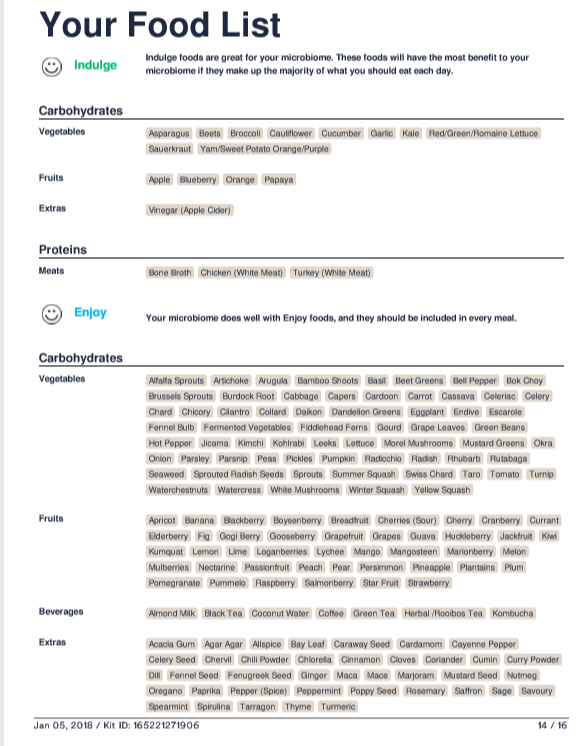
Their Food List

v3

which goes on for several pages. Several items were listed which my analysis suggest should be avoided (barley, almonds, etc) My general impression is their customized for the individual food list is a general healthy living list with perhaps a few minor changes.

Bottom Line

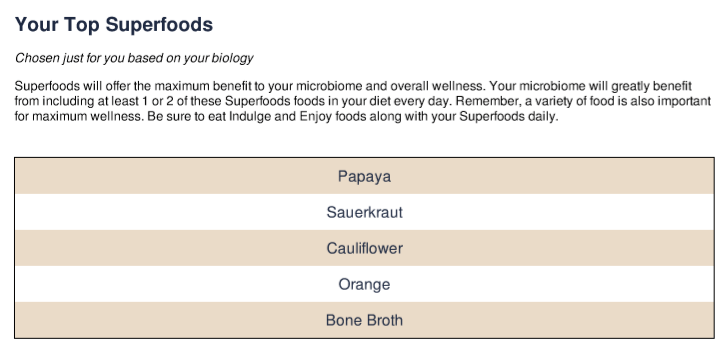
I will be researching papaya, cauliflower, orange and bone broth on PubMed to see if there are studies. If they are, I will add them to our database.