

FYI, if you tried to upload your uBiome in the last day and failed, please try again — there was a bug that has been fixed.
Author Archives: lassesen
Comparing repeated uBiome results
There are some 15 readers who have done 2 or more uBiomes. I have added a new page to allow the people to see differences better.
After login at: http://microbiomeprescription.com/Biome/login a new choice will appear if you have done 2 or more uBiome:

Click this take you to a page to select which ones you wish to compare:

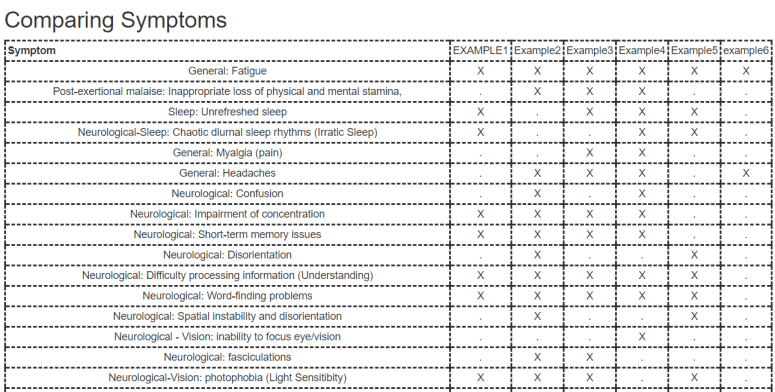
Selecting and clicking will take you to a page which will compare:
- Symptoms
- Function/Metabolites
- Bacteria
Comparing Function/Metabolism

Comparing Bacteria

Bottom Line
This tool will hopefully help with understanding how you have manipulated your microbiome by changes in diet, supplements, antibiotics and probiotics.
If you find interesting changes, feel free to post as a comment here.
Microbiome Site Update – POTS and ALA
Contributed data to the site consists of:
- 112 ubiome results uploaded from 90 different people
- 49 of these have had symptoms added, 40 had general fatigue
- 29 of these have had metabolites added (from ubiome site)
Observations for General Fatigue(40)
- 60% with unrefreshing sleep
Metabolite Function
With 65% either high or low
- Amino acid metabolism: D-Arginine and D-ornithine metabolism LOW
- Bacterial Abilities: Bacterial chemotaxis LOW
- Bacterial Abilities: Flagellar assembly LOW
- Secondary metabolite degradation: Toluene degradation JHIGH
Bacteria Class
- Actinobacteria
- 10% low, 68% High
- Bacilli
- 5% low , 68% High
- Betaproteobacteria
- 58% with low, 25% with high
- Gammaproteobacteria
- 10% with NONE, 70% with High
Bacteria Order
- Enterobacteriales
- 18% None, 67% with HIGH
- Actinomycetales
- 27% with none or low — 70% with High
Genus Level
- Lactobacillus
- 28% with none, 70% with High
- Kluyvera
- 20% with low, 65% with High
- Veillonella
- 30% with Low – 65% with HIGH
Observations with Fatigue with Unrefreshing Sleep
Metabolite Function
With 65% high or low
- Amino acid metabolism: D-Arginine and D-ornithine metabolism Low (81%)
- Lipid metabolism: Steroid hormone biosynthesis High (72%)
Following had more than 65% high:
- Class
- Order
- Family
- Genus
Following had more than 65% low
- Order
- Family
Postural orthostatic tachycardia syndrome (POTS)
Metabolites with 65% high or low
- Amino acid metabolism: D-Arginine and D-ornithine metabolism Low (85%)
- Bacterial Abilities: Bacterial chemotaxis Low (76%)
- Bacterial Abilities: Bacterial motility proteins Low (68%)
- Bacterial Abilities: Flagellar assembly Low (76%)
- Bacterial Abilities: Lysosome High (68%)
- Lipid metabolism: alpha-Linolenic acid metabolism Low (76%)
- Lipid metabolism: Steroid hormone biosynthesis High (76%)
- Secondary metabolite degradation: Chlorocyclohexane and chlorobenzene degradation High (76%)
- Class
- Actinobacteria
- High
- Gammaproteobacteria
- High
- Actinobacteria
- Order
- Actinomycetales
- High
- Enterobacteriales
- High
- Actinomycetales
- Family
- Enterobacteriaceae
- High
- Lactobacillaceae
- High
- Streptococcaceae
- High
- Veillonellaceae
- High
- Enterobacteriaceae
- Genus
- Pseudoflavonifractor
- High
- Streptococcus
- High
- Pseudoflavonifractor
Bottom Line
While our sample sizes are small, we do note some potential difference between those with general fatigue and POTS. Specifically:
- Pseudoflavonifractor and Streptococcus are more dominant and several others are less
- Lipid metabolism: alpha-Linolenic acid metabolism Low (76%)
- Suggests that supplementing with ALA may help
- I could find no studies using this supplement.
- Bacterial Abilities: Bacterial chemotaxis being low (poor communications/movement between cells) may be a significant factor for POTS.
The purpose of this post is to show how it is possible to identify metabolites and bacteria that are associated with certain symptoms (and in this case, for POTS, identify a supplement that may potentially help).
This is an education post to facilitate discussing this approach with your medical professionals. It is not medical advice for the treatment of any medical condition. Always consult with your medical professional before doing any changes of diet, supplements or activity. Some items cites may interfere with prescription medicines.
Should you do uBiome before going on Antibiotics?
A reader on a local CFS group asked:
Ken Lassesen, can I enlist your expertise and help? First, I’ve been enema-dependent for a few years and I’m wondering if my Ubiome might give you some fascinating info. Second, I’m going to treat SIBO soon with vancomycin and Rifaxamin and I haven’t had antibiotics in many years — before being sick with ME. Could this give any interesting or helpful info (either for you or me) – if I did a Ubiome before and after treatment? Thanks for the help!
The Answer is very much a yes. Each of these antibiotics cause significant changes — the question arises — will the net change be for the better or the worst?
The following is the information (with sources) that have been assembled so far. I have seen some CFS patients with high Proteobacteria thus Rifaximin would be good, but not vancomycin. For other patients, the opposite is true.
Bottom Line
Most studies deal with a sample of patients that presents a condition. The group as a whole may have positive results but individuals may not. Working off your own uBiome may allow your likely response to be better predicted. More individual treatment based on your own reality.
This is an education post to facilitate discussing this approach with your medical professionals. It is not medical advice for the treatment of any medical condition. Always consult with your medical professional before doing any changes of diet, supplements or activity. Some items cites may interfere with prescription medicines.
Gut Bacteria associated with Restless Leg
The following profile seems to occur with restless leg according to our explorer:
- Low class Gammaproteobacteria
- Low family Enterobacteriaceae and Order Enterobacteriales
- Low family Lactobacillaceae
- Low genus Kluyvera
- High family Bacteroidaceae and genus Bacteroides and order Bacteroidales
- High family Sutterellaceae
With high genus Oscillibacter being seen often.
Recommendations
The following should improve the bacteria shift seen above:
| Walnuts | 3.03 |
|---|---|
| barley | 2.02 |
| Choline | 2.02 |
| Polymannuronic acid | 2.02 |
| Pomegranate ellagitannins | 2.02 |
| Bifidobacterium infantis | 1.01 |
And
| Acetic acid | -2.02 |
|---|---|
| Aspartame | -2.02 |
| Choline deficiency | -2.02 |
| Doxycycline | -2.02 |
| high-fat diet | -2.02 |
| Isobutyric acid | -2.02 |
| Isovaleric acid | -2.02 |
| macrolide | -2.02 |
| saccharin | -2.02 |
| vancomycin | -2.02 |
| vegetarian | -2.02 |
Bottom Line
The following are likely to help
- Supplement with choline
- Eat Walnuts and Pomegrantes
- Barley porridge
Do not use Saccharin or Aspartame
This is an education post to facilitate discussing this approach with your medical professionals. It is not medical advice for the treatment of any medical condition. Always consult with your medical professional before doing any changes of diet, supplements or activity. Some items cites may interfere with prescription medicines.
 CFS Remission
