Bioscreen is now supported for analysis

http://microbiomeprescription.com/Kyber/Bioscreen

Analysis of Verisana Lab Report

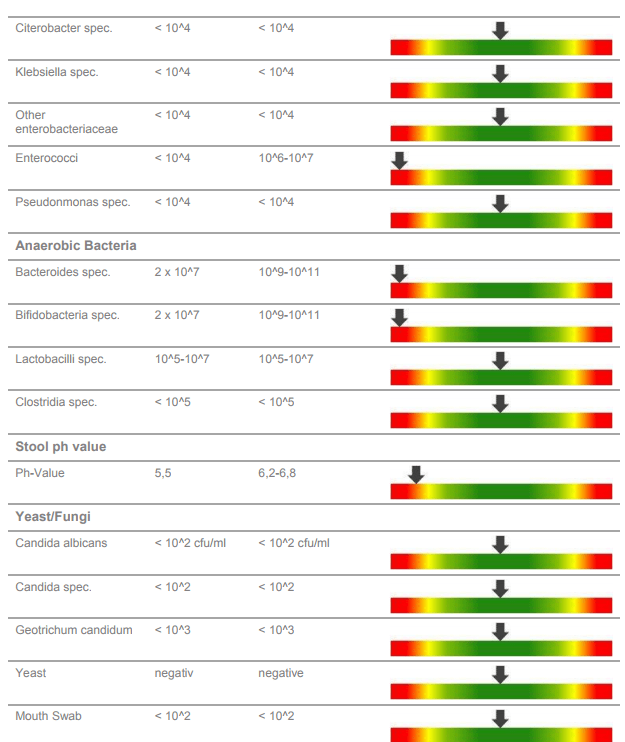
A UK reader forwarded their results for analysis. I modified my website to input data from this report (like I did for KyberKompakt) and do analysis using the same database.

The Report

The report is shown below

rep1

rep2.PNG

The Data Entry

rep3

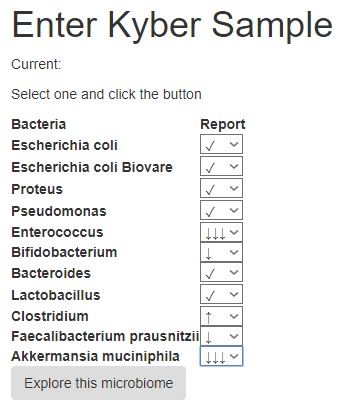
To keep life simple, the entry uses the same check marks and arrows as before. So the above report is entered as shown below. There were some minor spelling difference between plural and single versions of names (Bifidobacterium vs Bifidobacteria), but the sequence was maintained for ease of entry.

http://microbiomeprescription.com/Kyber/Verisana

rep4

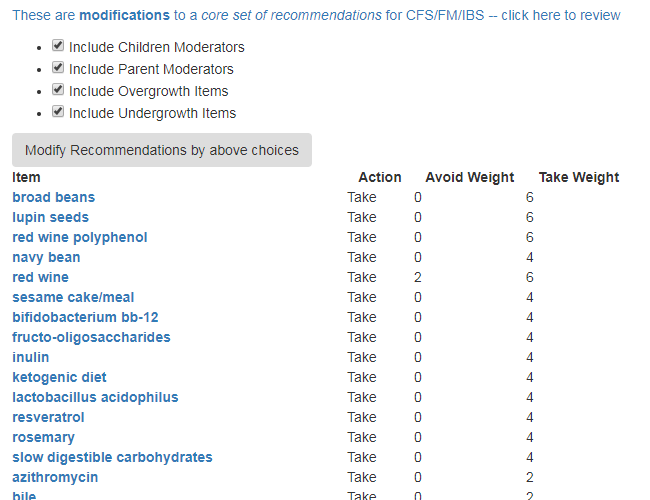
The results can be tuned as before.

rep5

The Weight is calculated as:   Sum of bacteria impacted by this.

  • Red Wine:
    • Three different “2” items were positively helped… 6
    • One “2” item was negatively helped … 2
    • Bottom Line weight is a 6-2 = 4 (more likely to help — but monitor carefully, we do not know how much it impacts each item.


New Lab Analysis report for…

New Lab Analysis report for input has been added:
http://microbiomeprescription.com/Kyber/Verisana

Website for AI on KyberCompact Reports

I did a  KyberKompact analysis a while back, and just put the same same thru my new website to do analysis.

The page is at: http://microbiomeprescription.com/Kyber/Upload/

The process is simple, match the up and down errors for the items on the reports.

Kyber2

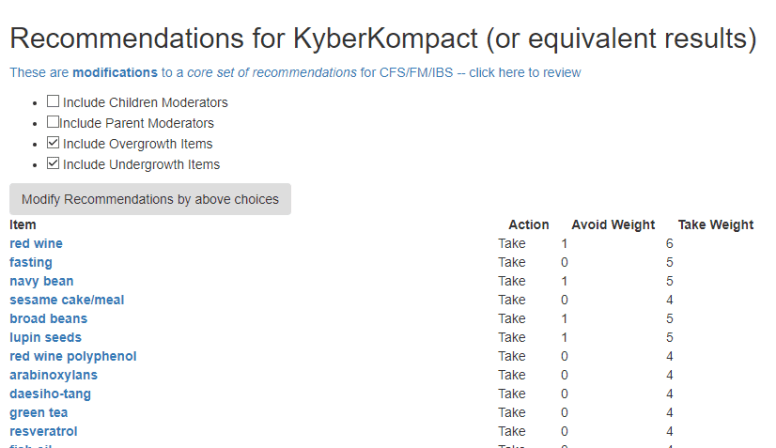
Click explore and the current recommendations appear (based on published studies) as shown below.

  • You can also take your ubiome results and match up with the selection shown above and use it that way until I get the uBiome version fully tested.
  • Clicking on include/parent will increase the recommendations to include the parent (i.e. “family”) or children (“strains”) recommendations
    • As is 142 items appeared, with parents and children the list increased to 162 items.

kyber1

There are some similar to items (i.e. red wine, resveratrol , red wine polyphenol).

The full list is shown below:

Item    Action    Avoid Weight    Take Weight

red wine
Take 1 6

fasting
Take 0 5

navy bean
Take 1 5

sesame cake/meal
Take 0 4

broad beans
Take 1 5

lupin seeds
Take 1 5

red wine polyphenol
Take 0 4

arabinoxylans
Take 0 4

daesiho-tang
Take 0 4

green tea
Take 0 4

resveratrol
Take 0 4

fish oil
Take 0 4

low processed foods diet
Take 0 4

bile
Take 0 3

esculin
Take 0 3

azithromycin
Take 0 3

meropenem
Take 0 3

helminth infection
Take 0 3

carboxymethyl cellulose
Take 0 3

cranberry bean flour
Take 0 3

cranberry polyphenols
Take 0 3

grapes
Take 0 3

heme
Take 0 3

high protein diet
Take 0 3

lingonberries
Take 0 3

melatonin
Take 0 3

metformin
Take 0 3

polysorbate 80
Take 0 3

pomegranate ellagitannins
Take 0 3

quercetin w. resveratrol
Take 0 3

rhubarb
Take 0 3

capsaicin
Take 0 3

epicor
Take 0 3

bifidobacterium longum bb536
Take 0 3

lactobacillus rhamnosus
Take 0 3

pomegranate
Take 0 3

enterococcus faecium
Take 1 3

chicory
Take 0 2

inulin
Take 0 2

jerusalem artichoke
Take 0 2

arabinoxylan
Take 0 2

rosemary
Take 0 2

cinnamon
Take 0 2

turmeric
Take 0 2

cocoa
Take 0 2

polyphenols
Take 0 2

whey
Take 0 2

mediterranean diet
Take 0 2

chemotherapy
Take 2 3

almonds/ almond skins
Take 0 1

chondrus crispus
Take 0 1

ketogenic diet
Take 0 1

magnesium
Take 0 1

whole grain and bran
Take 0 1

gum arabic
Take 0 1

lactobacillus acidophilus
Take 0 1

bifidobacterium bb-12
Take 0 1

vsl-3
Take 0 1

lactobacillus planatarum
Take 0 1

barley
Take 0 1

lactobacillus acidophilus and cellobiose
Take 0 1

raffinose
Take 0 1

oregano
Take 0 1

cacoa
Take 0 1

pea protein
Take 0 1

dates
Take 0 1

mutaflor
Take 0 1

vancomycin
Take 0 1

lactobacillus kefiri
Take 0 1

lactobacillus paracasei
Take 0 1

bifidobacteria longum
Take 0 1

bacillus licheniformis
Take 0 1

paenibacillus polymyxa (prescript assist)
Take 0 1

basil
Take 0 1

marjoram
Take 0 1

peppermint
Take 0 1

anise
Take 0 1

thyme
Take 0 1

abies alba mill.
Take 0 1

satureia montana
Take 0 1

carum carvi
Take 0 1

tannic acid
Take 0 1

propyl gallate
Take 0 1

methyl gallate
Take 0 1

lauric acid
Take 0 1

chitooligosaccharides
Take 0 1

arabinogalactan
Take 0 1

dopamine
Take 0 1

epinephrine
Take 0 1

high fiber diet
Take 0 1

low animal protein diet
Take 0 1

soy
Take 0 1

fructo-oligosaccharides
1 1

lactobacillus casei
1 1

slow digestible carbohydrates
1 1

garlic
1 1

chitosan
1 1

fat
1 1

gluten-free diet
1 1

ascophyllum nodosum
Avoid 1 0

berberine
Avoid 1 0

laminaria hyperborea
Avoid 1 0

low carbohydrate diet
Avoid 1 0

magnesium-deficient diet
Avoid 1 0

sucralose
Avoid 1 0

lacto-ovo-vegetarian diet
Avoid 1 0

high-saturated fat diet
Avoid 1 0

animal-based diet
Avoid 1 0

vegetarian
Avoid 2 1

high beef diet
Avoid 1 0

gluten-free
Avoid 1 0

iron supplements
Avoid 1 0

ß-glucan
Avoid 1 0

bifidobacterium pseudocatenulatum li09 and bifidobacterium catenulatum li10
Avoid 1 0

lactobacillus salivarius
Avoid 1 0

lactobacillus plantarum
Avoid 4 3

ß-lactam antibiotics
Avoid 1 0

refined wheat breads
Avoid 1 0

bile salts
Avoid 1 0

high animal fat diet
Avoid 1 0

high animal protein diet
Avoid 1 0

high processed foods diet
Avoid 1 0

high sugar diet
Avoid 1 0

low fiber diet
Avoid 1 0

iron sulphate
Avoid 1 0

high fat diet
Avoid 5 3

polymannuronic acid
Avoid 3 1

trametes versicolor
Avoid 3 1

lactobacillus plantarum with xylooligosaccharides
Avoid 3 1

low fodmap diet
Avoid 2 0

glycyrrhizic acid
Avoid 3 0

hyperiform
Avoid 3 0

propolis
Avoid 3 0

triphala
Avoid 3 0

chrysanthemum morifolium
Avoid 4 1

lactobacillus reuteri
Avoid 3 0

ethanol
Avoid 3 0

glyphosphate
Avoid 4 0

resistant starch
Avoid 7 3

high-protein diet
Avoid 4 0

omega 3 fatty acids
Avoid 4 0

flaxseed
Avoid 5 0

Bottom Line

The number of items above will grow as more and more studies are entered into the database.

This is an education post to facilitate discussing this approach with your medical professionals. It is not medical advice for the treatment of CFS. Always consult with your medical professional before doing any  changes of diet, supplements or activity. Some items cites may interfere with prescription medicines.

Comparing uBiomes from different dates

A reader sent me over two uBiomes taken 3 months apart and was confused by the results. Fortunately, I could upload her data and do some quick analysis (which will eventually be available as a web page).

Phylum Level Is Improving

The numbers below are the counts. It they are getting closer to normal, it is improving. If further away then a loss.

October December Normal tax_name tax_rank Change
15453 10574 45026 Actinobacteria phylum Loss
701911 424855 271874 Bacteroidetes phylum Improved
60 9124 38 Euryarchaeota phylum Loss
269622 527597 561301 Firmicutes phylum Improved
12694 22898 32511 Proteobacteria phylum Improved
271 512 4200 Synergistetes phylum Improved

We see a rare phylum (Euryarchaeota) was one of the two losses, so we really had 4 gains to 1 loss.

Class Changes

The dominant change at the class level are improvement if we take by raw counts. Both Clostridia and Bacteroidia (the two biggest classes have improved). The third largest class Erysipelotrichia has had a loss.

October December Normal tax_name tax_rank Change
15453 10574 45026 Actinobacteria class Loss
120 3024 24677 Alphaproteobacteria class Improved
15544 8799 20967 Bacilli class Loss
701911 424855 270991 Bacteroidia class Improved
527 12086 12351 Betaproteobacteria class Improved
221346 469302 511846 Clostridia class Improved
1191 6249 3903 Deltaproteobacteria class Improved
5367 1337 7271 Epsilonproteobacteria class Loss
15785 36597 10249 Erysipelotrichia class Loss
5488 199 24696 Gammaproteobacteria class Loss
60 9124 38 Methanobacteria class Loss
16946 12899 24121 Negativicutes class Loss

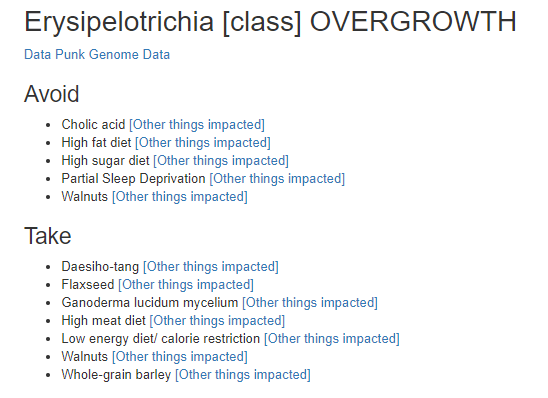
For this overgrowth, we have some suggestions.
class

NOTE: Walnut is reported at two places. We have contrary results from studies 😦

Order Changes

We see gain and loss here too.

October December Normal tax_name tax_rank Change
5261 2899 23920 Actinomycetales order Loss
346 249 15243 Bacillales order Loss
701911 424855 268676 Bacteroidales order Improved
527 11974 11721 Burkholderiales order Improved
5367 1337 7271 Campylobacterales order Loss
221346 468964 512463 Clostridiales order Improved
2140 7674 21896 Coriobacteriales order Improved
1191 6249 3544 Desulfovibrionales order Loss
15785 36597 10192 Erysipelotrichales order Loss
15197 8549 19016 Lactobacillales order Loss
60 9124 38 Methanobacteriales order Loss
180 199 6984 Pasteurellales order Improved
120 24 41600 Rhizobiales order Loss
16946 12899 24121 Selenomonadales order Loss
271 512 4200 Synergistales order Improved

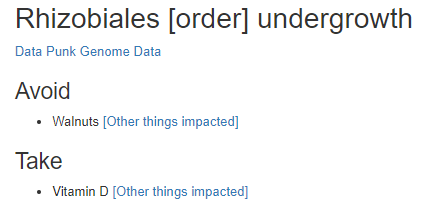
The worst loss was for Rhizobiales, with the following suggestions coming from the website
order

It is now clear that walnuts should be avoided.

Bottom Line

One concern that I have asked is about undergrowth. Working at the genus level gets very complex here. Working at higher levels like phylum, class and order is simpler.

With this new comparison page proposed, you get better clarity of the numbers and can focus on the highest count targets.

This is an education post to facilitate discussing this approach with your medical professionals. It is not medical advice for the treatment of any condition. Always consult with your medical professional before doing any  changes of diet, supplements or activity. Some items cites may interfere with prescription medicines.