Decreasing Phascolarctobacterium Genus

For updated information see Microbiome Prescription

Associated with folate biosynthesis [2014]

DataPunk.Net Data

INHIBITED BY

ENHANCED BY

PubMed Data

There are 38+ studies on PubMed.

Disease

  • Phascolarctobacterium …. associated with the metabolic state and mood of the host. ” [2017]
    • “Bacterial genera Roseburia, Phascolarctobacterium, Lachnospira, and Prevotella had potential positive correlation with positive mood, while genera Faecalibacterium, Bifidobacterium, Bacteroides, Parabacteroides, and Anaerostipes were correlated with negative mood. ” [2016]
  • “Decrease in genus Phascolarctobacterium was linked to presence of colonic inflammation regardless of IBD phenotype. ” [2017]
  • “Campylobacter infection …had a significantly higher abundance of Phascolarctobacterium(P = 0.017) and Streptococcus (P = 0.034) sequences ” [2014]

Diet

  • “High-protein diet …. decreases..” [2017]
  • “High Fat diet increases” [2015]
  • ” The abundance of Faecalibacterium, Phascolarctobacterium, and Dialister was greater (P < 0.05) in response to polydextrose and soluble corn fiber  intake, ” [2012]

Prebiotics

  • “fructooligosaccharides (FOS) and galactooligosaccharides (GOS)  ..while the butyrate-producing bacteria like Phascolarctobacterium in FOS group and Ruminococcus in GOS group were decreased. ” [2017]
  • “At genera level, five flourished after treatment with acarbose, including Lactobacillus and Dialister, while Butyricicoccus, Phascolarctobacterium, and Ruminococcus were inhibited.” [2017]

Probiotics

  • “aecalibacterium, Propionibacterium, Bifidobacterium and an unidentified genus from Bacteroidaceae and Lachnospiraceae and a negative correlation between  Lactobacillus casei Zhang  administration and the presence of Clostridium, Phascolarctobacterium, Serratia, Enterococcus, Shigella and Shewanella.” [2014]
  • “The relative abundance of Megamonas spp. Faecalibacterium spp. and Lactobacillus spp. increased significantly, the relative abundance of Bacteroides spp. and Phascolarctobacterium spp. decreased significantly in Lactobacillus paracasei N1115 probiotics group.”

Antibiotics

Bottom Line

Avoid

  • Berberine
  • Soluble corn fiber
  • Polydextrose
  • High Fat Diet

Take

Update on a previous analysis

I did this earlier post before doing deep dives, the reader pinged me so I am revisiting the results using the deep dives.

This person has two gut uBiomes, the differences are below

Measure Mar 2017 July 2017
Firmicutes to Bacteroidetes 2.9:1 3.8:1
Victivallis: 24.23 19.69
Anaeroplasma: RARE 6.39 2.31
Clostridium:  5.53 4.26
Oscillibacter: 4.48 3.18
Marvinbryantia: 3.79 3.17
Sarcina: 2.56 2.8
Intestinibacter: 2.09 1.77
Flavonifractor 2.04 1.41
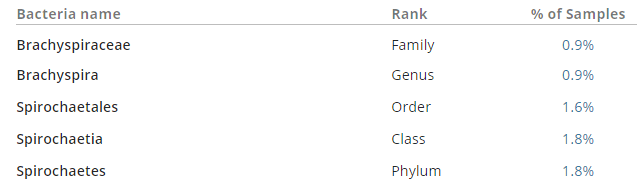
Brachyspira: RARE 1.69 0.20

Deep Dive References

The two highest ones I have not seen in other uBiome results.

I have not covered Brachyspira which is part of Spirochaetes -> Spirochaetia -> Brachyspirales -> Brachyspiraceae -> Brachyspira.   This single genus results in all of the rare results below (parents, grandparents, greatgrandparents….).

rare2

Since it has dropped so much already, I suspect there is no need to take explicit action

Bottom Line

The high Victivallis genus is a total pain and extremely high — we know that many antibiotics causes it to increase and I could not find any literature for antibiotics that causes it to decrease.  If it is to be treated by antibiotics then this bacteria must be cultured (which is not easy) and then different antibiotics tested to find one that works (and hopefully a paper published).

I have seen it high in only in one other ubiome analysis — after a fecal transplant where antibiotics were used in preparation.

The best path forward is to go on the assumption that the other high bacteria genus are supporting it, so reducing those would reduce victivallis as a side effect.

The lists below are done by merging the lists from the deep dives linked above. Some items may encourage one genus and discourage another genus — those are removed (unless it seems that it strongly predominates on one). The impact on Lactobacillus, Bifidobacterium and E.Coli are intentionally ignored [See this post for the logic]. This is all based on applying logic to the results of studies — thus theoretical. This is an addition (not a replacement) to this overview post.

Avoid

  • All antibiotics (due to Victivallis issue)
  • Berberine
  • Bifidobacterium longum
  • Bifidobacterium animalis
  • Fructooligosaccharides
  • High Fat Diet
  • Lactobacillus fermentum
  • Lysine supplements and foods
  • Minocycline
  • Penicillin
  • Saccharomyces boulardii
  • Vancomycin
  • Walnuts (and likely pomegranates)

Take

  • Bacillus licheniformis
  • Bifidobacterium Breve
  • Chitosan supplements
  • Enterococcus  faecalis probiotics
  • Fennel
  • Flaxseed
  • Gallate – Tea
  • Gluten free diet
  • Have Chocolate!
  • High resistance starch
  • Inulin
  • Lactobacillus casei
  • Lactobacillus kefiri LKF01
  • Lactobacillus rhamnosus probiotics
  • lycheerambutanguaranakorlanpitomba, Spanish lime and ackee. [fam-Sapindaceae]
  • Polymannuronic acid
  • Prescript Assist
  • Resistant starch (type II & IV)
  • Streptococcus Probiotics
  • Tannins
  • Tetracyclnes, Sparfloxaccin, Neomycin, Streptomycin

This is an education post to facilitate discussing this approach with your medical professionals. It is not medical advice for the treatment of CFS. Always consult with your medical professional before doing any  changes of diet, supplements or activity. Some items cites may interfere with prescription medicines.

Decreasing Anaeroplasma Genus

For updated information see Microbiome Prescription

This is often classed as a mycoplasma [A Phylogenetic Analysis of the Mycoplasmas: Basis for Their Classification, 1989]. CFS aas a mycoplasma infection has been one CFS research direction in the past.

“There are six genera of wall-less prokaryotes collectively referred to in this article as
mycoplasmas. These genera are Mycoplasma, Acholeplas ma, Spiroplasma, Ureaplasma,
Anaeroplasma, and the newly recognized genus Asteroleplasma. ” [1990]

DataPunk.Net Data

Tenericutes -> Mollicutes -> Anaeroplasmatales -> Anaeroplasmataceae -> Anaeroplasma

Nothing

PubMed Data

There are  30+ studies on pubmed

Disease

  • “Eubacteria, Anaeroplasma, Roseburia, Oscillospira and Dehalobacteria appeared to be protective against atherosclerosis and showed significant negative correlation with atherosclerotic plaque size and plasma adipocyte – fatty acid binding protein (A-FABP) and cholesterol.” [2016]
  • “The abundance of Pedobacter, Anaeroplasma, Paludibacter, Ruminococcus, and unclassified Lachnospiraceae was positively correlated with the CH4(methane) production, with no effects on volatile fatty acids.” [2016]

Diet

  • ” Inclusion of higher-Molecular Weight Condensed tannin  fractions F1 and/or F2 decreased the relative abundance of minor genera such as Ruminococcus, Streptococcus, Clostridium XIVa and Anaeroplasma but increased the relative abundance of Acinetobacter, Treponema, Selenomonas, Succiniclasticum “

Prebiotics

Probiotics

Antibiotics

  • Tetracyclnes, Sparfloxaccin are the most effective against the mycoplasma family [1997]
  • “neomycin-treated mice was depleted in several microbes that were increased with vancomycin treatment; Enterobacteriaceae, Anaeroplasma spp. and Sutterella spp.”  [2016]
  • “On the contrary, Anaeroplasma was the most reduced genus of all detectable genera, as its relative abundance decreased by 43% after streptomycin treatment.” [2017]

Bottom Line

Avoid

  • Vancomycin

Take

  • Tetracyclnes, Sparfloxaccin, Neomycin, Streptomycin
  • Tannins
  • Walnuts (Weak Evidence, we have to go up to Millicutes Class to find this)

Decreasing Victivallis Genus

For updated information see Microbiome Prescription

DataPunk.Net Data

Lentisphaerae -> Lentisphaeria -> Victivallales -> Victivallaceae -> Victivallis

Nothing

PubMed Data

There are  7+ studies on pubmed

Disease

  • Associated with genital-tract disease in cattle. [2015]

Diet

  • “In pure culture, strain CelloT could only grow on a variety of sugars. Glucose was converted to acetate, ethanol and H2. ” [2003]

Prebiotics

Probiotics

Antibiotics

  • common antibiotics appear to increase it [2012]
  • ” The antibiotics streptomycin and polymyxin B may be used to inhibit growth of contaminants.”[Bergey’s manual of Systematic Bacteriology, Volume 4]  i.e. This genus is resistant to these antibiotics.

Bottom Line

Note: This bacteria is hard to culture, which means testing of antibiotics to find an effective one very challenging.

Avoid

  • Streptomycin
  • Polymyxin B

Take

Ubiome for a reader in Spain

Standard Measures

All of the standard shifts seen with CFS

Rare Bacteria Genus

Just one < 5%. This has little information and it is a sibling to Aldercreutzia

Bacteria name Rank % of Samples
Paraeggerthella Genus 0.5%

Over grown Bacteria Genus

Bacteria
Ratio
Parasutterella:  13.92 X
Adlercreutzia:  6.84 X
Bilophila:  6.36 X
Butyricimonas: 5.28 X
Oscillibacter: 3.69 X
Intestinimonas: 3.36 X
Odoribacter: 3.20 X
Flavonifractor: 3.10 X
Alistipes:  3.03 X
Moryella: 2.04 X
Bacteroides:  1.77 X
Dorea: 1.72 X
Dialister: 1.55 X

References to literature that I am working off:

I have highlighted the extreme overgrowth associated suggestions in red

Bottom Line Suggestions

The lists below are done by merging the lists from the deep dives linked above. Some items may encourage one genus and discourage another genus — those are removed (unless it seems that it strongly predominates on one). The impact on Lactobacillus, Bifidobacterium and E.Coli are intentionally ignored [See this post for the logic]. This is all based on applying logic to the results of studies — thus theoretical. This is an addition (not a replacement) to this overview post.

Avoid

Bold — applies to HIGHEST, Italic to lowest

  • Allergens
  • Animal-based diet
  • Bacillus probiotics
  • Barley
  • Berbine
  • Bifidobacterium Animalis subsp. Lactis BB-12
  • Bifidobacterium catenulatum
  • Bifidobacterium longum.
  • Bifidobacterium pseudocatenulatum
  • Bile
  • Broad beans  and lupin seeds
  • Clostridium butyricum
  • Fermented Korean soybean paste
  • Fish Oil
  • Fructo-oligosaccharides
  • Gallic acid
  • Gum arabic
  • Helminth infections
  • High animal protein/meat diet
  • High Fat Diet
  • High meat diet
  • Lactobacillus fermentum
  • Lactobacillus Reuteri
  • L-citrulline
  • Low fat diets
  • Lysine supplements and foods
  • Metformin
  • Milk-derived saturated fat
  • pomegranate juice
  • Proton-pump inhibitors (PPI)
  • Saccharin
  • Saccharomyces boulardii
  • Stevia
  • stress
  • Tannic acid
  • Walnuts (and likely pomegranates)

Take

Bold — applies to HIGHEST, Italic to lowest

  • Bifidobacterum Bifidum
  • Bifidobacterum Infantis
  • Cellobiose
  • Chicory
  • Cranberry bean flour (or fresh cranberries)
  • E.Coli Probioitics
  • Enzymatically modified resistant starch
  • Faecalibacterium prausnitzii
  • Flaxseed
  • Galactooligosaccharides 
  • Gallate – green tea
  • Garlic
  • Grapes (table) – Resveratrol (grape seed extract)
  • Inulin
  • Lactobacillus Casei
  • Lactobacillus kefiri
  • Lactobacillus plantarum
  • Lactobacillus rhamnosus GG
  • Lactobacillus salivarius 
  • L-glutamine
  • Oligosaccharide prebiotics
  • Oral Iron Supplements
  • Polymannuronic acid
  • Resistant starch (type II & IV)
  • Sucralose (Splenda)
  • Vitamin D3
  • β-Glucan

This is an education post to facilitate discussing this approach with your medical professionals. It is not medical advice for the treatment of CFS. Always consult with your medical professional before doing any  changes of diet, supplements or activity. Some items cites may interfere with prescription medicines.