Decreasing Moryella genus

For updated information see Microbiome Prescription

DataPunk.Net Data

INHIBITED BY

ENHANCED BY

PubMed Data

There are 9+ studies on PubMed.

Disease

  • “Aggregatibacter (OTU id 4363066), Haemophilus, Haemophilus parainfluenza (H. parainfluenza), Moryella, Oribacterium, Prevotella, several Streptococcus, Rothia dentocariosa .. were reduced with Intra-oral halitosis] [2017]
  • “Decreased carriage of genera Lautropia, Bulleidia, Catonella, Corynebacterium, Moryella, Peptococcus and Cardiobacterium were found in  esophageal squamous cell carcinoma  subjects” [2015]
  • “The less represented genera Mogibacterium, Moryella and Oribacterium were enriched statistically in the tuberculosis samples,” [2013]

Diet

  • ” resveratrol ingestion produces taxonomic and predicted functional changes in the gut microbiome of obese mice. In particular, changes in the gut microbiome were characterized by a decreased relative abundance of Turicibacteraceae, Moryella, Lachnospiraceae, and Akkermansia and an increased relative abundance of Bacteroides and Parabacteroides ” [2017]
  • “Wheat… was strongly associated with the abundance of Firmicutes lineages such as Clostridium, Ruminococcus, Oscillospira and Moryella” [2014]

Prebiotics

Probiotics

Antibiotics

Bottom Line

Avoid

Take

  • Resveratrol (grape seed extract)
  • Flaxseed

Cat’s Claw and the CFSer

A reader pointed out that I have not mentioned this in any of the 800 posts to date. It is a good question!

My process is always to go to sources not dependent on one individual’s experience

Common Names:  cat’s claw, uña de gato,  پنجه  گربه in Persian, and مخلب  القط  in Arabic.

Latin Name:  Uncaria tomentosa (usual in commercial products), Uncaria guianensis
“There’s no conclusive scientific evidence based on studies in people that supports using cat’s claw for any health purpose.” Nation Center for Complementary and Integrative Health

PubMed and Google Scholar

  • On PubMed
    • “Uncaria tomentosa microbiome” – Zero hits
    • Uncaria tomentosa  – 204 hits
      • “Although there are no randomized controlled trials or published human outcome studies, some conditions reportedly improved by U. tomentosa include osteoarthritis, rheumatoid arthritis, prostatitis, viral illnesses and cancer (acting as a non-specific immunomodulantign agent) ” [2017]
    • “Uncaria tomentosa bacteria” – 16 hits
      • “antibacterial effect of 2% CC gel against E. faecalis in infected dentin” [2016]
      • “U tomentoa gel had the same effect as 2% miconazole gel. U tomentosa gel is an effective topical adjuvant treatment for denture stomatitis.” [2014]
      • “2% chlorhexidine (CHX) +cat’s claw (CC)  against the tested microbial strains ranged from 21.7 to 33.5 mm. This was the most effective substance against E. faecalis and C. albicans, followed by CHX and CC. Against S. aureus, CHX+CC, CHX, and CC showed similar antimicrobial activity (P > 0.05). ” [2010 ] CC was the least effective of the combinations tested.
      • “Three percent Uncaria tomentosa inhibited 8% of Enterobacteriaceae isolates, 52% of Streptococcus mutans and 96% of Staphylococcus spp. ” [2007]
      • “Nine ethanol extracts of Brunfelsia grandiflora (Solanaceae), Caesalpinia spinosa (Caesalpiniaceae), Dracontium loretense (Araceae), Equisetum giganteum (Equisetaceae), Maytenus macrocarpa (Celastraceae), Phyllanthus amarus (Euphorbiaceae), Piper aduncum (Piperaceae), Terminalia catappa (Combretaceae), and Uncaria tomentosa (Rubiaceae), medicinal plants traditionally used in Calleria District for treating conditions likely to be associated with microorganisms, were screened for antimicrobial activity against nine bacterial strains using the broth microdilution method.”  [2005Uncaria tomentosa was among the least effective.
    • From Google Scholar
      • “This small preliminary study demonstrates relative safety and modest benefit to the tender joint count of a highly purified extract from the pentacyclic chemotype of UT in patients with active RA taking sulfasalazine or hydroxychloroquine.” [2002]

Bottom Line

Cat’s claw is a poor financial choice. While it shows some benefits for dental issues, despite it’s long usage — there is a very significant absence of human studies showing significant benefit when taken alone.  It appears to have “modest” benefit when used with antibiotics.

This [2016] articles cites all of the reasonable studies. There is no evidence supporting it’s use in CFS, FM or IBS. The absence of published studies for a common recommendation in alternative medicine hints that there may have been studies with no positive results.

To Treating Physicians – The Microbiome Approach to CFS/FM/IBS

Your patient may have referred you to this blog. This physician directed page may assist you to get up to speed on evaluating the risks, benefits and logic of a model that I am proposing.  I am not advocating a specific generic treatment, but a way of approaching treatment for individual CFS patients.

Original Study from 1998

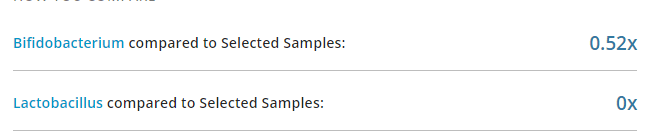
This was presented in Australia in 1998, Faecal Microbial Growth Inhibition in Chronic Fatigue/Pain Patients. The key finding was no or low lactobacillus, bifidobacterium and/or E.Coli. You can test and verify that in your own patients. Many CFS patients have used uBiome.com. In dozens of results that I have reviewed this pattern has been constant.

Simple Model

CFS symptoms are caused by a severe disturbance of metabolites produced by the microbiome being altered. The microbiome has stabilized in an unhealthy state. Various definitions have been proposed with one common characteristic: You must have N out of M symptoms

  • CDC (Fukuda 1994) Definition:  4 out of  8 [Src]
  • Canadian Definition:  have two or more neurological/cognitive manifestations (out of ~ 12 choices) and one or more symptoms from two of the categories of autonomic (10 choices), neuroendocrine (7 choices) and immune manifestations (6 choices) [Src]

A way to reconcile all of this is simple: There are overgrowth of different bacteria genus which share one thing in common: most of these inhibit one of more of Lactobacillus, Bifidobacterium or  E.Coli. The specific bacteria genus overgrown impacts the symptoms by the metabolites they produce.

What are the possible overgrowth bacteria genus?

The simplest way to gain insight is to refer to the “Substrata” section of the DataPunk website, provided by Peter D’Adamo, Distinguished Professor of Health Sciences at the University of Bridgeport. It details the “bad guy” species that inhibit Bifidobacterium.

When we look up Escherichia coli, on the same site, we see which species E. Coli inhibits. Those species are listed below. When there is no E.Coli in the colon, it would allow these to overgrow. Each genus found in the above list, I have put in bold italic — and, as you can see, it’s a 100% match. When there is no E.Coli, the “bad” genuses below overgrow, bifidobacterium is eliminated, and the cascade continues.

Simple explanation: Something, like an infection, knocks down E.Coli (or similar “policing” bacteria), then many “crime families” of bacteria are free to fight it out with different combinations winning in different patients. The winners determines the symptoms because each one consumes and generate different metabolites.  Got it?

Ah… just probiotics!

The unfortunate answer is likely no — the “bad guys” above will quickly dispatch the rookie cops sent in. The likely best ones are Mutaflor (E.Coli 1917) and Symbioflor-2 (a mixture of several E.Coli probiotics) — both are challenging to get outside of Germany.

A Treatment Approach to Consider

  1. Get a genus level comprehensive report on a patients microbiome. uBiome.com appears the easiest to get worldwide.
  2. Examine the high bacteria genus (1.5x higher than reference is my arbitrary criteria) and determine how you wish to reduce them.
    1. Diet changes
    2. Prebiotics
    3. Probiotics
    4. Antibiotics
  3. There is a jigsaw puzzle here because some items that reduces one overgrown genus may encourage another overgrown  genus.
    1. What works for one patients bacteria genus overgrowth mosaic may harm a different patient (who has a different mosaic).

Bottom Line

Simple model, appearance of causality established, treatment approach based on lab results … unfortunately treatment plan is a jigsaw puzzle that is different for each patient 😦 .

Remember this is just a model.

Enhanced uBiome analysis of a UK reader

Patient History

“…began a gradual decline in health nearly 6years ago, root issue is unknown, was living with someone that had EBV at one point but never had it confirmed on herself, plenty of other potential causes around the time.  Daily at least from the outside reader does very well, reader has never been bedridden and can actually do quite a lot, nothing like her former self but maybe 50% in terms of energy. However, reader’s extremely headstrong which means reader can push through tough times at the expense of her future self. Current symptoms that are most prominent are night sweats, difficulty regulating body temperature, daily headaches which can progress to migraines if not caught with self-medication (migraleve.) Has had POTS confirmed by doctors, tends to get a sore spine and general ‘bone ache’ as reader describes it, this with night sweats and temperature difficulties can make sleep an issue (tends to wake frequently.) Extremely prone to sore throats and generating lots of mucus in this area, reader had her tonsils removed as a child after repeat throat infections, there was heavy antibiotic use at this time, first major illness. Has major issues around her menstrual cycle, incidence of headaches and likelihood of a migraine increase three-fold at this time, tends to feel very bloated and sore around the abdomen at this time. Investigated lots with endocrine and though they saw plenty of bizarre readings (i.e. prolactin 4 times normal reading), they were unwilling to do much. Has issues with constipation sometimes, digests fatty food poorly, diary and beans. Consuming these foods can result in painful bloating and diarrhoea. Regularly, reader will complain of what feels like something sitting on her chest and also random sharp pains in the same area.”

Standard Items

uk1

Biodiveristy:  92%ile (what seems to be the most common value for CFS patients)

Level of all Probiotics Explorer:  0% (none)

Firmicutes to Bacteroidetes ratio: 1.3: 1 (Normal is 2.1 to 1)

Note: The description in patient history and the relatively high bifidobacterium and less extreme Firmicutes to Bacteroidetes ratio than normally seen, suggests that this reader is in the least effective 10% — both from their history and their microbiome results.

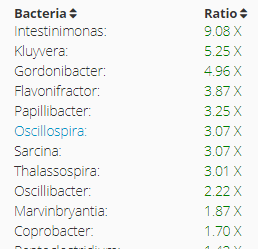
High Bacteria Genus

UK2

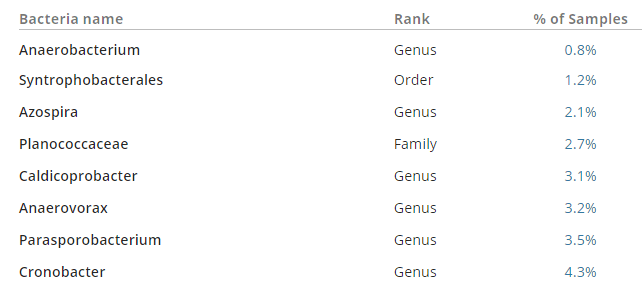
Rare Bacteria Genus

uk3

I will revisit the rare bacteria in a later revision.

Bottom Line Suggestions

The lists below are done by merging the lists from the deep dives linked above. Some items may encourage one genus and discourage another genus — those are removed (unless it seems that it strongly predominates on one). The impact on Lactobacillus, Bifidobacterium and E.Coli are intentionally ignored [See this post for the logic]. This is all based on applying logic to the results of studies — thus theoretical. This is an addition (not a replacement) to this overview post.

Avoid

  • Aspartame (Nutrasweet)
  • Berberine
  • Bifidobacterium longum
  • Fructooligosaccharides
  • High Fat Diet
  • Lactobacillus fermentum
  • L-Glutamic acid ( monosodium glutamate – MSG) and possibly gluten
  • L-Proline
  • L-Serine
  • Lysine supplements and foods
  • Minocycline
  • Penicillin
  • Saccharomyces boulardii
  • Walnuts

Take

  • Enterococcus  faecalis probiotics
  • Fennel
  • Flaxseed
  • Gallate – Tea
  • Gluten free diet
  • High resistance starch
  • Inulin
  • Lactobacillus Casei
  • Lactobacillus kefiri LKF01
  • L-Phenylalanine (Good sources of phenylalanine are eggs, chicken, liver, beef, milk, and soybeans.[5])
  • lycheerambutanguaranakorlanpitomba, Spanish lime and ackee. [fam-Sapindaceae]
  • Polymannuronic acid
  • Resistant starch (type II & IV)

Based on Symptoms:


This is an education post to facilitate discussing this approach with your medical professionals. It is not medical advice for the treatment of CFS. Always consult with your medical professional before doing any  changes of diet, supplements or activity. Some items cites may interfere with prescription medicines.

Decreasing Coprobacter Genus

This is the first genus with zero information, so far. There were hints of material behind paywalls.

For updated information see Microbiome Prescription

DataPunk.Net Data

Nothing

PubMed Data

There are 4+ studies on PubMed.

Disease

Diet

Prebiotic

Probiotic

Antibiotic

Bottom Line

Avoid

Take