Reducing Lachnospira genus

For updated information see Microbiome Prescription

DataPunk.Net Data

INHIBITED BY

ENHANCED BY

PubMed Data

There are  50+ studies on PubMed

Disease

  • “. Decreased relative abundance of Lachnospira, Veillonella, Faecalibacterium, and Rothia in early infancy was reported to be associated with increased asthma risk. ” [2016]
  • Shifts in Lachnospira and Clostridium sp. in the 3-month stool microbiome are associated with preschool age asthma. [2016]
    • “We conclude that opposing shifts in the relative abundances of Lachnospira and C. neonatale in the first 3 months of life are associated with preschool age asthma”
  • “amyotrophic lateral sclerosis .. the average ratios of…lachnospira at genus level between ALS patients and healthy people were … 13.07.  [2016]
  • “Bacterial genera Roseburia, Phascolarctobacterium, Lachnospira, and Prevotella had potential positive correlation with positive mood, ” [2016]
  • “in gallstone patients there were significant (P < 0.001) increases of gut bacterial phylum Proteobacteria and decreases of three gut bacterial genera, Faecalibacterium, Lachnospira, and Roseburia. ” [2013]

Diet

  • “Christensenellaceae R7, Lachnospira, Succiniclasticum, and Ruminococcaceae NK4A214 exhibited a negative response to thiamine supplementation. ” [2017]
  • “During treatment, both 100 mg and 200 mg lactoferrin vaginal pessaries significantly decreased the occurrence of bacteria associated with BV, such as GardnerellaPrevotella, and Lachnospira, ” [2017]
  • “Vegetable intake was positively associated with the relative abundance of the Lachnospira genus” [2016]
  • “a hypocaloric hyperproteic diet … was associated with a decrease in Lachnospira” [2016]

Prebiotics

Probiotics

Antibiotics

Bottom Line

Avoid

Take

  • Thiamine
  • Flaxseed
  • “Low calories High protein diet

Review of BIOHM Gut Report

A reader forward their results from Biohm (link to kit, $117)  with the expected disclaimer:

As a general wellness product, the BIOHM Gut Report & BIOHM Candida Report are for informational purposes only and are NOT intended for use in the diagnosis, cure, mitigation, treatment, or prevention of disease or any other conditions.

Images of Report

b1

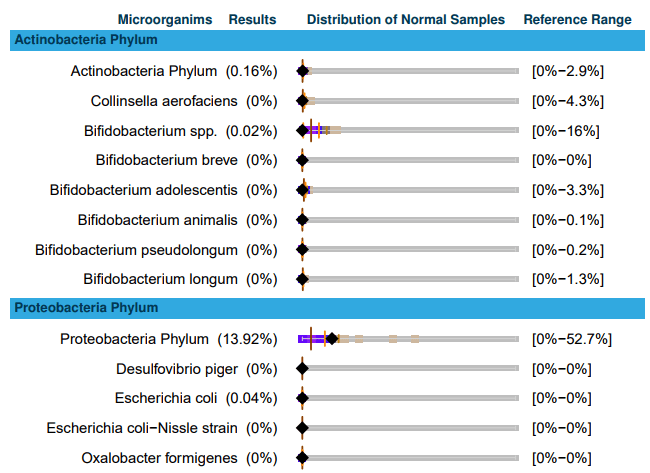
While this shows the percentage — it does not make it clear if there is either overgrowth or undergrowth for either fungal or bacteria. That is — is the volume abnormally high or low?

bh2

bh3

bh4

bh6


bh5

Analysis of Report

I like that the mean and +1/1 standard deviation is shown. The unfortunate aspect is that everything is in terms of percentage of all bacteria with the reference rounded to the closest 0.1%.  If the normal amount seen is 0.0001% and a person has .04% (400x more) then the chart will show 0% and (0%-0%) — so no apparent overgrowth… IMHO massive loss of  useful information!

To illustrate this, let us look at Lactobacillus. We have 0.01 and the reference range is 0 – 9.8% — SO IT IS IMPOSSIBLE TO HAVE LOW Lactobacillus according to this report reference range. I would definitely describe this as low lactobacillus. Similarly, Bifidobacterium is 0.02 with reference range of 0 – 16%. Same problem! It is impossible to get a “below reference range for lactobacillus or bifidobacterium!!

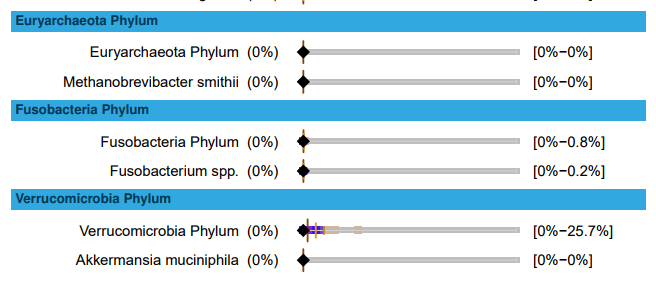
Last is Akkermansia muciniphila which is ZERO but so is the reference range….

Escherichia coli (0.04%) is above the reference range — but there is no indication if this is good or bad E coli. What is bizarre is to test for explicit probiotics,

  • Escherichia coli−Nissle strain
  • Bifidobacterium breve
  • Bifidobacterium adolescentis
  • Bifidobacterium animalis
  • Bifidobacterium pseudolongum
  • Bifidobacterium longum
  • Lactobacillus acipophylis [sic]
  • Lactobacillus rhamnosus

This does make business sense — because their business model includes selling probiotics.  I notice the absence of Lactobacillus Fermentum, Lactobacillus Keferi and other important probiotics, especially Lactobacillus Reuteri!!!!

What are probable highs using the available data?

  • Bacteroides spp.
  • Faecalibacterium prausnitzii
  • Escherichia coli — unclear

Referencing my deep dive pages (skipping E.Coli)

Bottom Line on this Test

IMHO, less useful data than uBiome at a higher cost. The number of bacteria genus examined is also less than uBiome.

If you have concerns about fungal overgrowth — this would be helpful to identify unusual species — but it is still unclear if there is an overgrowth from the report.

Bottom Line Suggestions

The lists below are done by merging the lists from the deep dives linked above. Some items may encourage one genus and discourage another genus — those are removed (unless it seems that it strongly predominates on one). The impact on Lactobacillus, Bifidobacterium and E.Coli are intentionally ignored [See this post for the logic]. This is all based on applying logic to the results of studies — thus theoretical. This is an addition (not a replacement) to this overview post.

Avoid

  • Bacillus subtilis
  • Berberine
  • Bifidobacterium adolescentis
  • Bifidobacterium Animalis subsp. Lactis BB-12
  • Bifidobacterium pseudocatenulatum
  • Broad beans  and lupin seeds
  • Enterococcus probiotics
  • Fructo-oligosaccharides
  • Gallic acid
  • gum arabic
  • High Fiber Diet
  • High meat diet
  • Jerusalem artichoke, Inulin,  Chicory
  • L. casei CCFM419
  • Lactobacillus acidophilus
  • Lactobacillus plantarum
  • L-citrulline
  • Low fat diets
  • red wine (or grape seed extract or reservatol)
  • Red wine, Grape Seed Extract
  • Resistant starch (type IV)
  • Rifaximin
  • Saccharin
  • Saccharomyces boulardii
  • Stevia
  • Tannic acid
  • VSL#3 Probiotics

Take

  • Bacillus licheniformis
  • Bacilus Coagulans probiotics
  • Bifidobacterium longum BB536
  • Bile salts
  • Chitosans
  • Garlic
  • gluten-free diet
  • Green Tea (Gallate)
  • High fat/ animal protein diet
  • Iron supplements
  • Lactobacillus paracasei probiotics
  • Lactobacillus casei strain Shirota (Yakult brand)
  • Lactobacillus kefiri LKF01
  • Low fiber diet
  • Navy bean (Cooked) Note other beans have opposite effect
  • Omega 3 fatty acids (600 mg of omega-3 daily for 14 days cited in studies )
  • Polymannuronic acid
  • Sucralose (Splenda)
  • Thyme
  • Whole-grain barley
  • β-Glucan

What about Biohm Probiotics?

“PathoBiome 30B is the name for BIOHM’s patented tri-action formulation of good bacteria (B. breve, L. acidophilus, L. rhamnosus), good fungus (S. boulardii), and a powerful enzyme (Amylase) that breaks down digestive plaque. Think of it as the engine that powers BIOHM.”

This is a definitely a NOT recommend for this reader. I cover this probiotics for other bacteria genus over growths in this post.

  • BAD – L. acidophilus
  • BAD – S. boulardii

The other two has no known effect on the over growths.

This is an education post to facilitate discussing this approach with your medical professionals. It is not medical advice for the treatment of CFS. Always consult with your medical professional before doing any  changes of diet, supplements or activity. Some items cites may interfere with prescription medicines.


Reducing Succinivibrio genus

For updated information see Microbiome Prescription

DataPunk.Net Data

No Information

PubMed Data

There are 60+ studies on PubMed

Disease

Diet

  • “Thiamine supplementation increased the abundance of cellulolytic bacteria including Bacteroides, Ruminococcus 1, Pyramidobacter, Succinivibrio, and Ruminobacter” [2017]
  • Succinivibrio and Halomonas from the Proteobacteria phylum were overrepresented in omnivores. (vs vegetarians) [2017]
  • ” The levels of Selenomonas ruminantium, Anaerovibrio lipolytica, Ruminobacter amylophilus, Succinivibrio dextrinosolvens and Megasphaera elsdenii were increased by ginkgo extract supplementation, ” [2017]
  • ” Perilla frutescens seed extract was accompanied by an increased abundance of Ruminobacter, Selenomonas, Succinivibrio, Shuttleworthis, Pseudobutyrivbrio, Anaerovibrio, and Roseomonas and a decreased abundance of Methanobrevibacter millerae.” [2016] –  Korean perilla, is a species of Perilla in the mint family Lamiaceae.
  • “Adding sodium bicarbonate also decreased (P < 0.05) the relative abundance of Streptococcus and Butyrivibrio and increased (P < 0.05) the proportions of Ruminococcus, Succinivibrio and Prevotella.” [2017]

Prebiotics

Probiotics

  • “Interestingly, B. lactis supplementation slightly reduced the abundance of the genera Ruminococcus (from the Ruminococcaceae family) and Succinivibrio compared to the standard formula group ” [2016]

Antibiotics

  • “the genus Succinivibrio were decreased in the pigs fed… chlortetracycline” [2017]

Bottom Line

Avoid

  • Thiamine
  • Ginkgo
  • Sodium bicarbonate

Take

  • Reduce meat consumption
  • Bifidobacterium animalis subsp. lactis (slight impact)

Reducing Acidaminococcus genus

The Acidaminococcus genus was created in 1969 and actually counts as two species with standing in nomenclature: A. fermentans and Aintestini. Cells belonging to this genus are Gram-negative, anaerobic cocci, generally isolated from the digestive tract of mammals [5][6]. [2017]

For updated information see Microbiome Prescription

DataPunk.Net Data

Nothing

PubMed Data

There are 110+  studies on PubMed

Disease

  • Rosacea ” reduced abundance of Peptococcaceae family unknown genus, Methanobrevibacter (genus), Slackia (genus), Coprobacillus (genus), Citrobacter (genus), and Desulfovibrio (genus), and increased abundance of Acidaminococcus(genus), Megasphaera (genus),” [2017]
  • ” type 1 diabetes mellitus … the composition of Haemophilus, Lachnospira, Dialister, and Acidaminococcus was decreased.” [2016]

Diet

  • Acidaminococcus, Bifidobacterium, Megasphaera and Mitsuokella were greater (P< 0·05) in moderate-protein, moderate-carbohydrate-fed kittens. (compared to High-protein, low-carbohydrate ) [2013]
  • “that glutamate is fermented … via the hydroxyglutarate pathway by Acidaminococcus fermentans” [1974]

Prebiotics

Probiotics

  • ” Bacillus natto and Lactobacillus acidophilus …Haemophilus decreased, Ruminococcus decreased, Clostridium colinum decreased, Acidaminococcus increased and Megamonas increased individually.” [2008]

Antibiotics

  • “Fosfomycin ..14% of Acidaminococcus fermentans strains were resistant. no Acidaminococcus fermentans strains showed resistance to the (penicillin G) antibiotic at this concentration.” [1992]

Bottom Line

Avoid

  • Bacillus natto (likely all bacillus)
  • Lactobacillus acidophilus
  • Glutamate

Take

  • High-protein, low-carbohydrate diet

Review of Biohm Probiotics

A reader asked me about this probiotic sold at https://biohmhealth.com.

BIOHM contains B. breveL. acidophilusL. rhamnosusS. boulardii and Amylase”

It appears to be directed at fungal infection.

Is it good for CFS?

Well, S. boulardii encourages the growth of many bacteria genus  seen in CFS that are already overgrown!!

“Saccharomyces boulardii is a tropical strain of yeast first isolated from lychee and mangosteen fruit in 1923 by French scientist Henri Boulard.” DataPunk.Net

A few examples:

For Lactobacillus acidophilus, the same issue

Bottom Line

Unless your microbiota shifts happen to land between all of the above bacteria genus, this probiotics is likely more harmful than good for CFS patients. It is high risk without a microbiome analysis to determine suitability first.