Italian State of the Art Microbiome Report

A reader forwarded me two reports, one from a male and one from a female. No notes on the people (I am fine with that). The report appear to be superior to uBiome on two counts:

  • It’s a professional grade report from a clinical laboratory
  • It reports down to the strain level on occasion.

Link to site (in Italian) http://www.ospedalebambinogesu.it/genetica-la-super-mappa-del-microbiota-intestinale#.Wf39d2i3xPY

This first post is on the female. (See this post for the male)

  • Low Bifidobacteria
  • No Lactobacillus
  • No E. coli
  • Low Akkermansia muciniphila (less than 1/100 of 1% of typical)

So standard CFS profile on these

italy

Copying the data to Excel allow me to get similar numbers as I do from uBiome reports.

High Levels

Proteobacteria  Haemophilus parainfluenzae 75956% 0.06836
Firmicutes  Ruminococcus torques 11110% 0.00222
Firmicutes Veillonella dispar 1819% 0.01473
Firmicutes  Ruminococcus gnavus 1720% 0.03956
Firmicutes  Epulopiscium dolichum 891% 0.00196
Firmicutes Coprobacillus 880% 0.00044
Firmicutes  Blautia producta 853% 0.00665
Firmicutes  Clostridium 721% 0.00281
Firmicutes  Ruminococcus 268% 0.09076
Firmicutes  Epulopiscium 220% 0.00011

The greatest impact appears to be (in order) from  Ruminococcus, Haemophilus parainfluenzae, Ruminococcus gnavus, Veillonella dispar. Since I have only done deep dives to the genus, not species level, I have borrowed directly from DataPunk.Net

Bottom Line

Combining all of the lists and tossing out things that appear on both side, we have the following lists. There are two genus cited above that I have not done a deep dive into. I have skipped rare bacteria because of the number of over growths found. This was a pretty clean merge — often the same item appeared multiple times in one list or the other.

The lists below are done by merging the lists from the deep dives linked above. Some items may encourage one genus and discourage another genus — those are placed in inconclusive. The impact on Lactobacillus, Bifidobacterium and E.Coli are intentionally ignored [See this post for the logic]. This is all based on applying logic to the results of studies — thus theoretical. This is an addition (not a replacement) to this overview post.

Avoid

Take

Note: Taking as a fresh herb may work similar to oil

This is an education post to facilitate discussing this approach with your medical professionals. It is not medical advice for the treatment of CFS. Always consult with your medical professional before doing any  changes of diet, supplements or activity. Some items cites may interfere with prescription medicines.


Reducing Enterococcus Genus

If you have high enterococcus reported, please verified that none of the probiotics that you have taken included enterococcus in the prior month. If so, this may be just residue from those probiotics.

“Vancomycin-resistant enterococci (VRE) are both of medical and public health importance associated with serious multidrug-resistantinfections and persistent colonization. Enterococci are opportunistic environmental inhabitants with a remarkable adaptive capacity to evolve and transmit antimicrobial-resistant determinants. The VRE gene operons show distinct genetic variability and apparently continued evolution leading to a variety of antimicrobial resistance phenotypes and various environmental and livestock reservoirs for the most common van genes. Such complex diversity renders a number of important therapeutic options including “last resort antibiotics” ineffective and poses a particular challenge for clinical management. Enterococci resistance to glycopeptides and multidrug resistance warrants attention and continuous monitoring.” [2017]

For updated information see Microbiome Prescription

DataPunk.Net Data

INHIBITED BY

ENHANCED BY

INHIBITED BY

PubMed Data

There are 25000+ studies on PubMed — this is just from a select sampling.

  • ” The incidence of Hirschsprung-associated enterocolitis with/without probiotics [Lactobacillus, Bifidobacterium, Streptococcus, and Enterococcus] was 22.6 and 30.5%, respectively, but this was not statistically different (OR 0.72; 95% CI 0.37-1.39; P = 0.33).” [2017]
  • L. reuteri strains tested were able to inhibit and displace (P < 0.05) the adhesion of …. Enterococcus faecalis NCDC115. The probiotic strain L. reuteri LR6 showed the strongest adhesion and pathogen inhibition ability among the eight L. reuteri strains tested” [2017]
  • ” Lactobacilli (Lactobacillus plantarum ATCC 8041 and Lactobacillus rhamnosus ATCC 7408 ) had an inhibitory effect on the growth of E. faecalis by agar cup method but not by deferred antagonism test.” [2017]
  • Lactobacillus strains ((L. gasseri, L. rhamnosus, L. acidophilus, L. plantarum, L. paracasei, L. acidophilus) ) had similar moderate antimicrobial activities against uropathogens.” [2016]
  • ” all the Lactobacillus isolates[Lactobacillus acidophilus, L. paracasei, L. delbrueckii, L. casei, L. helveticus, L. brevis, L. salivarius, L. fermentum, L. rhamnosus, L. animalis, and L. plantarum} displayed antimicrobial activity against 6 out of 7 antibiotic-resistant uropathogens (E. fecalis….),  L. fermentum and L. plantarum strains demonstrated remarkable inhibitory activities against  E. faecalis,” [2016]
  • “No decline in (enterococci) colony counts was seen over time in subjects who received Lactobacillus rhamnosus GG . ” [2015]

Bottom Line

This is a tough genus to reduce — antibiotics are likely to do more harm than good because of the high resistance reported. Many probiotics have only a moderate effect at best.

Avoid

Take

Personally, I tend to use Triphala, Lactobacillus Fermentum, and Licorice as part of my regular maintenance routine.

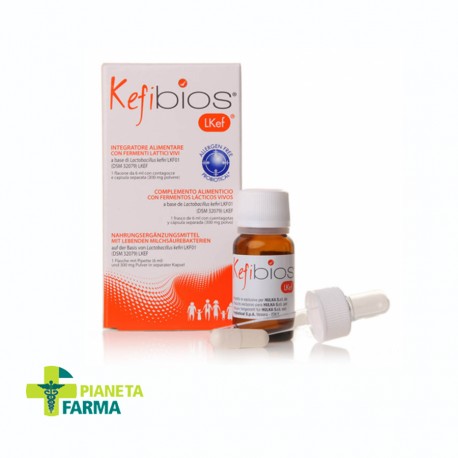
Lactobacillus Kefir Probiotic

In several of my deep dives, Lactobacillus Kefiri is mentioned as being effective against selective bacteria genus over growths. A reader in Spain found that it is available!

It is not just available, but the strain is given:  Lactobacillus Kefiri LKF01 (DSM 32079) LKEF  Store URI (In EU)

kefibios-gocce


For this specific strain:

“L. kefiri was recovered in the feces of all volunteers after one month of probiotic administration, while it was detected only in three subjects belonging to the pre-prandial group and in two subjects belonging to the post-prandial group one month after the end of probiotic consumption. After one month of probiotic oral intake we observed a reduction of Bilophila, Butyricicomonas, Flavonifractor, Oscillibacter and Prevotella. Interestingly, after the end of probiotic administration Bacteroides, Barnesiella, Butyricicomonas, Clostridium, Haemophilus, Oscillibacter, Salmonella, Streptococcus, Subdoligranolum, and Veillonella were significantly reduced if compared to baseline samples.

L. kefiri LKF01 showed a strong ability to modulate the gut microbiota composition, leading to a significant reduction of several bacterial genera directly involved in the onset of pro-inflammatory response and gastrointestinal diseases.” [2017] [Full Text]


For the species,

Bottom Line

This appears to not only reduce many high bacteria genus that CFS patients but also reduces inflammation and appear to take up residency.

If you have any of the high bacteria genus cited above, it is definitely a strong recommendation to discuss with your medical professional.

NOTE:

Q: Could we potentially benefit from eating regular kefir?

A: Alas not — Kefir is a mixture of many bacteria. They isolate the most effective strain from dozens of different kefirs.  A listing of those that could be in Kefir:
  • LACTOBACILLILactobacillus acidophilus
    Lb. brevis [Possibly now Lb. kefiri]
    Lb. casei subsp. casei
    Lb. casei subsp. rhamnosus
    Lb. paracasei subsp. paracasei
    Lb. fermentum
    Lb. cellobiosus
    Lb. delbrueckii subsp. bulgaricus
    Lb. delbrueckii subsp. lactis
    Lb. fructivorans
    Lb. helveticus subsp. lactis
    Lb. hilgardii
    Lb. helveticus
    Lb. kefiri
    Lb. kefiranofaciens subsp. kefirgranum
    Lb. kefiranofaciens subsp. kefiranofaciens
    Lb. parakefiri
    Lb. plantarum

    STREPTOCOCCI/LACTOCOCCI

    Streptococcus thermophilus
    St. paracitrovorus ^
    Lactococcus lactis subsp. lactis
    Lc. lactis subsp. lactis biovar. diacetylactis
    Lc. lactis subsp. cremoris
    Enterococcus durans
    Leuconostoc mesenteroides subsp. cremoris
    Leuc. mesenteroides subsp. mesenteroides
    Leuc. dextranicum ^

    YEASTS

    Dekkera anomala t/ Brettanomyces anomalus a
    Kluyveromyces marxianus t/ Candida kefyr a#
    Pichia fermentans t/ C. firmetaria a
    Yarrowia lipolytica t/ C. lipolytica a
    Debaryomyces hansenii t/ C. famata a#
    Deb. [Schwanniomyces] occidentalis
    Issatchenkia orientalis t/ C. krusei a
    Galactomyces geotrichum t/ Geotrichum candidum a
    C. friedrichii
    C. rancens
    C. tenuis
    C. humilis
    C. inconspicua
    C. maris
    Cryptococcus humicolus
    Kluyveromyces lactis var. lactis #
    Kluyv. bulgaricus
    Kluyv. lodderae
    Saccharomyces cerevisiae #
    Sacc. subsp. torulopsis holmii
    Sacc. pastorianus
    Sacc. humaticus
    Sacc. unisporus
    Sacc. exiguus
    Sacc. turicensis sp. nov
    Torulaspora delbrueckii t
    * Zygosaccharomyces rouxii

 NOTE 2

Because of so many different bacteria in Kefir there are a number of risks for conflict with medications (From WebMD)


This is an education post to facilitate discussing this approach with your medical professionals. It is not medical advice for the treatment of CFS. Always consult with your medical professional before doing any  changes of diet, supplements or activity. Some items cites may interfere with prescription medicines.
 

Enhance Analysis of Doctor’s Data Stool Analysis

Doctor’s Data Comprehensive Stool Analysis is an adequate report to support a CFS diagnosis.  It has limited value for generating sets of suggestions covering all of the bacteria genus in the human gut. As I have mentioned before, I will apply logic based on available limited knowledge and hope it helps enough to result in more comprehensive microbiome analysis later.

II did two earlier analysis of this type of report:

  • 2014-05-06 – the report was NOT typical of CFS
  • 2014-05-19 – the report was in the CFS spectrum

Report Microbiome Component

Canada

Expect CFS shifts:

  • No Bifidobacterium
  • No Lactobacillus

Using the AHMF 1998 Study as a compatible reference:

  • ” Klebsiella/Enterobacter group, 0%(Healthy) and 3%; (CFS)” – Agreement – High
  • Streptoccocus is a known major producer of d-lactic acid and associated with CFS [2009]
    • Also it is associated with sleep issues: “For both the responders and the whole group, poorer mood was associated with higher Lactobacillus. Short term antibiotic treatment appears to be insufficient to effect sustainable changes in the gut ecosystem in most CFS participants. Some improvement in objective sleep parameters and mood were found in participants with reduced levels of gram-positive gut microbiota after antibiotic treatment, which is encouraging. ” [2015]

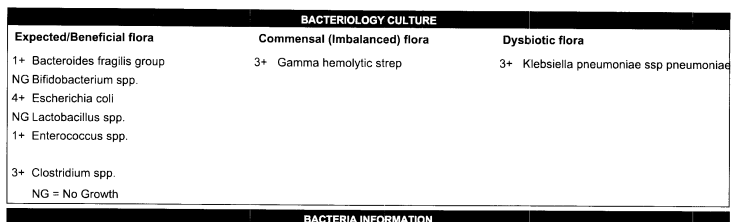
The real problem that I find with this report is that it is unclear if a 3+ is an overgrowth or good… from their example report  it seems to be an “insignificant”. The sample report also suggest that their report is more focus on detecting yeast problems than microbiome shifts.

Suggestions

This report  cites only one overgrowth, Klebsiella pneumoniae and going to DataPunk.Net we find only:

INHIBITED BY

I recommend that the reader consider getting a uBiome done. This does NOT require a prescription or MD’s order and is available everywhere in the world.  The cost is very reasonable, $89. It may well result in both improvements and reduced supplement costs by taking appropriate items for your microbiome instead of the randomness that is often done by most CFS patients.

This is an education post to facilitate discussing this approach with your medical professionals. It is not medical advice for the treatment of CFS. Always consult with your medical professional before doing any  changes of diet, supplements or activity. Some items cites may interfere with prescription medicines.


Enhanced Analysis of Bioscreen Analysis is it CFS or not????

A Bioscreen report was pending in my in-box. Bioscreen tests for a lot less bacteria genus than uBiome.  I have done a prior post on a Bioscreen analysis. There are no perfect tests, nor perfect knowledge about what different bacteria genus do. I apply a logic model to what is available

Report

bios1

bios2

Standard Items

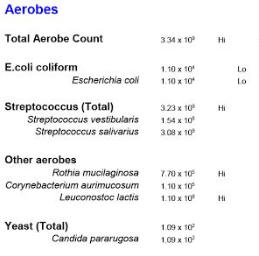
  • Bifidobacterium is HIGH, totally atypical for CFS
    • I would love to know the strains — it is possible to have bad strain in any family (just like real families!)
  • Lactobacillus is LOW — as expected
  • E. Coli is LOW as expected.

Overgrowths

With links to DataPunk.Net. The first thing that I saw was that none of these were included in my earlier deep dives — that is, we have a different profile which may account for the high bifidobacterium.

Reference:

What the bug is going on????

I contacted the reader and was informed they also have a diagnosis of Coeliac disease (which caused me to research Coeliac disease’s microbiome shifts and do a post). With both CFS and Celiac disease Low or No bifidobacterium is expected NOT AN OVERGROWTH!

Every overgrowth reported is atypical — not commonly seen with prior CFS uBiome results (I had to do three more deep dives to write this post!).

I wrote the reader because I was concern that there may be another condition that has been misdiagnosed. Another autoimmune disease,  primary sclerosing cholangitis 

RothiaEnterococcusStreptococcusVeillonella, and three other genera were markedly overrepresented in primary sclerosing cholangitis” [2017]  and we have “Our data do not support beneficial effects of probiotics[four Lactobacillus and two Bifidobacillus strains] on symptoms, liver biochemistry or liver function in PSC.” [2008] which hints that bifidobacillus may not be reduced as well as this 2016 study

Addendum

After this was posted, I received additional information which may explain the results.

  • “My doctor prescribed 2 courses of EES (erythromycin) – one week antibiotics, one week probiotics (Mutaflor and Metagenics LGG), then repeat. He also recommended taking L-Glutamine, Bio-Gest, Arginine and Citrulline for my personal circumstances.”
    • Streptococcus overgrowth is often reported after antibiotics.
      • “both antibiotic-treated groups had distinct gut microbial communities and metabolites, including a reduction of bacterial diversity and an enrichment of harmful bacteria such as Streptococcus and Pseudomonas. ” [2017]
  • “Regarding high Bifido, I was taking a multi-strain probiotic containing the exact strain of Bifido I am high in, and stopped it only 6 days prior to completing the BioScreen test due to some time constraints. I’m not sure whether Bifido has strong staying power in comparison to Lactobacillus (as I had zero Lacto despite it being in the same probiotic formula).”
    • “This randomized, parallel-group, open-label trial (n=36) included a 4-week run-in, 2-week intervention, and 3-week follow-up period. …Bifidobacterium  …was found at the end of the intervention (P<0.01 and P<0.001, respectively) and in the recovery time during follow-up (P<0.05 for both). ” [2010]
    • “Viable counts of fecal lactobacilli were significantly higher (P=0.05) and those of enterococci were significantly lower (P=0.04) after the intervention (of Bifidobacterium animalis subsp. lactis (BB-12) and Lactobacillus acidophilus (LA-5) _ when compared to placebo. ” [2011]

Bottom Line Theoritical Items

Despite not knowing if this is or is not CFS — we can still apply theory to correct the shifts. I would greatly prefer to be working from a uBiome report for this reader — things are just weird!

The lists below are done by merging the lists from the deep dives linked above. Some items may encourage one genus and discourage another genus — those are placed in inconclusive. The impact on Lactobacillus, Bifidobacterium and E.Coli are intentionally ignored [See this post for the logic]. This is all based on applying logic to the results of studies — thus theoretical. The last one was only partially done because high levels are often deemed to be good. This is an addition (not a replacement) to this overview post.

Avoid

  • Kefir
  • Sauerkraut
  • ad hoc Fermented Food
  • olives
  • cucumbers
  • wine
  • cheese
  • gluten (based on overgrowth genus)
  • Proton-pump inhibitors (PPI)
  • Hospital Food

Take

Addendum to Bottom Line

The microbiome examined was not “stable” but impacted by both erythromycin and bifidobacterium longum probiotics.  The scope of bacteria genus covered by this test is very sparse — so I apart from the above that may reduce Streptococcus, inference from this study is questionable. 

This is an education post to facilitate discussing this approach with your medical professionals. It is not medical advice for the treatment of CFS or other disease. Always consult with your medical professional before doing any  changes of diet, supplements or activity. Some items cites may interfere with prescription medicines.