Celiac disease and gluten sensitivity are associated. This post looks at celiac disease specifically.
- “Studies comparing intestinal microbiome in children with and without CD are contradictory.” [2013]
- ” for CD, the following infections were suggested to be associated with the disease: viruses: enterovirus, Epstein-Barr virus (EBV), Cytomegalovirus (CMV), hepatitis C virus (HCV), hepatitis B virus (HBV), and rotavirus, microbes: Bacteroides species, Campylobacter jejuni, Pneumococcus, Mycobacterium tuberculosis, and Helicobacter pylori (Lerner, 2015)”
- Many of these are also strongly associated with CFS.
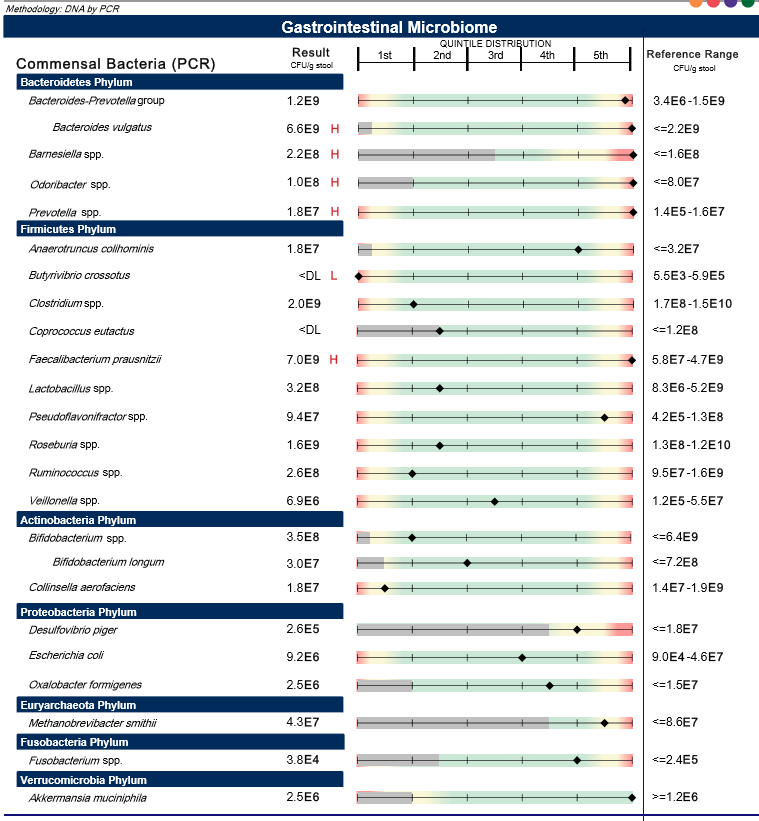
- “Faecal bifidobacteria concentration before probiotic consumption was significantly higher in healthy individuals (2.3×10⁸±6.3×10⁷ CFU/g) when compared to celiac patients (1.0×10⁷±1.7×10⁷ CFU/g)…..The probiotic supplementation significantly increased the number of bifidobacteria in the feces of celiac patients, although it was not sufficient to reach the concentration found in healthy individuals prior to its consumption.” [2017] Approximately 0.04x
- “The concentration of bifidobacteria per gram of feces was significantly higher in healthy subjects (controls) (1.5 ± 0.63 x10⁸ CFU/g) when compared to celiac patients (2.5 ± 1.5 x10⁷ CFU/g). The fecal pH was not different between celiac patients (7.19 ± 0.521) and controls (7.18 ± 0.522).” [2014] Approximately 0.02x
- “most of the current literature underlined that the dysbiosis in CD is hallmarked by an increase in gram-negative and Bacteroidetes species, and by a decrease in Bifidobacteria and Lactobacilli. ” [2016]
- “gluten-friendly bread (GFB) prolonged the survival of L. acidophilus and exerted an antibacterial effect towards S. aureus and S. Typhimurium. Moreover, GFB modulated the intestinal microbiota in vitro, promoting changes in lactobacilli and bifidobacteria members in coeliac subjects. ” [2016]
- Decrease in lactobacilli in the intestinal microbiota of celiac children with a gluten-free diet, and selection of potentially probiotic strains [2015].
- “Based on these results, Lactobacillus rhamnosus and Lactobacillus paracasei were selected, and their use as potential probiotic strains to improve signs and symptoms associated with celiac disease is discussed. “
- “Identification and characterization of intestinal lactobacilli strains capable of degrading immunotoxic peptides present in gluten.[2014]” ”
- “Four strains from the species Lactobacillus ruminis, Lactobacillus johnsonii, Lactobacillus amylovorus and Lactobacillus salivarius showed the highest peptide-degrading activities.”
- “The Firmicutes are the most abundant bacteria in CD adults, while Proteobacteria are present mainly in CD children. Other phyla shared between CD adults and CD children belong to the Bacteroidetes and Actinobacteria. Regarding bacterial genera, CD adults harbor larger numbers of Mycobacterium spp. and Methylobacterium spp., while Neisseria spp. and Haemophilus spp. are more abundant in CD children.” [2014]
- “Our broad complementary approach to validate gluten degrading activities qualifies R. mucilaginosa-associated enzymes as promising tools to neutralize T cell immunogenic properties for treatment of celiac disease.” [2014]
- “The presence of the species Lactobacillus curvatus, Leuconostoc mesenteroides and Leuconostoc carnosum was characteristic of coeliac patients,” [2007]
- “The main differences were obtained in ecological indexes belonging to the genus Lactobacillus, with significant richness, diversity and habitability reduction in CD patients. In CD bands were categorized primarily with Streptococcus, Bacteroides and E.coli species. In HC the predominant bands were Bifidobacterium, Lactobacillus and Acinetobacter, though the Streptococcus and Bacteroides were lower.” [2016]
- “Interestingly, 94 strains were able to metabolise gluten, 61 strains showed an extracellular proteolytic activity against gluten proteins, and several strains showed a peptidasic activity towards the 33-mer peptide, an immunogenic peptide in patients with coeliac disease. Most of the strains were classified within the phyla Firmicutes and Actinobacteria, mainly from the genera Lactobacillus, Streptococcus, Staphylococcus, Clostridium and Bifidobacterium. In conclusion, the human intestine exhibits a large variety of bacteria capable of utilising gluten proteins and peptides as nutrients. These bacteria could have an important role in gluten metabolism and could offer promising new treatment modalities for coeliacdisease.” [2014]
- “Species with activity in at least two of the four assays were typed as: Rothia mucilaginosa HOT-681, Rothia aeria HOT-188, Actinomyces odontolyticus HOT-701, Streptococcus mitis HOT-677, Streptococcus sp. HOT-071, Neisseria mucosa HOT-682 and Capnocytophaga sputigena HOT-775, with Rothia species being active in all four assays. Cleavage specificities and substrate preferences differed among the strains identified. The approximate molecular weights of the enzymes were ~75 kD (Rothia spp.), ~60 kD (A. odontolyticus) and ~150 kD (Streptococcus spp.). In conclusion, this study identified new gluten-degrading microorganisms in the upper gastrointestinal tract. A cocktail of the most active oral bacteria, or their isolated enzymes, may offer promising new treatment modalities for coeliac disease.” [2013]
Bottom Line
Note: there are differences between different published studies. Of odd note is that several studies identified bacteria that were active degrading gluten (in the belief that it would help) — these same bacteria genus were found high in other studies of CD — suggesting that degrading gluten may be a suspect approach — it almost seem that CD patients may have an over abundance of gluten degrading bacteria.
Also there was an absence of actual studies on humans.
Example: “Therefore, a three-month administration of B. breve strains helps in restoring the healthy percentage of main microbial components.” but no report of improved symptoms!!! 😦 [2016]
“However, probiotics are live bacteria and thus clinical recommendation for the treatment of chronic disease should be based on strong clinical evidence. Since the study by Olivares et al. (1) does not demonstrate any additional beneficial symptomatic or clinical effect by the addition of B. longum CECT 7347 to the GFD, we believe that the claim that this probiotic ‘could help improve health of CD patients’ is somewhat overstated. Although previous in vitro and basic work by the same group suggested potential beneficial effects, the clinical translation of those results, as shown in this study, is not strong.” [2015]
Low Levels of:
- Lactobacillus
- Bifidobacterium
Just like CFS!
Overgrowth of:
- Mycobacterium spp.
- Methylobacterium spp.,
- Leuconostoc spp
- Lactobacillus curvatus,
- High Streptococcus
- High Bacteroides
- High E. Coli
Probiotics:
WARNING: None have been demostrated effective
- Lactobacillus ruminis,
- Lactobacillus johnsonii,
- Lactobacillus amylovorus
- Lactobacillus salivarius
- Lactobacillus rhamnosus
- Lactobacillus paracasei
- Rothia mucilaginosa
This is an education post to facilitate discussing this approach with your medical professionals. It is not medical advice for the treatment of coeliac disease. Always consult with your medical professional before doing any changes of diet, supplements or activity. Some items cites may interfere with prescription medicines.



 CFS Remission